4 Oct 2013 | Africa, News, Uganda
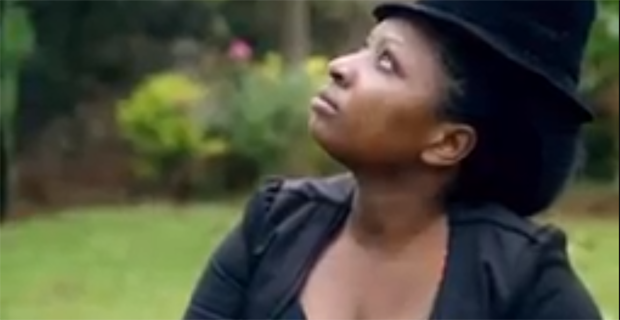
A scene from a music video by Ugandan singer Nnabbi Omukazi.
Ugandan artists have for a long time been able to read the public mood in the country and have taken note of it in their plays and songs.
nder the military dictatorship of Idi Amin, a few brave artists expressed themselves through music and drama. Plays that were critical of the Amin regime were written and performed. Several of the authors were killed or forced into exile.
During the early years of President Yoweri Museveni’s National Resistance Movement (NRM) government, musicians, choreographers and playwrights promoted the new government through their works for bringing back stability after the overthrow of Obote and Lutwa regimes. The general public was full of praises for the new regime and artists tapped into that feeling.
However, as the early optimism waned, many artists became more critical. These artists have been censored, paid off or even deported, delivering big blows to artistic freedom of expression in Uganda in the process.
Nnabbi Omukazi composed a song in which she claimed to have had a dream where a dead politician told her that she did not die from cocaine, but that she had been poisoned.
.
It was believed to be about Cerinah Nebanda, a young, vocal and critical member of parliament who died early this year. The government quickly told the public it was from a cocaine overdose, but her family and some members of parliament were not convinced by this explanation. They decided to hire a pathologist to take body samples of the deceased to South Africa to ascertain the cause of death. The pathologist was intercepted by security en-route to the airport and detained, which compounded the family’s suspicion that the MP had been poisoned because of her critical stance on several government positions. For composing that song, Police interrogated Nnabbi, and her song was banned from the airwaves.
Another artist, Matthias Walukagga, composed the song Tuli bakoowu (We are tired) in which he indirectly hints at the president’s overstay in power. In one verse, the artist asks; “When will the old man also declare that he is tired.” This song was banned on airwaves, but people still buy the CD’s and play it.
One of the biggest Ugandan artists, Bobi Wine aka “Ghetto President” wrote a song criticizing the way small traders in Kampala were being mistreated by the city authorities. In his song Tugambire ku Jennifer (Tell Jennifer to stop harassing us) Bobi attacks Jennifer Musisi, the Executive Director of Kampala Capital City Authority, for not caring about the plight of the poor and only protecting the interests of the rich. Responding to Bobi’s song, Musisi first dismissed it as one without consequence. However, when she realised the pressure the song was creating from the poor city dwellers, she invited Bobi to ceasefire talks. He also walked away with a fat contract to promote city activities starting with the Kampala Carnival 2013, taking place on 6 October 2013.
Patronage does not stop with politicians, it extends to almost all spheres of Ugandan society. Several other performing artists have been given fat contracts from State House (the President’s residence) to work for the presidency in different areas. In fact today, one will see a bus full of artists going to State House on invitation from the President to discuss “issues of national importance.”
Richard Kaweesa and Isaac Rucibigango, both smart and intelligent performing artists composed the song “You want another Rap”, which President Museveni used to woo young voters in the 2011 elections. This song went viral on social media and it worked in the president’s favor. The two artists were handsomely paid by the presidency. Again in 2012 when Uganda was marking 50 years of independence, Kaweesa was given another deal from State House to compose the Jubilee song. This earned him a reported 600 million shillings (US Dollars 235,300).
The same trend can be seen with comedians, as several have specialised in imitating big politicians. Segujja Museveni has perfected the art of mimicking President Museveni and has on several occasions been invited to perform for him. At his first performance before the president, he laughed so hard he had to wipe away tears. It was the first time the nation saw the president have such a hearty laugh. Since then, Segujja’s career has been on a meteoric rise.
As for dramatic artists; they are still reluctant to freely express themselves because of the potential consequences. However, they keep on making references to the political, economical and social spheres of Uganda in their plays. One artist that did this was British-born theatre producer David Cecil. He was deported from Uganda in February 2013 after being accused of staging a play promoting homosexuality. This was at a time when the government of Uganda was up in arms against anyone who seemed not to have a problem with homosexuality.
Most artists have decided to play it safe by keeping away from controversial issues, mainly political, that affect society. Sarah Zawedde, a musician says that the biggest threats to artistic freedom in Uganda are from the cultural, religious and political spheres.
24 Sep 2013 | News, Uganda
(Photo illustration: Shutterstock)
In May this year, the Ugandan government closed two newspapers. The crime The Monitor and The Red Pepper newspapers committed was publishing a letter by the now renegade former Coordinator of Security Services, General David Sejusa, in which he claimed that President Yoweri Museveni was grooming his son Muhoozi Kainerugaba to succeed him. In the same letter, General Sejusa claimed that there was a plot to assassinate all army officers and senior government officials who are against the president’s succession plan.
The letter had been written to the Internal Security Organization (ISO) boss to investigate the allegations, but was leaked to the media. Despite this, the government went ahead and closed the two media houses which had run the story for two weeks. They were only allowed to reopen after meetings with the minister of internal affairs, where the editors were told that government would not hesitate to close the media houses for good if they did not stop “reporting irresponsibly.” These are the only privately owned dailies in the country.
This was not The Monitor’s first run-in with the government. At its inception in the early 1990’s, it was the only privately owned daily that competed with the government-owned New Vision. New Vision towed the government line as a mouthpiece and enjoyed all the advertising deals from all government ministries and agencies. The Monitor was totally denied all government adverts, with the intention of killing it off because it was the only paper that was questioning government decisions on different issues. It was the readership plus some support from private businesses that kept it alive. The African Centre for Media Excellence (ACME) has also criticised the paper and its sister FM station, KFM, for bending under government pressure. This came after it pulled down a critical story about the president, claiming that it had been badly written.
Print media is not alone in being targeted. During the 2009 riots that rocked Uganda, the government closed five privately owned FM radio stations reporting on it. Four of them were reopened after six weeks, after they had publicly apologised to the president and promised never to do that again. Central Broadcasting Services (CBS), however, was closed for over a year. It took a lot of pleading to the president from the media, church, monarchy and other wealthy and influential people to reopen CBS. Since it went back on air, most of the political discussions were bumped off air and some individuals who government felt were anti-establishment were barred from appearing as panelists on the different radio talk shows.
To add to the problem, the government also directly controls a wide range of media. New Vision is run under the government-owned Vision Group and is building up a powerful media conglomerate with four other newspapers publishing in local languages, three television stations, three radio stations in the capital Kampala, plus other local radio stations in at least all the other regions of the country. All these are strictly government mouthpieces, and management will not allow opposition politicians or activists to use these platforms to reach the masses. The national broadcaster, Uganda Broadcasting Corporation (UBC), which runs the national television station and a multitude of radio stations in the countryside, is also tightly under government control.
Furthermore, while Uganda is seen in the East African region as having the best and less repressive media legislation, the government has of late tended to make amendments to the existing media laws to make them restrictive. The African Media Barometer (AMB), which is made up of leading media practitioners in the country from private and government-owned media houses, as well as lawyers and representatives from civil society, reported in 2012 that there are a few positive developments in Uganda with the licensing of more print and electronic media outlets. However, AMB also notes that the media freedom declines ahead of elections as the government grows increasingly nervous and attempts to clamp down on freed speech. Private media houses, especially radio stations, also practice self-censorship in order not to annoy the powers that be.
Ibrahim Bisika from the government’s Media Centre says the friction between media and government arises out of “editorial mismanagement” where media houses publish stories that bring them in direct confrontation with government. Moses Serwanga, a director at the Uganda Media Development Foundation (UMDF) says that media freedoms in the country are getting curtailed because of the creeping political dictatorship where political leaders do not want to leave office.
30 Dec 2010 | News
Press censorship feared in Eastern Africa as the ICC indicts first media personality. Ernest Waititu reports
There is fear that some East African governments might clamp down on local-language stations in the wake of indictment of a Kenyan journalist by the International Criminal Court (ICC) for alleged crimes against humanity.
Joshua Arap Sang, a broadcast journalist, has become the first media personality to be indicted by the ICC.
Sang was on 15 Dec named alongside six politicians and government officials for having masterminded the 2007-2008 post-election violence.
He is the head of operations at Kass FM, a nascent radio station that broadcasts in the Kalenjin language. The language is spoken in Kenya’s Rift Valley region, where much of the violence took place.
In naming the radio personality as one of the six suspects, the ICC prosecutor Luis Moreno-Ocampo said that together with two politicians from the Rift Valley indicted for instigating the violence “Joshua Sang played a crucial part” in coordinating attacks.
Arap Sang, as he is popularly known by his listeners, was, according to the ICC Prosecutor, “involved in planning this operation, collecting supporters and also using coded messages” on radio to plan the violence.
Moments before and after the ICC prosecutor made the indictment, Sang was on air on Kass FM. He responded to the indictment with appeals to his listeners to remain calm, saying he was confident of his innocence.
A disputed election result in late 2007 led to violent attacks in various Kenyan regions, including Kisumu, Mombasa, Eldoret, and the capital, Nairobi. The violence left 1,133 people dead and over 650,000 homeless.
Media observers and monitors singled out certain local-language radio stations for contributing to ethnic animosity through hate speech. The observers noted that some local-language radio stations not only took clear sides supporting leading political parties but also spread fear and propaganda through their programming, slandered individuals and communities and propagated ethnocentrism.
Speaking in Nairobi a few days before the indictment, in an exclusive meeting with journalists working with community and local-language radio stations, which included Sang, Moreno underlined the importance of in the peace process in Kenya, saying the radio stations “have a bigger role than me in dividing or uniting Kenyans.”
Although they were cited for unfair coverage of the election campaigns and the violence that broke out after the contested results were announced, mainstream media seem to agree with others on the role that local-language radio played during the violence.
Earlier in the year Joseph Odindo, editorial director of Nation Media Group, the largest media house in the region, called local-language radio station “poison”. In his view, vernacular radio stations played a role in “fanning the violence” that followed the elections in 2007.
Others in the mainstream media say the naming of Sang as a key suspect in post-election violence should not be taken as an indictment of the Kenyan media in general, but as censure of an individual journalist. The chair of the Editors’ Guild in Kenya, Macharia Gaitho says the indictment of a journalist by the International Criminal Court (ICC) is not a reason to pass judgment on Kenyan media as a whole, which in general acted responsibly in reporting the 2007 general elections and the violence that followed.
Media scholars in the region acknowledge the influence of local-language broadcast radio in a region still plagued by low literacy rates. Dr Levi Obonyo , the head of communications at Daystar University and a council member of the Media Council of Kenya, says that local-language broadcast journalists in Kenya have bigger influence over listeners than your average media personalities.
The indictment of Sang has sent shock waves in the East-African region, which saw a number of media personalities indicted by the International Criminal Tribunal for Rwanda for having participated in the genocide that killed close to a million people in 1994.
In the neighboring Uganda, media commentators hope that Sang’s indictment will not serve as an excuse for the Ugandan Government, which has a history of gagging the media, to roll back media freedoms.
Journalist Benjamin Rukwengye writes that for Uganda, which is in the build up to another divisive election, “every journalist has a role to play in ensuring that the relative media freedom we currently enjoy is augmented, rather than curtailed by a government which will eagerly flaunt Arap Sang as [a point of] reference.”

Ernest Waititu, a native of Kenya, is founder and editor of Afrikanews.org. He first wrote for Index on this topic in Volume 39 Number 2.
CLICK HERE FOR STOCKISTS AND SUBSCRIPTION DETAILS
8 Feb 2010 | Index Index, minipost
Two reporters from The Monitor newspaper, Angelo Izama and Charles Mwanguhya Mpagi Izama lost an appeal to compel the government to release papers relating to oil deals, when the judge decided the information was not in the public interest. Izama was arrested and bailed for criminal libel last week in an unrelated case.
