4 Aug 2014 | Azerbaijan, Azerbaijan News, Europe and Central Asia, News
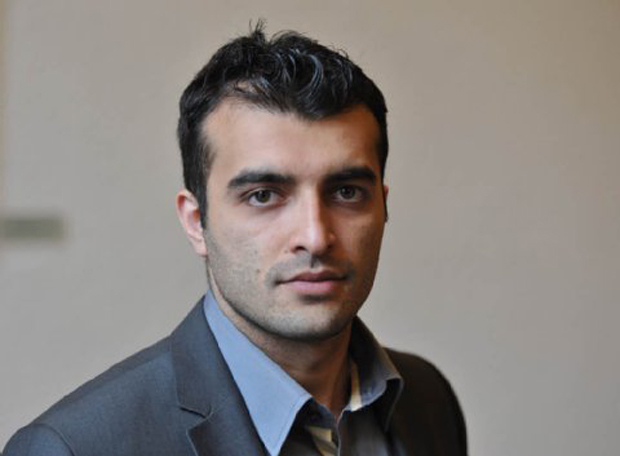
(Photo: National Endowment for Democracy)
Azerbaijani human rights activist Rasul Jafarov has been charged with tax evasion, illegal entrepreneurship and power abuse and sentenced to three months of pre-trial detention. Jafarov’s detention follows the arrest last week of Leyla Yunus and the disappearance of the print edition of Azadliq from the streets of Baku. Arif Yunus was put under a three month pretrial detention on 5 Aug.
Jafarov, an Index contributor, is a prominent campaigner and critic of Azerbaijan’s government, led by President Ilham Aliyev. He has worked on putting together a detailed list of the country’s some 140 political prisoners and was one of the organisers behind the Sing for Democracy campaign, in connection with the 2012 Eurovision final in Baku. He was charged with three articles of the Penal Code by Rasul Nasimi district court in the capital Baku, following interrogation at the Prosecutor General’s office. Last week he was handed down a travel ban.
His arrest comes days after fellow human rights defenders Leyla Yunus and her husband Arif were charged with crimes including high treason. Last week, Azadliq, of the country’s few remaining independent newspapers, was also forced to suspend publication of its print edition due to financial troubles. The charges against Jafarov are the same as those that in May saw Anar Mammadli, another prominent human rights defender, sentenced to 5.5 years in prison.
The Institute for Reporters’ Freedom and Safety (IRFS), an Azerbaijani press freedom organisation, said Jafarov’s arrest is “part of a dedicated campaign aimed at suspension of activities of unregistered NGOs in Azerbaijan”. Registering NGOs in Azerbaijan is difficult — Jafarov has reportedly attempted to register his organisation Human Rights Club a number of times without success. As a result, many groups operate without a licence.
There has recently been an escalation in the targeting of opposition voices in Azerbaijan, according to IRFS, who say this crackdown has included state-controlled media smear campaign, raids on NGO offices, confiscation of equipment, suspension of NGO bank accounts, and intimidation and legal pursuit of NGO workers.
In May, Azerbaijan assumed chairmanship of the Council of Europe’s Committee of Ministers, whose tasks include “ensure[ing] that member states comply with the judgments and certain decisions of the European Court of Human Rights”.
“Further deterioration of the situation with fundamental rights and freedoms, as well as repressions against the civil society is incompatible with Azerbaijan’s international commitments, especially in light of its current presidency in the Council of Europe,” said the Civic Solidarity Platform, a network of 60 human rights NGOs of the OSCE region, in a statement.
“We know that the charges against those brave human rights defenders are politically motivated. The authorities want to silence those holding the country to its international obligations and commitments, including within the Council of Europe” said Maria Dahle, Executive Director of the Human Rights House Network.
Index Reports: Locking up free expression: Azerbaijan silences critical voices (Oct 2013) | Running Scared: Azerbaijan’s silenced voices (Mar 2012)
An earlier version of this article stated that Arif Yunus had been arrested last week. This was incorrect. Yunus was arrested on 5 Aug and sentenced to a three month pretrial detention.
This article was posted on August 4, 2014 at indexoncensorship.org
8 May 2014 | Europe and Central Asia, News

Eurovision contestant Teo, in the music video for this year’s Belarusian entry Cheesecake (Image: Yury Dobrov/YouTube)
If you want a Eurovision of the future, imagine a faux-dubstep bassline dropping on a human falsetto, forever. That was how it felt watching YouTube footage of this year’s entrants in the continent’s greatest song-and-dance-spectacle.
The Eurovision Song Contest, born of the same hope for the future and fear of the past as the European Union, is approaching its 50th year. And strangely, it’s doing quite well. In spite of fears that the competition would end up as an annual carve up between former Soviet states, recent years have in fact seen a fairly equal spread of winners throughout the member states of the European Broadcasting Union (who do not actually have to be in Europe; a fact often missed by anti-Zionists who somehow see a conspiracy in the fact that Israel is a regular entrant in the competition is that channels in countries such as Libya, Jordan and Morocco are also members of the EBU, and technically could enter if they wish. Morocco did, in 1980). Since 2000, the spread of winners between Western Europe, the former Soviet states, and the Balkans and Turkey have been pretty much even.
While some of the geopolitics will always be with us — Turkey and Azerbaijan united in their hatred of Armenia, Cyprus and Greece douze-pointsing each other at every opportunity — the once-derided contest has in fact functioned as a genuine competition. Year in, year out, the best song in the competition tends to win, while the laziest entrants, not taking the event seriously as a songwriting competition (yes, we’re looking at you, Britain), tend to fall behind and then complain that Europe doesn’t “get” pop music.
The best songs and singers triumph, by and large. But Eurovision still does have a political edge.
Take Tuesday’s semi-final in Copenhagen. Russia’s entry, Shine, performed by the Tolmachevy Sisters and described by Popbitch as sounding like “almost every Eurovision song you’ve ever imagined” contained some unintentionally ominous lines:
Living on the edge / closer to the crime / cross the line a step at a time
Add an “a” to the end of that “crime”, and you’ve got the Kremlin’s current foreign policy neatly summed up in a single stanza.
I am not suggesting that the Tolmachevys were sent out to justify Putin’s expansionism. Nonetheless, the Copenhagen crowd were keen that Russia should know what the world thought of its foreign policy and domestic human rights record: as it was announced that Russia had made Saturday’s grand final, the arena erupted in jeering. The dedicated Eurovision fan is clearly not just a poppet living in a fantasy world of camp. They are engaged with the world, and particularly the regressive policies of countries such as Russia, Azerbaijan and Belarus, perhaps more so than your average European.
When Sweden’s Loreen won the competition in Baku, capital of Azerbaijan, in 2012, she pledged to meet the country’s human rights activists. That same year, BBC commentator “Doctor Eurovision” (he actually is a doctor of Eurovision) made explicit references to Belarus’s disgraceful dictatorship, rather than simply giggle at the funny eastern Europeans.
This raises an interesting question about how we engage with dubious regimes.
Before the Baku Eurovision in 2012, there was some discussion over whether democratic countries should boycott the competition, sending a message to Aliyev’s regime.
“No,” Azerbaijani civil rights activists told Index on Censorship. “Let the world come and see Azerbaijan.” They felt that for most of the world, most of the time, they are citizens of a far away country of whom we know nothing. They wanted to take their chance while the world was looking. I think they got it right. As discussed last week, Azerbaijan is engaged in a massive international PR campaign, but to most people in the world since that Eurovision and the attention it raised for the country’s opposition, it has not been able to entirely disguise its atrocious record on free speech and other rights.
On Friday, the International Ice Hockey Federation’s world championship will open in Belarus. Though there was some discussion of boycotting that event, it has died down. Nonetheless, journalists from Europe and North America will be covering the event, and fans will travel too.
Belarus’s macho dictator Alexander Lukashenko is a keen ice hockey fan, and will be aiming to sweep up the glory of hosting a major international sporting event, not long after the country hosted the world track cycling championships in 2013.
Ice hockey fans and sports journalists are generally not the type of people who go in for Eurovision. But maybe they should try to take a leaf out of the Song Contest supporters book. Have a look at the country around them, learn a little about the politics, and spread the word about the side the dictators don’t want us to see.
Autocrats try to use these international competitions to control the world’s view of them. We should beat them at their own games.
This article was posted on May 8, 2014 at indexoncensorship.org
8 May 2014 | Azerbaijan, Azerbaijan News, Europe and Central Asia, News
This week eight young Azerbaijani activists were sentenced to between six and eight years in jail. The members of the N!DA Youth Movement, which works for democracy and social change, were convicted for possession of drugs and explosives, and for intending to “cause public disorder”. The charges are widely believed to be trumped up, and the trials have been criticised by foreign observers over “irregularities” and “shortcomings”, including inconsistencies in testimonies and mishandling of evidence.
This is just the latest addition to a long list of human rights abuses by authorities in the oil rich country. As the repression has largely been allowed to take place away from international attention, this is a good moment to remember a few things about Azerbaijan, especially as the country prepares to take over a six month chairmanship of the Council of Europe’s Committee of Ministers.
1) The six are far from the only political prisoners in Azerbaijan
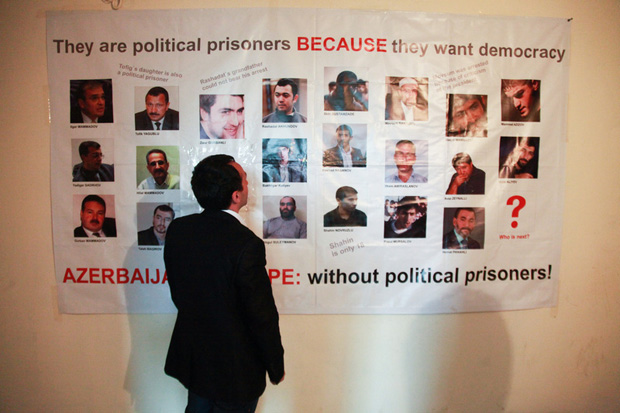
(Image: Aziz Karimov)
According to the latest figures, there are 142 political prisoners in Azerbaijan today. These include human rights defenders, youth activists, and a large number of religious activists, among others. There are currently 17 people serving life sentences. Ahead of the country’s presidential election last October, candidate Ilgar Mammadov was arrested. In March, he was sentenced to seven years in prison for “organizing mass disturbances” and “resisting the police”. Meanwhile, President Ilham Aliyev insists that there are no political prisoners in Azerbaijan.
2) You may escape imprisonment, but you could still face violence and intimidation
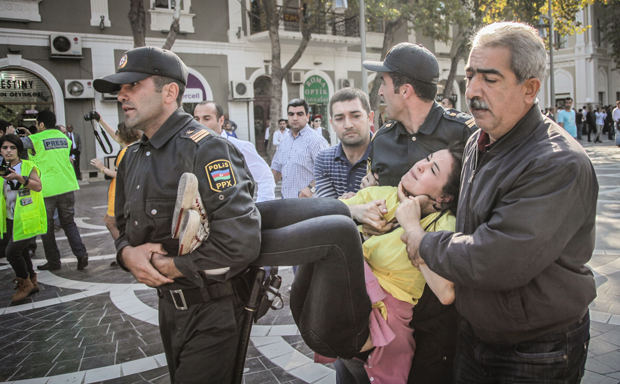
(Image: Aziz Karimov)
Attacks, threats and intimidation are regular occurrences for political opponents, activists and press in Azerbaijan. Following protests in the capital Baku as Aliyev secured his third consecutive term in power last October, demonstrators were beaten and detained by police. Police also raided the offices of independent Election Monitoring and Democracy Studies Centre (EMDSC) which reported irregularities in the election. In 2012, reporter Idrak Abbasov was brutally beaten when filming the demolition of a house by the State Oil Company of Azerbaijan, allegedly by employees of the company and police. The same year, fellow journalist Khadija Ismayilova, known for covering corruption among the country’s powerful elite, was blackmailed with intimate images of her and her boyfriend. She continues to face intimidation today. These abuses are often allowed to happen with impunity.
3) Independent and critical media are under threat
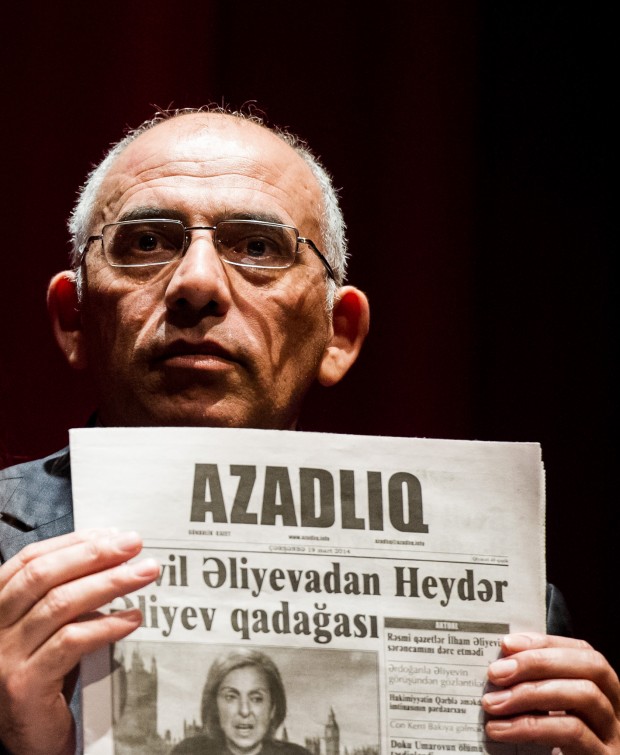
(Image: Alex Brenner for Index on Censorship)
Azerbaijan’s critical press have long been subjected to an array of attacks. Independent news outlets face economic sanctions, and are often barred from distribution networks. Some 70% of distribution is controlled by the government. Most of the nine national TV channels are either directly owned by the state or controlled by the authorities. Journalists also fall victim to legal threats. In the first six months of 2013, 36 defamation suits were brought against media outlets or journalists, four of which were criminal defamation suits. One victim of this hugely restrictive media environment is leading independent paper and Index Award winner Azadliq. The paper has been hit with £52,000 worth of fines following defamation suits, state-owned press distribution company Gasid has not been transferring payments that reflect the paper’s sales. Azadliq claims Gasid owe them some £44,000.
4) Authorities are on an ongoing PR mission
(Image: Zeljko Joksimovic/Wikimedia Commons)
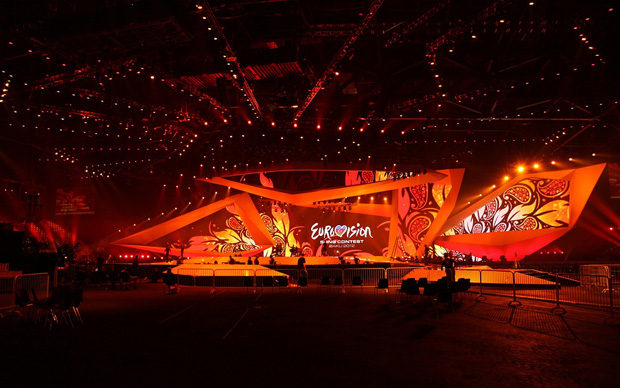
While the situation inside the country shifts between bad and worse, authorities have focused their attentions on a wide-reaching international PR campaign. Ahead of hosting the Eurovision Song Contest, authorities ordered urban renewal that saw houses demolished and families evicted. Vast sums have in recent years been poured into the radical regeneration and beautification of Baku, and there’s more to come. There is also the posh London bar Baku, owned by the Aliyevs; the glossy, internationally distributed Baku magazine, edited by first daughter Leyla and co-published by Conde Nast; and the sponsorship deal with Champions League finalists Atlético Madrid. Next year, Baku will again play host to a prestigious international event — the inaugural European Games.
5) They are about to take charge of one of Europe’s most important human rights bodies
(Image: Sandro Weltin/Council of Europe)
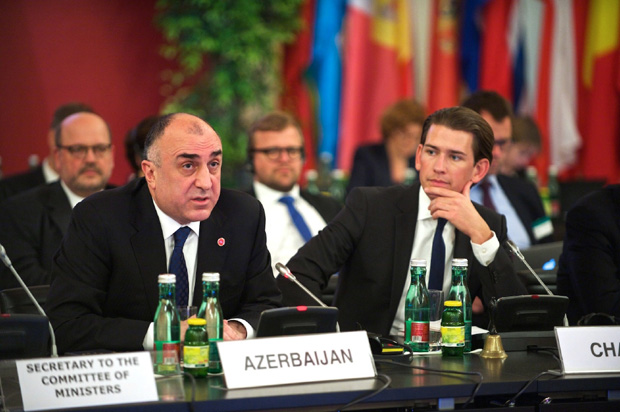
“The Committee of Ministers supervises the execution of judgments of the European Court of Human Rights the Council of Europe…The Committee of Ministers’ essential function is to ensure that member states comply with the judgments and certain decisions of the European Court of Human Rights,” the Council of Europe declare on their website. Next week Azerbaijan will assume the chairmanship of this very Committee of Ministers. But one could say that COE is only sticking to form in its relationship with the country. Only last year, a majority in its Parliamentary Assembly (PACE) voted down a resolution on the existence of political prisoners in Azerbaijan.
This article was originally published on 8 May 2014 at indexoncensorship.org
17 May 2013 | Azerbaijan News, Europe and Central Asia, News
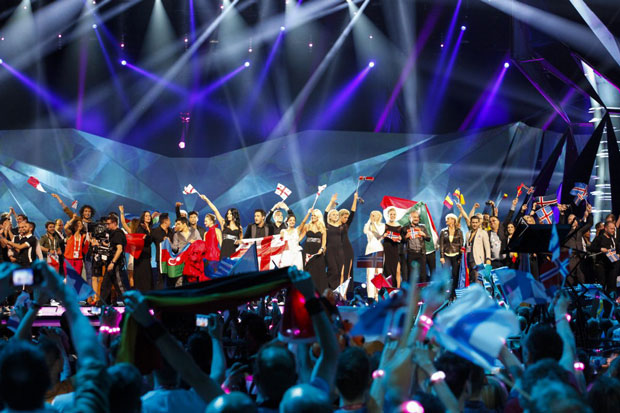
The Eurovision Song Contest gives a platform to some of Europe’s outliers on free expression. Photo: Sander Hesterman (EBU) / Eurovision 2013
Europe will once again be swept away by a sparkly hurricane of techno beats and pompous ballads, kitschy and/or traditional costumes, wind machines, pyrotechnics, heavily accented English, awkward host banter and nul points. Yes, Eurovision takes our breath away in more ways than one.
While first and foremost a showbiz spectacle, if you look beneath the layer of sequins you’ll soon discover the political tinge to the continent’s premier singing competition. From the start in 1956, it was designed as fun way of testing out new broadcasting technology. Those partial to the occasional conspiracy theory would have you believe this was also a convenient cover for pan-European satellite testing during the Cold War, which is why NATO members Turkey and Israel were invited to the party.
With the lifting of the Iron Curtain and the inclusion of the Eastern Bloc in 1990, much was said about the healing, unifying power of the contest. Since then, even more has been said about the tendency of the late arrivals to share their points amongst themselves. The UK, for instance, have been vocal about political, neighbourhood voting being the cause of their recent Eurovision failings, rather than, say, sending entries like this. And while Eurovision, somewhat censoriously, prohibits political songs that has not stopped artists from trying to get their meaningful messages across.
The most famous recent example is perhaps Georgia’s pun-tastic 2009 offering “We Don’t Want To Put In’‘, to be performed at final in — you guessed it — Moscow. They were told to change the song or drop out, and ultimately chose the latter. Krista Siegfrids, Finland’s entrant this year, has warned she might be planting a kiss on one of her female dancers in protest at her country’s failure to adopt equal marriage legislation.
Most significantly, Eurovision gives its entrants prime time access to some 800 million viewers around the world – an unparalleled platform on which to promote their nation should they choose to. Many have jumped at the opportunity, chief among them the land of fire; Azerbaijan. As 2012 hosts, the Aliyev regime poured millions of their significant oil wealth into reforming their international reputation as a repressive hereditary dictatorship. The only problem with this otherwise foolproof plan was that they forcefully evicted people to make room for an ambitious Eurovision-inspired urban renewal project in Baku, attacked journalists covering and speaking up about it, and generally conducted their notoriously human rights abusing business as usual. Not much has changed since the party left town a year ago — only this week, the regime announced they have extended libel laws to online speech ahead of October’s presidential election.
Before that, 2009 hosts Russia attempted to dazzle Europe and the world, with a spectacular stage show in the 25,000 capacity Indoor Olympic Arena in Moscow. However, LGBT activists seized the opportunity to shine the spotlight on the country’s poor record on gay rights, attempting to stage a Slavic-wide Pride parade on the day of the final. In a clear violation of the right to freedom of expression and assembly, the parade was banned. Many of the protesters who showed up anyway, were attacked and arrested. LGBT rights remain poor in Russia, with a 100-year ban on pride parades in Moscow announced only last year. The charm offensive of last year’s singing, dancing, baking grandma entry has this year been followed by the John-and-Yoko-esque ‘What If?‘, which among other gems, contains the lyrics “Together we can make a better place/ On this little island out in space”. Meanwhile, in Russia, internationally funded NGOs have to register as ‘foreign agents’, or risk fines and prison time.
You don’t have to host to be able to host to take full advantage of the promotional platform Eurovision. Like Belarus, you can condense your message to fit the 3-minute performance slot. In 2011, the country known as Europe’s last dictatorship sent Anastasiya Vinnikova to perform the subtly named “I Love Belarus“. Somehow, it didn’t progress to the final. Maybe the rest of Europe had some trouble reconciling the country described in the song, with its “fields full of gold” and “free, friendly and young people”, with the country where you’re put in prison for pointing out that your repressive dictator is, well, a dictator.
Also in the running this year is Hungary, the country with some of the most draconian press regulation on the continent. There’s Ukraine, where the former prime minister is serving a seven-year jail sentence for what is widely recognised as politically motivated charges. In Italy, the final will be broadcast on public broadcaster RAI, one half of the TV duopoly that poses a big threat to the country’s media plurality. In Greece, financial woes have also had a pretty detrimental effect on freedom of expression. Bulgaria’s web of cosy relationships between authorities and media leaves the country without an accurate picture of itself.
Yes, Eurovision is first and foremost one of the biggest parties in the world. However, as you’re watching the spectacle unfold on Saturday, spare a thought for the Europeans who are not as free to express themselves as their fellow countrymen on stage in Malmo.
