19 Mar 2014 | Campaigns, Europe and Central Asia, United Kingdom

(Image: Semmick Photo/Shutterstock)
Restricting press freedom in the name of national security, the Royal Charter press regulator and the UK’s lack of constitutional guarantees for freedom of expression were only some of the things criticised in a new report by the World Association of Newspapers and News Publishers (WAN-IFRA). The organisation represents over 18,000 publications and 15,000 websites in over 120 countries.
Referring to the UK’s influence internationally WAN-IFRA says: “How changes to the system of press regulation are managed in the UK will have an unparalleled impact beyond its shores.” They fear that a regulator with government involvement — such as the Royal Charter — risks being “an open invitation for abuse” of press freedom in less democratic countries. The report in many ways echoes Index on Censorship’s position on press regulation and threats to press freedom in the UK.
The report comes after concerns were expressed by UK media and press freedom organisations over the state of press freedom following the Leveson debate, and the threats and pressure faced by the Guardian over their reporting on Snowden and mass surveillance, culminating in the destruction of hard drives in the Guardian’s basement overseen by GCHQ representatives. A delegation from WAN-IFRA travelled to the UK on a fact-finding mission in January.
The report agrees that the phone hacking scandal led to a major breach in public confidence in the press, but stressed that the vast majority of British journalists “adhere to professional standards”. It warns against conflating the hacking scandal with the regulatory debate, stressing that: “British law provides appropriate remedy for illegal activity in proven cases of wrongdoing.”
The report makes several heavy criticisms of the proposed Royal Charter system. Punitive damages, enshrined in statute, for not signing up to the regulator “defies any definition of ‘voluntary’ as understood by the WAN-IFRA delegation”. The report in particular says that it was quite inappropriate to develop a system of press regulation without the involvement of the industry in the final stages of discussion, when the government’s preferred Royal Charter was drawn up. The speed of implementation, the lack of legislative scrutiny, parliamentary vote or public consultation was criticised, with the report arguing the whole process should have been more transparent. “The Royal Charter system — used as an example or transposed elsewhere to countries lacking the United Kingdom’s historic commitment to human rights — risks an open invitation for abuse in other parts of the world,” it argues.
The report further states that claims of the Royal Charter being a “hands-offs” regulator is “undermined by the readiness of the UK government to intervene against the Guardian newspaper”. The treatment the Guardian has been subject to following their mass surveillance revelations was identified as a cause for concern. Prime Minister David Cameron’s claims that the reporting harmed national security, with no evidence to back this up, “suggest an unprecedented level of political interference in the freedom of the press”. The report states that he should distance his government from conflating terrorism with journalism. However, the recent court judgement finding the detention of David Miranda (partner of Glen Greenwald) legal under the UK’s Terrorism Act suggests that any positive response to this recommendation is unlikely. The report also criticised other publisher’s perceived lack of support for the Guardian, calling it a “low point” given “the apparent need for solidarity within the media fraternity”.
“If the UK government feels it is acceptable, in the name of national security, to dictate what is in the public interest, and given the UK’s continued influence over developing nations where media are essential for the spread of democratic values, the future of a free, independent press that can hold power to account is under threat worldwide,” said WAN-IFRA CEO, Vincent Peyrègne.
The report also expresses, among other things, worries over the arrests of journalists, criminalisation of social media, mass surveillance and proposals to introduce web filters.
Recommendations include urging the UK government “to step back from any further involvement – perceived or otherwise – in the regulation issue”, to defend and support public interest journalism, and encourage investigative reporting “as an essential benefit to society”.
This article was posted on 19 March 2014 at indexoncensorship.org
20 Feb 2014 | Europe and Central Asia, News, United Kingdom
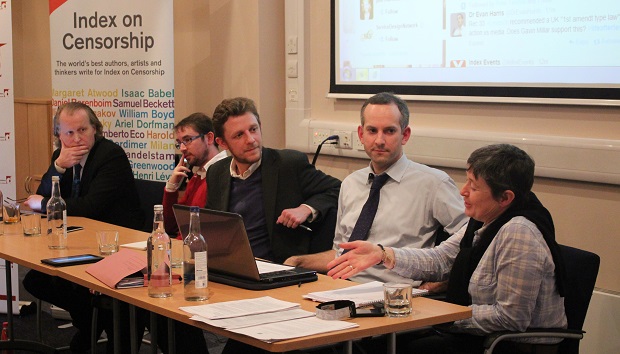
The panel from left to right: Gavin Millar QC, Tom Phillips, Padraig Reidy, Jonathan Heawood and Gill Phillips (Image: Georgia Hussey)
A new press regulator, with or without statutory underpinnings, would not stop another scandal like phone hacking from happening, an Index on Censorship panel said yesterday. The panel, consisting of Gill Phillips (Legal Director, Guardian Media Group), Gavin Millar QC (Doughty Street Chambers), Jonathan Heawood (Director of the Impress Project), and Tom Phillips (Senior Writer, Buzzfeed UK), chaired by Padraig Reidy, spoke at a Doughty Street Chambers and Index on Censorship debate on press freedom in the UK after the Leveson inquiry.
“In terms of the institutions that failed over phone hacking, the Press Complaints Commission doesn’t even make it onto the podium,” said Tom Phillips. “So the idea that any kind of regulation was ever intended to be the solution to this is missing a whole bigger picture.”
If you set up a system to stop something “human ingenuity and imagination” will find a way to get around it, said Gavin Millar QC. He added that the best regulation “has to come from the heart”, and was worried about the complicated rules surrounding regulation taking the responsibility away from those “who are putting the stuff out.”
Jonathan Heawood argued that we can make press abuses “less likely” though a “good, intelligent, intelligently applied regulator” and “sufficiently enforced, sufficiently clear sanctions”. He added that regulation is “part of the solution” to improve conditions allowing public interest journalism to flourish.
Press regulation took centre stage at the event, but wider issues of press freedom were also discussed. Gavin Millar pointed out how the UK’s debate on press freedom and press regulation may be perceived in authoritarian countries, while Tom Phillips warned that ignoring the evolving social norms of the internet age bad is for press freedom. Gill Phillips argued that while the UK isn’t as bad on press freedom as some other countries, “where we’re going” and “the threat of criminalisation that effects every day journalism” is worrying.
The event took place ahead of the release of Index on Censorship’s policy paper Life after Leveson: British media freedom in 2014. The paper acknowledges that the recent change in libel law was good for this country’s press freedom, “the record of successive governments have been far from perfect” and “there are still several areas where this government can act to safeguard the free press and free speech more broadly in the coming year.”
It was a timely discussion, as yesterday the High Court dismissed David Miranda’s challenge to his detention at Heathrow under the Terrorism Act in August. It was also the day former News of the World editor Rebekah Brooks took the stand in the ongoing hacking trial.
“The [Miranda] judgement has some wide ranging views downgrading journalism in the 20th century that I find personally bizarre,” said Philips. Millar said the judgement shows how the “remaining tendency of government using the possibility of court proceedings against newspapers to stifle the publication of state secrets” has a “chilling effect” on press freedom.
The sold-out event encouraged audience interaction, which made for a lively and at times heated, debate. One comment from the floor argued the panel had missed the point — that the debate was about press abuses, and a regulator was the minimum step that had to be taken. Another audience member questioned the press calling for regulation of other industries, but not wanting to be regulated themselves. The Guardian’s Roy Greenslade argued that we need to separate those issues of press abuse that can be tackled through the law and those that must be tackled by self-restraint on the part of the media. Observer columnist Peter Preston said the Royal Charter regulator would be part of a “conspiracy of chaps”.
The discussion also took place on Twitter, under the hashtag #LifeAfterLeveson
This article was published on 20 February 2014 at indexoncensorship.org
26 Mar 2013 | Volume 42.01 Spring 2013

In our increasingly digital times, freedom of expression may look like one of the positive beneficiaries of our ever more interconnected world. Countries like China or Iran build firewalls and employ small armies of censors and snoopers in determined attempts to keep their bit of the internet controlled and uncritical of their ruling elites. But with social media, blogs, citizen journalism, and ever greater amounts of news on a diverse and expanding range of sites, information is shared across borders and goes around censors with greater ease than ever before.
Yet online and off, free speech still needs defending from those in power who would like to control information, limit criticism or snoop widely across people and populations. And it would be a mistake to think the free speech attackers are only the obvious bad guys like China, Iran or North Korea.
While Putin’s Russia jails members of Pussy Riot, passes new laws to block websites and journalists continue to face risks of violent attack, it is Turkey, in 2013, that has more journalists in jail than even Iran or China. In 2004, the European Union assessed Turkey as democratic enough to be a candidate for EU membership. Today, Turkey’s government puts pressure on media companies and editors to rein in critical journalists and self-censorship is rife.
Meanwhile, in the UK, a fully paid-up member of the democracy club, the government and opposition argue over whether Parliament should regulate the print media (“statutory underpinning”, to use the jargon introduced by the Leveson Report into the phone-hacking scandal). On 18 March, the UK’s three main political parties agreed on a new press regulation system whereby an independent regulator would be set up by royal charter. And in this debate over media standards and regulation, the most basic principle, that politicians should not in any way control the press (given their interests in positive, uncritical press coverage), has been too easily abandoned by many. Yet the press faces big questions: what has happened to its standards, how can individuals fairly complain? Similar debates are under way in India, with corruption and the phenomenon of ‘“paid news” among concerns there. Falling standards provide easy targets for those who would control press freedom for other reasons.
Plenty of governments of all shades are showing themselves only too ready to compromise on civil liberties in the face of the large amounts of easily accessible data our digital world produces. Shining a light on requests for information — as Google and Twitter do in their respective transparency reports — is one vital part of the campaigns and democraticdebate needed if the internet is not to become a partially censored, and highly monitored, world.
Google’s recent update of its figures for requests for user data by law enforcement agencies shows the US way ahead of other countries — accounting for over a third of requests with 8,438 demands, with India coming in at 2,431 and the UK, Germany and France not so far behind India.
Both India and the UK have also used too widely drawn laws that criminalise “grossly offensive” comments, leading to the arrest and prosecution of individuals for innocuous social media comments. Public outcry and ensuing debate in both countries is one sign that people will stand up for free speech. But such laws must change.
A new digital revolution is coming, as millions more people move online via their mobiles. As smart phone prices fall, and take-up expands, the opportunities for free expression and accessto information across borders are set to grow. But unless we are all vigilant, whether we face democratic or authoritarian regimes, in demanding our right to that free expression, our digital world risks being a partially censored, monitored and fragmented one. This is the global free speech challenge of our times.
28 Nov 2012 | Leveson Inquiry, Media Freedom, United Kingdom
The judge’s part is done, now its up to the press and parliament. Can the press convince politicians they are capable of reform? Or will the government decide it needs powers to control the press?
(more…)
