
Posts Tagged ‘Shiv Malik’

The blame game

December 16th, 2010

Journalist Shiv Malik was injured by a police baton strike during last week’s student protests. He asks who should be blamed for the violence: protesters, police officers or politicians?
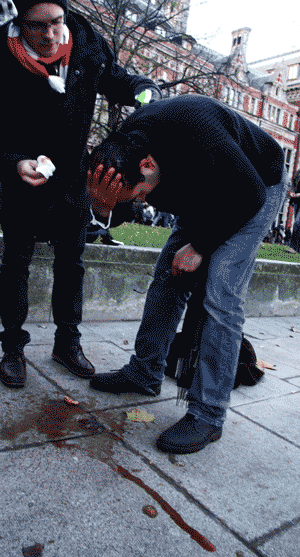
It wasn’t true. At 15:30pm, two hours after it began, the front of Thursday’s anti-fees march had not been kettled. It was hemmed in on four sides of the square, but a main exit was still open — up Whitehall, the actual route of the march. The thing was, no one wanted to leave. “ We saw what happened after a million people marched during the Iraq war. We don’t want to just go home. And they haven’t even voted yet,” one red haired female college student told me.

Asserting their right to free movement, the crowd surged up Victoria which was blocked by a line of riot and mounted police. Within a few minutes, I found myself at the front line.

“Get back, get back,” shouted a six-foot copper, his truncheon raised. Now with the crowd pressing up behind me, attempting to break the line, there was nowhere to go. The officer’s baton then glanced the side of my face, knocking off my glasses and catching my left eye. I caught my glasses before they dropped to the floor and then prepared for a second strike. This time, I held the officer’s baton for a few seconds as it came down on me.

It was a natural response — I was defending myself against assault. However, an officer trying to keep order is a licensed professional in a unique position: they are permitted to strike out — within reason — to keep the peace and hold their line. For the officer, protecting myself by placing a hand around his baton, even for a moment, riled him up no end; I was stopping him from doing his job. The third strike caught the top of my head. The blood began to pour.

The narrative of who started what and when, and the blame game of who is responsible for violence — protesters or the police — is most always chewed over by people who don’t actually go to demonstrations where there is a threat of public disorder. As someone who has attended dozens of violent protests over the last ten years, including all four major student demos since 10 November, I can say that most trouble starts when protesters try to move in a direction — up a street or down an alley — which police commanders have decided they must be barred from.

Thursday’s events left hundreds of students and police injured. It was pure chance that no one died.

It’s worth asking a counter factual question. What would have happened if the police hadn’t been there, stacked line-by-line near Parliament? The answer, I believe, is that the students would have entered the House of Commons and occupied it. And it is entirely possible that it would have been 99 per cent peaceful, rather like the countrywide protests of 30 November or the dozens of other student occupations around the country. Ultimately, the police were there to protect the Palace of Westminster from a very unpopular decision being taken against people who couldn’t vote at the last election or felt rightly betrayed by the party they did vote for. And the easiest way you can stop thousands of people from occupying a building is to beat them back or charge at them with horses. Protesters will obviously fight back and use violence in turn.

One protester here sums this up: “A feeling of desperation always leads to severe consequences. The problem is the government are not supposed to allow it to go that far. They have, they’ve pushed their luck and now they are happy to hide behind the police, who aren’t our enemy, yet they’re the ones who get the stick for it. They brutalise us, we fight back, but it deters from the fact that the enemy is in there,” he says pointing towards the Palace of Westminster.

The police know this too. Asked if repeated clashes with students could damage the police’s reputation, Association of Chief Police Officer president Sir Hugh Orde said, “Yes, if it is allowed to be played as the cops acting as an arm of the state, delivering the elected government’s will, rather than protecting the rights of the citizen.”

He added “the predictable consequence” of the anti-cuts demos were that “the police become the focus of people’s anger. Any time citizens in uniform comes up against the citizen, relationships suffer.”

Orde is absolutely right, we are all citizens. So ultimately it is those politicians who cower behind the uniforms and resources of some of those citizens, who are responsible for the violence. And they should only carry on if they have the stomach for more blood.

Shiv Malik is a journalist and co-author of Jilted Generation: How Britain Has Bankrupted Its Youth
Malik ordered to hand over materials

June 26th, 2008

Journalist Shiv Malik was today ordered to must give police all tapes of conversations with alleged jihadist Hassan Butt, with whom he had been writing a book. Justice Dyson also ruled that Malik must hand over copies of his notebooks within seven days. But he will be allowed to obscure material not directly relating to Butt in the copies. Read more here

No Comments

Tags: Tags: ,

Malik ruling victory for investigative journalism

June 19th, 2008

Shiv MalikToday’s ruling may help to fend off ‘fishing expeditions’, writes
Padraig Reidy

A London court today ruled that the production order served on journalist Shiv Malik was ‘too wide’ in its scope.

Malik, who was written extensively on UK jihadists and extremism, was served a production order for materials relating to his book Leaving Al Qaeda, co-authored with former Al Muhajiroun member Hassan Butt.

Greater Manchester Police Counter Terror Unit must now draw a new, more specific, production order, to be presented to the court on 26 June.

Speaking after the ruling, Malik said: ‘In an age of terrorism and counter terrorism, and wide-ranging, dragnet legislation, the courts have taken it upon themselves to limit the powers handed down by the government to the police. They have denied the police the right to go on unlimited fishing expeditions. In doing so they recognised the right of sensible and determined journalists to protect confidential sources.

‘They have also raised their concerns in regards to the direct prosecution of journalists when it comes to withholding information in terror investigations. In a free society journalists should never themselves be prosecuted for carrying out their regular functions, and I am grateful to the judges in the high court for raising their concerns on this point of law.’

Jeremy Dear of the National Union of Journalists, which supported Malik in the case said: ‘Today’s judgment isn’t just a victory for Shiv Malik. It’s also a victory for all those who believe in the importance of investigative journalism.

‘The ruling sends a clear signal to the police that they can’t see journalists as simply another tool of intelligence gathering.’

‘The NUJ backed Shiv Malik’s case because journalism matters, and we will continue to challenge those who fail to respect its vital role in our democracy.’

Malik told to write own production order

May 22nd, 2008

Lawyers representing journalist Shiv Malik and Greater Manchester Police were today told to draft new production orders as judges adjourned to consider their decision in Malik’s attempt to quash an order relating to materials for his book Leaving Al Qaeda. (more…)

Malik case resumes

May 22nd, 2008

Journalist Shiv Malik’s attempt to have a production order served on him by police resumes at the Royal Courts of Justice this morning. Malik, 27, was ordered to hand over notes, tapes and other materials relating to his book Leaving Al Qaeda, co-authored with former Al Muhajiroun member Hassan Butt. (more…)

Radical means

March 31st, 2008

Journalists investigating terrorism may find their research of interest to more than their readers. Index reports on a threat to press freedom

‘Essential reading’

The head of MI5 once described journalist Shiv Malik’s work as “essential reading”. The police clearly think so too: today Greater Manchester police were granted a production order, under Schedule 5 of the Terrorism Act 2000, allowing them access to Malik’s research for his book Leaving Al Qaeda. Malik is now investigating the possibility of an appeal.

Shiv Malik has made his name writing about radical Islamism in Britain for liberal magazines such as Prospect and the New Statesman. His research has attracted the attention of the Pentagon as well as British intelligence.

(more…)

Judgement on Malik Production Order delayed

March 25th, 2008

The verdict on whether a police Production Order should be served on journalist Shiv Malik will not be revealed until next Monday, Index has learned. (more…)

Anti-terror police demand author’s notes

March 25th, 2008

Journalist Shiv Malik is appearing in court this morning after Greater Manchester Police requested a Production Order for materials relating to his forthcoming book, Leaving Al-Qaeda. Malik, who is co-writing the book with former Islamist Hassan Butt, received notice of the order last week. Police are requesting copies of the book, along with any notes and audiovisual recordings Malik and Butt may have made. Police say there are ‘reasonable grounds for believing that it is in the public interest that the Greater Manchester Police Counter Terrorism Unit has access to [the] material’, as it may ‘demonstrate Hassan Butt’s role and activities in facilitating support for individuals fighting coalition forces in Afghanistan’. Read more here

 •