Index relies entirely on the support of donors and readers to do its work.
Help us keep amplifying censored voices today.
Prev
Next
[vc_row][vc_column][vc_column_text]
This article is part of Index on Censorship partner Global Journalist’s Project Exile series, which has published interviews with exiled journalists from around the world.
[/vc_column_text][vc_column_text]
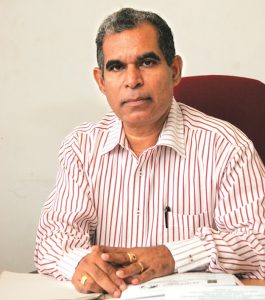
Upali Tennakoon (courtesy)
When former editor Upali Tennakoon speculates about what led to the attempt on his life in 2009, two incidents jump to mind. One was an editorial he wrote for Rivira, the Sri Lankan newspaper he managed. The other was an article he chose not to publish, a move that angered a powerful army general.
At the time, Tennakoon knew well the dangers for journalists in the South Asian nation. The government had barred reporters’ access to the war zone and criticized independent media’s “unpatriotic” coverage of the war, particularly reporting on human rights abuses by the military.
On Jan. 8, 2009 government critic Lasantha Wickrematunge, the editor of another Sri Lankan newspaper called The Sunday Leader, was shot and killed by four motorcycle-riding gunmen on his drive to work. Wickrematunge’s assassination came days before he was slated to give evidence in court about alleged corruption involving then-defense secretary Gotabaya Rajapaksa. The editor had foretold his death in an editorial he had ordered to be published in just such an event.
“When finally I am killed, it will be the government that kills me,” he wrote.
Fifteen days after the attack on Wickrematunge, it was Tennakoon’s turn. As he drove to work with his wife near the capital Colombo, a man approached his car at about 6:40 a.m. “I thought he was trying to talk to me,” says Tennakoon, in an interview with Global Journalist.
Instead the man smashed the side window of the car with an iron bar and started attacking Tennakoon. Three other armed men on two motorbikes also joined the attack with knives, wooden rods and iron bars, breaking the windshield and the side windows. Tennakoon’s face and hands were bleeding. From the passenger seat, his wife flung herself on top of him in a desperate effort to shield him from the blows.
“[We had] nothing to do, anything,” he recalled. “They also tried to break my neck, but they missed it; otherwise I would have been dead.”
The assailants fled, and Tennakoon was taken to a hospital. Three weeks later, he and his wife fled to the United States, where they have lived for the last nine years.
Looking back, Tennakoon says that the attempt on his life may have been retribution for an editorial he wrote criticizing then-president Mahinda Rajapaksa’s government in the wake of Wickrematunge’s death.
Tennakoon says there is also a second possible motive. He was attacked for choosing not to publish an article written by one of his reporters based on information from army commander Gen. Sarath Fonseka. Tennakoon thought the information was a misleading attempt by Fonseka to blame a rival, Sri Lanka’s then naval commander, for failing to stop a successful supply mission by Tamil rebels.
The precise motive remains a mystery in part because to date, no one has been successfully prosecuted for either the attack on Tennakoon or Wickrematunge. In 2016, with a new government in power, Tennakoon returned to Sri Lanka and identified one of his attackers from a lineup as an army intelligence officer named Premananda Udalagama. Udalagama had already been taken into custody in connection with Wickrematunge’s death, but was later released on bail.
Last year, police told a Sri Lankan court that the former army commander Fonseka had testified that the former defense secretary, Gotabaya Rajapaksa, ran a secret intelligence unit outside of the normal command structure that targeted Wickrematunge as well as other journalists and dissidents, according to al-Jazeera. Rajapaksa has denied any wrongdoing, and both he and Fonseka did not respond to messages from Global Journalist.
Tennakoon’s experience was hardly unusual. Between 2004 and 2009, 16 journalists were killed in Sri Lanka, according to the Committee to Protect Journalists. In at least 10 cases, not a single suspect has been convicted.
Tennakoon, 65, now lives in Los Angeles and works for a rental car agency. He still blogs and writes occasionally for Helabima, a U.K.-based Sinhala-language publication. He spoke with Global Journalist’s Yanqi Xu about his attack and the problem of impunity in Sri Lanka, where a new government elected in 2015 came to power promising to prosecute those responsible for attacks on journalists during the civil war. Below, an edited version of their interview:
GJ: What happened right after you were attacked?
Tennakoon: I called the police. We stayed in the hospital for five days.
The situation was fearful. I got threatening calls and was asked to leave the country immediately. My friend at the newspaper asked [then] defense secretary Gotabaya Rajapaksa to send security to me while I was in the hospital, but the defense secretary refused and said it was not necessary.
[After the hospital] I didn’t go back to my place and stayed at my wife’s parents’ house… I knew the perpetrators might be waiting for a second chance to finish their job… We left on Feb. 14 [2009] because I did not have any backup in Sri Lanka. My wife and I both had five-year multiple-entry visas to the U.S., so we decided to come. After we arrived, we applied for asylum. We were granted asylum about seven months later.
GJ: What do you know about the people who attacked you?
Tennakoon: The Crime Investigations Department [CID] investigated the telecommunications of those who might have been involved in these cases [of attacks on journalists]. They thought some were related to my case.
My wife and I went back to Sri Lanka in 2016 and identified one attacker, who was actually intelligence personnel. I went alone again in early 2017, but didn’t identify anyone.
Evidence has emerged over the connections between the killing of Lasantha Wickrematunge and the assault on me. It can be assumed that the same squad handled both attacks and I believe their intention was to kill me. Such a squad involving the members of the military could not have been formed without the support of the top-brass of the military.
GJ: Do you think you’ll see justice for your attack?
Tennakoon: I do not believe that in the current political situation the attackers will be brought to justice. The previous government never inquired or arrested anyone.
The new government promised to inquire into cases of violence against journalists and bring the criminals to court during the election.
But now they are not helping the police and CID to access the information they needed. I have the feeling that current political authorities too are trying to protect the perpetrators… their intention is only to take political mileage out of these cases. They are not bothered about bringing culprits to book.
The current president [Maithripala Sirisena] asked why the attackers were remanded for so long and talked about their human rights, but he was not talking about our human rights. We, in hundreds, lost our jobs, and Lasantha Wickrematunge even got killed. The case is still being heard… the issue is that justice is getting delayed. And, as we all know, justice delayed is justice denied.
GJ: Was it a hard choice to leave Sri Lanka? Do you feel safe to returning now?
Tennakoon: It was difficult to give up journalism as it was a huge part of my life. I also had to leave my parents behind. I have no wish to return since the individuals who I believe to be responsible are still in positions of power… Sarath Fonseka, the then Army Commander, is now a cabinet minister. Former defense secretary Gotabaya Rajapaksa plays an active role in the political domain too, though he is out of power.
I feel [releasing suspects on bail] jeopardized my personal safety. I don’t know what will happen to me when I visit Sri Lanka next time. I do not feel safe to return.[/vc_column_text][/vc_column][/vc_row][vc_row][vc_column width=”1/2″][vc_video link=”https://youtu.be/tOxGaGKy6fo”][/vc_column][vc_column width=”1/2″][vc_column_text]Index on Censorship partner Global Journalist is a website that features global press freedom and international news stories as well as a weekly radio program that airs on KBIA, mid-Missouri’s NPR affiliate, and partner stations in six other states. The website and radio show are produced jointly by professional staff and student journalists at the University of Missouri’s School of Journalism, the oldest school of journalism in the United States. [/vc_column_text][/vc_column][/vc_row][vc_row][vc_column][vc_custom_heading text=”Don’t lose your voice. Stay informed.” use_theme_fonts=”yes”][vc_separator color=”black”][vc_row_inner][vc_column_inner width=”1/2″][vc_column_text]Index on Censorship is a nonprofit that campaigns for and defends free expression worldwide. We publish work by censored writers and artists, promote debate, and monitor threats to free speech. We believe that everyone should be free to express themselves without fear of harm or persecution – no matter what their views.
Join our mailing list (or follow us on Twitter or Facebook) and we’ll send you our weekly newsletter about our activities defending free speech. We won’t share your personal information with anyone outside Index.[/vc_column_text][/vc_column_inner][vc_column_inner width=”1/2″][gravityform id=”20″ title=”false” description=”false” ajax=”false”][/vc_column_inner][/vc_row_inner][vc_separator color=”black”][/vc_column][/vc_row][vc_row][vc_column][vc_basic_grid post_type=”post” max_items=”6″ style=”load-more” items_per_page=”2″ element_width=”12″ grid_id=”vc_gid:1517223145889-6c84a978-58ad-0″ taxonomies=”22142″][/vc_column][/vc_row]
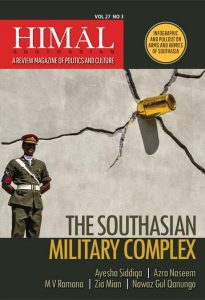 One of South Asia’s most influential news magazines, Himal Southasian, is to close next month after 29 years of publishing as part of a clampdown on freedom of expression across the region. The magazine has a specific goal: to unify the divided countries in South Asia by informing and educating readers on issues that stretch throughout the region, not just one community.
Index got a chance to speak with Himal Southasian’s editor, Aunohita Mojumdar, on the vital role of independent media in South Asia, the Nepali government’s complicated way of silencing activists and what the future holds for journalism in the region.
“The means used to silence us are not straightforward but nor are they unique,” Mojumdar said. “Throughout the region one sees increasing use of regulatory means to clamp down on freedom of expression, whether it relates to civil society activists, media houses, journalists or human rights campaigners.”
Himal Southasian, which claims to be the only analytical and regional news magazine for South Asia, faced months of bureaucratic roadblocks before the funding for the magazine’s publisher, the Southasia Trust, was cut off due to non-cooperation by regulatory state agencies in Nepal, said the editor. This is a common tactic among the neighbouring countries as governments are wary of using “direct attacks or outright censorship” for fear of public backlash.
But for Nepal it wasn’t always this way. “Nepal earlier stood as the country where independent media and civil society not accepted by their own countries could function fearlessly,” Mojumdar said.
In a statement announcing its suspension of publication as of November 2016, Himal Southasian explained that without warning, grants were cut off, work permits for editorial staff became difficult to obtain and it started to experience “unreasonable delays” when processing payments for international contributors. “We persevered through the repercussions of the political attack on Himal in Parliament in April 2014, as well as the escalating targeting of Kanak Mani Dixit, Himal’s founding editor and Trust chairman over the past year,” it added.
Index on Censorship: Why is an independent media outlet like Himal Southasian essential in South Asia?
Aunohita Mojumdar: While the region has robust media, much of it is confined in its coverage to the boundaries of the nation-states or takes a nationalistic approach while reporting on cross-border issues. Himal’s coverage is based on the understanding that the enmeshed lives of almost a quarter of the world’s population makes it imperative to deal with both challenges and opportunities in a collaborative manner.
The drum-beating jingoism currently on exhibit in the mainstream media of India and Pakistan underline how urgent it is for a different form of journalism that is fact-based and underpinned by rigorous research. Himal’s reportage and analysis generate awareness about issues and areas that are underreported. It’s long-form narrative journalism also attempts to ensure that the power of good writing generates interest in these issues. Based on a recognition of the need for social justice for the people rather than temporary pyrrhic victories for the political leaderships, Himal Southasian brings journalism back to its creed of being a public service good.
Index: Did the arrest of Kanak Mani Dixit, the founding editor for Himal Southasian, contribute to the suspension of Himal Southasian or the treatment the magazine received from regulatory agencies?
Mojumdar: In the case of Himal or its publisher the non-profit Southasia Trust, neither entity is even under investigation. We can only surmise that the tenuous link is that the chairman of the trust, Kanak Mani Dixit, is under investigation since we have received no formal information. Informally we have indeed been told that there is political pressure related to the “investigation” which prevents the regulatory bodies from providing their approval.
The lengthy process of this denial – we had applied in January 2016 for the permission to use a secured grant and in December 2015 for the work permit, effectively diminished our ability to function as an organisation until the point of paralysis. While the case against Dixit is itself contentious and currently sub judice, Himal has not been intimated by any authority that it is under any kind of scrutiny. On the contrary, regulatory officials inform us informally that we have fulfilled every requirement of law and procedure, but cite political pressure for their inability to process our requests. Our finances are audited independently and the audit report, financial statements, bank statements and financial reporting are submitted to the Nepal government’s regulatory bodies as well as to the donors.
Index: Why is Nepal utilising bureaucracy to indirectly shut down independent media? Why are they choosing indirect methods rather than direct censorship?
Mojumdar: The means used to silence us are not straightforward but nor are they unique. Throughout the region one sees increasing use of regulatory means to clamp down on freedom of expression, whether it relates to civil society activists, media houses, journalists or human rights campaigners. Direct attacks or outright censorship are becoming rarer as governments have begun to fear the backlash of public protests.
Index: With the use of bureaucratic force to shut down civil society activists and media growing in Nepal, how does the future look for independent media in South Asia?
Mojumdar: This is actually a regional trend. However, while Nepal earlier stood as the country where independent media and civil society not accepted by their own countries could function fearlessly, the closing down of this space in Nepal is a great loss. As a journalist I myself was supported by the existence of the Himal Southasian platform. When the media of my home country, India, were not interested in publishing independent reporting from Afghanistan, Himal reached out to me and published my article for the eight years that I was based in Kabul as a freelancer. We are constantly approached by journalists wishing to write the articles that they cannot publish in their own national media.
The fact that regulatory means to silence media and civil society is meeting with such success here and that an independent platform is getting scarce support within Nepal’s civil society will also be a signal for others in power wishing to use the same means against voices of dissent.
It is a struggle for the media to be independent and survive. In an era where corporate interests increasingly drive the media’s agenda, it is important for all of us to reflect on what we can all do to ensure the survival of small independent organisations, many of which, like us, face severe challenges.
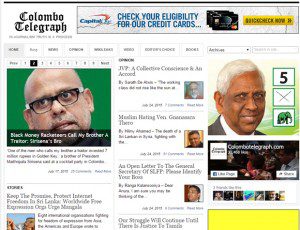 The Colombo Telegraph, Sri Lanka’s most iconoclastic investigative news website, is gearing up for this year’s second national election. And once again they face the threat of censorship — despite a presidential promise to bring it to an end.
January’s polls saw the website blocked to domestic voters by order of authoritarian incumbent president Mahinda Rajapaksa. Unseated by shock winner Maithripala Sirisena, one of the victor’s first acts after the vote was to lift the official banning order.
Unfortunately his officials didn’t get the memo and simply resorted to more subtle and illegal censorship. Their covert interference was exposed by the Colombo Telegraph just a month later, drawing a personal apology from the minister responsible, Mangala Samaraweera, and a promise of a full investigation.
That promised investigation has so far come to nothing, while the later announcement of a general election for August 18 has raised political tensions. This week eight international freedom of expression groups, including Index on Censorship, wrote to Samaraweera reminding him of his promise.
“The media must be free to cover the upcoming campaigns without fear of interference, covert or overt, online or off,” said the groups. Censorship, legal or illegal, may fall hard on independent voices like the Colombo Telegraph unless the state’s secret censors are found and stopped.
Colombo Telegraph editor Uvindu Kurukulasuriya is calling on the government to complete the inquiry as soon as possible and guarantee that the media will be free to report the campaign.
But the Colombo Telegraph has few friends among the current government, led by United National Party prime minister Ranil Wickremesinghe.
The government has been embarrassed by the site’s publication of parts of a leaked 19-page draft parliamentary committee report into an alleged government bond scam linked to Central Bank Governor Arjuna Mahendran and his son-in-law. The dissolution of parliament would have buried its detailed allegations had it not been leaked.
Wickremesinghe said the draft report was ‘false and perverted’ and has no official status. This did not stop him threatening media that cite it with prosecution under an act prohibiting sharing details of committee proceedings before they are presented to parliament itself. The use of the act – much criticised by independent media who have called for its repeal – is designed to deter other journalists following up the story during the election campaign.
Media rights are suddenly looking shaky across the country. Despite pledging to introduce a Right to Information Act as a key part of the Sirisena-Wickremesinghe government’s first 100 days in power, they failed to deliver. And the ruling party set the tone for the election campaign by reportedly pressing state media to downplay coverage of the start of Rajapakse’s bid to return to power as prime minister.
Meanwhile the threat of more illegal online censorship remains as long as the original crime remains un-investigated. It took a careful study by the site’s technical advisers in Denmark to discover that what appeared to be poor connections to some of the site’s more controversial news pages, was in fact targeted interference.
The source of the interference was traced to a server in the central office of Sri Lanka Telecom at the OTS Building in Lotus Road in Colombo.
Websites can be “prohibited or be subject to supervision and control” under section 69 of the Sri Lanka Telecommunications Act 1991 – but only under ministerial authority, and under a publicly announced order. No such order was made to replace the one lifted by Sirisena.
Kurukulasuriya’s online news site, run by volunteers for four years, has developed a strong record of controversial scoops backed with an impressive array of documentation.
“We’ve never supported any particular political party, organisation or individual over another, and have proven it over the years. We just want our site to continue as an independent media organisation without unnecessary legal interference or illegal censorship.”
Any nation’s media would be hard pressed keeping track of a landslide of political change, environmental crises, imminent constitutional reform and a general election, all while keeping safe from a generation of assassins used to impunity.
When the media itself needs reform too, the problems might seem overwhelming. This is why Sri Lanka needs a constitutionally recognised national commission to oversee that reform and ensure freedom of expression is properly defended.
Maithripala Sirisena’s unexpected and virtually peaceful election win over incumbent President Mahinda Rajapaksa was quickly painted as a game changer for the country’s media.
He and new Prime Minister Ranil Wickremesinghe began well by lifting blocks on independent news websites banned by the old regime. Exiled journalists were urged to return. Sirisena also promised to use his new authority to investigate the 2009 murder of combative political journalist Lasantha Wickrematunge, whose killers are still free.
But the early offers soon began to look token. There was no matching commitment to identify the killers of cartoonist Prageeth Eknelygoda, who went missing five years ago, or the men behind the notorious “white van” abductions of peaceful activists. In fact Sirisena’s commitment to media freedom looks somewhat qualified.
A series of special expert commissions will be established to oversee an independent review of the judiciary, police, public services, elections, human rights and anti-corruption measures, written into authority by a 19th amendment to the constitution. Pointedly perhaps, the list does not include a commission on the media.
Plans for an independent media commission are not new, and were excluded from what was eventually enacted as the 17th amendment to Sri Lanka’s Constitution in 2001. Media rights groups should steel themselves for a fight to ensure that the much-needed body is not excluded again.
Uvindu Kurukulasuriya, editor of the once banned Colombo Telegraph, thinks it unfortunate that the new government will not establish a media commission, but thinks it was deliberate. “They are not willing to transform state media into (independent) public service broadcasters, and they don’t want to broad-base (collectivise) the state owned Lake House newspaper group.”
The journalist and legal scholar Asanga Welikala calls for the founding of an independent media commission on the recommendation of the constitutional council and representing working journalists, academics, proprietors and new media.
“The commission once constituted would have overall oversight of public service media and would be answerable to parliament,” he argued for the online political journal Groundviews. “Its primary role would be to oversee the public service media institutions, but may include other powers and functions, including the regulation of the (new and traditional) media marketplace, and to promote the freedom of expression in all its forms including through new technology.”
Kurukulasuriya urges action to break the grip of the political appointees heading the country’s major public and private media companies. The co-option of the owners was the subtler side of the old regime’s system of media control, he says. “The previous Rajapaksa regime changed the ownerships of several media institutions through intimidation.”
Self-censorship drove the majority; more deadly means of censorship were reserved for the small cadres of independent journalists who could not be bought or fired, says Kurukulasuriya. Will the government go on reading “media freedom” as owners’ rights, not journalists’ rights?
Reforming the Sri Lankan media is a vast task. The counter-intuitively named Independent Television Network needs privatisation and the nominally public Sri Lanka Broadcasting Corporation (SLBC), and the Sri Lanka Rupavahini Corporation (SLRC), need a proper public service broadcast mandate and an end to political interference. A constitutionally mandated media commission could appoint and “audit” the works of a new independent broadcasting authority founded to oversee their works.
There is justice still to be found too. According to the Committee to Protect Journalists (CPJ), Sri Lanka has the fourth worst record on its 2014 Impunity Index, which spotlights countries where journalists are murdered and the killers remain free.
In an open letter to Rajapaksa on the eve of elections, Wickrematunge’s widow Sonali Samarasinghe wrote: “At no time in the history of our country has the freedom of expression so brutally been repressed as it is now. Such media as do operate in the country, have been transformed either into propaganda mouthpieces for you and your brothers, or bullied into submission.”
The state media’s job is to “reflect the line of whatever government is in power,” admitted Rajpal Abeynayake, the editor of the state-run Daily News in a memorable post-election quote to The Guardian’s Amantha Perera. “If the government changes, so does the newspaper. It’s as simple as that. If they want to change that practice they could, but so far no government has done it.”
That Sirisena is showing little inclination to substantively change matters. Bandula Padmakumara — the chairman of the Lake House newspaper group, morning news show anchor and well documented supporter of the Rajapakse family — went just a few hours after the election results came in. But few others have followed.
The new president may have to rely on established partners in self-censorship to help shore up his “fragile, sprawling and diverse” coalition, as the New York Times described it. With parliamentary elections set for late April under Sirisena’s 100 day schedule, the campaign may see old favours be called in and the media expected to help paper over the coalition’s cracks.
Without greater independence the Sri Lankan media will not be able to fairly and accurately report the campaign. International and regional media rights groups need to heap pressure of their own on Sirisena’s new media ministry secretary, Karunarathna Paranawithana, who describes himself on his Facebook page as a “diplomat, journalist (and) political activist”.
The appointment of a constitutionally recognised commission for the media next month would not do much to change the situation in time for the election, but it would send a clear message to embattled journalists that change was on the agenda and risks were worth taking.
According to Sirisena’s own strict timetable, his administration will establish the independent commissions on Wednesday 18 February. There’s still time to add one on media to the list.
This article was posted on 26 January 2015 at indexoncensorship.org