9 Sep 2015 | Magazine, mobile, Volume 44.03 Autumn 2015
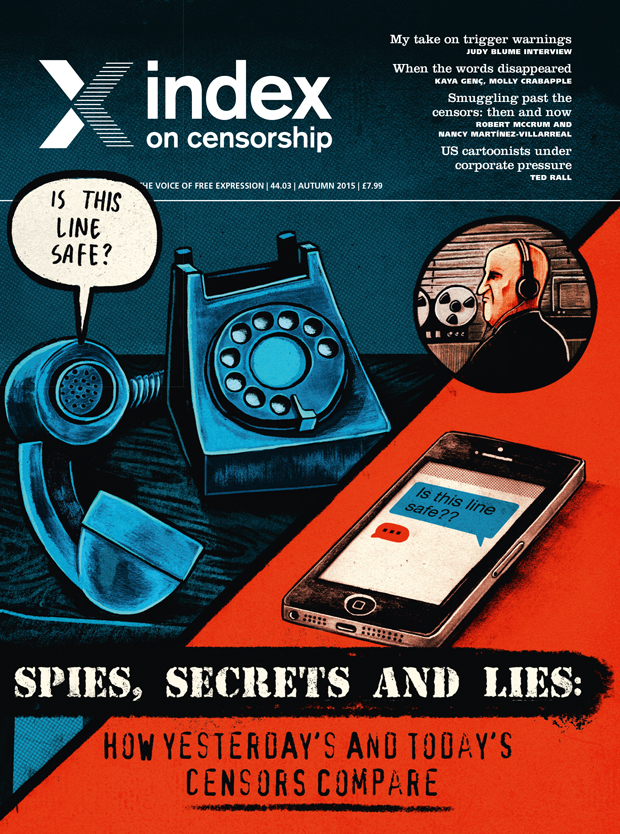 In the old days governments kept tabs on “intellectuals”, “subversives”, “enemies of the state” and others they didn’t like much by placing policemen in the shadows, across from their homes. These days writers and artists can find government spies inside their computers, reading their emails, and trying to track their movements via use of smart phones and credit cards.
Post-Soviet Union, after the fall of the Berlin wall, after the Bosnian war of the 1990s, and after South Africa’s apartheid, the world’s mood was positive. Censorship was out, and freedom was in.
But in the world of the new censors, governments continue to try to keep their critics in check, applying pressure in all its varied forms. Threatening, cajoling and propaganda are on one side of the corridor, while spying and censorship are on the other side at the Ministry of Silence. Old tactics, new techniques.
While advances in technology – the arrival and growth of email, the wider spread of the web, and access to computers – have aided individuals trying to avoid censorship, they have also offered more power to the authorities.
There are some clear examples to suggest that governments are making sure technology is on their side. The Chinese government has just introduced a new national security law to aid closer control of internet use. Virtual private networks have been used by citizens for years as tunnels through the Chinese government’s Great Firewall for years. So it is no wonder that China wanted to close them down, to keep information under control. In the last few months more people in China are finding their VPN is not working.
Meanwhile in South Korea, new legislation means telecommunication companies are forced to put software inside teenagers’ mobile phones to monitor and restrict their access to the internet.
Both these examples suggest that technological advances are giving all the winning censorship cards to the overlords.
But it is not as clear cut as that. People continually find new ways of tunnelling through firewalls, and getting messages out and in. As new apps are designed, other opportunities arise. For example, Telegram is an app, that allows the user to put a timer on each message, after which it detonates and disappears. New auto-encrypted email services, such as Mailpile, look set to take off. Now geeks among you may argue that they’ll be a record somewhere, but each advance is a way of making it more difficult to be intercepted. With more than six billion people now using mobile phones around the world, it should be easier than ever before to get the word out in some form, in some way.
When Writers and Scholars International, the parent group to Index, was formed in 1972, its founding committee wrote that it was paradoxical that “attempts to nullify the artist’s vision and to thwart the communication of ideas, appear to increase proportionally with the improvement in the media of communication”.
And so it continues.
When we cast our eyes back to the Soviet Union, when suppression of freedom was part of government normality, we see how it drove its vicious idealism through using subversion acts, sedition acts, and allegations of anti-patriotism, backed up with imprisonment, hard labour, internal deportation and enforced poverty. One of those thousands who suffered was the satirical writer Mikhail Zoshchenko, who was a Russian WWI hero who was later denounced in the Zhdanov decree of 1946. This condemned all artists whose work didn’t slavishly follow government lines. We publish a poetic tribute to Zoshchenko written by Lev Ozerov in this issue. The poem echoes some of the issues faced by writers in Russia today.
And so to Azerbaijan in 2015, a member of the Council of Europe (a body described by one of its founders as “the conscience of Europe”), where writers, artists, thinkers and campaigners are being imprisoned for having the temerity to advocate more freedom, or to articulate ideas that are different from those of their government. And where does Russia sit now? Journalists Helen Womack and Andrei Aliaksandrau write in this issue of new propaganda techniques and their fears that society no longer wants “true” journalism.
Plus ça change
When you compare one period with another, you find it is not as simple as it was bad then, or it is worse now. Methods are different, but the intention is the same. Both old censors and new censors operate in the hope that they can bring more silence. In Soviet times there was a bureau that gave newspapers a stamp of approval. Now in Russia journalists report that self-censorship is one of the greatest threats to the free flow of ideas and information. Others say the public’s appetite for investigative journalism that challenges the authorities has disappeared. Meanwhile Vladimir Putin’s government has introduced bills banning “propaganda” of homosexuality and promoting “extremism” or “harm to children”, which can be applied far and wide to censor articles or art that the government doesn’t like. So far, so familiar.
Censorship and threats to freedom of expression still come in many forms as they did in 1972. Murder and physical violence, as with the killings of bloggers in Bangladesh, tries to frighten other writers, scholars, artists and thinkers into silence, or exile. Imprisonment (for example, the six year and three month sentence of democracy campaigner Rasul Jafarov in Azerbaijan) attempts to enforces silence too. Instilling fear by breaking into individuals’ computers and tracking their movement (as one African writer reports to Index) leaves a frightening signal that the government knows what you do and who you speak with.
Also in this issue, veteran journalist Andrew Graham-Yool looks back at Argentina’s dictatorship of four decades ago, he argues that vicious attacks on journalists’ reputations are becoming more widespread and he identifies numerous threats on the horizon, from corporate control of journalistic stories to the power of the president, Cristina Fernández de Kirchner, to identify journalists as enemies of the state.
Old censors and new censors have more in common than might divide them. Their intentions are the same, they just choose different weapons. Comparisons should make it clear, it remains ever vital to be vigilant for attacks on free expression, because they come from all angles.
Despite this, there is hope. In this issue of the magazine Jamie Bartlett writes of his optimism that when governments push their powers too far, the public pushes back hard, and gains ground once more. Another of our writers Jason DaPonte identifies innovators whose aim is to improve freedom of expression, bringing open-access software and encryption tools to the global public.
Don’t miss our excellent new creative writing, published for the first time in English, including Russian poetry, an extract of a Brazilian play, and a short story from Turkey.
As always the magazine brings you brilliant new writers and writing from around the world. Read on.
© Rachael Jolley
This article is part of the autumn issue of Index on Censorship magazine looking at comparisons between old censors and new censors. Copies can be purchased from Amazon, in some bookshops and online, more information here.
14 Aug 2015 | Azerbaijan, Azerbaijan Statements, Campaigns, mobile, Statements
The Sport for Rights coalition condemns the conviction and harsh sentencing of Azerbaijani human rights defenders Leyla and Arif Yunus on 13 August by the Baku Court of Grave Crimes. After a trial marred by irregularities and due process violations, the court convicted the couple on politically motivated charges including illegal entrepreneurship, tax evasion, and fraud, and sentenced Leyla to 8.5 years in jail, and Arif to seven.
“These sentences are outrageous, and aimed purely at sanctioning the legitimate work of these two Azerbaijani human rights defenders. While the heavy sentences are no surprise, they serve to further undermine Azerbaijan’s complete disregard for the international standards of fair trial and due process”, said Souhayr Belhassen, FIDH Honorary President.
“The unprecedented speed with which the Yunus trial was carried out is appalling and tells us a lot about its quality. The judgment is full of inaccuracies due to a total lack of examination of the evidence provided. Violations of international standards of the right to a fair trial were obvious”, declared Gerald Staberock, Secretary General of OMCT.
Leyla, the Director of the Institute for Peace and Democracy, and Arif, a historian and activist in his own right, were arrested in July and August 2014, following Leyla’s public calls for a boycott of the inaugural European Games, which were held in Baku in June 2015. Sport for Rights considered them ‘Prisoners of the Games. Leyla had also been working to compile a detailed list of cases of political prisoners, and was a strong advocate of fundamental freedoms, property rights, and peaceful resolution of the Nagorno-Karabakh conflict.
The couple have been held in separate facilities; Leyla in the Kurdakhani investigative detention unit, and Arif at the Ministry of National Security’s investigative prison. Leyla reported being mistreated on several occasions, and Arif reported poor conditions. Both Leyla and Arif suffer from serious health problems, which have sharply deteriorated in detention, and have caused delays during trial proceedings, including on the day of the verdict, when Arif fainted and was attended to by a doctor. Nonetheless, the authorities resisted calls for their release on humanitarian grounds, and the court rushed to issue a verdict.
“The health situation of Leyla and Arif Yunus is extremely worrying and deserves the highest attention of the international community. Whilst we are thankful for the international attention brought to the case by some voices, we remain concerned by the lack of action of the Council of Europe and the European Union. It is clear that the climate of fear has reached a new low with these sentences and the killing of journalist Rasim Aliyev”,said Ane Tusvik Bonde, Regional Manager for Eastern Europe and Caucasus of the Human Rights House Foundation (HRHF).
The Yunus’ conviction takes place amidst a broader human rights crackdown in Azerbaijan, in the aftermath of the European Games and the run-up to November’s parliamentary elections. The same week as the verdict in the Yunus’ case, journalist Khadija Ismayilova also stood trial, facing serious jail time on politically motivated charges, and Rasim Aliyev, journalist and Chairman of the Institute for Reporters’ Freedom and Safety, died in hospital after being severely beaten. With less than three months until the parliamentary elections, the Azerbaijani authorities seem determined to continue working aggressively to silence the few critical voices left in the country.
The Sport for Rights coalition reiterates its call for the immediate and unconditional release of Leyla and Arif Yunus, as well as the other jailed journalists and human rights defenders in Azerbaijan. Sport for Rights further calls for sustained international attention to the country and increased efforts to hold the Azerbaijani regime responsible for its human rights obligations in the pre-election environment and beyond.
Supporting organisations:
ARTICLE 19
Canadian Journalists for Free Expression
Civil Rights Defenders
Freedom Now
Front Line Defenders
Human Rights House Foundation
Index on Censorship
International Federation for Human Rights (FIDH), within the framework of the Observatory for the Protection of Human Rights Defenders
Norwegian Helsinki Committee
PEN American Centre
Platform
Solidarity with Belarus Information Office
World Organisation Against Torture (OMCT), within the framework of the Observatory for the Protection of Human Rights Defenders
[smartslider2 slider=”35″]
[timeline src=”https://docs.google.com/spreadsheets/d/1_rMZeC8deu7lQgoJPEESF0IqNO9u7aVuESqWMualEJw/pubhtml” width=”620″ height=”600″ font=”Bevan-PotanoSans” maptype=”toner” lang=”en” ]
7 Aug 2015 | Azerbaijan, Azerbaijan News, mobile
[smartslider2 slider=”35″]
The following letter was written by Leyla Yunus, director of the Peace and Democracy Institute, who is currently on trial on spurious charges. Her husband, Arif, a historian and researcher is also on trial. The letter was originally published at Meydan.tv.
They’re planning to wipe us out in agony. Why is that? So that our pain and our deaths become a lesson for all.
They didn’t give me an opportunity to speak in court, but I want my voice to be heard. Finally, I saw Arif. We haven’t seen each other, and I haven’t heard his voice for a year! He celebrated his 60th anniversary in a prison cell, and I’ll have to mark my 60th birthday in duress as well.
We were separated on the 37th anniversary of our wedding, and I already don’t believe that we can be together in this world… with our daughter and the whole family.
Azerbaijan: Silencing human rights
Ongoing coverage of the crackdown on civil society by the government of President Ilham Aliyev
|
We are both historians, and we are well aware that despotism is based on repressions. Back in the past, [Russian revolutionary Sergey] Stepniak-Kravchinsky wrote: “It’s worse than plague. Plague kills indiscriminately, while despotism chooses its victims from the cream of the nation. ”
Tofiq Yagublu, Anar, Ilgar, Intigam, Hilal, Seymour Ghazi, Khadija, Thale Bagirzade, Movsum Samedov, Yadigar Sadigov, Rasul Jafarov, Rashadat and others from NIDA. More than a hundred of the brightest and cleanest…
In the 80s Arif, and I worked in samizdat newspaper Express-Chronicle published illegally. Then, in 1986 our colleague Anatoly Marchenko died in the Chistopol prison. For me, it was a shock. I am well aware of the deaths in Stalin’s camps, since three brothers of my grandfather passed away there. But in 1986….
At that time, I realized that the terror continued in the USSR, and we had to be ready for it, but I could not assume that the independent Azerbaijan would follow the same path.
As a human rights activist with nearly 30 years of experience, I knew about torture in Azerbaijan. Still, it was hard when I was attacked in the first months of my detention, when on September 23, 2014, Major Yagubov, a young and strong man, started beating me. As a result of these beatings, I lost the ability to see normally with my left eye.
On December 11, 2014, I was dragged by my feet into a solitary confinement without explaining a reason… I heard from Arif that he had also been assaulted during the first days of his arrest…
Arif suffers from stage 3 arterial hypertension. This means strokes, paralysis, hemorrhage, and unpredictable blood pressure hikes. Now he has a tumor on his head. He has been held in a solitary confinement for a year, and he suffers from a persistent pain. It is well-known that I suffer from diabetes and liver decomposition. The EU sent an expensive medicine, but we all understand that in detention this medicine will not be able to help me…
They’re planning to wipe us out in agony. Why is that? So that our agony and our deaths become a lesson for all. If they do not shy away from destroying a well-known family, then others are easy to destroy too. Fear must live in the hearts of citizens. Fear and hopelessness. I have no illusions about this tribunal, as there was no so-called investigation.
Which articles of the law to use in order to fake accusations, make up a crime and sentence a defendant – these orders come to prosecutors and judges from the top. Preparing our indictment, prosecutors got so carried away with the falsification that even a well-known, documented fact of an unlawful destruction of our house on Shamsi Badalbeyli Street 38 was presented as a peaceful move to another apartment. Even the Administrative, Economic, Appeals and Supreme Courts acknowledged the destruction of our house. However, this was clearly an unlawful destruction of property with all assets (archives, computers) on August 11, 2011.
This obvious lie is a clear evidence of how falsified the entire investigation is. Neither the investigators nor the prosecutor fear that their lies can be refuted…
Arif is accused of transferring money from one of his accounts to another. I have witnessed so many trials against political prisoners, given a well-deserved “striped robe” to so many judges, which is why I will definitely not participate in this tribunal. But I’ll just sit with Arif and hold his hand. We both know that this is our last date. When it all breaks down, I will not be there with him … But we are both historians and we know: “wayfarer will seek his way to Lacedaemon so that we … remain faithful to the law.” As my Polish teacher taught me: “For your freedom and ours.”
This letter was originally published at Meydan.tv
24 Jul 2015 | Azerbaijan, Azerbaijan News, Campaigns, mobile
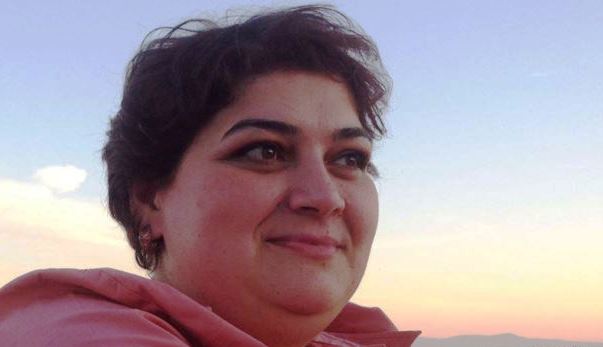
Khadija Ismayilova
Investigative journalist Khadija Ismayilova declared her innocence at a pre-trial hearing, calling the charges against her poltically motivated.
Ismayilova, who has reported on corruption allegations involving the family of President Ilham Aliyev, is accused of embezzlement, tax evasion and abuse of power. Detained since December 2014, Ismayilova was originally charged with “incitement to suicide”, though that charge was later dropped.
The court barred members of the public, journalists, political figures and foreign diplomats, who had come to observe the proceedings, from entering the courtroom, Contact.az and Radio Free Europe reported.
Ismayilova’s trial was set to begin on 7 August.
“The decision to bar access to the public on the first day of Khadija’s trial underscores the capricious manner in which the government of President Ilham Aliyev is ruling Azerbaijan. Her’s is not the first spurious case aimed squarely at stifling critical voices in civil society. It’s vital that court officials hold the trial in a transparent manner”, Jodie Ginsberg, CEO of Index on Censorship said.
In the past year major figures in Azerbaijan’s civil society have been silenced through pre-trial detentions and multi-year prison sentences.
An earlier version of this article incorrectly stated that the pre-trial hearing was part of the trial.
Recent coverage:
• Married political prisoners kept apart for 11 months, reunited in court
• Lawyers call for the release of Intigam Aliyev
• Azerbaijan: Silencing human rights
This article was posted on 24 July 2015 at indexoncensorship.org