As we approach World Press Freedom Day, the right to freedom of expression will again be celebrated as an inalienable European value across the continent — by the public, the media and politicians alike. But to many, this will mean little more than engaging in a well trodden mental routine. We hardly consider the difficulties that freedom of expression faces in practice.
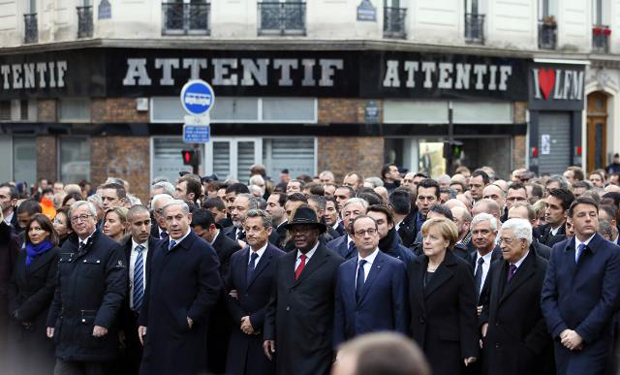
In the first part of 2015, more than a third of journalist killings in the word took place in two European countries; France and Ukraine. If it is true that Europe’s reactions to the Charlie Hebdo attack — the majority of them very emotional — were salubrious, they simultaneously gave rise to ambiguous situations. Many of the leaders that will on 3 May reaffirm their commitment free expression, supported the same message by taking part in the historic march in Paris on 11 January.
But upon seeing Angela Merkel, some were also reminded that Germany continues to treat blasphemy as a crime — as do Denmark, Spain, Poland and Greece, among others. Ireland, whose Enda Kenny was also in attendance, has a constitution which specifically mentions blasphemy and in 2010 enacted a new law against it. All these European countries defend themselves by saying that they do not apply their laws against “blasphemers”. That argument does not carry much weight when it comes to opposing those countries — Saudi Arabia, Iran, various Asian countries — that have tried to turn blasphemy into a universal crime recognised by the UN.
Spain’s Mariano Rajoy too marched in solidarity, but his government has taken steps to promote changes in the penal code that would “represent a serious threat to freedom of information, expression and the press”.
And what was Viktor Orban doing in Paris? The Hungarian president has reunified Hungary‘s public media so as to better bind them to his own party. Despite being the leader of an EU country, Orban has followed Vladimir Putin’s example. In this experimental model, the Andrei Sakharov Center and Museum is no longer ordered to close as it was in the old days, but rather fined 300,000 roubles (€5,000) for failing to register as a “foreign agent”. One day brings an announcement of compulsory registration for bloggers in Russia; another day, harassment against Russian and Hungarian NGOs perceived as “unpatriotic”.
Turkish Prime Minister Ahmet Davutohlu traveled to Paris, only to later label Charlie Hebdo’s post-attack issue a “provocation”. A reminder: Turkey is an EU candidate country where dozens of journalists have been sentenced to prison, and where various internet sites, including those that dared to reproduce some of Charlie Hebdo’s caricatures, have been blocked.
But also present at the march, were various representatives of European journalists — myself included. Just behind the Charlie Hebdo survivors, we carried a banner with the message “Nous sommes Charlie”.
Walking next to me was Franco Siddi, of the Italian National Press Federation. He talked to me about how imprisonment for defamation is still a possibility in Italy, though the European Court of Human Rights has ruled it a disproportionate punishment.
In my home country Spain too, this possibility of imprisonment remains, even if under Spanish jurisprudence freedom of expression consistently prevails over the demands of plaintiffs. In Italy, the situation is the same, yet my Italian colleagues point out that in 2014 alone, 462 journalists in the country were threatened with legal action for alleged acts of defamation. And while the current proposal for reform being considered foresees eliminating the possibility of jail time, it increases the potential fines.
This is not the only potential legal threat facing European journalists. Long before 9/11, there existed a reflexive habit of passing “urgent” laws under security pretexts, as in the UK during the most difficult years of the Northern Ireland conflict. The current model is the United States’ Patriot Act, which has recently been discussed in France. Meanwhile, in Britain and Spain are debating what free expression activists describe as “gag laws”. In Macedonia, the sentencing of the investigative journalist Tomislav Kezarovski to two years in prison under one of these security inspired laws stands out as a warning sign.
Against this worrying backdrop, across Europe journalists, freedom advocates, campaigners and even politicians are standing up for press freedom. When Gvozden Srecko Flego, member of the Parliamentary Assembly of the Council of Europe, recently highlighted the cases of Russia, Ukraine, Turkey and Azerbaijan as particularly problematic, he also suggested a countermeasure. He recommends “organising annual debates […], with the participation of journalists’ organisations and media outlets” in the respective parliaments of each state.
Media concentration, one of the most serious challenges to media pluralism and free expression in Europe, is being tackled. One proposal, which some international bodies have already accepted, would create a “Media Identity Card” requiring owners to publicly identify themselves and thus create an environment of more open and transparent media ownership.
When defending freedom of expression as a European value, we cannot allow ourselves to simply fall in into mental routines. This World Press Freedom Day we need both words and actions.
Paco Audije is a member of the Steering Committee of the European Federation of Journalists (EFJ)
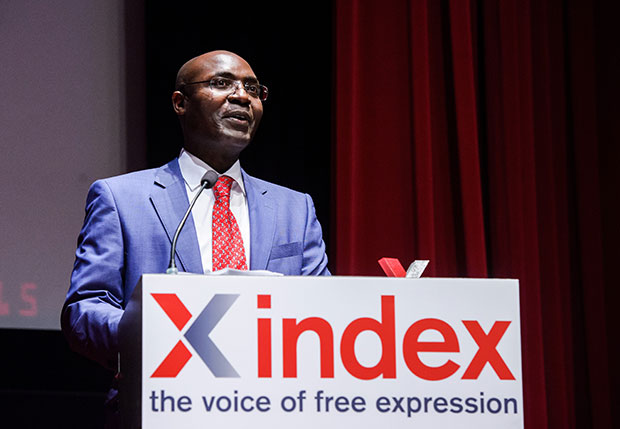
Journalist and human rights activist Rafael Marques de Morais (Photo: Alex Brenner for Index on Censorship)
Just days after being named the joint winner of the journalism award at the 15th Index on Censorship Freedom of Expression Awards, Angolan journalist Rafael Marques de Morais appeared in court for exposing corruption and human rights abuses.
Marques was confronted with up to 15 additional charges when he arrived in court on 24 March. The case was later adjourned until 23 April.
I went to court today facing nine charges of criminal defamation. I left slapped with up to 15 additional ones for defamation. Speechless!
Marques’ leading investigative work into corruption and human rights abuses at Angola’s diamond companies was distilled into his 2011 book Blood Diamonds: Torture and Corruption in Angola. He recounted 500 cases of torture and 100 murders of villagers living near diamond mines, carried out by private security companies and military officials.
Marques declared the bosses of these groups morally responsible for the atrocities committed under them, and filed charges of crimes against humanity against seven Angolan generals. After his case was dropped by the prosecution, the generals launched a series of retaliation lawsuits in Angola and Portugal, charging Marques with criminal libel.
The suit demands a total of £800,ooo from Marques. He could face up to nine years in prison.
Index on Censorship calls for Angolan authorities to drop all charges against Rafael Marques de Morais and respect press freedom.
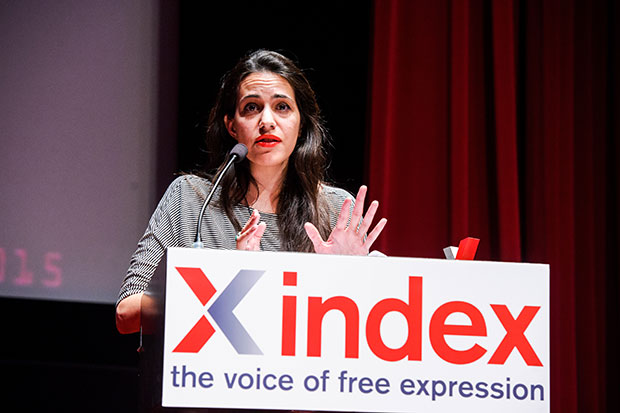
Safa Al Ahmad has spent the last three years covertly filming a mass uprising in Saudi Arabia’s Eastern Province that had, until her film, gone largely unreported. She did this in a country where those accused of dissent can face execution and travelling solo as a female is restricted. Al Ahmad’s 30-minute documentary, Saudi’s Secret Uprising, gave a rare glimpse of civil unrest from the region when it was broadcast by the BBC in May 2014. Since her important documentary aired Al Ahmad has faced extensive and violent online threats, and has been advised for her own safety not to return to her country. She is the joint recipient of the 2015 Index on Censorship Freedom of Expression Award for Journalism.
Saudi Arabia is a mystery, even to its own people.
Parts of our history deliberately concealed, the present muddled with rumours and half-truths.
The government-owned and controlled media play a major role in the dissemination of those false realities of ourselves and others.
This makes facts a precious commodity in Saudi Arabia.
The uprising in the east of Saudi Arabia is a perfect example of how well the government has succeeded in controlling the story and the narrative around an unprecedented event in modern Saudi history. And it also exposes the failure of media in not cutting through the government’s narrative.
Since the protests started in Qatif in early 2011 along with the rest of the Arab world, youth were arrested and given death sentences for posting on Facebook, like Mohmed Alnmir. Poets like Adel Al Labad, and human rights activist Fathil Al Manasif were given 15 year sentences for threatening “social stability”. So called anti-terrorism laws were introduced to criminalise most forms of dissent.
For the film I made that tells this story, and shares my opinions, I have been accused of lying and spying, advocating terrorism, aiding and abetting terrorists, and of course I have been called a heretic.
As a journalist in the Middle East people think they have the right to constantly ask what religion or sect you belong to and judge your work accordingly. It has become nearly impossible to do a story without talking about Sunnis and Shia. But sectarianism is used as a tool, as a weapon, to further confuse and tangle an already complicated political landscape. It has become acceptable reductive language in the media, both Arab and western, to explain our world.
In Saudi Arabia, it was used to isolate and crush a fledgling uprising. A clever way to stop the rest of the country from joining those who have the same demands – to stop political oppression, free political prisoners, have transparent and just courts, stop corruption, and have equal rights for all citizens.
But in the end, the uprising became reduced into a story of “Shia” minority protesting the majority Sunni rulers. A true statement at face value, but not the whole complicated, messy truth.
Documentary maker and journalist Safa Al Ahmad (Photo: Alex Brenner for Index on Censorship)
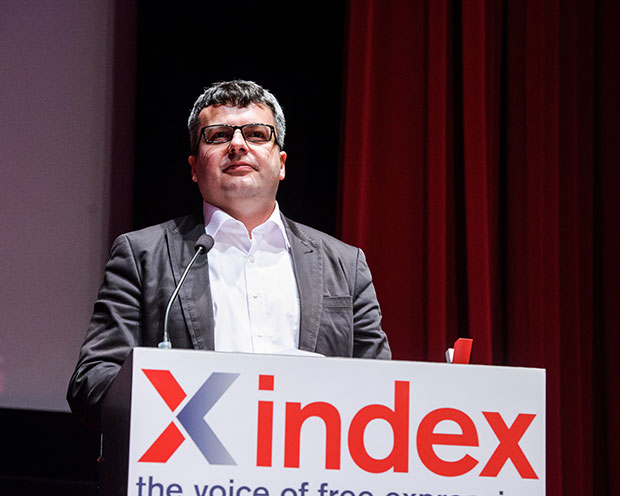
Hungarian journalist Tamás Bodoky founded the investigative news website Atlatszo.hu to promote a free press in Hungary, a country where journalists and news organisations face recently introduced media taxes, a proposed internet tax for citizens, smear campaigns and police-run office raids. Bodoky has brought together a range of crowd-sourced approaches to empower citizens in the face of this deteriorating situation for human rights, including tools to allow for anonymous reporting of corruption, to help investigate freedom of information requests (and refusals), and MagyarLeaks, a Tor-based whistleblowing service. Last year Atlatszo.hu was put on the government’s NGO blacklist, but Bodoky continues to run the site, as well as workshops to help keep investigative journalism in Hungary alive. He is the recipient of the 2015 Index on Censorship Freedom of Expression Award for Digital Activism.
Atlatszo.hu is calling on all those who believe that the independence of journalism in Hungary is under threat. All those who agree that politics and business interests have sunk their claws into everyday life. All those who know that taxpayer money is vanishing. We are calling on you to help us let the world know the truth.
Almost four years ago Atlatszo.hu pledged to tackle the uphill battle represented by these challenges.
As a watchdog NGO for investigative journalism, we set out to promote transparency and freedom of information in Hungary.
Atlatszo.hu – “atlatszo” means transparent in Hungarian – produces investigative reports, accepts information from whistleblowers, files freedom of information requests, and commences freedom of information lawsuits in cases where those requests are refused.
We are only a small group of journalists, lawyers and IT-specialists. But since the beginnings we have won more than 60 percent of FOI lawsuits we initiated. In fact we have been so successful in the courtrooms that in 2013 the governing majority introduced a bill to curtail FOI legislation which was dubbed “Lex Átlátszó” by the Hungarian press.
Looking back to 2011, when Atlatszo.hu was founded, I remember that many journalists dismissed the effort and were quite sure it wouldn’t last. We ignored these critics. We were confident that this was the way to go; to position ourselves outside the mainstream media, and to seek out alternative communication channels — because all of the main journalistic platforms were and still are severely constrained.
In Hungary, domestic journalism has come to represent the interests of local oligarchs. Multinational media firms are busy appeasing the political and economic powers that be. The advertising sector is a powerful censorship instrument – too often used to exert pressure. And every year since we started, the situation has become dramatically worse.
Now, the ruling political elite is pushing out its full arsenal. From business regulation to media control. From forcing personnel changes to diverting media outlets by prescribing countless directions. State funded public media has been reduced to a propaganda tool.
Most recently, the Hungarian government sparked a row over the foreign funding of local NGOs. The row has escalated to the extent that even groups advocating simple environmental concerns, or campaigning against corruption, are now being targeted. The only tangible reason to be found is that the government doesn’t appreciate funding going to any organization it doesn’t fully approve of.
I look at all of this, I look at my country, and I say one simple thing. I say Atlatszo will not be defeated. Hungary can have a fair and just democracy. Yes, it still can be done.
Thank you.
Journalist Tamas Bodoky (Photo: Alex Brenner for Index on Censorship)