13 Oct 2014
5 awards. 16 years. Champions against censorship.
The Index Freedom of Expression Awards recognise those individuals and groups making the greatest impact in tackling censorship worldwide. Established 16 years ago, the awards shine a light on work being undertaken in defence of free expression globally. All too often these stories go unnoticed or are ignored by the mainstream press.
Each year, the awards call attention to some of the bravest journalists, writers, artists and human rights defenders in the world. The 2015 awards were no exception. We honoured Amran Abdundi, a Kenyan activist who has worked through various channels to support women who are vulnerable to rape, female circumcision and murder in northeastern Kenya. We also gave awards to Mouad “El Haqed” Belghouat, a Moroccan rapper who continues to make music about endemic corruption and widespread poverty in his country despite censorship being imprisoned three times; Tamás Bodoky, a journalist campaigning for a free press in Hungary; Rafael Marques de Morais, who has exposed government and industry corruption in Angola; and Safa Al Ahmad, a journalist who has spent three years covertly filming a mass uprising in Saudi Arabia’s Eastern Province that had, until her film, gone largely unreported.
The Freedom of Expression Awards grew naturally from the principles established by our founder, the poet Stephen Spender, who sought to give a voice to those facing censorship behind the Iron Curtain and beyond. Index had long championed writers and artists fighting threats to free expression by publishing their work in our magazine, or through our own reporting. Recognising their work through our Freedom of Expression Awards was a natural next step.
In Azerbaijan, where I have come from, telling the truth can cost a journalist their life.
That is the price that my colleagues in Azerbaijan are paying for the right of the Azerbaijani people to know the truth about what is happening in their country.
For the sake of this right we accept that our lives are in danger, as are the lives of our families.
But the goal is worth it, since the right to truth is worth more than a life without truth.”
— Idrak Abbasov, Award winner, 2012
Who is eligible
Anyone involved in tackling free expression threats – either through journalism, advocacy, arts or using digital techniques – is eligible for the awards. Index invites nominations from the public via its website and through social media platforms. Other non-governmental organisations are also invited to suggest nominees, and individuals and groups can also self-nominate. There is no cost to applying.
We shortlist on the basis of those who are deemed to be making the greatest impact in tackling censorship in their chosen area, with a particular focus on those who are tackling topics that are little covered or tackled by others, or who are using innovative methods to fight censorship.
Nominations are now closed. The shortlist will be announced on 27 January 2015.
The categories?
Advocacy – recognises campaigners and activists who have fought censorship and challenge political repression. This award is sponsored by Doughty Street Chambers.
Arts – recognises artists and producers whose work asserts artistic freedom and battles repression and injustice.
Digital Activism – recognises innovative uses of new technology to circumvent censorship and foster debate. This award is sponsored by Google.
Journalism – for impactful, original, unwavering investigative journalism across all media. This award is sponsored by The Guardian.
The judges
Each year Index recruits an independent panel of judges with expertise in advocacy, arts, journalism and human rights to work on the shortlisting of nominees. This year’s judges include journalist and campaigner Mariane Pearl and human rights lawyer Keir Starmer. Previous judges include playwright Howard Brenton, philanthropist Sigrid Rausing, and broadcaster Samira Ahmed.
The timeline
Nominations opened on October 14 and remained open until November 20, 2014. Nominations are now closed. The nominee shortlist will be announced on January 27. Judges make their final awards selection in February. The Digital Advocacy winner is decided by public vote. The winners of the awards will be announced at the 2015 Index Freedom of Expression Awards on March 18.
26 Sep 2014 | Digital Freedom, Europe and Central Asia, News and features, Politics and Society
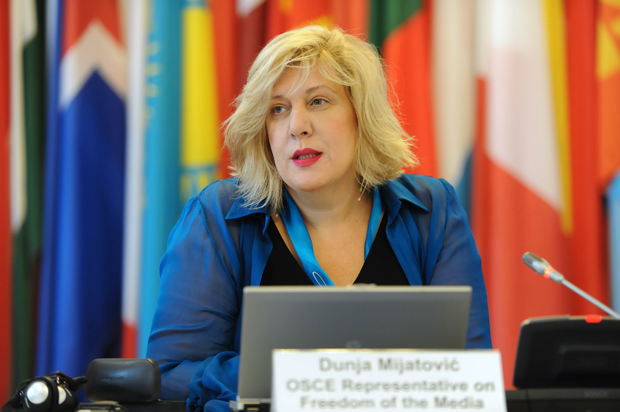
Dunja Mijatovic, OSCE Representative on Freedom of the Media
“States must stop trying to define who is and isn’t a journalist. The media landscape has changed irreversibly,” said Dunja Mijatovic, OSCE Representative on Freedom of the Media, as she opened the organisation’s Open Journalism event in Vienna on Friday, 19 Sept.
Journalism – wherever you draw its boundaries – has more voices than ever, but are all they all being properly recognised and safeguarded? This was one of the main problems addressed by the expert panel, which included Index on Censorship, alongside delegates from Azerbaijan, Serbia, Estonia, Russia, Kazakhstan, Bosnia and many other OSCE member states.
Gill Phillips, the Guardian’s director of editorial legal services, spoke via pre-recorded video about difficulties in defining journalism and deciding who gets journalistic protection. She cited the Snowden scoop, which was led by Glenn Greenwald, a former lawyer, and later embroiled his partner, David Miranda. Who gets the protection? Greenwald? Miranda? Lead staff reporter David Leigh? All three?
There was widespread condemnation of Russia’s new law, which compels bloggers with more than 3,000 views per day to be registered with the authorities. “[The bloggers] have certain privileges and obligations,” said Irina Levova, from the Russian Association of Electronic Communications, who repeatedly defended the law. “Online and offline rights are not the same,” she said, adding that some of those who deemed the law a mode of censorship have been revealed as “foreign agents”.
Another topic – raised repeatedly by various attendees – was Russian media’s growing influence over citizens in nearby countries. Begaim Usenova of the Media Policy Institute in Kyrgyzstan said: “The common view being spread from the Russian media is that the United States is starting world war three and only Putin can stop him.”
Yaman Akdeniz, a Turkish cyber-rights activist, shared news of Twitter accounts that remain blocked in his country, including some with over 500,000 followers. Igor Loskutov, a business director from Kazakhstan, looked back on the first 20 years of internet in his country and how authorities have gone from ignoring their first rudimentary websites to now wanting complete control.
The thorny issue of “public interest” was also discussed. Jose Alberto Azeredo Lopes, professor of International Law at the Catholic University of Porto, raised some smiles with his theory: “It’s like pornography. You can’t define it. But you know it when you see it.”
As the day-long discussions wrapped up, one delegate asked: if a blogger’s first-ever post goes viral, are they immediately subject to the same laws as the press? Especially in countries that now insist bloggers register.
The debate over the difference between journalists and bloggers went round in circles – as it always does – but the OSCE is hoping to be able to compile all the findings from its expert meetings into an online resource to move the discussion forward.
Azeredo Lopes concluded: “If you don’t distinguish freedom of expression from freedom of the press, you end up with no journalists, and that is the crisis that journalism faces today.”
Read our interview with Dunja Mijatovic, OSCE’s Representative on Freedom of the Media, in the autumn issue of Index on Censorship Magazine, coming soon
This article was published on Friday September 26 at indexoncensorship.org
12 Sep 2014 | Belarus, Europe and Central Asia, News and features, Russia
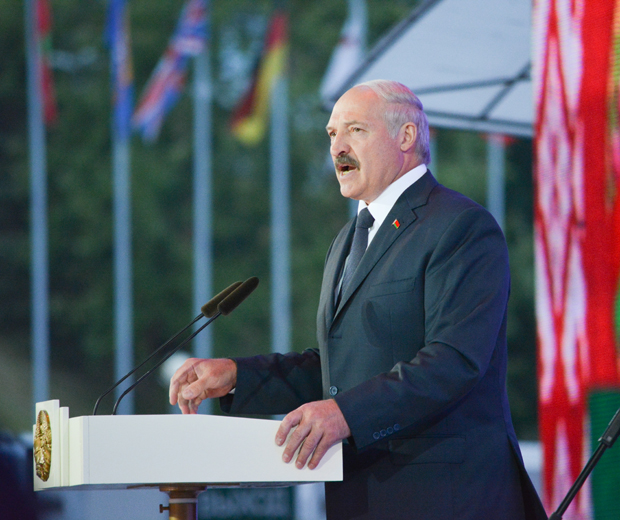
(Photo: Okras/Wikimedia Commons)
Pity poor Dmitry Dayneko. The Belarusian teen recently completed the ice-bucket challenge, as millions like him have before, and posted the video of himself being drenched in cold water on social media. So far, so hilarious/tedious (depending on your view of the challenge), but, ultimately, quite harmless.
Except apparently it wasn’t. Dmitry and the friends who poured cold water over his head say they were summoned by local authorities and given a stern warning to behave themselves, apparently on the orders of the KGB in Minsk. The reason? Not the icy water itself, but Dmitry’s temerity in nominating Belarus’ president, Alexander Lukashenko, to do the challenge next.
Lukashenko, one feels, is not a man who does lighthearted fun. One cannot imagine him posting a selfie of himself holding a cocktail with an umbrella in it, hashtagged #YOLO. One cannot even begin to think what he’d wear on fancy dress day at Bestival. He’s probably weirdly competitive at bowling. He does not do Wii.
This does not make him an exceptional dictator. In the history of autocrats, I can’t think of a single one who was mainly in it for the laughs, unless it was fun of the crushing your enemies, seeing them driven before you, and hearing the lamentations of their women variety.
In journalist Ben Judah’s recent, acclaimed essay on the court of Vladimir Putin, he describes a lonesome, rigid emotionless figure, whose only apparent joy is ice hockey, which Judah says, Putin finds “graceful and manly and fun”. This is quite normal for a man of his age and geographical situation (Lukashenko has the same love for ice hockey). But there is a difference between “fun” and “funny”; playing sport is fun. It may even be more fun if your opponents are scared of you. What it is not, though, is funny.
Because dictatorships don’t — can’t — do funny. People can make great jokes about authoritarian regimes, certainly. Ben Lewis’s Hammer And Tickle details the jokes that got people through Soviet communism between 1917 and 1989, most of which revel in the jarring, depressing juxtaposition between Soviet promises of milk and honey and everyday reality (“What is the definition of capitalism?” “The exploitation of man by man” “And what is the definition of communism?” “The exact opposite”.)
But those within the regime, within The Party, never, ever find themselves funny, which is why the generals end up with such large hats.
A couple of years ago, a viral video spread of Belarusian soldiers putting on a display on the country’s Independence Day. It was synchronised, controlled, disciplined, and one the campest things I have ever seen — the Red Army choreographed by Busby Berkeley. But this would not for one moment have occurred to anyone in charge.
Funny doesn’t work for dictatorships because funny usually involves humanity, and vulnerability. This is the appeal of the viral ice bucket challenge video: not admiring the superhuman feat of standing still while freezing water cascades over you, but laughing at the apprehension beforehand, and the hopping and shouting and screaming in the moments afterwards.
In the hands of the likes of Putin or Lukashenko and their apparatchiks, the challenge would have to become a real feat of strength and endurance: somehow Vladimir Putin would invent colder iced water than everyone else did, and then have more of it poured on him than anyone thought possible. And it would be boring because he would not flinch. And then he would not nominate anyone else, because, well, where do you go after Vladimir Putin or Alexander Lukashenko? What man could equal such a task?
Andy Warhol once pointed out that in America, an odd consumer egalitarianism existed: “You can be watching TV and see Coca-Cola,” the artist said, “and you know that the president drinks Coke, Liz Taylor drinks Coke, and just think, you can drink Coke, too. A Coke is a Coke and no amount of money can get you a better Coke than the one the bum on the corner is drinking.”
The same is true of viral phenomena like the ice bucket challenge, or the Harlem Shake before it (that meme aggravated the Azerbaijaini authorities so much that people were arrested for allegedly taking part in it). There’s no way of making throwing water over someone’s head much more than it is. The Harlem Shake effectively died when people started trying to make slicker or (shudder) sexier versions.
In spite of near-ubiquitous celebrity participation, an ice bucket challenge is an ice bucket challenge is an ice bucket challenge.
In spite of its claim to oversee a “social state” that works “for the sake of the people”, the Soviet nostalgist regime of Lukashenko cannot bear such egalitarianism.
This article was posted on 11 Sept 2014 at indexoncensorship.org
20 Aug 2014 | Digital Freedom, News and features, Turkey Statements
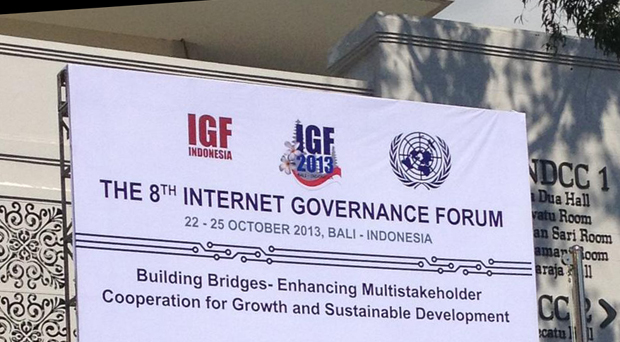
IGF 2013 was in Indonesia. This time Turkey plays host.
This year’s Internet Governance Forum (IGF) — a high-profile, United Nations-mandated annual conference on issues surrounding governance of the internet — is taking place in Istanbul, Turkey. But Yaman Akdeniz and Kerem Altiparmak, two renowned Turkish internet rights advocates, are boycotting it. Here they explain why.
Between May 2007 and July 2014 Turkey blocked access to approximately 48,000 websites subject to its controversial Internet Law No 5651. Although the law is ostensibly aimed to protect children from harmful content, from the very beginning it has been used to prevent adults’ access to information. In February amendments made to the legislation extended blocking provisions to include URL-based blocking of internet content. The same amendments compelled all internet service providers (ISPs) to be part of an association for access providers to centrally enforce blocking orders within four hours of receipt. It also introduced one-to-two-year data retention requirements for hosting companies and all ISPs. Furthermore, subject to new provisions, ISPs are required to take all necessary measures to block alternative access means such as proxy websites and other circumvention services including, possibly, VPN services. The amended version of the law also shields staff from the Presidency of Telecommunications and Communication (TIB) from prosecution if they commit crimes in their work for the telecoms authority.
In March access to both Twitter and YouTube was blocked arbitrarily and unlawfully by the TIB. With both blocking orders the government aimed to prevent the circulation of graft allegations ahead of local elections to be held on 30 March. During the blocking period, the authorities also ordered major ISPs to hijack Google and OpenDNS’s DNS servers, tampering with the DNS system to surveil communications, as well as to prevent users from circumventing blocking orders. Turkey’s constitutional court stated that the blocking of Twitter by TIB constituted a grave intervention on the freedom of expression of all Twitter users. Furthermore, in a 14-2 majority judgment, the court decided that the YouTube ban infringed on freedom of expression protected by the constitution.
However, despite these strong rulings, Twitter decided to implement its country withheld content policy for Turkey and started to block access to certain Turkish accounts and individual tweets. It was reported in June that Twitter complied with 44 out of 51 court decisions since they visited Ankara on 14 April, and the US-based social media platform continues to aid and assist Turkish authorities in censoring political content.
Facebook has also banned the pages of a number of alternative news sources, including Yüksekova Haber (Yuksekova News), Ötekilerin Postası (The Others’ Post), Yeni Özgür Politika (New Free Policy), Kürdi Müzik (Kurdish Music), and other groups related to Kurdish movements. The site has also been criticised for removing several pages related to the Peace and Democracy Party (BDP). Regardless of the above-mentioned constitutional court decisions, access to popular platforms such as Scribd, Last.fm, Metacafe, and Soundcloud is currently blocked from Turkey. Access to WordPress, DailyMotion, Vimeo and Google+ has in the past year been blocked temporarily by court or administrative orders. A number of alternative news websites that report on Kurdish issues, including Firat News, Azadiya Welat, Dengemed and Keditor, remain indefinitely blocked. In total it is estimated that 200 websites are banned indefinitely for their pro-Kurdish or left wing content.
Over the past year, many people have received suspended sentences and fines for their social media activity, usually on charges related to terrorism, blasphemy, or criticism of the state and its officials. In the crackdown following the Gezi Park protests of June 2013, dozens of people were detained over their social media posts. Criminal investigations and prosecutions were initiated subject to Articles 214 and 217 of the Turkish criminal code concerning incitement to commit a crime and disobey the law, as well as miscellaneous provisions of Law No 2911, on demonstrations and public meetings. In September 2013, pianist and composer Fazil Say was given a suspended sentence of 10 months and court supervision for insulting religious values in a series of tweets. Such criminal investigations and prosecutions have a chilling effect on all social media platform users.
In addition to widespread blocking of websites and content as well as criminal investigations and prosecutions to silence political speech, the Turkish authorities are also building surveillance infrastructure, which includes the deployment of deep packet inspection systems to monitor all forms of communications unlawfully.
Therefore, we have decided to boycott IGF 2014 hosted by Ministry of Transport, Maritime and Communications and coordinated by the Information and Technologies Authority. We also confirm that we will not be taking part in the IGF.
Yaman Akdeniz & Kerem Altiparmak
This edited version of the statement has been republished with permission from the authors. You can find the original and fully referenced statement here.