26 Jun 2014 | About Index, Campaigns, Statements, Ukraine
President Petro Poroshenko
11 Bankova street
01220 Kyiv
Ukraine
26 June 2014
Mr President,
We, the undersigned members and partners of the Human Rights House Network (HRHN), condemned in the strongest terms human rights violations which took place throughout Ukraine since 29 November 2013, and now call upon you to extend the mandate of the International Criminal Court investigations (taking into account events in Crimea and Eastern Ukraine) and to ratify the Rome Statute, in order to encourage such investigations, as an essential part of bringing peace to the country.
We welcome the repeated pledges of Ukrainian authorities to investigate all human rights violations committed since 29 November 2013 and hold those accountable, throughout the country and irrespective of which side the violator belongs to in the ongoing armed conflict in East Ukraine. The current situation of impunity must end.
The International Criminal Court is the only international body able to not only document grave human rights violations, amounting to core international crimes (war crimes, crimes against humanity, or genocide), but also investigate individuals responsible for such crimes. In order to restore peace and strengthen trust into State institutions, those responsible for such human rights violations have to be held accountable. We have for a long time called for a comprehensive reform of the judicial system in the country, which still remains to be initiated. Unfortunately, the national judicial system now shows its limits and in our view it is clear that it does not have the adequate knowledge, independence and resources to investigate all human rights violations since 29 November 2013 throughout the country.
Therefore, it is necessary to activate the international justice system, based on the complementarity principle, to guarantee that investigation into core international crimes committed by all parties in Ukraine, including by members of law enforcement and State agents, is credible and transparent, bringing those responsible to justice.
The Court’s jurisdiction should however not be limited in time, as it is now. On 17 April 2014, the Government of Ukraine indeed lodged a declaration under Article 12(3) of the Rome Statute accepting the jurisdiction of the ICC over crimes committed on its territory from 21 November 2013 to 22 February 2014.[3] We now call upon the Government to issue a declaration extending ICC jurisdiction from 21 November 2013 until the date of the entry into force of the Rome Statute for Ukraine.
We also call upon the authorities in Ukraine to accede to the Rome Statute as soon as possible. By doing this, Ukraine will make an important step to permanently depart from the culture of impunity that is prevailing.
In addition to the investigation into human rights violations, and action taken to end the use of violence in the country, Ukraine needs to undertake a massive reform of its legislation and practice in many fields. Ukraine’s law enforcement agencies have needed radical reform for a long time now: It is not about changing the names of institutions and units or about window-dressing, but about systemic changes, starting from the principles for establishing and structuring enforcement agencies, and ending with approaches to evaluating their performance.
We therefore support Ukraine’s efforts to propose a resolution at the United Nations Human Rights Council’s on-going session, although we deeply regret the draft resolution’s silence about the role of civil society in the country and the need for an investigation by the Court.
In Ukraine, human rights NGOs have proven their strong commitment to the rule of law and the respect of all human rights for all people, as well as their high level of professionalism and excellence. No country can build a sustainable future without full inclusion of civil society in decision-making, especially Ukraine in its present situation. Furthermore, States and leaders in all sectors of society must acknowledge publicly the important and legitimate role of human rights defenders in the promotion of human rights, democracy and rule of law, and avoid stigmatisation, as stated by the Human Rights Council resolution 22/6 of 21 March 2013.
Finally, we also welcome the reference in the draft resolution on Ukraine at the Human Rights Council to the extremely worrying human rights situation in Crimea and join Ukrainian authorities, the United Nations, the Organisation for Security and Cooperation in Europe, and other international voices, in condemning the enforcement of legislation of the Russian Federation on the territory of Crimea, at variance with the United Nations General Assembly resolution 68/262.
The role of civil society is essential in documenting human rights violations in Crimea and providing support to victims of such violations. A field mission has been launched by Ukrainian and Russian human rights defenders in co-operation, with which we expect full cooperation by all governmental agents in Ukraine.
On this background, we call upon you Mr President and the Government, with no further delay, to issue a declaration to extend the jurisdiction of the International Criminal Court from 21 November 2013 until the date of Ukraine’s accession to the Rome Statute either through appeal of the competent body of the Government or by adopting the Draft Law #4081a.
We further call upon you to:
- Take all necessary measures to support the work of human rights NGOs, journalists and bloggers and other media, including by investigating any threats, intimidation, harassment and violence against them, including arbitrary detentions, abductions, attacks and killings;
- Strongly and publicly acknowledge the important and legitimate role of human rights defenders in the promotion of human rights, democracy and the rule of law as an essential component of ensuring their protection; In line with United Nations Human Rights Council resolution 22/6 of 21 March 2013, paragraph 5
- Ensure that the reform process in the country, as well as all dialogue about the future of the country, is inclusive and transparent, giving space to civil society.
Sincerely,
Human Rights House Kyiv (on behalf of the following NGOs):
- Association of Ukrainian Human Rights Monitors on Law Enforcement (Association UMDPL)
- Centre for Civil Liberties
- Human Rights Information Center
- Institute of Mass Information
- Kharkiv Human Rights Protection Group
- La Strada Ukraine
- NGO “For Professional Journalism” – Svidomo
- Ukrainian Helsinki Human Rights Union
Education Human Rights House Chernihiv (on behalf of the following NGOs):
- Chernihiv Public Committee of Human Rights Protection
- Center of Humnistic Tehnologies “AHALAR”
- Center of Public Education “ALMENDA”
- Human Rights Center “Postup”
- Local Non-governmental Youth organizations М’АRТ
- Transcarpathian Public Center
- Ukrainian Helsinki Human Rights Union
Azerbaijan Human Rights House (on behalf of the following NGOs):
- Association for Protection of Women’s Rights – APWR
- Azerbaijan Human Rights Centre (AHRC)
- Institute for Peace and Democracy
- Human Rights Centre
- Legal Education Society
- Legal Protection and Awareness Society
- Media Rights Institute
- Public Union of Democracy Human Rights Resource Centre
- Women’s Association for Rational Development (WARD)
Barys Zvozskau Belarusian Human Rights House in exile, Vilnius
- Belarusian Association of Journalists
- Belarusian PEN Centre
- Belarusian Helsinki Committee
Human Rights House Belgrade (on behalf of the following NGOs):
- Belgrade Centre for Human Rights
- Helsinki Committee for Human Rights, Serbia
- Human Rights House Belgrade and Lawyers’ Committee for Human Rights –YUCOM
Human Rights House London (on behalf of the following NGOs):
- Index on Censorship
- Vivarta
Human Rights House Tbilisi (on behalf of the following NGOs):
- Article 42 of the Constitution
- Caucasian Centre for Human Rights and Conflict Studies (CAUCASIA)
- Georgian Centre for Psychosocial and Medical Rehabilitation of Torture Victims
- Media Institute
- Human Rights Center
- Union Sapari – Family Without Violence
Human Rights House Oslo (on behalf of the following NGOs):
- Human Rights House Foundation
- Norwegian Helsinki Committee
- Health and Human Rights Info
Human Rights House Voronezh (on behalf of the following NGOs):
- Civic Initiatives Development Centre
- Confederation of Free Labor
- For Ecological and Social Justice
- Free University
- Golos
- Interregional Trade Union of Literary Men
- Lawyers for labor rights
- Memorial
- Ms. Olga Gnezdilova
- Soldiers Mothers of Russia
- Voronezh Journalist Club
- Roronezh – Chernozemie
- Youth Human Rights Movement
Human Rights House Yerevan (on behalf of the following NGOs):
- Helsinki Citizens’ Assembly – Vanadzor
- Journalists’s Club Asparez
- Public Information and Need of Knowledge – PINK
Human Rights House Zagreb (on behalf of the following NGOs):
- APEO / UPIM Association for Promotion of Equal Opportunities for People with Disabilities
- B.a.B.e.
- CMS – Centre for Peace Studies
- Documenta – Centre for Dealing with the Past
- GOLJP – Civic Committee for Human Rights
- Svitanje – Association for Protection and Promotion of Mental Health
The Rafto House in Bergen – Norway (on behalf of the following NGOs):
The House of the Helsinki Foundation For Human Rights – Poland (on behalf of the following NGOs):
- Helsinki Foundation for Human Rights, Poland
Copies have been sent to:
- Mr Oleksandr Turchynov, Chairman of Verkhovna Rada
- Office of the Commissioner for Human Rights of the Council of Europe
- Private Office of the Secretary General of the Council of Europe
- Chairman of the Organisation for Security and Cooperation in Europe (OSCE)
- OSCE Special Monitoring Mission to Ukraine
- OSCE’s Office for Democratic Institutions and Human Rights
- United Nations Human Rights Monitoring Mission in Ukraine
- Delegation of the European Union in Ukraine
- Subcommittee on Human Rights of the European Parliament
- Diplomatic community in Kyiv, Brussels, Geneva and Strasbourg
- Various ministries of foreign affairs and parliamentary committees on foreign affairs
About the Human Rights House Network (www.humanrightshouse.org)
The Human Rights House Network (HRHN) unites 87 human rights NGOs joining forces in 18 independent Human Rights Houses in 13 countries in Western Balkans, Eastern Europe and South Caucasus, East and Horn of Africa, and Western Europe. HRHN’s mandate is to protect, empower and support human rights organisations locally and unite them in an international network of Human Rights Houses.
The Human Rights House Kyiv and the Education Human Rights House Chernihiv are members of HRHN. 10 independent Ukrainian human rights NGOs are members of both Human Rights Houses.
The Human Rights House Foundation (HRHF), based in Oslo (Norway) with an office in Geneva (Switzerland), is HRHN’s secretariat. HRHF is international partner of the South Caucasus Network of Human Rights Defenders and the emerging Balkan Network of Human Rights Defenders.
HRHF has consultative status with the United Nations and HRHN has participatory status with the Council of Europe.
26 Jun 2014 | Azerbaijan, Azerbaijan News, News and features
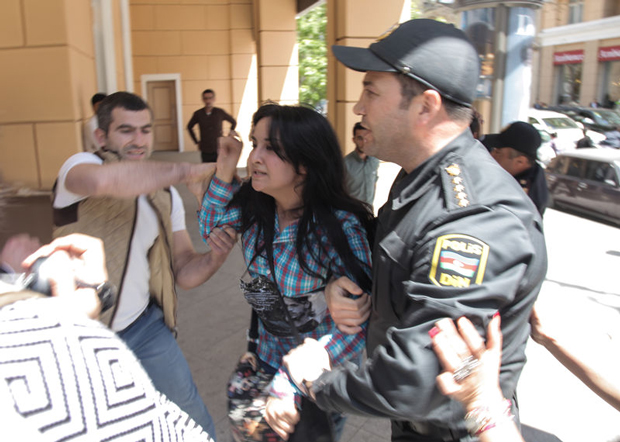
The Baku Court of Grave Crimes announced the verdict for the NIDA movement activists in May 2014. The human rights defenders Rashadat Akhundov, Zaur Gurbanly and Ilkin Rustamzadeh to 8 years’ imprisonment, Rashad Hasanov and Mamed Azizov – to 7.5 years. Protesters were detained and victimised by police. (Photo: Aziz Karimov / Demotix)
In a bleakly comic turn at the beginning of Ilham Aliyev’s address to the Parliamentary Assembly of the Council of Europe this week, Assembly president Anne Brasseur asked press photographers to leave the chamber and reminded those present that they were not permitted to vocalise their approval or disapproval during the Azerbaijani dictator’s stand. It appeared that Brasseur hadn’t quite meant what she said, as in the end photographers at the front of the room were merely required to move their tripods to ensure everyone in the room could see Aliyev as he spoke.
Aliyev’s speech was given to mark the Azerbaijan’s taking up of the chair of the Council of Europe’s Committee of Ministers last month. And what a speech it was!
The man who promises to “turn initiatives into reality” (still no idea) told of Azerbaijan’s enormous progress in all fields, not just oil fields. He spoke of the country’s “very positive atmosphere” and listed the country’s great freedoms: freedom of political activity, freedom of expression, freedom of media… Azerbaijan was proud of these freedoms, he said. Azerbaijan knew that an uncensored internet and independent newspapers were important for democracy.
It was a lovely speech, and also one that contained barely a word of truth beyond the conjunctions. Aliyev may as well have praised the nation’s Quidditch team for defeating Ravenclaw on penalties at the World Cup. He could have told us about his new motorcar, and his adventures with Ratty, Mole and Badger, and been more believable.
Watching Aliyev, the only time one got the sense he even believed what he was saying himself was when discussing the disputed territory of Nagorno-Karabakh, and even then he was only drily insisting that the regions “geographical toponyms” (place names?) were Azeri in origin: All Your Geographical Toponyms Are Belong To Us, so to speak.
The truth about Azerbaijan is quite different from the picture painted by its president this week. As Human Rights Watch pointed out ahead of the Council of Europe speech, “In the past two years, Azerbaijani authorities have brought or threatened unfounded criminal charges against at least 40 political activists, journalists, bloggers, and human rights defenders, most of whom are behind bars.” Search for Azerbaijan stories on Index, and you will find more details of those arrests and abuses.
And this isn’t exactly obscure knowledge. People know three things about Azerbaijan: it has a lot of gas and oil; it takes Eurovision very seriously; and it has a poor human rights record. After his speech, Aliyev was confronted by Michael McNamara of the CoE socialist group, who quoted Amnesty’s statistic that there are currently 19 political prisoners in Azerbaijan. Not so, said Aliyev. There are no political prisoners in Azerbaijan. The people who came up with these statistics were lying. There was a programme of “deliberate provocation” against Azerbaijan — though it was unspecified who was leading this programme.
Aliyev swore that this plot to undermine Azerbaijan would fail.
The Azerbaijani president is not alone in his capability for bare-faced falsehood. It’s a specific strain of Soviet and post-Soviet behaviour, learned from the Communist Party and the KGB. If the leader says something, it is true, no matter what the evidence to the contrary. There are no political prisoners in Azerbaijan, says Aliyev, and we encourage a free media because it is important to our democracy; Ukraine has been taken over by fascists, says Vladimir Putin, and Russia has no choice but to fight them. There is no point in putting on a play about depression in Belarus, an Alexander Lukashenko apparatchik tells the Belarus Free Theatre, because there is no such thing as depression in Belarus.
“So what?” you may say. “Politicians and institutions lie.” And you’d be right. But this is a form of lying that goes far beyond “I was perfectly within my rights to claim those expenses”/”I did not have sex with that woman”. Political lies in functioning democracies tend to have to do with cover ups of personal or institutional failings. In an authoritarian society, with power utterly concentrated to the leader and his cadre, there is no such thing as an isolated failure. As a result, every aspect of life must be spun. All triumphs belong to the leader, all criticisms are propaganda, all failures sabotage. When there is no balance of power, is there really an objective truth? When, for example, the dictator Lukashenko told a journalist that journalist Irina Khalip, under house arrest, could leave Belarus any time she wanted, was that actually true? Was it true the moment he said it? Did it become true after he said it? And did it remain true?
This state of things raises a question for those of us seeking to better the lot of people living under regimes such as Belarus and Azerbaijan: can we pounce on the moments when autocrats declare as fact something we know to be untrue, cling on until they actually make it true? Or does this merely confirm the idea that truth is whatever their whim makes it?
This article was posted on June 26, 2014 at indexoncensorship.org
20 Jun 2014 | Digital Freedom, News and features, Russia
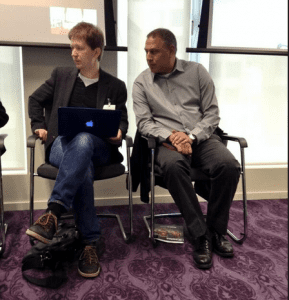
@AndreiSoldatov and @cyberrights at the @IndexCensorship Brussels event on Press Freedom in Russia Turkey Azerbaijan. Photo: Ricardo Gutiérrez
On Thursday, Index hosted a discussion with five leading media experts from Turkey, Russia, and Azerbaijan. As journalists, bloggers, entrepreneurs and campaigners, they experience first-hand how censorship – online and off – is being ramped up in their countries, and they argue that their stories are still not being sufficiently heard.
Turkey’s Yaman Akdeniz and Amberin Zaman, Russia’s Andrei Soldatov and Anton Nossik, and Azeri blogger Arzu Geybulla shared shocking stories about journalists harassed in government-led smear campaigns, the arrests on spurious criminal charges of those who speak openly on social media, and the growing role of governments in blocking free expression online.
“The internet is becoming less and less independent of government interference,” Nossik told the Brussels audience.
Index works with writers – including authors, journalists and bloggers – and artists globally to help them tell a wider world about the threats they face. We are a platform that allows individuals to speak for themselves, and fights for those who cannot.
In the first article from one of our event speakers, Andrei Soldatov assesses the state of online freedom in Russia:
Since November 2012, we’ve been living in a country with the internet censored extensively by a nationwide system of filtering.
This system has been constantly updated ever since. Now we have four official blacklists of banned websites and pages: the first one is to deal with sites deemed extremist; the second is about sites blocked because of child pornography, suicide and drugs; the third consists of sites with copyright problems; the fourth, the most recent one, was created in February and lists the sites blocked without a court order because they call for non-sanctioned protests. There is also an unofficial fifth blacklist aimed not at sites but at hosting companies, based abroad, which have proven themselves not very cooperative with Russian authorities.
Technically, the internet filtering system in Russia is not very sophisticated. Thousands of sites were blocked by mistake, while if you want to access a blocked site you can do that using circumvention tools or even very basic things like Google translate.
At the same time very few people were sent to jail for posting critical things online, and relatively few new media were put under direct government pressure.
But surprisingly, freedom of expression on the internet in Russia has been hugely affected: users have become cautious in their comments, and internet companies, the largest in the country, even when invited to talk to Putin, are so frightened that they failed to raise the issue of regulation at the meeting.
The beauty of the Russian approach is that it doesn’t need to be technically sophisticated to be efficient. It also doesn’t need mass repression against journalists or activists.
So why is that?
Basically, the Russian approach is all about instigating self-censorship. To do this, you need to draft the legislation as broad as possible, to have the restrictions constantly expanded — like the recent law which requires bloggers with more than 3.000 followers to be registered — and companies, internet service providers, NGOs and media will rush to you to be consulted and told what’s allowed. You should also show that you don’t hesitate to block entire services like YouTube – and companies will come to you suggesting technical solutions, as happened with DPI (deep packet inspection). It helps the government to shift the task of developing a technical solution to business, as well as costs.
You also need to encourage pro-government activists to attack the most vocal critics, to launch websites with list of so-called national traitors, and then to have Vladimir Putin himself to use this very term in a speech.
All that sends a very strong message. And as a result, journalists will be fired for critical reporting from Ukraine by media owners, not by the government; the largest internet companies will seek private meetings with Putin, and users of social networks will become more cautious in their comments.
We have seen this before – the very same approach was used against traditional media in the 2000s. What made the situation on the internet special is that the government found a way to shift the task of providing a technical solution for censorship to companies, including the global ones, and make the companies pay for the system. The way global platforms seem to respond to that is not very impressive. Localisation cannot be a solution because it helps to localise the problems of censorship. Now the Russian search engine Yandex presents two different maps of Ukraine, with and without Crimea, for the Ukrainian and Russian audiences respectively.
The biggest problem with this approach is that it provokes governments to put more pressure on global platforms. One day Twitter was heavily criticised by a Russian official in a pro-Kremlin paper who threatened to block the platform completely. The next day Twitter rushed to block an account of Pravy Sector, one of the most-anti Russian political parties in Ukraine, and blocked it for Russian users.
This article was published on June 20, 2014 at indexoncensorship.org
19 Jun 2014 | Azerbaijan Statements, Campaigns, Digital Freedom, Digital Freedom Statements
The following is a transcript of a joint oral statement, led by ARTICLE 19 and supported by several IFEX members, that was read aloud today, 19 June 2014, at the 26th UN Human Rights Council session in Geneva:
Thank you Mr. President,
Two years ago this Council affirmed by consensus that “the same rights that people have offline must also be protected online, in particular freedom of expression”.
In 2014, the outcome document of Net-Mundial in Brazil recognised the vital role of the internet to achieve the full realisation of sustainable development goals. 31 UN Special Rapporteurs recently affirmed that guaranteeing the free-flow of information online ensures transparency and participation in decision-making, enhancing accountability and the effectiveness of development outcomes.
Development and social inclusion relies on the internet remaining a global resource, managed in the public interest as a democratic, free and pluralistic platform. States must promote and facilitate universal, equitable, affordable and high-quality Internet access for all people on the basis of human rights and net-neutrality, including during times of unrest.
The blocking of communications, such as the shutdown of social media in Malaysia, Turkey, and Venezuela is a violation of freedom of expression and must be condemned. Dissent online must be protected. We deplore the detention of Sombat Boonngamanong in Thailand, who faces up to 14 years imprisonment for using social media to urge peaceful resistance to the recent military coup in the form of a three-finger salute.
One year after the Snowden revelations, this Council must recognise that trust in the internet is conditional on respect for the rights to freedom of expression and privacy online, regardless of users’ nationality or location. Any mass (or dragnet) surveillance, which comprises collection, processing and interception of all forms of communication, is inherently disproportionate and a violation of fundamental human rights.
The targeted interception and collection of personal data must be conducted in accordance with international human rights law, as set out in the necessary and proportionate principles. Critical and intermediate infrastructure must not be tampered with for this end, nor should any system, protocol or standard be weakened to facilitate interception or decryption of data.
ARTICLE 19 urges the Human Rights Council to take action to comprehensively address these challenges.
Thank you.
Signed,
ActiveWatch – Media Monitoring Agency
Africa Freedom of Information Centre
Albanian Media Institute
Arabic Network for Human Rights Information
ARTICLE 19
Association of Caribbean Media Workers
Bahrain Center for Human Rights
Cairo Institute for Human Rights Studies
Cambodian Center for Human Rights
Canadian Journalists for Free Expression
Center for Independent Journalism – Romania
Center for Media Freedom and Responsibility
Egyptian Organization for Human Rights
Foro de Periodismo Argentino
Foundation for Press Freedom – FLIP
Freedom Forum
Human Rights Watch
Index on Censorship
Institute for the Studies on Free Flow of Information
International Press Institute
Maharat Foundation
Media, Entertainment and Arts Alliance
Media Institute of Southern Africa
Media Rights Agenda
National Union of Somali Journalists
Norwegian PEN
Pacific Islands News Association
Pakistan Press Foundation
PEN Canada
Privacy International
Reporters Without Borders
Southeast Asian Press Alliance
South East European Network for Professionalization of Media
West African Journalists Association
World Association of Community Radio Broadcasters – AMARC
Access
Alternative Informatics
Asian Forum for Human Rights and Development (FORUM-ASIA)
Association for Progressive Communications (APC)
Bangladesh Internet Governance Forum
Bangladesh NGOs Network for Radio and Communications (BNNRC)
Barys Zvozskau Belarusian Human Rights House
Big Brother Watch
Bir Duino (Kyrgyzstan)
Bits of Freedom
Bolo Bhi Pakistan
Bytes For All
Center for e-parliament Research
Centre for Internet & Society
Center for National and International Studies, Azerbaijan
Center for the Development of Democracy and Human Rights, Russia
Chaos Computer Club
CIVICUS: World Alliance for Citizen Participation
Digital Rights Foundation, Pakistan
Electronic Privacy Information Center
English Pen
European Centre for Not-for-Profit Law (ECNL)
Helsinki Citizens’ Assembly – Vanadzor
Human Rights Monitoring Institute, Lithuania
International Centre for Not-for-Profit Law (ICNL)
International Federation for Human Rights (FIDH)
Kazakhstan International Bureau for Human Rights and Rule of Law
Kenya Human Rights Commission
Liberty
OpenMedia.org
Open Net Korea
Open Rights Group
Panos Institute West Africa
Samuelson-Glushko Canadian Internet Policy & Public Interest Clinic (CIPPIC)
Simon Davies, publisher of “Privacy Surgeon”
Thai Netizen Network
Zimbabwe Human Rights Forum