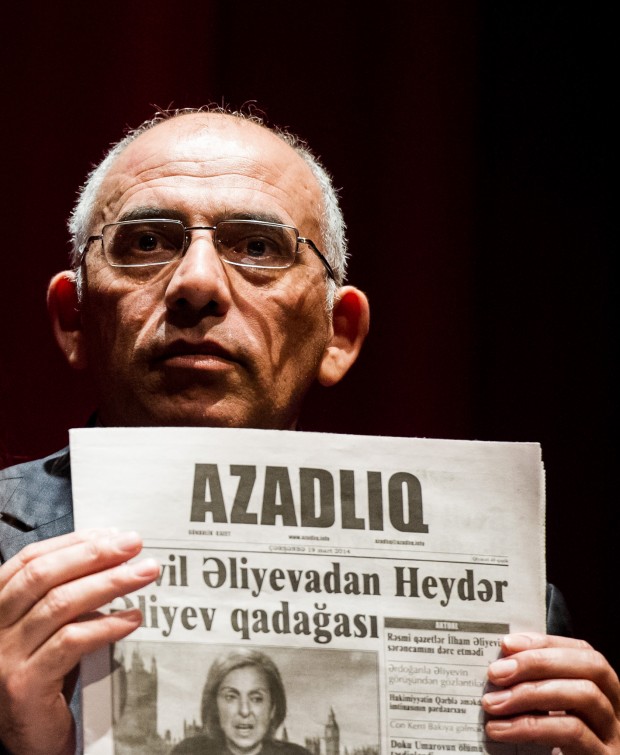
Rahim Haciyev, deputy editor-in-chief of Azerbaijani newspaper Azadliq (Photo: Alex Brenner for Index on Censorship)
One of the few remaining independent media outlets in Azerbaijan, the newspaper Azadliq has continued to report on government corruption and cronyism in spite of an increasing financial squeeze enforced by the authorities.
The country likes to present itself as a modern democracy, but it is widely recognised as an authoritarian regime where opposition is often brutally cracked down on and critical voices silenced. In this environment, Azadliq works to hold the ruling Aliyev family, and the rest of the powerful elite in the country to account. The latest attacks on the paper came hot on the heels of the country’s 2013 presidential election, where Ilham Aliyev was reelected in a vote labelled flawed by the OSCE.
The paper has been been the target of defamation suits that have resulted in £52,000 in fines. Courts found Azadliq guilty of “damaging” the business reputation of Kabira Mamedova, director of the Baku-based Bina shopping centre, and Taghi Ahmadov, CEO of the Baku Metro, after the paper published articles critical of their activities.
The paper’s bank accounts have been frozen since 25 October, and Gasid, the state-owned press distribution company, has not been transferring payments that reflect the paper’s sales; according to Azadliq’s latest calculations, Gasid now owes about £44,000.
Azadliq’s journalists also face continuous threats. On 4 October 2013, Azadliq reporter Ramin Deko was part of a group of journalists assaulted by a pro-government mob while covering an opposition rally in the central Azerbaijan town of Sabirabad. He also alleges he was abducted and beaten up on 3 and 4 April 2011 by law enforcement bodies. While he was illegally detained, he said he was told to stop writing critical articles and to change his workplace to a pro-government newspaper.
Despite this, Azadliq refuses to back down, and continues to cover the activities of the Azerbaijan corrupt elite. “We play a significant role in providing people with alternative information. Our staff are underpaid, overworked, and yet are fully committed to their work”, said deputy editor-in-chief and acting editor Rahim Haciyev.
Haciyev, who joined the paper in 2001, talked to Andrei Aliaksandrau about why his work at Azadliq is so important.
Index: Your publication faces constant pressure from the authorities. Have you ever thought of leaving for a safer job?
Haciyev: No, this is my work, and it is not only a job, it is my form of expression. The fight for free speech is sacred for me. This is the way of opposing lawlessness and tyranny, and working for Azadliq provides me with a possibility to continue this fight for what I believe in.
Index: What is the wider media landscape in Azerbaijan? And how does this fit into the wider political and social situation?
Haciyev: Repressive steps taken by the government of the country have led to significant restrictions of media freedom. Today there is a real threat of independent press in Azerbaijan totally disappearing. The country lives under a strict authoritarian rule. Activists of political opposition, civil society organisations and independent journalists face constant pressure. There are more than a hundred political prisoners behind bars in Azerbaijan, including journalists.
Index: What is your view on the Snowden/Greenwald revelations about mass surveillance?
Haciyev: Our newspaper covered the story. I think a government should keep its secrets – but it is the role of the press to inform the public and share the information they gather. And any kind of pressure exerted on the media is nothing but a violation of the freedom of expression.
Index: Technologies have changed the media market globally. Do you think newspapers are still relevant?
Haciyev: I am sure printed newspapers will keep their relevance for a long time. Despite the development of the internet, we can still see great demand for newspapers among the audience. For us,our website is getting more and more popular, and the circulation of the printed newspaper is going down – but it is not because people are losing their interest in the printed publication, merely because of all the restrictions and pressure our authorities put on us.
Music Freedom Day is a global collaboration to raise awareness of the challenges many musicians face around the world in creating their music. In 2013, 19 musicians were killed, seven abducted and 18 spent time in jail for using their right to free speech to express themselves through music, according to the human rights organisation Freemuse.
Mali is one such country where musicians have faced persecution and censorship for their work.
Documentary filmmaker Johanna Schwartz wrote for Index on Censorship magazine on the censorship and persecution that musicians in Mali have faced from Islamists, with musician Fadiamata Walet Oumar.
In the article they highlighted how music was being driven out of the country, with even those with musical ringtones on their mobile phones facing crackdowns. Many musicians fled Mali during the worst excesses of persecution, as the article charts. Schwartz is an award-winning documentary maker, and she is giving Index readers an exclusive preview of her documentary They Will Have To Kill Us First.
Collectively, the European Union of 28 member states has an important role to play in the promotion of freedom of expression in the world. Firstly, as the world’s largest economic trading block with 500 million people that accounts for about a quarter of total global economic output, it still has significant economic power. Secondly, it is one of the world’s largest “values block” with a collective commitment to the Universal Declaration of Human Rights, the International Covenant on Civil and Political Rights and perhaps more significantly, the European Convention on Human Rights. The Convention is still one of the leading supranational human rights treaties, with the possibility of enforcement and redress. Finally, Europe accounts for two of the five seats on the UN Security Council (Britain and France), so has a crucial place in the global security framework. The EU itself has limited foreign policy and security powers (although these powers have been enhanced in recent years), leaving significant importance to the foreign policies of the member states. Where the EU acts with a common approach it has leverage to help promote and defend freedom of expression globally.
How the European Union supports freedom of expression abroad
The European Union has a number of instruments and institutions at its disposal to promote freedom of expression in the wider world, including its place as an observer at international fora, its bilateral and regional agreements, the European External Action Service (EEAS) and geographic policies and instruments including the European Neighbourhood Policy (ENP) and the European Neighbouring and Partnership Instrument (ENPI). The EU places human rights in its trade and aid agreements with third party countries and has over 30 stand-alone human rights dialogues. The EU also provides financial support for freedom of expression through the European Development Fund (EDF), the Development Co-operation Instrument (DCI), the European Instrument for democracy and human rights (EIDHR) and the European Endowment for Democracy (EED). The EU now also has a Special Representative for Human Rights. Since 1999, the EU has published an annual report on human rights and democracy in the world. The latest report, adopted in June 2012, contains a special section on freedom of expression, including freedom of expression and “new media”. It recalls the EU’s commitment to “fight for the respect of freedom of expression and to guarantee that pluralism of the media is respected” and emphasises the EU’s support to free expression on the internet.
The European Union has two mechanisms to financially support freedom of expression globally: the European Instrument for democracy and human rights (EIDHR) and the European Endowment for Democracy (EED). The latter was specially created after the Arab Spring in order to resolve specific criticism of the EIDHR: that it didn’t support political parties, non-registered NGOs and trade unions and could not react quickly to events on the ground. The EED is funded by, but is autonomous from, the European Commission, with support from member states and Switzerland. The aims of the EED, to provide rapid and flexible funding for pro-democratic activists in authoritarian states and democratic transitions, is potentially a “paradigm shift” according to experts that will have to overcome a number of challenges, in particular a hesitation towards funding political parties and the most active and confrontational of human rights activists. The EU also engages with the UN on human rights issues at the Human Rights Council (HRC) and in the 3rd Committee of the General Assembly. The EU, as an observer along with its member states, is one of the more active defenders of freedom of expression in the HRC. Promoting and protecting freedom of expression was one of the EU’s priorities for the 67th Session of the UN General Assembly (September 2012-2013). The European Union was also instrumental in the adoption of a resolution on the “Safety of Journalists” (drafted by Austria) in September 2012. The European Union is most effective at the HRC where there is a clear consensus among member states within the Union . Where there is not, for instance on the issue of blasphemy laws, the Union has been less effective at promoting freedom of expression.
The EU and its neighbourhood
The EU has had mixed success in promoting freedom of expression in its near neighbourhood. Enlargement has clearly been one of the European Union’s most effective foreign policy tools. Enlargement has had a substantial impact both on the candidate countries’ transition to democracy and respect for human rights. With enlargement slowing, the leverage the EU has on its neighbourhood is under pressure. Alongside enlargement, the EU engages with a number of foreign policy strategies in its neighbourhood, including the Eastern Partnership and the partnership for democracy and shared prosperity with the southern Mediterranean. This section will look at the effectiveness of these policies and where the EU can have influence.
The EU and freedom of expression in its eastern neighbourhood
Europe’s eastern neighbourhood is home to some of the least free places for freedom of expression. The collapse of the former Soviet Union and the enlargement of the European Union has significantly improved human rights in eastern Europe. There is a marked difference between the leverage the European Union has on countries where enlargement is a real prospect and the wider eastern neighbourhood, where it is not, in particular for Russia and Central Asia. In these countries, the EU’s influence is more marginal. Enlargement has clearly had a substantial impact both on the candidate countries’ transition to democracy and their respect for human rights because since the Treaty of Amsterdam, respect for human rights has been a condition of accession to the EU. In 1997, the Copenhagen criteria were outlined in priorities that became “accession partnerships” adopted by the EU and which mapped out the criteria for admission to the EU. They related in particular, to freedom of expression issues that needed to be rectified. With the enlargement process slowing since the “big bang” in 2004, and countries such as Ukraine and Moldova having no realistic prospect of membership regardless of their human rights record, the influence of the EU is waning in the wider eastern neighbourhood.
After enlargement, the Eastern Partnership is the primary foreign policy tool of the European Union in this region. Launched in 2009, the initiative derives from the EU’s Neighbourhood Policy (ENP), which is specific about the importance of democracy, the rule of law and respect for human rights. In this region, the partnership covers Armenia, Azerbaijan, Belarus, Georgia, Moldova and Ukraine. Freedom of expression has been raised consistently during human rights dialogues with these six states and in the accompanying Civil Society Forum. The Civil Society Forum has also been useful in helping to coordinate the EU’s efforts in supporting civil society in this region. Although it has never been the main aim of the Eastern Partnership to promote freedom of expression, it has had variable success in promoting this right with concrete but limited achievements in Belarus, the Ukraine, Georgia and Moldova; with a more ineffectual role being seen in Azerbaijan.
In recent years, since the increased input of the EEAS in the ENP, the policy has become more markedly political, with a greater emphasis on democratisation and human rights including freedom of expression after a slow start. In particular, freedom of expression was raised as a focus for the ENP after its review in 2010-2011. This is a welcome development, in marked contrast to the technical reports of previous years. This also echoes the increased political pressure from member states that have been more public in their condemnation of human rights violations, in particular regarding Belarus. Belarus is one Eastern Partnership country where the EU has exerted a limited amount of influence. The EU enhanced its pressure on the country after the post-presidential election clampdown beginning in December 2010, employing targeted sanctions and increasing support to civil society. This has arguably helped secure the release of some of the political prisoners the regime detained. Yet the lack of a strong sense of strategy and unity within the Union has hampered this new pressure to deliver more concrete results. Likewise, the EU’s position on Ukraine has been set back by internal divisions, even though the EU’s negotiations on the Association Agreement included specific reference to freedom of expression.
In Azerbaijan, the EU’s strategic oil and gas interests have blunted criticism of the country’s poor freedom of expression record. Azerbaijan holds over 89 political prisoners, significantly more than in Belarus, yet the EU’s institutions, individual member states and European politicians have failed to be vocal about these detentions, or other freedom of expression violations. In the EU’s wider neighbourhood outside the Eastern Partnership, the EU has taken a less strategic approach and accordingly has been less successful in either raising freedom of expression violations or helping to prevent them.
The European Union’s relationship with Russia has not been coherent on freedom of expression violations. While the institutions of the EU have criticised specific freedom of expression violations, such as the Pussy Riot sentencing, they were slow to criticise more sustained attacks on free speech such as the clampdown on civil society and the inspections of NGOs using the new Foreign Agents Law. The progress report of EU-Russia Dialogue for Modernisation fails to mention any specific freedom of expression violations in Russia. The EU has also limited its financial involvement in supporting freedom of expression in Russia, unlike in other post-Soviet states. The EU is not united on this criticism: individual European Union member states such as Sweden and the UK are more sustained in their criticisms of Russia’s free speech violations, whereas other member states such as Germany tend to be less critical. It is argued that Russia’s powerful economic interests have facilitated a significant lobbying operation including former politicians that works to reduce criticism of Russia’s freedom of expression violations.
In this region, the European Union’s protection of freedom of expression is weakest in Central Asia. While the EU has human rights dialogues with Kazakhstan, Kyrgyzstan, Tajikistan, Turkmenistan and Uzbekistan, it has not acted strategically to protect freedom of expression in these countries. The EU dramatically reduced its leverage in Uzbekistan in 2009 by relaxing arms sanctions with little in return from the Uzbek authorities, who continue to fail to abide by international human rights standards. Arbitrary arrests, beatings and torture at the hands of the security services, as well as unfair trials of the regime’s critics are all commonplace. The European Parliament’s special rapporteur report of November 2012, took a tough stance on human rights in Kazakhstan, making partnership conditional on respect for Article 10 rights. But, this was undermined by High Representative Baroness Ashton’s visit to the country in November 2012, where she failed to raise human rights violations at all.
This lack of willingness to broach freedom of expression issues continued during Baroness Ashton’s first official visit to four of the five Central Asian republics: Kyrgyzstan, Uzbekistan, Tajikistan and Kazakhstan. In Kyrgyzstan she additionally attended an EU-Central Asia ministerial meeting, where the Turkmen government (one of the top five most restrictive countries in the world for freedom of expression) was represented. Baroness Ashton’s lack of vocal support for human rights was condemned by local NGOs and international watchdogs.
Members and partners of the Human Rights House Network condemn in the strongest terms the excessive use of force by Ukrainian authorities to disperse peaceful demonstrations, following the refusal by Ukraine to sign the European Union association agreement.
Tuesday, 03 December 2013, by Human Rights House Foundation (HRHF)
In their joint letter [download on the right], member and partner NGOs of the Human Rights House Network (HRHN) also call upon President Viktor Yanukovych to immediately revoke measures aiming at using force against protestors and release all protestors and journalists detained, and ensure that relatives of injured and arrested protestors and journalists were informed of their situation.
The 29-30 November 2013 demonstration on Maidan Nezalezhnosti, Kyiv’s Independence Square, essentially of students and activists, was peaceful until the police used excessive force to disperse it. The NGOs call upon Ukrainian authorities to undertake an independent and transparent investigation on the unlawful dispersal of the peaceful protest, and bring those responsible to justice, as requested by one of the members of the Human Rights House Kyiv, the Ukrainian Helsinki Human Rights Union.
Another member of the Human Rights House Kyiv, the Information Centre for Human Rights reports that 52 journalists were injured by police forces or by stones and grenades thrown by violent elements. The Centre for Civil Liberties, also a member of the Human Rights House Kyiv, is coordinating the legal aid “EuroMaidanSOS” since Sunday night. The Centre has received around 200 phone calls during the weekend. So far, they have registered 75 complaints related to arrests, beatings and people who were temporarily taken away from the 29-30 November demonstration. This does not include clashes with the police in front of the Presidential Administration Sunday 1 December. The NGOs call upon Ukrainian authorities to immediately and unconditionally drop all charges against peaceful protestors and journalists, release and compensate all of them, and ensure that they can carry out their work.
According to “EuroMaidanSOS”, 14 people (youth activists and students apparently) have disappeared, since the police intervention on 29-30 November 2013 at Maidan Nezalezhnosti. “EuroMaidanSOS” and human rights groups have called hospitals but not found information allowing them to trace back to the disappeared people. The NGOs call upon President Viktor Yanukovych to ensure that law enforcement authorities inform relatives of injured and arrested protestors of their situation. Ukraine has the obligation to protect anybody from being a victim of an enforced disappearance, even more so when injured or arrested by law enforcement authorities at a peaceful protest.
In their joint letter, the NGOs call upon you President Viktor Yanukovych to follow advice from Ukrainian civil society, including by:
Taking concrete measures aiming at stopping the use of force by police to disperse protestors, even if they occupy governmental buildings, and to publicly acknowledge the right of anybody to peacefully protest and the duty of the State security forces to protect peaceful protestors;[1]
Undertaking an independent and transparent investigation on the unlawful dispersal of the peaceful protest of 29-30 November 2013, and ensure that those responsible are brought to justice and do not enjoy impunity; Immediately and unconditionally dropping all charges against peaceful protestors and journalists, release and compensate all of them; Ensuring that law enforcement authorities inform relatives of injured and arrested protestors of their situation, protecting everybody from being a victim of an enforced disappearance, including by immediately investigating the cases of 14 people disappeared following the police intervention on 29-30 November 2013 at Maidan Nezalezhnosti;[2]
Ensuring that human rights NGOs and journalists are able to monitor assemblies and report on police violence without fearing retaliation, and that human rights defenders and activists are not charged for participating in peaceful protests.[3]
Signed by:
Human Rights House Kyiv (on behalf of the following NGOs):
Ukrainian Legal Aid Foundation
Ukrainian Helsinki Human rights Union
Human Rights Information Center
Association of Ukrainian Human Rights Monitors on Law Enforcement (Association UMDPL)
Azerbaijan Human Rights House (on behalf of the following NGOs):
Women’s Association for Rational Development
Institute for Reporters’ Freedom and Safety
Society for Humanitarian Research
Media Rights Institute
Association for the Protection of Women’s Rights in Azerbaijan after D. Aliyeva
Legal Education Society
Azerbaijan Lawyers Association
Barys Zvozskau Belarusian Human Rights House in exile, Vilnius
Human Rights House Belgrade (on behalf of the following NGOs):
Helsinki Committee for Human Rights in Serbia
Lawyers Committee for Human Rights (YUCOM)
Belgrade Centre for Human Rights
Human Rights House Sarajevo (on behalf of the following NGOs):
Association Transitional Justice Accountability and Remembrance in Bosnia and Herzegovina
Helsinki Committee for Human Rights in Bosnia and Herzegovina
Renesansa
Serbian Civic Council
Human Rights House Tbilisi (on behalf of the following NGOs):
Article 42 of the Constitution
Caucasian Centre for Human Rights and Conflict Studies
Georgian Centre for Psychosocial and Medical Rehabilitation of Torture Victims
Human Rights Centre
Union Sapari – Family without Violence
Human Rights House Oslo (on behalf of the following NGOs):
Human Rights House Foundation
Human Rights House Voronezh (on behalf of the following NGOs):
Charitable Foundation
Civic Initiatives Development Center
Confederation of Free Labor
For Ecological and Social Justice
Free University
Golos
Interregional Trade Union of Literary Men
Lawyers for labor rights
Memorial
Ms. Olga Gnezdilova
Soldiers Mothers of Russia
Voronezh Journalist Club
Voronezh-Chernozemie
Youth Human Rights Movement
Human Rights House Yerevan (on behalf of the following NGOs):
Helsinki Citizens’ Assembly – Vanadzor
Socioscope
Jurists against Torture
Human Rights House Zagreb (on behalf of the following NGOs):
Association for Promotion of Equal Opportunities for People with Disabilities
B.a.B.e. – Be active, Be emancipated
Centre for Peace Studies
Documenta – Centre for Dealing with the Past
GOLJP – Civic Committee for Human Rights
Svitanje – Association for Protection and Promotion of Mental Health
Election Monitoring and Education Center, Azerbaijan