15 May 2013 | In the News
GLOBAL
Challenging mainstream narratives with social media
A lot has been said about the impact of social media on the dissemination of news and the future of journalism. Opinions seem to span from believing Twitter and Facebook hold the power to bring down dictatorships, to despairing at the space it gives to armchair analysis and knee jerk reactions. One thing can be agreed upon: readers, listeners and viewers now have access to a platform to express themselves and challenge the mainstream narrative of events, Milana Knezevic writes. (Index on Censorship)
AZERBAIJAN
Azerbaijani Parliament Passes Controversial Internet Libel Law
Azerbaijan’s parliament has legalized tighter Internet controls in a move the country’s opposition groups fear could be used to curb online dissent. (Radio Liberty)
EGYPT
Egyptian artists declare war on sexual harassment
Since the fall of President Hosni Mubarak two years ago, artists have been active in breaking Egypt’s age-old taboos around sexual violence, especially since sexual harassment has been on the rise. Melody Patry reports. (Index on Censorship)
ISRAEL
Free Speech Under Attack in Israel
The Israeli Ambassador to London, Daniel Taub, entirely misses the point in his comments on Professor Stephen Hawking’s decision to pull out of a conference in Jerusalem as a protest at Israel’s treatment of Palestinians. (Shifting Grounds)
RUSSIA
Pussy Riot Doc Defends Free Speech But Skips the Messy Details
At the culmination of the documentary Pussy Riot: A Punk Prayer, band member Maria Alyokhina tells the court that “this trial is not just an evil, grotesque mask, it is the face that the government wears when speaking to the people of our country.” (The Nation)
RWANDA
Rwanda’s Media Law Opens Gates To Self-Regulation For Journalists
Contrary to critics alleging Rwanda on violation of Human rights, democracy and freedom of speech; the country’s recently adopted law on media regulation seems to shame such accusations and it rather demonstrates maturity in the said fields. (News of Rwanda)
UNITED STATES
Judge dismisses lawsuit, says no free-speech rights violated at Detroit-area Arab festival
A judge says free-speech rights weren’t violated when police officers asked Christian demonstrators to leave an Arab festival in Dearborn last year. (The Republic)
Lawyer says law against encouraging suicide violates free speech
The Minnesota Supreme Court is considering an appeal by a nurse who says his conviction for advising two people to kill themselves is unconstitutional. (UPI.com
Does Free Speech Protect Your Right to Criticize Religion? Duh!
I’m a lawyer by training. It’s one of the most frustrating things I’ve ever done because now I can recognize all the things otherwise smart people get wrong about the Constitution. And, boy howdy, there are a lot of people who misunderstand the Constitution.(Care2)
Facebook: A ‘Like’ is free speech for Hampton case
When a wrongful termination lawsuit involving six former employees of Hampton Sheriff B.J. Roberts goes before a federal appellate court on Thursday, those employees will have a prominent backer in their corner: Facebook. (The Daily Press)
6 May 2013 | United Kingdom
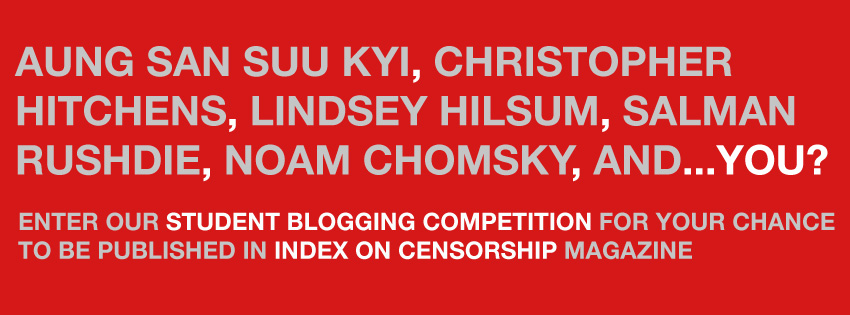
Are you passionate about freedom of expression? Do you want to write for an award-winning, internationally renowned magazine and website, which has published the works of Aung San Suu Kyi, Salman Rushdie and Arthur Miller? Then enter Index on Censorship’s student blogging competition!
The winning entry will be published in Index on Censorship magazine, a celebrated, agenda-setting international affairs publication. It will be posted on our popular and influential website, which attracts contributors and readers from around the world. Index is one of the leading international go-to sources for hard-hitting coverage of the biggest threats and challenges to freedom of expression today. This competition is a fantastic opportunity for any aspiring writer to reach a global, diverse and informed audience.
The winner will also be awarded £100, be invited to attend the launch party of our latest magazine in London, get to network with leading figures from international media and human rights organisations, and will receive a one-year subscription to Index on Censorship magazine.
To be in with a chance of winning, send your thoughts on the vital human right that guides our work across the world, from the UK to Brazil to Azerbaijan. Write a 500-word blog post on the following topic:
“What is the biggest challenge facing freedom of expression in the world today?
This can cover old-fashioned repression, threats to digital freedom, religious clampdown or barriers to access to freedom of expression, focusing on any region or country around the world.”
The competition is open to all first year undergraduate students in the UK, and the winning entry will be determined by a panel of distinguished judges including Index Chair Jonathan Dimbleby. To enter, submit your blog post to [email protected] by 31 May 2013.
2 May 2013 | Newswire, Religion and Culture
An arm of the US government named 15 nations as the “worst violators of religious freedom”.
The Commission on International Religious Freedom (USCIRF), an independent advisory body created by the International Religious Freedom Act to monitor religious freedom abuses internationally, released its 2013 report, which idenitifes “governments that are the most egregious violators.”
The 15 countries are Burma, China, Eritrea, Iran, North Korea, Saudi Arabia, Sudan, Uzbekistan, Egypt, Iraq, Nigeria, Pakistan, Tajikistan, Turkmenistan and Vietnam, all of which severely restrict independent religious activity and harass individuals and groups for religious activity or beliefs. These nations are classified as Tier 1 “countries of particular concern” (CPCs) in the report.
Despite its recent opening and political reforms, change in Burma have “yet to significantly improve the situation for freedom of religion and belief.” The report states that most violations occurred against minority Christian and Muslim adherents. China’s government is also cited for its ongoing severe abuses against its citizens’ freedom of thought.
The report said that Egypt’s transitional and elected governments have made progress toward religious freedom, it further highlighted the attacks that Coptic Christians have sustained in the period after the Arab Spring that brought down the Mubarak regime. “In many cases, the government failed or was slow to protect religious minorities from violence.”
The former Soviet states of Tajikistan, Turkmenistan and Uzbekistan were included for pursuing state control over religion, targeting Muslims and minorities alike. Iraq was cited for, among other things, tolerating “violent religiously motivated attacks” and Iran for “prolonged detention, torture, and executions based primarily or entirely on the religion of the accused.”
Saudi Arabia continues to suppress religious practices outside of the officially-sanctioned Wahhabi interpretation of Islam, interferes with the faith of guest workers and prosecutes individuals for “apostasy, blasphemy and sorcery”, according to the report. Pakistan has a strict blasphemy law and failure to prosecute acts of religious violence, the report said.
The situation in Sudan has deteriorated since South Sudan gained its independence. Criminalization of apostasy, the imposition of the government’s strict interpretation of Shari’ah on both Muslims and non-Muslims and attacks against Christians, were cited in the report for the decline.
The report also identified Nigeria for continuing religious violence between Muslims and Christians compounded by the government’s toleration of the sectarian attacks. North Korea’s totalitarian regime was also included for its ongoing harassment and torture of citizens based on religious beliefs.
A second tier includes Afghanistan, Azerbaijan, Cuba, India, Indonesia, Kazakhstan, Laos and Russia, where abuses of religious freedom are tolerated by the government and meet the threshold for CPC designation by the US Department of State, but don’t meet all of the standards for “systemic, ongoing, egregious” measurements.
Other countries regions being monitored included Bahrain, Bangladesh, Belarus, Ethiopia, Turkey, Venezuela and Western Europe.
2 May 2013 | religion & culture
An arm of the US government named 15 nations as the “worst violators of religious freedom”.
The Commission on International Religious Freedom (USCIRF), an independent advisory body created by the International Religious Freedom Act to monitor religious freedom abuses internationally, released its 2013 report, which idenitifes “governments that are the most egregious violators.”
The 15 countries are Burma, China, Eritrea, Iran, North Korea, Saudi Arabia, Sudan, Uzbekistan, Egypt, Iraq, Nigeria, Pakistan, Tajikistan, Turkmenistan and Vietnam, all of which severely restrict independent religious activity and harass individuals and groups for religious activity or beliefs. These nations are classified as Tier 1 “countries of particular concern” (CPCs) in the report.
Despite its recent opening and political reforms, change in Burma have “yet to significantly improve the situation for freedom of religion and belief.” The report states that most violations occurred against minority Christian and Muslim adherents. China’s government is also cited for its ongoing severe abuses against its citizens’ freedom of thought.
The report said that Egypt’s transitional and elected governments have made progress toward religious freedom, it further highlighted the attacks that Coptic Christians have sustained in the period after the Arab Spring that brought down the Mubarak regime. “In many cases, the government failed or was slow to protect religious minorities from violence.”
The former Soviet states of Tajikistan, Turkmenistan and Uzbekistan were included for pursuing state control over religion, targeting Muslims and minorities alike. Iraq was cited for, among other things, tolerating “violent religiously motivated attacks” and Iran for “prolonged detention, torture, and executions based primarily or entirely on the religion of the accused.”
Saudi Arabia continues to suppress religious practices outside of the officially-sanctioned Wahhabi interpretation of Islam, interferes with the faith of guest workers and prosecutes individuals for “apostasy, blasphemy and sorcery”, according to the report. Pakistan has a strict blasphemy law and failure to prosecute acts of religious violence, the report said.
The situation in Sudan has deteriorated since South Sudan gained its independence. Criminalization of apostasy, the imposition of the government’s strict interpretation of Shari’ah on both Muslims and non-Muslims and attacks against Christians, were cited in the report for the decline.
The report also identified Nigeria for continuing religious violence between Muslims and Christians compounded by the government’s toleration of the sectarian attacks. North Korea’s totalitarian regime was also included for its ongoing harassment and torture of citizens based on religious beliefs.
A second tier includes Afghanistan, Azerbaijan, Cuba, India, Indonesia, Kazakhstan, Laos and Russia, where abuses of religious freedom are tolerated by the government and meet the threshold for CPC designation by the US Department of State, but don’t meet all of the standards for “systemic, ongoing, egregious” measurements.
Other countries regions being monitored included Bahrain, Bangladesh, Belarus, Ethiopia, Turkey, Venezuela and Western Europe.