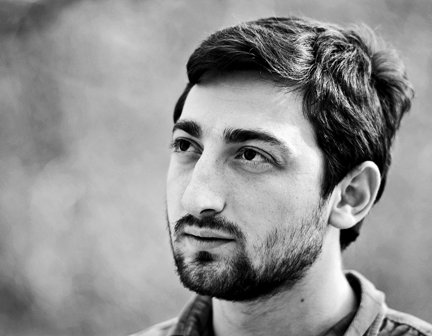
As Armenia prepares to celebrate its status as UNESCO World Book Capital, one young author has found himself in hot water after a penning a literary work which references the conditions faced by the country’s mainly conscript army. Threatened with prosecution under article 263 of the former Soviet republic’s Criminal Code, 24-year-old Hovhannes Ishkhanyan could face up to two years in prison for Demob Day.
Despite having a print run of just 300, of which only 120 copies have sold, the Armenian military maintains that the short-story collection is insulting to itself and also to the Armenian Orthodox Church and the mothers of soldiers.
Ishkhanyan’s supporters allege that the army has been embarrassed in the last few years by stories of harassment, hazing and non-combat deaths. Activists accuse the military of failing to properly investigate abuse, and portraying murders as suicides.
Of the 16 fictional stories in the “The Day of Discharge” three examine hazing rituals, and abuse in the army.
The issue is particularly sensitive in Armenia, still effectively in a state of war with neighbouring Azerbaijan. Only 32 of 228 conscripts who have died between 2007 and 2011 were killed by enemy fire according to official statistics quoted by the local Armenian media, and in recent years videos uploaded to YouTube showing the abuse of conscripts have angered the public.
In response to criticism in October 2011, the Armenian Defence Minister, Seyran Ohanyan announced that he “considers the non-stop deliberate manipulations of army issues by certain groups to be unacceptable. […] From now on, the Defense Ministry will be most strict with those defaming our army.” Writers and human rights activists believe Ishkhanyan’s troubles mark an attempt to close down public debate on the issue.
Two local bookshops have pulled the title from their shelves although one other continues to sell it and on 27 February Ishkhanyan was nonetheless called in for questioning. “I did not make a stir thinking they would not call me and everything would smooth down but they did not and transferred the case to the Central Department of Yerevan police. I was called there and asked the same questions,” the author told online publication Armenia Now.
“First they raised the question of the army then they understood they couldn’t subject me to any liability and now they say that my works contain pornographic scenes and they have applied to the Ministry of Culture,” he explained, adding that the only article a criminal case can be brought is Article 263 of the RA Criminal Code dealing with pornographic materials and which carries with it the possibility of two months to a maximum of two years imprisonment.
Ishkhanyan was questioned for a second time on 24 March, the book’s publisher was interrogated on 4 April.
“[W]e don’t see any legal grounds for prosecution. This can be assessed by us as censorship later, but I cannot make comments today since we have only just received an application from Hovhannes Ishkhanyan and the case is in progress,” Armenia’s Human Rights Ombudsperson Karen Andreasyan told the Aravot newspaper.
Writers in the Armenian Diaspora have come to Ishkhanyan’s defence, with two, Nancy Agabian and Nancy Krikorian launching a petition in Ishkhanyan’s defence.
“Literature is one means by which an open society examines, discusses and debates the problems it faces,” the prominent authors wrote. “A celebration of the five hundred year anniversary of books in Armenia rings hollow at this time when even one book, dealing with a timely and crucial issue of Armenian society, does not have a chance of being read.”
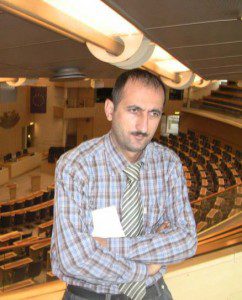
Speaking to Index, the author’s father, established investigative journalist Vahan Ishkhanyan, noted the more personal repercussions of the furore:
Because the affair is still open Hovhannes and his relatives are under permanent stress. During the Soviet era many writers were under pressure in Armenia, but this is the first time in 20 years of independence that they are trying to file a case for a work of fiction.
Onnik Krikorian is a British journalist and photojournalist based in Armenia and regional editor for the Caucasus at Global Voices Online. His work has appeared in the Los Angeles Times, New Internationalist, Scotsman and the Institute for War & Peace Reporting, among others, and he regularly fixes for Al Jazeera English, BBC and the Wall Street Journal. He tweets at @onewmphoto.
On the eve of the Eurovision song contest, Azeri journalists have complained to the European Court of Human Rights about the president’s stranglehold over the country’s broadcasting system.
Every year millions of people around the world watch the Eurovision Song Context, one of the biggest annual international media events. But many may not know that this year it is being hosted by a country which tightly controls its own media and offers its own viewers little choice in what they can watch – Azerbaijan.
In this former Soviet republic most TV and radio outlets are controlled by President Aliyev or members of his family, while nominally independent broadcasters are owned by people close to him. Moreover, the president appoints all nine members of the broadcasting regulatory body, the National Television and Radio Council, whose responsibilities include granting broadcast licences.
One consequence is that, though freedom of speech is officially guaranteed by the constitution, there is little public debate on political, economic and other vital issues. Violence against journalists and bloggers in the country is endemic and independent journalists work in a climate of constant legal threat.
But now two prominent Azerbaijani journalists have gone to the European Court of Human Rights to challenge this effective monopoly of control. The journalists — Yashar Agazade and Rasul Jafarov — have lodged a complaint about the repeated refusal of the regulatory council to grant a licence for the independent radio station they wish to set up.
They argue that this refusal not only denies their right to freedom of expression under Article 10 of the European Convention on Human Rights but means Azerbaijan is failing to ensure a pluralistic media landscape as the Convention requires it to.
Their application comes on the back of some fifty other complaints from Azeri journalists already pending at the Strasbourg court.
The matter has particular urgency because elections are due in 2013, and a favourable decision would force the government to make media reforms that would allow for more open debate before then. So whatever the outcome of the coming Eurovision contest, the journalists are hoping their case — which is being supported by MLDI — will result in a “nul point” verdict from the European Court judges.
Mark Stephens of Finers Stephens Innocent, part of the legal team for the applicants, said:
“Azerbaijan has de facto outlawed criticism of its leadership. If an Azeri journalist engages in the sort of tongue-in-cheek commentary that is provided for Eurovision by Graham Norton, chances are it will result in their imprisonment. So it is essential for this case to be successful if tongue-in-cheek comments are to be made either by Graham Norton, or indeed Azeri journalists on local political matters — or, indeed, Eurovision.”
Azerbaijani journalist Idrak Abbasov wins the journalism award, which recognises investigative journalism of dogged determination across a range of media, including print, online, radio and television
Accepting the award, Idrak Abbasov said:
First of all, I would like to thank Index on Censorship and all those present. I know that there are many people here today who devote their lives to the struggle for other people’s right to know the truth.
In Azerbaijan, where I have come from, telling the truth can cost a journalist their life. In countries such as Azerbaijan we journalists have to make a choice, and we choose the right to tell the truth.
For this right to tell the truth Elmar Guseinov gave his life in 2005. He knew he would not be forgiven, but he did not stop writing the truth.
I am not complaining. I made a conscious choice when I chose this profession, and I thank fate every day for my work.
Censorship, persecution, limited access to public information, arrests – the situation of the mass media in Azerbaijan is growing worse and their freedom is being curtailed year after year.
At the moment, nine journalists are under arrest on trumped-up charges of possessing drugs or weapons. In Azerbaijan, a request from a deputy of the ruling party is sufficient grounds for arresting the editor of a journal that is criticising the government, even in the absence of evidence. This is what happened to Evez Zeynalli.
In the town of Guba, four journalists were arrested without any charge whatsoever. Human rights activists are convinced that they were arrested for passing on to bloggers a video recording of an event that the censor had not wanted to see publicised.
Khadija Ismayilova, a journalist working for Radio Liberty, was blackmailed in an attempt to force her to stop her investigations into offshore companies owned by the President’s family. In 2009 Radio Liberty, the BBC and Voice of America were banned from local radio stations.
This is the price that my colleagues in Azerbaijan are paying for the right of the Azerbaijani people to know the truth about what is happening in their country. For the sake of this right we accept that our lives are in danger, as are the lives of our families. But the goal is worth it, since the right to truth is worth more than a life without truth.
CLICK HERE to view the full shortlist of the Guardian journalism award
Index’s most recent report Azerbaijan’s silenced voices is online now
 As Armenia prepares to celebrate its status as UNESCO World Book Capital, one young author has found himself in hot water after a penning a literary work which references the conditions faced by the country’s mainly conscript army. Threatened with prosecution under article 263 of the former Soviet republic’s Criminal Code, 24-year-old Hovhannes Ishkhanyan could face up to two years in prison for Demob Day.