In this issue, Index interviews Czech writer Vaclav Havel. Havel discusses his time in prison, his position now and the peace movements.

Samuel Beckett and Vaclav Havel
read more
In this issue, Index interviews Czech writer Vaclav Havel. Havel discusses his time in prison, his position now and the peace movements.

In this issue, Index examines the interaction between human rights and religion and explores how religious people, globally, find themselves under attack.

In this issue, Index on Censorship magazine explores Kenya’s atmosphere for freedom of expression.

In this issue, Index on Censorship magazine interviews three South African poets who describe their personal commitment in South Africa and how it has affected their work

In this issue, Index examines the censorship of the press and life as a censored writer in Poland, Hungary, and Czechoslovakia.

In this issue, Index examines the global censorship of music and its history from the time of Confucius to the present day.

In this issue former Secretary General of Amnesty International discusses the differences between reports from human rights groups from governments.

In this issue, Index investigates the freedom of broadcasters in Africa, Southeast Asia, the Middle East and more.

In this issue, Index examines if ‘forgotten Palestinians’ been successfully integrated into the Israeli state with Samih al-Qasim and Emile Habibi

In this issue, Manlio Argueta investigates how the ‘literature of liberation’ arose.

In this issue, Index publishes a piece by Jacobo Timerman, a distinguished newspaper editor, who outlines threats to human rights and freedom of expression.

In this issue, Index publishes submissions from writers including Kurt Vonnegut, Gabriel Garcia Marquez and Arthur Miller.
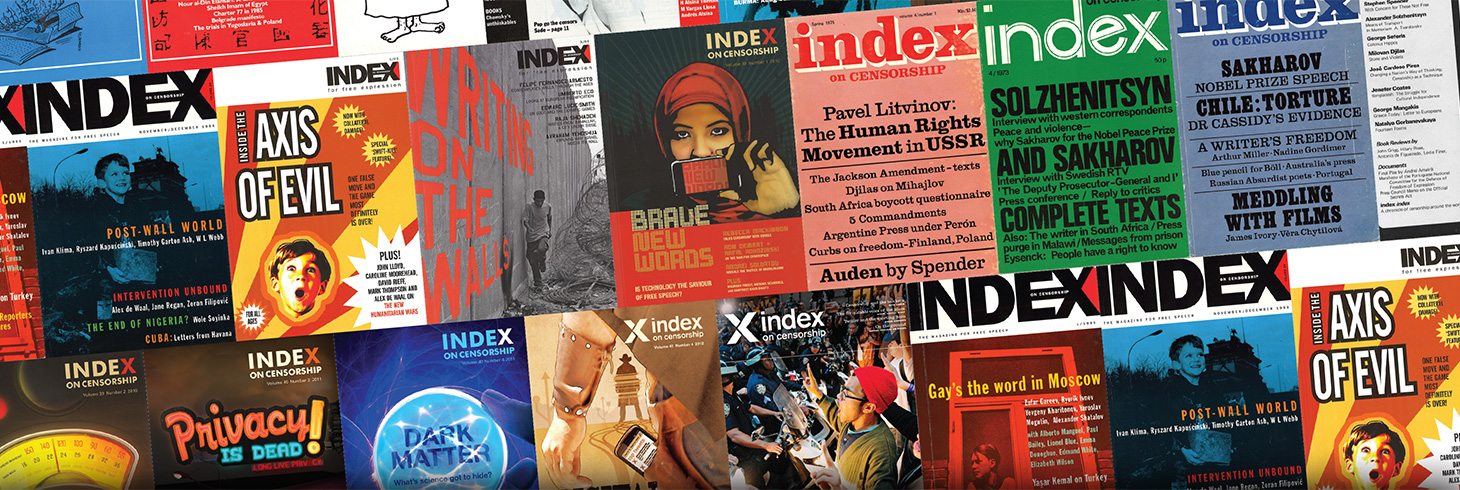
A quarterly journal set up in 1972, Index on Censorship magazine has published oppressed writers and refused to be silenced across hundreds of issues.
The brainchild of the poet Stephen Spender, and translator Michael Scammell, the magazine’s very first issue included a never-before-published poem, written while serving a sentence in a labour camp, by the Soviet dissident Aleksandr Solzhenitsyn, who went on to win a Nobel prize later that year.
The magazine continued to be a thorn in the side of Soviet censors, but its scope was far wider. From the beginning, Index declared its mission to stand up for free expression as a fundamental human right for people everywhere – it was particularly vocal in its coverage of the oppressive military regimes of southern Europe and Latin America but was also clear that freedom of expression was not only a problem in faraway dictatorships. The winter 1979 issue, for example, reported on a controversy in the United States in which the Public Broadcasting Service had heavily edited a documentary about racism in Britain and then gone to court attempting to prevent screenings of the original version. Learn more.