In this issue, Malcolm Coad examines the gradual revival of Chilean film by exiled film-makers after seven years of military rule

The rebirth of Chilean cinema in exile
read more
In this issue, Malcolm Coad examines the gradual revival of Chilean film by exiled film-makers after seven years of military rule

In this issue, Index examines the Chinese Communist Party’s cultural policy since its accession to power in 1949.

In this issue, a leading Polish writer sees censorship as ‘the most important social problem today.’

In this issue, Index publishes the 19 points of the most important document to come out of China during the brief liberalisation at the beginning of this year.

In this issue, Index examines the effect of fifteen years of military government on the Brazilian press and the arts.

In this issue, Index examines how the deposed Soviet leader came to change some of his views in the last seven years of his life.

In this issue, Index publishes six experts’ interpretations of the relationship between television and politics in Western Europe

In this issue, Index publishes an account of the intellectual background of the Cambodian revolution, and of one Cambodian’s intellectual journey into and away from the revolutionary camp.

In this issue, Index investigates problems facing British TV reporters working in Ulster.

In this issue, Index investigates suppression of information on nuclear problems in the United States and United Kingdom.

In this issue, Index investigates the activities of those who put up wall posters, explaining their significance in the Chinese political process.

In this issue, Index published a detailed account of the decline at all levels of education since Argentina’s military coup of March 1976.
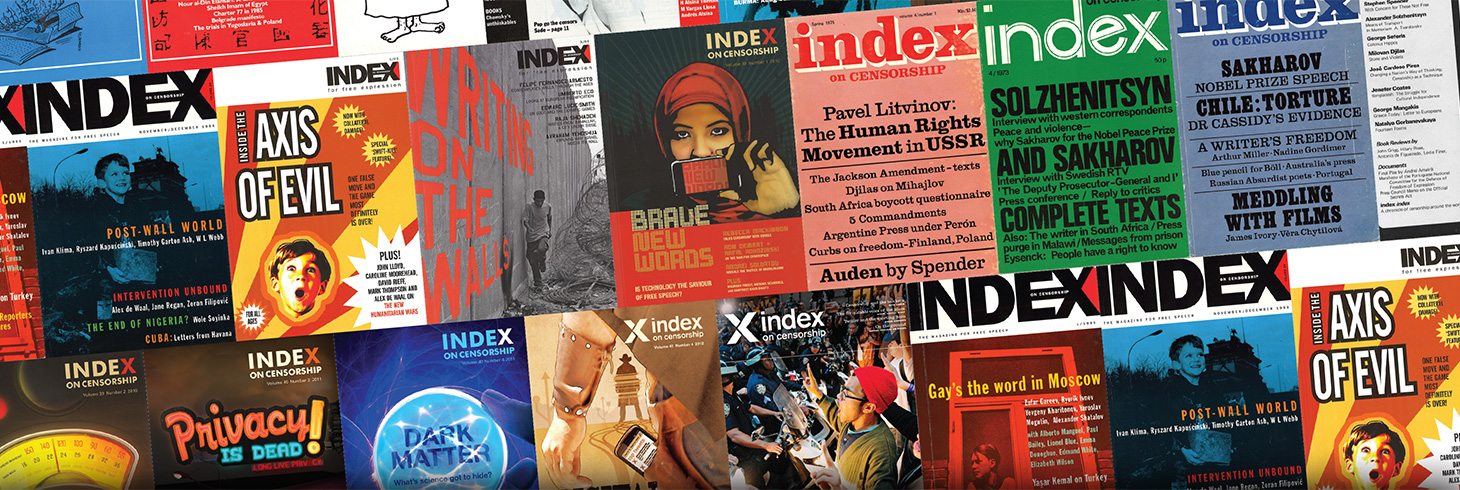
A quarterly journal set up in 1972, Index on Censorship magazine has published oppressed writers and refused to be silenced across hundreds of issues.
The brainchild of the poet Stephen Spender, and translator Michael Scammell, the magazine’s very first issue included a never-before-published poem, written while serving a sentence in a labour camp, by the Soviet dissident Aleksandr Solzhenitsyn, who went on to win a Nobel prize later that year.
The magazine continued to be a thorn in the side of Soviet censors, but its scope was far wider. From the beginning, Index declared its mission to stand up for free expression as a fundamental human right for people everywhere – it was particularly vocal in its coverage of the oppressive military regimes of southern Europe and Latin America but was also clear that freedom of expression was not only a problem in faraway dictatorships. The winter 1979 issue, for example, reported on a controversy in the United States in which the Public Broadcasting Service had heavily edited a documentary about racism in Britain and then gone to court attempting to prevent screenings of the original version. Learn more.