31 May 2013 | Art and the Law Reports, Artistic Freedom Commentary and Reports, Index Reports
[vc_row][vc_column][vc_column_text]
Contents Summary | Introduction | What is artistic freedom of expression? | What are the limits to freedom of expression? | Institutional self-censorship | Reinforcing support for artistic freedom of expression | Conclusion | Appendix I: Audience Feedback and Statistics | Appendix II: Conference Programme | Appendix III: Cases of Censored Artwork | Artist Videos | Full report in PDF
Taking the offensive: Defending artistic freedom of expression in the UK has been generously supported by Arts Council England. The conference was produced by Index on Censorship in association with Free Word and Southbank Centre.
Conference Report | May 2013 | Written by Julia Farrington
Summary
Freedom of expression is essential to the arts.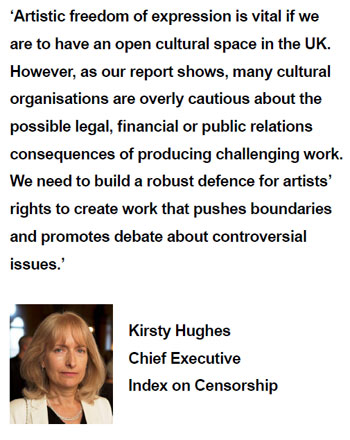 It needs to be actively sustained at the heart of artistic practice and mission, or it risks being undermined and diminished by competing concerns. It is a contentious right that triggers often divisive debate about the responsibility of the artist to balance between respecting and challenging society’s sensibilities.
Censorship and self-censorship are significant influences in the arts, creating a complex picture of the different ways society controls expression. In contrast to conventional state sponsored censorship which is direct and clearly demarcated, contemporary censorship in the UK is the result of a wide range of competing interests–public safety and public order, religious sensibilities, corporate interests. These constraints are often implemented without clear guidance or legal basis.
A key focus of this report is on how self-censorship manifests in arts organisations and institutions. The causes of self-censorship range from the fear of causing offence, losing financial support, violent public reaction or media storm, police intervention, prejudice, managing diversity and the impact of risk aversion. Participants acknowledged that these considerations influence many decisions about what work is commissioned or produced. Fear of prosecution for expression that might be considered to be criminal was also cited. Many admitted that a lack of knowledge around legal limits contributed to self-censorship.
Juggling the expectations and rights of the artist with those of audiences, funders, sponsors, media and the general public emerged as a difficult and demanding task. Many speakers from the platform and the floor felt strongly that, to reinforce support for artistic freedom of expression, arts organisations will have to be more transparent about the dilemmas they face and more willing to open up dialogue about critical decisions. There was a range of thought about the benefits of providing guidelines or policies, though there was strong support for developing guidance around policing.
Representatives of arts organizations raised common themes that would benefit from further discussion. There should be more debate with the audience, general public and young people about the positive value of controversy, disagreement and diversity of opinion as a means of understanding ourselves and our society. There is unequal access to exercising the right to artistic freedom of expression, with artists from ethnic minorities encountering additional obstacles. The size and funding of organisations will be a determining factor in how far they can go to support challenging work. Support for artistic freedom of expression at senior management and board level is absolutely central to developing an ethos that is able to defend artistic freedom when challenged.
Censorship and self-censorship
This report distinguishes between censorship and self-censorship. Self-censorship is the suppression of ideas by artists or institutions. It refers to work that has not yet been made.Censorship is used to describe the silencing of work that has been made. This includes the removal of work that is on display or in performance or the vetting of finished work before it is displayed or performed.
Introduction
Index on Censorship’s major conference ‘Taking the Offensive – defending artistic freedom of expression in the UK’ Southbank Centre, London, January 2013 was the first cross-art-form, sector- wide, national conference on artistic freedom in this country. It was held in partnership with Southbank Centre and Free Word Centre and was funded by Arts Council England. The conference was held to debate the growth of self-censorship in contemporary culture, the social, political and legal challenges to artistic freedom of expression and the sources of these new challenges and pressures including security issues, risk aversion and a growing sensitivity to ‘offence’. The conference discussed and debated how best to defend and push back the boundaries to free expression across the arts in the UK and how to build and reinforce support throughout the arts sector in defence of the fundamental right to freedom of expression.
The conference was held mainly on the record with the goal of opening up debates within the arts sector first and then to take the debate to a wider public audience in the future. Jude Kelly, OBE, Artistic Director of the Southbank Centre, in her opening remarks identified the need for the sector to, “talk about how they would articulate, and defend freedom of expression and then how they can speak to media and their audiences …to articulate their position.” One of the triggers for the conference was to tackle the isolation that often accompanies controversy. Backlash around challenging work from audience members, board members, funders, sponsors, general public and media can be hard to handle and can leave those in the eye of the storm feeling isolated. Jude Kelly called for the sector to, “stand together and make a cogent and responsible and sophisticated fist of this debate. We will persuade the media and the public that this is an arena in which we have the right to determine how we operate.”
The conference painted a picture of contemporary censorship in the arts, made up of a wide range of constraints and pressures on arts organisations, and the audience heard how other cultural and media players experience and manage censorship. It also addressed practical means to tackle the pressures that can lead to censorship with the final panel looking at what practical steps are needed to address the problems raised. We hope the conference itself and this report will prove of value across the sector. It will inform Index on Censorship’s future work programme on promoting greater understanding and co-operation on how to defend and promote artistic freedom of expression.
The day-long conference was attended by an audience of 220 people from the cultural sector, law, funders, and religious groups. Full details of the programme and the audience evaluation are in the appendix.
In this report, we present the range of opinions and ideas voiced during the conference at the panels, plenaries and in the breakout sessions. The report considers the discussion under a series of headings, drawing together themes of debate, rather than following the format of the programme itself. In the opening section the report looks at a key issue – which generally gets assumed rather than talked about sufficiently – what is artistic freedom of expression and what status does it have in contemporary culture? The report then looks at the whole gamut of constraints, controls and suppression of artistic freedom that were identified during the day before drawing together the different strategies needed to reinforce support across the sector. The final section summarises some of the key conclusions including ways to take the debate forward.
What is artistic freedom of expression?
The premise for the conference was that whilst everybody in the arts would probably support artistic freedom of expression as an essential tenet of our cultural life, there has been little or no cross-sector discussion or debate about it and therefore no shared idea of what it is, or the many and complex challenges that are inherent in actively supporting it. Discussion of artistic freedoms inevitably opens up complex debate about competing rights and responsibilities. For this and other reasons that will be presented in this report, support for freedom of expression is in the main only discussed, as one speaker observed, when “things go wrong”.
A powerful yet vulnerable right
Our freedoms are, as Nicholas Serota, director of The Tate, said in his keynote speech, hard won and the struggle to support them is necessarily on-going as the conditions in society constantly change. They are vulnerable to being “usurped by special interests, misunderstandings or misapplication of the law” and the “pressures of mass communication and multiple cultures make the job of vigilance more important and complicated than ever before”. Writer and broadcaster Kenan Malik said that freedom of expression is intrinsic to art, “without it art withers” and has to be sustained at the heart of artistic practice and at the core of artistic mission.
Mona Siddiqui, Professor of Islamic Studies at Edinburgh University described it as “our most valuable social tool”, allowing artists the freedom to be critics and commentators and express, as another speaker put it, “the values, urgencies and anxieties in society.” Film- director Penny Woolcock observed that it allows artists to enter into relationships with people or investigate areas of society that are closed off to other professionals. It allows for artists to challenge stereotypes and taboos and, as playwright Gurpreet Kaur Bhatti stressed, it requires considerable personal courage on the part of the artist and those who provide the infrastructure to present work.
The right to shock
The right to freedom of expression is extended to opinion that is abhorrent, that shocks, disgusts and appals and causes offence. As Gurpreet said “it may not be pretty” and Sally Tallant, artistic director of Liverpool Biennial, reminded us that great art is often deeply shocking and very unpopular in the first instance and only later becomes iconic and loved. Some of the conditions in which artistic freedom thrives were described by various participants as: the willingness to embrace controversy and diversity of opinion, to maintain open debate and dialogue, to take risks and experiment.
With rights come responsibilities
Some felt that artists should be free to say what they like, while others stressed that artists should ‘act responsibly’ though there was a very broad spectrum of opinion about what acting responsibly means. Some believe it is an artist’s responsibility to challenge all and any boundaries, while others feel that being responsible means respecting boundaries and controlling their expression accordingly. This considerable range of interpretation of the word responsibility goes some way to explaining the polarisation and intensity of the debate on artists’ rights.
Inequality of access to this right
Several participants pointed out that access to this right is not equally distributed across society and that education, in particular of young people and audiences is very important to ensure that all people can access and exercise the right to freedom of expression. One artist pointed out that community artists work in a different world from major venues and established artists, who have freedoms that the majority of artists do not. Kenan Malik warned against artists being given special privileges to be freer than other people as this would diminish the right of non-artists; any defence of freedom of expression should encompass any form of expression.
The right to freedom of expression is enshrined in the Human Rights Act, and in various international declarations to which the UK is a signatory. It is a fundamental not an absolute right, which is not without boundaries. In certain qualified circumstances, it can be argued that constraints should be placed on artistic expression.
What are the limits to freedom of artistic expression?
 The legitimacy or acceptability of expression that is considered harmful, dangerous or offensive and “crosses the line” is the subject of continuing debate and the scope for disagreement on what can be considered necessary and proportionate constraints on that right is very wide. In the case of arts venues and institutions, judgments about where to draw the line are ultimately the responsibility of the artistic director. Nicholas Serota explained that trust and confidence lie at the heart of these decisions and are necessarily made on a case-by-case basis “with conviction, responsibly weighing consequences”. Trust has to be developed with many different agencies, funders, sponsors, artists, audiences and it is important that an institution or arts organisation can demonstrate how it made its decision to present contested work, in good faith and for the public interest.
This section summarises the day’s discussion about how artistic expression is controlled and silenced and by whom. The absence of direct state-sponsored, highly visible censorship, which prevails in many countries around the world, may contribute to the commonly held view that there is no censorship in this country and that it is not a problem. However speakers throughout the day from across the sector confirmed that censorship is a major issue for the arts, and that it comes in many different forms, both direct and indirect, some more subtle, some more overt making it hard to “find one’s bearings”. The lawyer Anthony Julius, Deputy Chairman, Mishcon de Reya, differentiated between the age-old paradigm of censorship of the arts as the confrontation between the artist and the authoritarian state, and contemporary UK censorship, which sits within a liberal democracy. Contemporary censorship he said “is a heterogeneous assemblage of agencies, individuals, confessional groups, spontaneous groups that come into existence in response to provocation”.
Human rights charters acknowledge the relatively narrow range of acceptable interventions on legal grounds – such as security and violence – but also open up a much broader set of public order and public morality issues which various actors and influencers can then use as justification when attempting to silence speech for social or moral reasons.
Institutional self-censorship, a term that was used for the first time in a public discussion at this conference, was seen as a key factor and accordingly a discussion of its causes and characteristics has a separate section devoted to it.
Legal limits
There are UK laws, both criminal and civil, that outlaw hate speech and criminalise, but do not define, certain forms of grossly offensive expression. Recent guidelines produced by the Crown Prosecution Service, as Sir Hugh Orde, President of Association of Chief Police Officers told us, attempt to rein in the growing number of social media prosecutions and give some indication of where the bar is set in terms of legally acceptable expression that might cause offence at least online. However as was pointed out several times, since there have been so few court cases concerning artistic expression, many agreed that the boundaries in the arts are controlled to a far greater extent by non-judicial considerations including public opinion and prevailing (and changeable) morality, taste, sensitivity.
Public Censorship
CCensorship due to public influence happens when pressure on an art venue to remove work comes from members of the general public or special interest or religious groups. This can sometimes be the result of violent and disorderly protest or the threat of violence. The media plays an important role in influencing opinion, with some within it on occasion stirring public outrage about an artwork with the aim of having work removed. David Abraham described how public censorship of this kind is often led by elements within the media who encourage members of the public to complain to the police or to come out in protest against work, often involving people decrying work that they have not seen. The internet, social media and digital technology have made it easier for public outrage to gain momentum. This kind of moral outrage and public censorship, which can be hostile and sustained, is roused by work that is, for example, considered blasphemous, pornographic, appears exploitative of minors, or that portrays homosexuality especially in relation to religion. Some members of the public expect to influence decisions on what is acceptable, and public views on what is acceptable can have considerable impact on institutions presenting controversial work.
Police intervention
There was some discussion about the role of the police in directly censoring work, particularly in the artists’ breakout session. The police, as the arm of the law, have discretion to and can under certain circumstances intervene directly in the name of crime prevention, keeping the peace, or balancing the rights of other individuals or groups against the rights of the artist, to remove or stop artistic work. Sir Hugh Orde said that the police are often called in to manage “the fallout from artistic expression” which has the potential to be violent and can lead, as in the case of the play ‘Behzti’ by Gurpreet Kaur Bhatti, to the “unfortunate consequence” of legal artistic expression being suppressed due to concerns about public order or safety.
One participant in the artists’ breakout session said that in her experience the police were, “extremely over-cautious often resulting in de facto censorship or intimidation of artists.” Another artist with an experience of working in community settings and with marginalised communities said that people, “might be surprised at the significance of the role of the police” in deciding what kind of artistic expression is appropriate in public spaces, and another felt the police were “over-protective” and that, “audiences should be allowed to make up their own mind and not allow police officers to make it up for them.”
Online governance
The future of internet governance and the control of online content is a major subject for debate around the world and will impact inevitably on artistic expression. As a private company Google, which owns Youtube, has to operate within the law, but they do have quite a lot of power to set standards for their online spaces. Bill Echikson, Google Head of Freedom of Expression Policy Europe, North Africa and Middle East, said they aim to, “err on the side of freedom of expression”. They were recently criticised, when they pre-emptively blocked the video clip ‘Innocence of Muslims’ in Egypt and Libya and when challenged about this decision, Echikson told the conference it was felt that the video represented a real and immediate threat to security and withdrew it on those grounds, though it was later reinstated.
According to Google, online censorship is on the increase around the world, as the amount of material uploaded increases year on year. Bill said that with 72 hours of content being uploaded every minute some governments are increasingly looking to whether and how to control digital freedom of expression. 10 years ago there were only six countries that patrolled the internet, but now 44 out of 78 countries studied by the Open Net Initiative filtered, censored or blocked content to some extent. At any one time, 30 of the 150 countries where Google is used, 30 are blocking or censoring products, including YouTube, Blogger and Search.
Corporate censorship
Some participants expressed concern that the government’s push for the arts to find financial support from private philanthropy and corporate sources may risk creating potential or actual obstacles to freedom of expression, threatening the independence and range of programming. One participant pointed out that smaller organisations and those in rural areas were most at risk of producing: “dull, safe and uncontentious work that is more easily fundable. The ripple down effect of self-censorship is the elephant in the room. It has the biggest potential impact on artistic freedom of expression”. (See following section for more discussion on financial pressures).
One speaker, in the break out session on this issue, voiced some concern that, increasingly, philanthropists are expressing the view that they would like to give money in return for some influence. Another speaker questioned how organisations can truly support freedom of expression when they are pressured to take money from major corporates with poor human rights records.
Larissa Sansour a Palestinian artist, whose proposed work for an art prize sponsored by Lacoste was censored, as it was deemed to be “too Palestinian”, said that corporations should not see artists as an extension of their advertising campaign, but should support artists to do their own work.
Censorship and fear of causing offence
The fear of causing offence, in particular to religious sensibilities, can be a very powerful factor in controlling speech and artists who are trying to tackle uncomfortable truths relating to religious issues and find they encounter censorship. Svetlana Mintcheva, Director of Programmes, National Coalition Against Censorship, asserted that suppression of speech is often done to protect vulnerable groups, but it should nevertheless be treated as a free speech issue and challenged.
Gurpreet Kaur Bhatti told how her radio play ‘The Heart of Darkness’ about a so called “honour” killing had recently had lines removed by the BBC Compliance Department1 to avoid offending the sensibilities of their Muslim audience. Kaur Bhatti told the conference how “the BBC said the lines were offensive but they absolutely were not. They were a crucial part of the story…We live in a fear-ridden culture.” Mona Siddiqui concurred that the BBC is extremely cautious about causing offence to religious sensibilities.
Self-censorship
The group in the breakout session on self-censorship in the main accepted that a degree of self-censoring is part of everyday interaction in which we edit out expression that may be inappropriate, hurtful or offensive or out of a desire to be respectful or polite. This inevitably affects artists’ decision-making and it was pointed out that artists may avoid addressing certain subjects out of concern that they may offend their family, friends and neighbours and fear of being ostracised, more than being worried about dealing with hostility from the wider public. One participant felt that “there is uncertainty about what we say to each other, we’re not sure what is and isn’t offensive” and another said that uncertainty means we “lose out on the opportunity of understanding each other, by closing down expression and debate on complex issues”. Several speakers cited the fatwa against Salman Rushdie following the publication of the ‘The Satanic Verses’ as a significant turning point in UK cultural life, leading to greater self-censorship.
Regulation and classification
Channel 4 as a public broadcaster, is regulated by Ofcom. Channel 4 Chief Executive David Abraham believes this underpins their commitment to freedom of expression and increases public trust. The British Board of Film Classification is an independent body that regularly consults with the general public to set its standards on what is acceptable. When discussing how high the bar is set, Vice-President Gerard Lemos, alluded to examples of extreme violence and sexual sadism that are given an R18 classification indicating that in his view the bar is set high. A notion of harm, rather than offence, is the touchstone of their classification and, at times, censorship of film.
1 See Media Coverage section of Appendix I for links to press.
Institutional self-censorship
Making difficult choices about what work to produce is an essential part of the role of any programmer, commissioner or artistic director, and they have to take funders, sponsors, artists, audiences into account when making decisions. But self-censorship can be distinguished from other forms of editing, when the decision to drop a particular piece of work, or cut certain phrases, characters or aspects of a work is dictated by either fear of the consequences or triggered by prejudice. A key focus for the conference was to look at how self-censorship operates in arts organisations and institutions of all sizes, public authorities and other stakeholders. Strategies for tackling the causes of institutional self-censorship are discussed in the next section.
Fear of consequences
The term institutional self-censorship was used by several people, indicating that they felt self-censorship to be an established and pervasive factor in the cultural arena, but one that, because it is institutional behaviour, is largely invisible to those involved and is not openly discussed. The causes of institutional self- censorship were identified and discussed during the day. Svetlana Mintcheva, Director of Programmes, National Coalition Against Censorship, listed fear of litigation, PR backlash, loss of funding, violence and causing offence as typical triggers for institutional self-censorship. Where litigation was concerned, as one speaker pointed out, the fear of prosecution far out-stripped the reality, saying that “many arts producers – much more so than the artists themselves – were over fearful of the prospect of prosecution, when in nearly all incidents there were no reasonable grounds for bringing charges”.
Risk aversion
 The breakout session on the role of the board reported on how a preoccupation with risk assessment had led to a tendency to hypothesise and focus too heavily on “worse possible case scenarios”; the threat or possibility of an adverse reaction can therefore dictate the decision about what work to produce. There was also discussion about whether the Charity Commission’s guidance on campaigning and political activity2 could have an overly constraining effect on board members’ decisions, given that some risk taking is necessary to support artistic freedom of expression. It was noted that each organization is different and that boards must think about the guidance in relation to their own mission, but the limitations on certain sorts of activity should certainly not be used as a way to shut down debate about programming work with claims that “my board won’t like it”. There was concern that, when selecting an artistic director, trustees might decide to go for a ‘safe pair of hands’ rather than someone who might take ‘artistic risks’. It was noted that trustees on arts boards come from a wide range of business, legal and marketing backgrounds bringing a heightened awareness of reputational damage, relations with governments and corporates. This in turn feeds the culture of risk aversion that fuels self-censorship and one speaker claimed that “the greatest risk is to have an organisation that takes no risks”.
Financial pressures
Being able to demonstrate positive economic impact of arts programming is nothing new. But in a recession this is more critical and as one speaker said “in vulnerable funding times, local authorities are finding it difficult to continue to make a cultural offer”. Especially hard hit is the infrastructure of smaller arts venues that foster emerging and diverse talent, risk and experimentation. One speaker wondered whether we “can afford to court controversy” when money is tight, and it is so costly and time-consuming to take on legal defence. Erica Whyman, Assistant Director Royal Shakespeare Company, said “market forces and the political climate have made us very nervous about making work that most people don’t like”. The director of a small arts organisation claimed that organisations like hers are amongst the least attractive to philanthropic giving, and so there is a real danger “that we self-censor and deliver up what the rich and the funding bodies find palatable and are not threatened by.”
Cultural diversity policies and prejudice
Kenan Malik observed that diversity policies have inadvertently fuelled institutional self- censorship. Rather than encouraging a true diversity of speech and expression, they have often been used to silence speech that might offend “in the name of diversity you can’t say that” or “because we live in a diverse society you can’t say that”. He observed that the tendency to homogenise minority communities has created significant obstacles for artists coming from ethnic minorities who may not conform to the idea of what is acceptable or expected by the mainstream. Jeanette Bain-Burnett, Artistic Director Association for Dance of the African Diaspora, concurred, describing a deep-seated prejudice in the UK that limits the range of work that ethnic minority artists are able to produce, based on specific yet unspoken expectations. Further addressing the stereotyping of ethnic minority artists, an artist wrote in his conference evaluation that “artists critiquing their own minority communities were more likely to get their work produced than artists critiquing the mainstream [/vc_column_text][/vc_column][/vc_row][vc_row][vc_column][vc_column_text][or][/vc_column_text][/vc_column][/vc_row][vc_row][vc_column][vc_column_text] challenging misconceptions”. A speaker from the floor observed that this is further compounded by the make-up of senior management and boards of arts organisations being predominantly white, middle-class and male, which will “limit the view of who is allowed to express themselves and what constitutes good art”.
Local authorities
There was some discussion about the need to maintain good relations with local authorities who have it in their power to block work. Sally Tallant spoke of a lack of understanding of arts as intrinsically a “place for risk and experimentation” and that some work is viewed with suspicion and as a potential risk to public order, when in fact it is being misread. This leads to what more than one speaker alluded to as the “fear-driven environment” amongst police, local authorities and local politicians, laying the ground for more censorship of work that is complex or abstract. Sally Tallant warned that, “if there are complaints from the public, elected members or local politicians get involved and this further complicates the issues”. She recommended keeping up an open and sustained dialogue with all involved.
Cultural diplomacy
In the field of international relations, the pull between pragmatism and principle was also an issue for some arts organisations when considering how far to support freedom of expression. This was particularly clear in the case of the British Council which aims to express a “British dream” of freedom, human rights racial tolerance and education – values that the Council says it wants to share abroad. But to achieve this it seeks a less confrontational path. It looks to build “trust and opportunity for engagement” and very much to operate under local law and different religious and social contexts. A participant challenged Neil Webb, Director Drama and Dance, on the Council’s support for China’s choice of authors at last year’s London Book Fair which excluded any author who was critical of the Chinese government. The participant felt that rather than operating under British standards of free speech in UK, the Council was allowing China to influence who is allowed to speak.
2 Speaking Out. Campaigning and political activity by charities (CC9)
Reinforcing support for artistic freedom of expression
One of the main purposes of the conference was to begin to identify strategies to promote and defend artistic freedom of expression across the sector, from commissioning the artist and the first contact with funders and sponsors, throughout the life-cycle of the artwork. There was broad agreement that supporting artistic freedom of expression is central to the role of arts venues, organisations and institutions in all art forms, which provide a potentially safe space for saying challenging and difficult things. For Nicholas Serota, facilitating the dialogue between those that make art and those that view it is ‘part of the service to the public’. And yet there was a high degree of consensus that arts organisations were not delivering effectively on this ‘service’.
Opening up dialogue within and across the sector
The need for more open dialogue and debate addressing the pressures on artistic freedom was reiterated throughout the day; some felt the need was greatest at board level, others stressed the need for dialogue involving the whole organisation; others felt that a great deal could be gained by opening up dialogue between organisations. As one speaker said “individually and institutionally we avoid scandal, we keep it quiet” which means “we can’t get better at dealing with it”. Many felt that far greater trust, transparency and as one person asserted “honesty” about the challenges being faced, need to be developed across the sector; dilemmas should be recast as a necessary part of the creative process, to be shared and openly discussed, rather than something to keep behind closed doors. This will make it possible for organisations to come together when there is a crisis, rather than standing back and withholding support: “if we collectively don’t feel confident about the dilemmas we face how can we move on with the public?”
Public debate about the role of art in society
It was seen as equally important to open up the public debate about the role of art in society and the value, benefits and challenges that supporting freedom of expression brings, particularly with communities who have few opportunities to debate and discuss these issues. Several felt that schools and colleges have a vital role in opening up public debate – “it is critical that young people have time and space to explore some of the complexities around art, freedom of expression and global sensitivities”. This has to include confronting sensitivities around religion and not shying away from the fear of causing offence. As Mona Siddiqui said, “if artists are worried about causing offence to Muslims then they should say so and have the debate”. One participant’s evaluation stressed the importance of including supposed ‘offendable’ groups in discussion to avoid stigmatization and further polarization of opinion.
Reclaiming controversy
 Erica Whyman felt that we have “fostered a culture that art is not for debate, controversy and disagreement but it is to please”. Many speakers echoed this idea, calling for controversy to be reclaimed by arts organizations and to articulate this commitment to all stakeholders and so “determine how we operate”. A recurrent call was for arts organisations to demonstrate leadership in bringing audiences to the point where they value free speech, to make space for criticism, disagreement, difficult or uncomfortable expression. At the end of the final panel, when asked for a closing thought, one speaker said “controversy is not a dirty word” and another “there is nothing wrong with causing offence”.
Managing controversy and the need for greater transparency
It was acknowledged that when there is controversy about a particular art work, though this can often be a turbulent and difficult time, it provides a critically important opportunity for arts organisations to demonstrate support for freedom of expression. Several people pointed to the paradox that the most significant decisions – and the discussions underpinning those decisions – in response to challenging art often remain shrouded in secrecy. Decisions about whether to keep contested artwork on display or in production, when there is a specific possibility of, for example, breaking the law or threat to security, are typically made in private by a range of experts including lawyers and police. Several people claimed that by keeping this discussion behind closed doors, arts organisations are denying the public access to the most important, informative and insightful debates generated by artworks, about balancing rights and the legal boundaries of expression. Nicholas Serota set an example of greater transparency in his opening speech, by throwing light on how decisions on high-profile cases, which had attracted criticism at the time, were reached by the Tate, explaining that the timing and context of the decisions was critical.
More guidance on laws and rights
A number of people called for information on existing legislation that impacts on freedom of artistic expression in order to help dispel some causes of self-censorship, where lack of understanding or knowledge of the law leads to over-cautious decision making. Such guidance can be part of helping artists and artist directors assert their rights more confidently and be more informed about where and how to push boundaries and where those boundaries lie. However given the complexities of identifying boundaries, for instance around what is grossly offensive or obscene, guidance will not replace the need for legal advice in some cases. Much of police decision making is discretionary and guidance for the police on managing controversy and competing rights in the artistic sphere would also be very helpful. Sir Hugh Orde cited how guidance had put an end to inappropriate police intervention regarding members of the public, artists and tourists taking photographs of sensitive locations, following the Terrorism Act 2000.
Guidance for the police and local authorities to promote understanding of the arts as a “place for risk and experimentation” would help to make the case for the wider public benefit of artistic expression. This could ease some of the tensions and make for more constructive dialogue with police, local authorities, local politicians and health authorities. This latter was stressed by performance artist, ‘vacuum cleaner’, who makes work about his own mental health and had encountered ignorance and over-protective responses.
Svetlana Mintcheva suggested a document that upholds the right for cultural organisations to display work in spite of cultural or social criticism could be useful and outlined the document3 she has created which includes a general free speech statement and suggested procedures for preparing for and handling controversy. The goal was that a director that wants to protect a work of art would refer to best practice and bring in mutual support.
There were calls for various types of guidance at different points across the conference including: Director of Public Prosecutions guidelines on prosecuting cases relating to censorship where artists are involved; best practice guidance of how to handle a crisis; guidance to support the production of works that tackle contentious issues; bespoke guidance for smaller arts organisations. More than one person suggested that a crisis helpline would be valuable.
Debate about a freedom of expression policy for the arts
What sort of policy if any might be needed or helpful to defend freedom of expression in the arts, given this picture of constraints, pressures and different views and interests, was the subject of discussion, including whether there should be one at all, whether it should be binding, or unified, whether it should be held at the sectoral or organizational level. It was noted that any policy or statement would need to identify what kind of problems it aimed to solve, who would be behind it and what it would hope to accomplish. Svetlana Mintcheva offered her recent experience in the United States proposing that it could address “lack of a cohesive response in the art world to censorship controversies and the lack of preparedness to confront censorship”.
Moira Sinclair, Executive Director Arts Council England, was clear that it was “counter-intuitive” for a policy to sit with the Arts Council, who could not “require people to sign up to a freedom of expression policy; it won’t come from a piece of paper; it will come from bravery and clarity from artists and organisations”.
There was rather little support for a general, sector-wide policy. Rather, there was more support for individual organisations adopting a freedom of expression policy or framework that would provide a “cohesive response and prepare an institution to handle crises”. Another suggestion was for individual organisations to draw up a policy based on a series of agreed principles that “we should uphold and return to.” One participant felt that a policy at the commissioning stage could be especially useful to support artists entering into relationships with corporate sponsors.
However, others were not keen on the idea of any sort of policy: one claimed that “policies make us feel policed”; another that a policy would feel like “a judge deciding, or someone handing it from above”. One writer asserted that “a policy would interfere with the essential idea of artists giving form to some sort of personal experience for themselves”.
Examples of transparency policies
The BBC World Service tries to be as open as possible about its newsgathering objectives and welcomes the advent of social media which is “turning citizens into watch dogs” as well as “a news and information gathering machine”. Behrouz Afagh Head of BBC World Service’s Asia & Pacific Region said “transparency is the new objectivity” and described how some more radical online media organisations have even opened up their daily editorial meetings to their audience, though no examples were given. Transparency is also central to the British Board of Film Censorship’s operation, and their website features a section called ‘BBFC Insight’ where they publish detailed information about the content of every film that they rate. People are constantly commenting on and challenging the BBFC’s decisions online and increasingly the general public are talking to each other. “This changes the nature of the discourse between the BBFC and the public” as they are now crowdsourcing opinions. Bill Echikson said that Google aims primarily to protect its users, and their rights, and Google issues a transparency report4 on governments that have asked them to take down content and reveal user data. “When we are forced to hand over material we like it to be by legal means – by court decision or by warrant” and they like to let their users know what is happening.
Working with funders and sponsors
The breakout session on sponsorship and philanthropy urged organisations to be very clear about their artistic vision. This is always the starting point of the relationship. The clearer and more defined the vision, the more likely the issue of censorship will be avoided entirely. Most importantly, fundraising should avoid polarising the relationship with the funder, but working together to achieve the desired outcome. Training of fundraisers should include more focus on developing skills to navigate the nuances of relationships so fundraisers are able to avoid situations where they feel they must ‘cave into’ demands.
3 Museum Best Practice for Managing Controversy
4 Google Transparency Report July-December 2012 on UK takedown requests
Conclusion
The conference could be seen as a landmark in understanding of censorship of the arts in this country. Institutional self-censorship, which many acknowledged is suppressing creativity and ideas, was openly discussed for the first time. The report identifies multiple pressures on artistic freedom of expression and that censorship has become a major issue. Worries about legal action, police intervention and loss of funding are causing cultural institutions to be overly cautious and arts organisations fear public and media protests and complaints if they cause ‘offence’.
Key pressures on decision making can be summarised as:
- Self-censorship: Some artistic work is being suppressed at the ideas stage out of fear that it will provoke controversy or cause offence
- Public and special interest group campaigns: The internet, social media and digital technology have made it easier for public ‘outrage’ to gain momentum – many of those calling for a ban will not even have seen or read the ‘offensive’ work
- Over-cautious policing: Fears of potential public order or safety issues are leading the police to be overly cautious
- Financial pressures: In the current economic climate, institutions feel they ‘can’t afford to court controversy’
- Cultural diversity policies: Rather than encouraging diversity of speech, these policies have in some cases inadvertently suppressed work that might offend
- Risk aversion: A preoccupation with risk assessment has led institutions to focus on worst case scenarios of what might happen when taking artistic risks
There was considerable appetite for more debate on how to tackle these pressures, and common themes that would benefit from further discussion were identified. There should be more debate with the audience, general public and young people about the positive value of controversy, disagreement and diversity of opinion as a means of understanding ourselves and our society. There is unequal access to exercising the right to artistic freedom of expression, with artists from ethnic minorities encountering additional obstacles. The size and funding of organisations will be a determining factor in how far they can go to support challenging work. Support for artistic freedom of expression at senior management and board level is absolutely central to developing an ethos that is able to defend artistic freedom when challenged.
‘Taking the Offensive’ made a very significant contribution to opening up the debate about artistic freedom of expression in this country and the strategies needed to reinforce support for challenging work. Speakers from the platform and the floor identified a range of practical ideas on how best to defend open cultural space. Additional suggestions that came through the evaluation are summarised in Annex 1. Some of these can be implemented at an organisational level, and the range of ideas reflects the fact that there is not a one-size-fits- all way forward. If there are to be any overarching, sector wide initiatives, these will need to be thought through in detail, further debated and consulted on. Index aims to play a key role in such developments, to keep freedom of expression at the heart of artistic practice and mission, and to help build a robust defence for artists’ rights to create work that pushes boundaries and promotes debate about controversial issues.
Appendix I
Facts, figures and feedback
Index on Censorship’s conference ‘Taking the offensive – defending artistic freedom of expression in the UK’ took place at Southbank Centre on January 29th 2013. It was attended by 224 delegates and speakers representing a range of stakeholders5, the majority being representatives from arts organisations but with a good and even spread across funders, NGOs and artists. Local government civil service, media, academia and religious groups were also represented.
Audience feedback forms
Audience members were invited to fill in an evaluation form comprising 5 questions with ‘tick box’ replies, where 5 is excellent and 1 is poor. We had 72 respondents. 87.5% gave a 4 or above for overall satisfaction and usefulness of the content. Choice of speakers and duration and format were also high, with around 80% giving 4 or above. Opportunities for interaction and Q & A were rated lowest but still at a good level with 63% giving 4 or above6. 87.5% of the respondents want to stay involved in the project – a remarkable indicator of the success of the day.
Next Steps
The audience feedback forms asked for suggestions on what our next steps should be – 51 people responded. The answers can be placed under the following headings: guidance and support networks, further debate and public engagement, awareness raising and education.
Guidance and support networks
There was a perceived need for guidance at different stages in the making and producing of work that addresses contentious issues, with smaller grass-roots arts organisations singled out as in particular need of support. Guidance could cover managing the press, police and members of the public in case of controversy and it was suggested that a helpline should be set up. Guidance was also recommended from the Director of Public Prosecutions when dealing with artist censorship for police and local authorities who may intervene as they see it on behalf of members of the public. It was also suggested that the sector should establish principles of cross sector support and advocacy minimising isolation and improving wider understanding of the role and potential of arts within contemporary society.
Further debate and public engagement
There was a call for public engagement, debate and conversation on the role of art in society especially with communities with few opportunities to do so and for open discussion about the challenges facing artistic freedom of expression. One respondent pointed to the need for free and frank dialogue between all stakeholders, learning from each other, rather than coming up with a hard and fast policy document too soon. There were recommendations that religious and non-religious people should work together on this as the project moves forward to avoid stigmatisation. One respondent to the feedback described the need for an open and honest interrogation of the notion of artistic freedom of expression and its relationship to philanthropic giving and public funding.
Awareness raising and education
A range of awareness raising and education was identified as necessary to address different kinds of censorship including: working with the police to prevent over-reaction and closing down of shows, performances, and with artists and institutions so they acknowledge that they self censor and work actively against it. Schools and other learning environments need to be more involved in these debates. It is critical that young people have time and space to explore some of the complexities around art, freedom of expression and global sensitivities.
Campaigning
There was a general comment about the need to push for legal reforms where necessary to strengthen these rights. There were several mentions of the potentially harmful impact of government education reforms in particular Ebacc (which at the time of writing is still a threat to the future of arts education in schools) and the knock on effect on access to the right of artistic expression. Another participant pointed to the need to form a strategic plan to address attacks on artistic freedoms through coalitions, mapping these attacks both nationally and internationally, and developing collaborative approaches to urgent situations as they arise.7
General comments
Participants were also asked to give general feedback about the day – 37 people responded. Whilst there was a lot of very positive feedback as reflected in the figures above, some felt that the speakers were too mainstream and the tone too ‘top down’; the lack of artists and absence of disabled voices was noted. As the figures suggest some felt that there could have been more time for discussion with and between audience. One respondent thought that the ending was inconclusive and another that the conference was too conservative and there were not enough dissenting voices.
Media coverage
The Independent covered Gurpreet’s story about BBC Compliance (also picked up by the Guardian, the Telegraph, the Daily Mail and the International Business Times) and the Standard took up David Abraham’s comment on the Pollard Review. The Stage referenced the conference in an article about cuts. a-n (artist newsletter) wrote a review of the conference.
5 Arts organizations 23%; Funders 15%; NGOs 13%; Artists 12%; Local and civil servants 9%; Media 8%; Academics 5.5 %; – Freelance
arts practitioners and consultants 3%; Religious groups 2.5%
6 1. Overall how satisfied were you with the conference? 45.8% – 5:5; 41.7% – 4:5; 12.5% – 3:5
2. How do you rate usefulness of content? 43.0% – 5:5; 40.3% – 4:5; 9.7% – 3:5; 4.2% – :52; 2.9% – 1:5
3. How do you rate Q & A sessions and opportunities for interaction? 26.4% – 5:5; 37.5% – 4:5; 26.3% – 3:5; 6.9% – 2:5; 2.8% – 1:5
4. How do you rate selection of speakers? 38% – 5:5; 40% – 4:5; 14.1% – 3:5; 4.2% – 2:5; 2.8% – 1:5
5. How do you rate duration and format? 33.3% – 5; 41.7% – 4; 19.4% – 3; 2.8% – 2:5; 2.8 – 1:5
7 Artsfex – a new and emerging international network of organisations and individuals working to defend artistic freedom of expression
– covers this area. Index on censorship is on the steering committee of this initiative.
Appendix II
Conference Programme
9.00 Welcome to conference – Jude Kelly OBE, Artistic Director, Southbank Centre
9.15 – 9.45 Key Note Speech – Sir Nick Serota, Director, Tate
The role of cultural institutions in defending freedom of expression
9.45 – 11.05 Panel discussion chaired by: Jonathan Dimbleby
Artists’ perspective (video) – Gurpreet Kaur Bhatti, Bob & Roberta Smith, Penny Woolcock
David Abraham (Channel 4)
Anthony Julius (Mishcon De Reya)
Sir Hugh Orde (Association of Chief Police Officers)
Professor Mona Siddiqui (Edinburgh University)
Sally Tallant (Liverpool Biennial)
Who controls artistic freedom of expression in 2013?
Who polices what is sayable in the arts, in theatres, galleries, public arts-spaces and on line? Are the constraints on freedom of expression social, political, legal or all three?
11.05 – Break
11.30 – 12.30 Breakout sessions
NB: Breakout sessions will be conducted under the Chatham House Rule
1) Self-censorship – facilitated by Nigel Warburton (Open University)
2) Sponsorship, Philanthropy and Freedom of Expression – facilitated by John Nicholls (Arts Quarter) with David Lan (Young Vic) and Ben Eyre (Philanthropy Advisor)
3) The role of the board – facilitated by John Kampfner (Turner Contemporary/Google) with Sir John Tusa (Clore Leadership Programme) and Caroline Cooke (Charity Commission).
4) Artists speak out – facilitated by Penny Woolcock (Film director/writer) and Xenafon Kavvadias (Visual Artist).
12.30 – 1.15 Reconvene for feedback from breakouts
1.15 – 2.15 Lunch
2.15 – 3.35 Panel discussion chaired by: Ziyad Marar (Sage Publications)
Artists’ perspective (video) – Larissa Sansour, Natalia Kaliada, Htein Lin
Behrouz Afagh (BBC World Service)
Jeanette Bain-Burnett (Association of Dance of the African Diaspora)
Bill Echikson (Google)
Gerard Lemos (British Board of Film Classification)
Neil Webb (British Council)
Freedom of expression on the international stage.
What is the role of UK cultural organisations in promoting and defending freedom of expression on the international stage? And how is the UK arts sector affected by international debates and differences – not least in the digital era – over where the boundaries of freedom of expression are set.
3.35 – Break
4.00 – 5.15 Plenary chaired by: Kirsty Hughes (Index on Censorship)
Artists’ perspective (video) – Zimbo/Dylan Duffus, Joanna Raykowski, the vacuum cleaner, Anthony Schrag
Kenan Malik (Writer/academic)
Svetlana Mintcheva (National Coalition Against Censorship – US)
Mark Sealy (Autograph Black Photographers) – no show
Moira Sinclair (Arts Council England)
Erica Whyman (Royal Shakespeare Company)
Do we need a freedom of expression policy for the arts?
Would a freedom of expression policy help to secure institutional commitment to artistic freedom or undermine the very freedom of expression it is aiming to promote? What suggestions and proposals do you have to reinforce support for freedom of expression in the arts today?
5.15 Closing words from Jude Kelly
5.30 Drinks and networking sponsored by Clifford Chance.
Appendix III
Some of the examples of artistic censorship mentioned during the conference
- Gerald Scarfe cartoon ‘Israeli Election–Will Cementing Peace Continue?’ was published on International Holocaust Remembrance day 27thJanuary 2013 and caused offence to some.
- Innocence of Muslims – ‘movie trailer’. The 14 minute video clips were initially uploaded to YouTube in July 2012, under the titles The Real Life of Muhammad and Muhammad Movie Trailer. Videos dubbed in the Arabic language were uploaded during early September 2012 and led to outbreaks of violent protest in Egypt, Libya and elsewhere.
- Gurpreet Kaur Bhatti – Behzti (Dishonour) was cancelled in 2004 when Sikh demonstrations outside the Birmingham Rep turned violent.
- Marcus Harvey – Myra (painting) 1995 – Sensations – an exhibition of young British artists at Royal Academy 1997 caused outrage amongst parents of the victims who called for it to be removed from the gallery.
- Robert Maplethorpe – The Perfect Moment (1989 solo exhibit tour) The quashing of the case against Dennis Barrie artistic director of Cincinnati Contemporary Arts Center, April 1990, for exhibiting Robert Maplethorpe was a famous victory for artistic freedom of exhibition.
- John Latham – God is Great 1997. A last minute decision led to the removal of the work, featuring the Bible, the Koran and the Talmud embedded in a plate of glass, from an exhibition dedicated to Latham at Tate Britain in 2005 with regard to political and religious sensitivities.
- Richard Prince – Spiritual America Tate Modern removes naked Brooke Shields picture from ‘Pop Life’ exhibition 2009, following advice from Metropolitan Police’s obscene publications squad.
- Larissa Sansour – Nation Estate 2012. The work explores a vertical solution to the Palestinian State and was dropped from a competition sponsored by Lacoste for being too “Palestinian”.
- Penny Woolcock – One Day 2009. A street cast grime musical about life in the ganglands of Birmingham was effectively censored by police who warned cinemas in the city that there would be violence if the film was shown.
- Made in God’s Image – shOUT exhibtion 2009. A sustained press storm raged against a work in Glasgow Gallery of Modern Art’s social justice biennial presenting work by LGBTI artists, that invited gay people to write themselves back into the bible.
- David Wojnarowicz’ video ‘Fire in my Belly’ (1987), which depicts the crucifiction being overrun by ants was taken out of an exhibition Hide & Seek at the Smithsonian Museum in November 2010 following protests by Christian group.
- Samina Malik, the ‘Lyrical terrorist’ was the first woman to be convicted under Section 58 of the Terrorism Act 2000, though her sentence was later quashed following an appeal.
- Perdition – Jim Allen, a play about alleged collaboration during the War between the leadership of the Zionist movement in Hungary and the Nazis in production at Royal Court in 1987 was cancelled shortly before it opened following pressure from members of the Jewish community.
Contents Summary | Introduction | What is artistic freedom of expression? | What are the limits to freedom of expression? | Institutional self-censorship | Reinforcing support for artistic freedom of expression | Conclusion | Appendix I: Audience Feedback and Statistics | Appendix II: Conference Programme | Appendix III: Cases of Censored Artwork | Artist Videos | Full report in PDF
This report was updated on 17 Sept 2013 to correct editing errors.[/vc_column_text][/vc_column][/vc_row][vc_row][vc_column][vc_column_text]
[/vc_column_text][vc_video link=”http://www.youtube.com/embed/videoseries?list=PLlUhPA3TuB567z33HfK59xCqgCNrw5PeC”][/vc_column][/vc_row]
