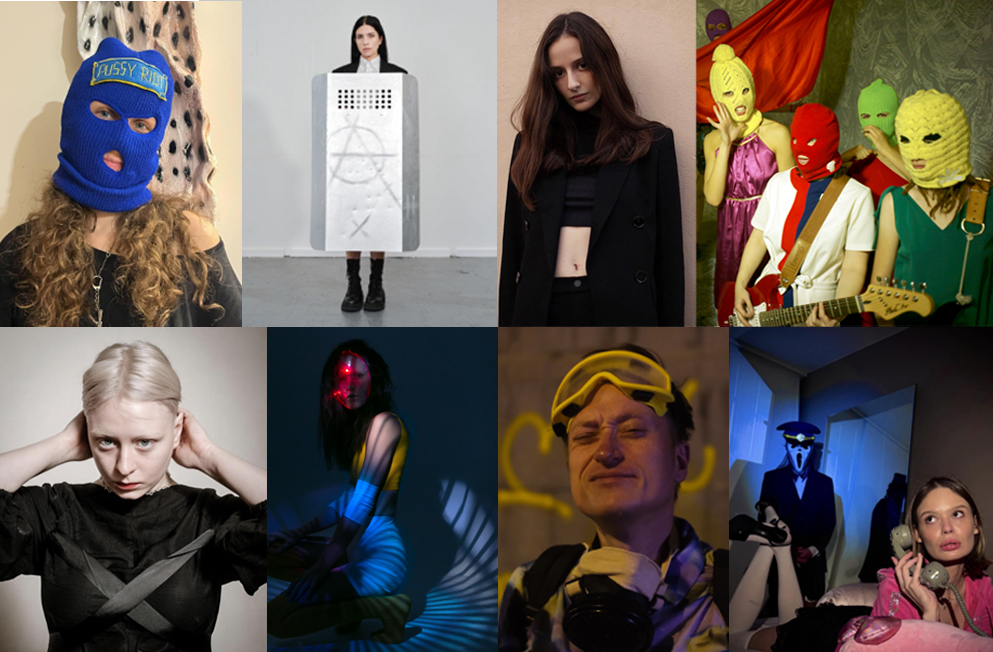
On 15 December, the Tverskoy District Court in Moscow approved the prosecution’s request to classify Pussy Riot as an “extremist organisation” and to ban its activities in Russia. The hearing took place behind closed doors.
Founded in 2011 by Nadezhda Tolokonnikova, Pussy Riot emerged as a feminist punk collective centred on direct action. Through bold, unsanctioned performances, the group rapidly drew international attention. Pussy Riot shot to global fame ahead of the 2012 presidential election after the group staged a so-called “punk prayer” in Moscow’s Cathedral of Christ the Saviour. Their song Virgin Mary, Drive Putin Away challenged the growing alliance between church and state.
Members of Pussy Riot were arrested afterwards and sentenced to prison terms. And the case triggered an unprecedented international outcry. Their prosecution quickly became emblematic of the Russian authorities’ readiness to criminalise artistic and political expression.
Despite sustained repression, Pussy Riot and its members have received worldwide recognition. In 2012, the group featured in TIME 100, Time magazine’s annual list of the world’s most influential people. That same year, Index on Censorship awarded Pussy Riot the Freedom of Expression Arts Award, acknowledging their determination to defend free expression in the face of imprisonment and state retaliation.
Designating Pussy Riot an “extremist organisation” marks a new and serious escalation. Any reference to the group, including the circulation of its music, symbols or archival materials, may now carry criminal penalties. Human rights defenders warn that such measures are intended not only to silence a single collective, but to eliminate the space for public dissent and critical artistic expression in Russia altogether.
This is how Pussy Riot members reacted to the news, in their own words:
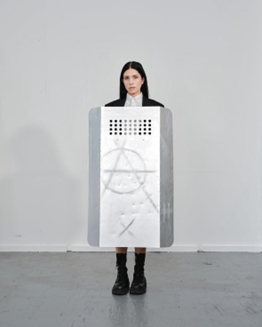
Nadya Tolokonnikova, creator of Pussy Riot
Pussy Riot has been declared an extremist organisation in Russia, with the aim of erasing the very existence of Pussy Riot from the consciousness of Russians.
A balaclava under your pillow, our song on your computer, or a like under our post - any of this can lead to a prison sentence. Pussy Riot have effectively become those-whose-name-must-not-be-spoken in Russia.
When we were put on trial for the punk prayer, we told the judge and the prosecutors that even if we were in a cage, we were still freer than they were. A decade and a half later, this is still true.
I can say what I think about Putin - that he is an aging sociopath, spreading his rot not only inside the country but across the entire world. If refusing to shove my tongue up my ass is extremism, so be it - I’ll be an extremist.
Masha Alyokhina
Russian courts, go to hell. I spent two years in a penal colony. My head was smashed with metal, I was beaten with whips, doused with green dye and with shit, my bank accounts were blocked, travel bans were imposed on me. I washed floors in buildings scheduled for demolition, spent almost a year and a half under electronic monitoring, and served six terms of 15 days in special detention centres.
You are trying to ban the name and the balaclavas in my country for exactly one reason: we did not shut up after leaving the country. And we will not shut up. At least, I don’t plan to.
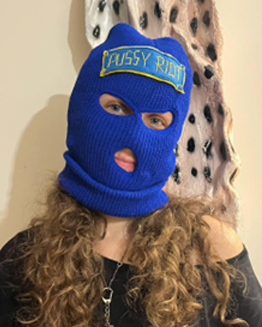
Nika Nikulshina
Pussy Riot has been officially labelled an “extremist organisation.” Participation now carries a sentence of up to six years in prison. Well-fed men in uniform boots claim that our actions threaten state security, including the FIFA 2018 action - when we interrupted the World Cup final to remind people how this state imprisons, tortures, and kills others every single day. I believe extremism is not art and not protest.
Extremism is violence, the stripping away of human rights, and the destruction of civilian life for political goals. Drones and missiles flying into Ukrainian homes every day - that is extremism. Torture in prisons is extremism. A system built on constant, routine state violence - that is extremism.
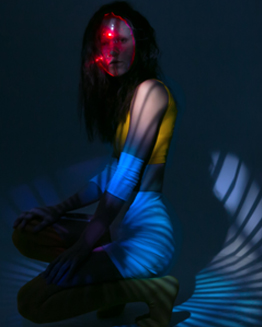
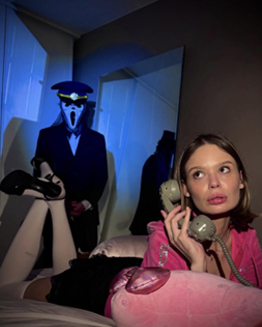
Diana Burkot
The label of “extremist” for music, rainbow flags, and actions in colourful balaclavas - sorry, not sorry, but it’s obvious that it’s not us who are insane, it’s them. And that means I couldn’t care less about their so-called laws, government, and institutions. In 2025, I envy those who can afford the privilege of being apolitical, even though I fundamentally disagree with their position.
Laws are meant to protect people, not to terrorise them. Until this affects you personally, it can be hard to engage in daily activism - but when it does affect you personally, it may already be too late. I call for the creation of a responsible civil society by the majority of the planet’s population. Everything is actually quite simple - power exists as it does because of the principle of “divide and rule”: create wars to invent an external enemy, suppress people using every possible lever and other dirty - but as old as the world - tricks, so they have neither the time nor the strength to figure out what is really going on. Don’t let them do this to you.
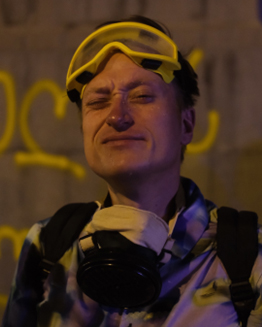
Sasha Sofeev
The terrorists have labelled us extremists.
I can't say that I'm particularly upset by a decision coming from people like that. For me, these are completely illegitimate institutions that do not represent my interests in any way.
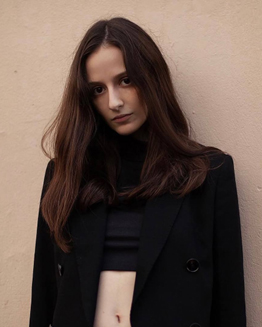
Lucy Shtein
The more harshly the Russian authorities brand you today, the clearer it becomes that you are doing the right thing, it is a sign that we have chosen the correct path.
The real extremists and terrorists are plainly sitting in the Kremlin and other offices of power, but according to the state’s Orwellian newspeak, where everything is turned on its head, they are presented as heroes and patriots.
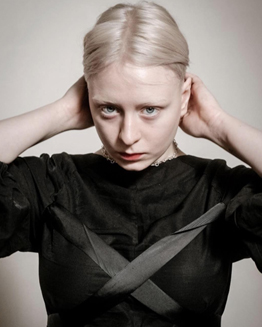
Taso Pletner
The feeling of a split existence has intensified. The space I physically occupy is here, but my identity and my memory are there, at home. Anxiety about not knowing how dangerous my new status may be for my family and loved ones has grown stronger.
My homeland has been taken from me. My home has been taken from me. And more and more often, I find myself thinking about what the word “never” actually means.