This article first appeared in the Winter 2025 issue of Index on Censorship, Gen Z is revolting: Why the world’s youth will not be silenced, published on 18 December 2025.
It’s something of a surprise to learn that the rap music genre in Russia dates as far back as the Soviet era – and that then, it came about thanks to a woman, Olga Opryatnaya. Second director of the Moscow Rock Club, sometime in the mid-1980s she heard a performance by the group Chas Pik. Struck by their innovative funk-rock fusion overlaid with an MC’s flow, Opryatnaya invited them to record an album. And thus, Russian rap was born.
Today, Russian rap music made by women coalesces around Zhenski rap, a sub-genre that emerged in the mid-1990s. Starting with Lika Rap, the 1994 album by Lika Pavlova (aka Lika Star), women have “represented” in what remains in Russia – as elsewhere – a male-dominated genre.
But this has not been a smooth ride. And as the curious case of Instasamka, the first female rapper to be subjected to state censorship shows, double standards abound – with women being targeted, unlike their male counterparts, with ambiguous charges of “moral inappropriateness”.
The censorship of women musicians in Russia is not, it should be said, a recent phenomenon. Pussy Riot, the feminist political collective, have been persecuted for more than ten years, with five of their exiled members sentenced in absentia in September 2025 to long jail sentences for speaking out against the war in Ukraine. But their cause went largely unnoticed within Russia’s rap community.
Now the war between Instasamka and the authorities, beginning in late 2021, has added cultural censorship to the well-established category of suppressing political speech.
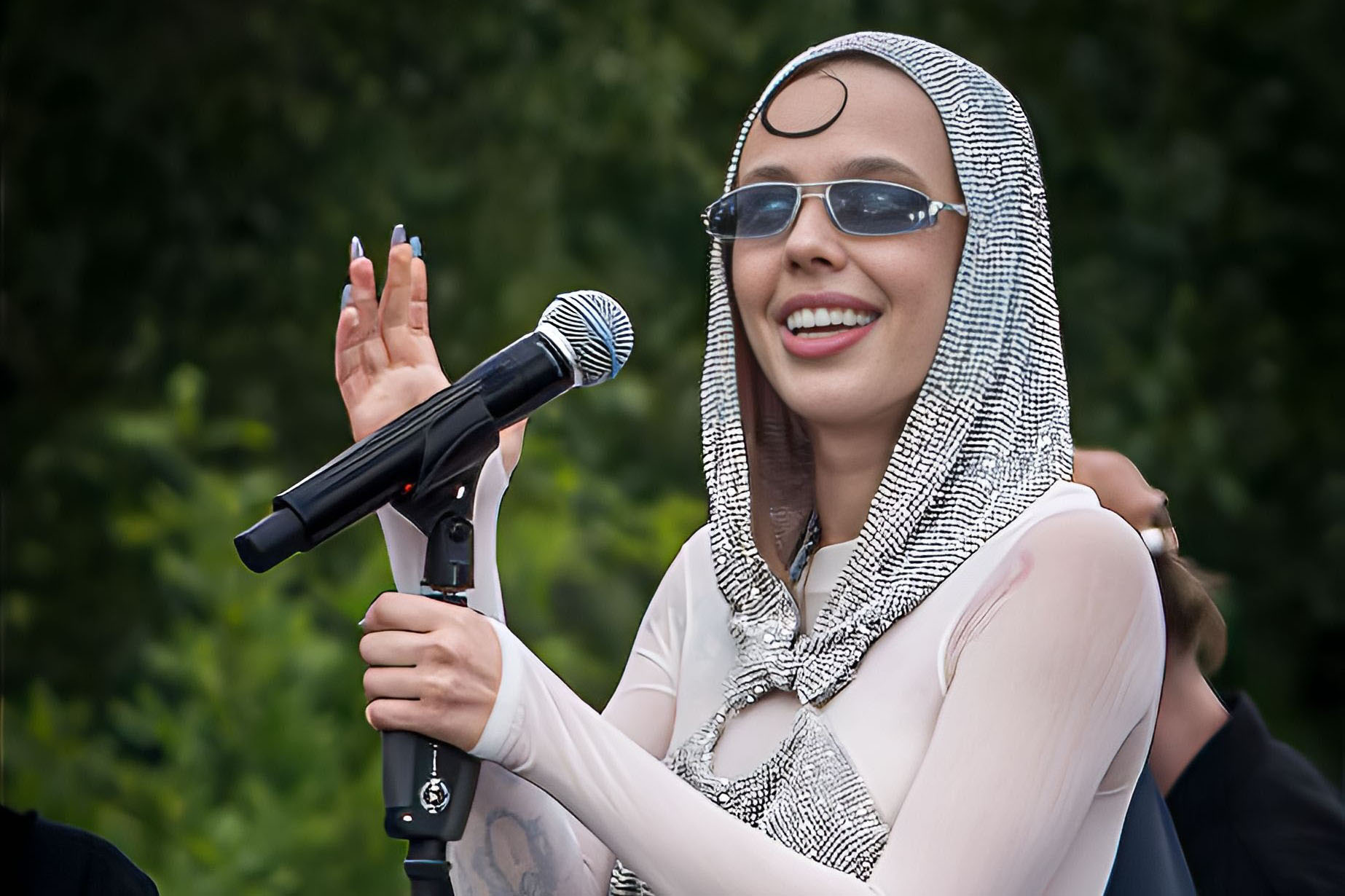
A vlogger and social media personality before becoming a musician, Instasamka’s older Instagram posts give a good sense of her defining aesthetic – accentuated physical features interspersed with tattoos, tropes often featured by her counterparts in the USA. Rubbing against the conservative – anti-foreign – values that have been in ascendency in Russia in recent years, it was no surprise that she would, in due course, attract the wrong sort of attention.
The offensive against Instasamka (real name Darya Zoteeva) was initially led by state organisations and civic organisations on 24 November 2021. The Rospotrebnadzor, the Federal Service for the Oversight of Consumer Protection and Welfare, cancelled her concert after complaints from members of the Surgut city Duma in Khanty-Mansia. The day after, the media watchdog Roskomnadzor cancelled her concert in Sverdlovsk due to similar complaints from local officials. The censorship campaign against her picked up, though, after being taken up by conservative parental groups like Fathers of Russia. A concerted campaign accusing her of promoting debauchery and prostitution among children starting in December 2022 led, ultimately, to the cancellation of her February 2023 tour.
Wilting under the pressure, Instasamka temporarily relocated to the United Arab Emirates, albeit in a precarious financial position – her bank account had been frozen by the Ministry of Internal Affairs due to an investigation on charges of tax evasion and money laundering.
The fraught situation that Instasamka found herself in only began to unwind in the late spring of 2023, following a meeting between her and Katerina Mizulina, head of the Safe Internet League. At the meeting, Instasamka and Hoffmannita (a fellow female rapper similarly targeted by conservative pressure groups) publicly apologised to concerned parents, and undertook to reform their public personas.
Her travails were far from over, however. Instasamka’s unapologetic pop (read: commercial) sensibilities had always set her out on a limb. In a music form that has traditionally (if not always consistently) prided itself on social awareness and political literacy, Instasamka’s peers themselves labelled her with one damning word: inauthenticity. By late 2023, the perception of Instasamka in Russia’s rap community was one of vocal disgust rather than silent tolerance, “I forbade my children from listening to Instasamka,” Levan Gorozia from rap group L’One told Index. “They need to understand what’s good and what’s bad.”
Similarly award-winning, rapper Ira PSP noted: “I haven’t heard of such names. They’re probably pop projects; all the rappers know each other.” Kima, another well-known rapper in the community, explicitly questioned the artistic credentials of her “peer”. Instasamka, she said, “is a successful commercial project. She’s great at copying Western artists. I don’t think of her as a rapper. […] A girl who raps can call herself whatever she wants, but she’s not a rapper if someone writes lyrics for her. I haven’t heard decent female rap lately that has both substance and a decent flow.”
But there is, perhaps, another dimension to Instasamka’s support – or lack of therein – within Russia’s female rap community.
As one member of rap group Osnova Pashasse – one of the oldest all-female rap groups in Russia – pointed out (anonymously but speaking for the group), the issue goes far deeper. “In our country, many still don’t take rap with a female voice seriously,” she said. “Perhaps this is the fault of the female MCs themselves who don’t focus their work on something interesting, with intellectual or spiritual themes, or even some captivating abstraction in their lyrics, but instead constantly emphasise their gender in their lyrics and sometimes try to compete with men.”
Credibility for female rappers, it seems, does not sit easily with commercial kudos. But then again, even commercial success is predicated on staying with the boundaries of social and cultural norms – which, in effect, sometimes operate as a form of artistic censorship.
***
The success of female rappers in Russia is, by and large, contingent upon the approval of a male-dominated culture and male-dominated ideas of quality. The historical antecedents of female rappers working in the genre notwithstanding, fair evaluation of their capabilities is not a given. As branding expert Nikolas Koro noted, a small fan base has a marked limiting impact on the visibility and commercial viability of female rappers. “In financial terms, the number of female rap fans is mere pennies. So, the fate of almost all women rappers in Russia is either to leave the stage … or change the musical format.”
Ira PSP expressed the challenges trenchantly. The issue, she said, is that “we are neither heard nor seen. The girls and I have dedicated our lives to culture, but there is no [financial] return.”
So, where is Zhenski rap heading? The balance that its practitioners must try to strike can be found somewhere between the desire to be seen as “authentic” (legitimate in the eyes of the rap community) and being themselves. They must appeal to both the dominant cultural norms within rap and assert their individuality, as women and as rappers. In the 2000s, this meant balancing skill, sex-appeal, and objectification, which only become more pronounced from the 2010s on. And they, of course, must take into account the very real prospect of censorship – creative or cultural, by peers or by the state.
The Instasamka saga did not end with her apology of 2023. After another scheduled tour was cancelled in 2024, on the grounds of her “provocative appearance”, Instasamka finally threw in the towel, declaring that she would rebrand herself and embrace a more socially acceptable demeanour. This she has played out by re-inventing herself as a champion of child safety – and by showing rather less cleavage on Instagram. In July 2025, she participated in a roundtable discussion on a proposed legislative initiative to limit the access of minors to blogging platforms. Instasamka has shifted her entire public persona behind vocally supporting a “pro-child” agenda – completely distancing herself from her past in the process.
She has also, it seems, changed her views about artistic censorship. In July this year, she openly criticised fellow rappers Dora and Maybe Baby for allegedly “anti-Russian” behaviour. Their transgression, in Instasamka’s opinion? Performing covers of songs from firebrands like the rapper FACE. Real name Ivan Dryomin, FACE was a vocal critic of the Putin regime. Forced out of the country, he was labelled a “foreign agent” by the Russian government in 2022.