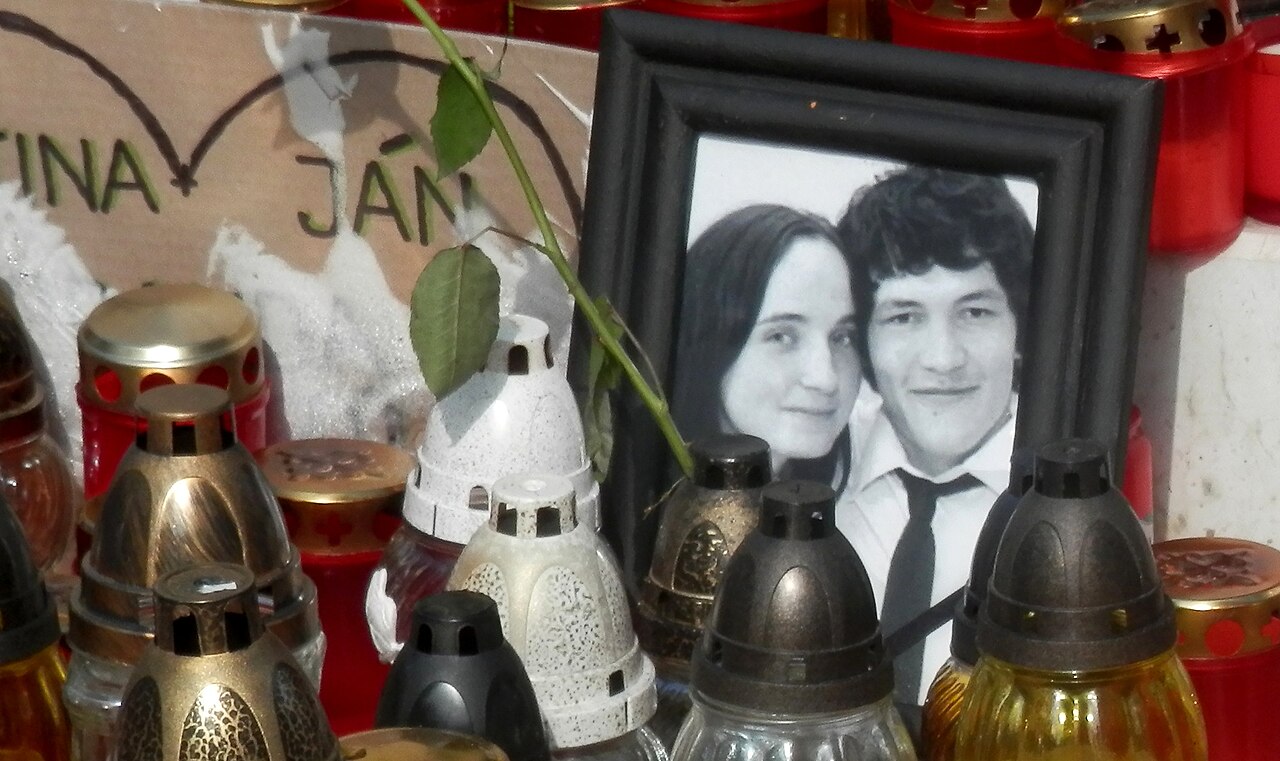
The day of Ján Kuciak’s anniversary is still traumatic for this country in the heart of Europe. But neither the president, nor the head of the national parliament, nor the prime minister said a one word about Kuciak nor his fiancée, archaeologist Martina Kušnírová, nor their assassination. In eight years, the prime minister Robert Fico has not once mentioned his name publicly. He mostly talks only about “that journalist” and spreads conspiracy theories and lies about the killing.
I and many others talked about Ján Kuciak on Saturday 21 February 2026, at one of the 30 commemorative demonstrations all around Slovakia. I travelled to Zlaté Moravce about 80 minutes’ drive from capital Bratislava, where local civic activists regularly organise political protests against the populist right-wing government.
I knew Ján personally; I was honoured to host the only public appearance of his very short, but breathtaking career in January 2017. Almost no one knew his name at that time. Where do Slovak millionaires hide their money? was the title of his awesome speech. It was an unforgettable masterclass on innovative data journalism. Ján, an extraordinary talent of his generation, had searched for, read, processed and analysed large public datasets from ministries and government offices to uncover corruption and explain tax frauds and reported on it in his unusually complex stories.
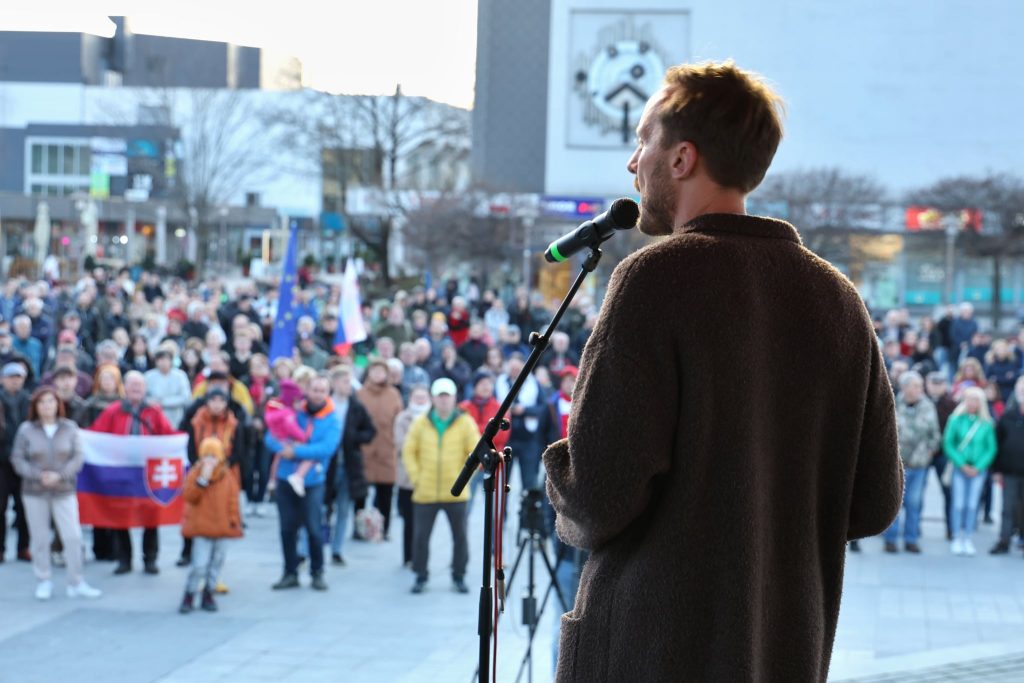
Author Michal Hvorecký speaks to a crowd on the eighth anniversary of Jan Kuciak’s murder
In his editorial office, he visualised the collected data in an old-school analogue way drawing with pencils on huge pieces papers spiderwebs of connections full of notorious oligarch names and their criminal networks. He acted as our very first digital-age watchdog. He put the information into context and explained how top members of the governing Party Smer and their sponsors and affiliated post-Soviet style businessmen – many still in power after all these years – stole huge sums and moved the money to tax havens like Cyprus. He also investigated the suspected theft of EU funds destined for eastern Slovakia by the members of Italian mafia.
Ján Kuciak uncovered that the corruption in Slovakia doesn’t only mean petty bribes, but something much deeper and more dangerous – state capture. Corruption as a system. His stories told us how Robert Fico turned democracy into a mechanism for his own enrichment and the power. Party Smer functioned – and unfortunately still does – like a cartel.
Since 2020 we have known how Ján was killed and by whom. But who ordered the assassination? Who wanted to silence him at all costs? We still do not know, and we need to know. Ján exposed a form of corruption so deeply entrenched that it threatened the rule of law and democracy.
Recently, Slovakia’s Special Criminal Court reopened the murder case for the third time. Hopefully, the court will learn from its previous errors and thoroughly examine all the evidence.
To this day, I am convinced that Ján Kuciak could have lived. If the state had acted. If Minister of Interior Robert Kaliňák – today a Minister of Defence – had not laughed at him and refused to demand a police investigation. Ján was openly threatened by influential oligarch and controversial media tycoon Marián Kočner. As a journalist he filed a criminal complaint. It didn’t help. Police refused to assist and protect him. A couple of months later Ján was executed with a single bullet to the heart and Martina with the shot to the head.
Recently, one of the businessman Ján Kuciak was intensively reporting about, Jozef Brhel, founder and sponsor of Smer, was accused of leading an organised criminal group that laundered dirty money from state contracts for years, and in February 2026, he was finally found guilty.
What Ján taught us is to never give up the fight for justice and to speak up about state capture, the most dangerous mutation of corruption. The 21 February is our annual reminder that freedom and the rule of law cannot be taken for granted. Slovakia has a strong civic society ready for widespread protest whenever necessary, and a free critical media, both also thanks to Ján. Good writing can still change the world and make it a better place, as his major work, published posthumously, proved.
“One day, Slovakia will wake up,” Ján wrote. I hope this day is very near.