This piece first appeared in the Winter 2025 issue of Index on Censorship, Gen Z is revolting: Why the world’s youth will not be silenced, published on 18 December 2025.
La Mutinerie sits in the heart of Paris’ bohemian Marais district. Two pairs of kohl-lined eyes gaze out from a mural at all who enter.
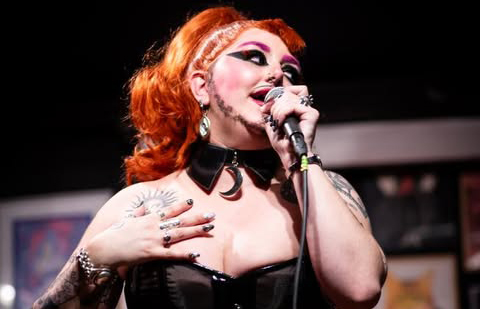
Inside, on stage, is a familiar scene you might see late at night in neon-lit venues across the French capital. Violente Violette, the host for the evening, delivers a racy blend of music, comedy and striptease, dressed in a tight-fitting corset, leather skirt and suspenders – flaunting a sparkly moustache and beard.
Once a month La Mutinerie, one of the most famous queer bars in Paris, hosts the Purple Slut cabaret. Violent Violette is a cabaret performer, sex worker and Purple Slut’s creator.
Violette started the show a little over a year ago in the hopes of providing a platform for artists from queer and sex-worker communities. The atmosphere is warm, welcoming and full of joy. The audience is packed tightly on benches. Those who can’t find a seat gather along the bar and latecomers crowd around the door, peeking over shoulders just to catch a glimpse of the show. There is a lot of cheering, not much clothing, and plenty of purple. People just seem happy to have a stage and a space.
Yet the Purple Slut cabaret’s very existence is under threat, and Violette says Meta is to blame.
Each show ends with a plea from Violette: “Please show us love online, our Instagram accounts keep getting suspended, many of us are systematically reported, so every follow helps keep these shows running.”
Many in the LGBTQ+ community say that Instagram and Facebook have become increasingly hostile places following policy changes announced by Meta boss Mark Zuckerberg in January 2025.
The changes were significant in two ways. Firstly, previous restrictions were lifted and the moderation guidelines shifted to much broader language. The term “hate speech” was changed to “hateful conduct”, a blurry concept at best. Secondly, how these guidelines are enforced changed. Previously moderation on these platforms was carried out using large teams of human moderators. Following the announcement, thousands of moderators working for Meta were made redundant. Now, users of Meta’s platform – the community – flag content they think breaks its rules. Facebook says that it is reviewed by “technology and human reviewers”.
The platform’s shift towards community moderation paves the way for co-ordinated mob-like behaviour, where moderation tools are weaponised against underrepresented members of society.
The platform’s rules are not only more vague, they allow for homophobia and increased attacks on the LBGTQ+ community. This is most obvious in the “hateful conduct” section of Meta’s guidelines.
Meta policy does not allow for conduct which alleges mental illness or abnormality unless it is motivated by “gender or sexual orientation, given political and religious discourse about transgenderism and homosexuality and common non-serious usage of words like “weird”. The use of the terms “transgenderism” and “homosexuality” are equally concerning, said Violette. “Transgenderism” has been used by far-right and transphobic groups, intended to imply that being trans is an ideology, says Violette. The advocacy group Gay & Lesbian Alliance Against Defamation (GLAAD) calls “homosexuality” an “outdated and pathologising way of referring to LGBTQ people”.
The Meta changes were met with outrage by some human rights organisations.
USA-based LGBTQ+ advocacy group Human Rights Campaign decried the dismantling of the hateful conduct policy which “expressly permits abuse against LGBTQ+ people while forbidding the same abuses against all other communities”.
Violette told Index their accounts are suspended every few weeks or so and after their first suspension they hired a lawyer. Every time it happens they send a letter to Meta Europe’s headquarters in Ireland through the post, an old-school strategy to ensure that their request will be “seen by a human”. Methodically, the letters go through the supposed reason for the suspension and argue their case to get their accesses reinstated.
Violette says they know the regulations by heart now. They say they exclusively use Instagram (instagram.com/cabaret_purple_zlut) to post photos and promote the cabaret. Since the platform is particularly sensitive to nudity, they know how to self-censor their posts and avoid automatic suspension. While nudity in general can be an issue on the platform, they say LGBTQ+ nudity comes under much more scrutiny.
“A lot of people don’t like what we do, so they use the tools Meta gives them, which is reporting, and by reporting us over and over again, they eventually manage to get our accounts taken down.”
In most cases, suspensions are due to users reporting the account as inappropriate or sexually explicit. In their letters, Violette and their lawyer systematically compare the accusations to the photos or posts, knowing that each one was posted taking into account Meta’s guidelines. It takes a few days for their request to be processed and for the account to be reactivated.
Violette says that some of their fellow queer cabaret performers have given up Instagram altogether, fed up of having to fight the platform. Some tried to move over to less effective social media platforms such as Bluesky or Mastodon. If they are not considered to be able to contribute to the promotion of an event effectively, then they do not get booked. Those who choose to stay on Instagram but who cannot get their accounts back often have to start again, building their following back up from scratch. LGBTQ+ cabaret performers are struggling to make ends meet online, but is this just the symptom of a much larger homophobic and transphobic problem?
Human Rights Watch technology researcher Deborah Brown argues that the platform had already shown patterns of anti-LGBTQ+ sentiment, but the January changes demonstrated that Meta was no longer even pretending to align its content guidelines with human rights norms – protecting against homophobia. “Even if they were not actively properly protecting LGBTQ+ communities before,” she said, “at least they used to communicate that they needed protection.”
The new policies also decrease the reach and visibility of “political content”. Accounts which publicly share political content are left out of algorithms which might otherwise amplify their message. Since then, many pro-equality or LGBTQ+ rights groups have seen their audiences drop significantly, leading many to accuse social media companies of “shadow-banning”.
Difficult to trace and even harder to prove, shadow-banning is broadly defined as limiting the visibility of social media users without their knowledge. While social media companies often justify the practice by arguing they protect users from harmful content, this algorithmic censorship can disproportionately impact LGBTQ+ communities. According to a recent study by the University of Sussex, shadow-banning is “often mis-applied and overly-targets the LGBTQIA+ community and other minorities” and has contributed to what they call “the algorithmic erasure of drag”.
Violette said many queer artists feel like they are fighting the algorithm. “It is a constant battle, the problem is it is difficult to prove.”
Brown added that shadow-banning is often the result of an account being previously flagged. “If there is a strike on an account, then that will affect the reach of the content it posts online,” she explained.
Meta’s policies and guidelines were never perfect to begin with, now they are “simply unacceptable”, believes Violette. The platform’s latest iteration hinders the reach and visibility of LGBTQ+ content, paving the way for homophobic and transphobic behaviour, whilst also reducing the protections offered to people from marginalised communities.
A platform which presents itself as the pinnacle of free speech cannot foster free expression if people feel unsafe. Brown said: “If you accept that that kind of abuse is permissible, then people will be forced to self-censor or leave.”
It means that there is less “space” for LGBTQ+ communities and their content online, the impact of which is being felt beyond our screens. Violette has struggled to fill clubs and theatres.
They said: “If our social media presence isn’t a useful communication tool, then venues won’t book us. If people don’t know we exist, then they won’t come to our shows. If clubs aren’t full, then they can’t survive.”
La Mutinerie and the Purple Slut cabaret have a pay-what-you-can policy, designed to keep their safe space open to everyone in their community. Violette and their partner make Purple Slut merchandise which they sell to support the artists as best they can.
Queer and trans venues in Paris are crucial cultural and safe spaces, their disappearance would be devastating to the under-represented communities they welcome.
Both space and speech should be protected, be it on or offline. Today’s online environment enables homophobia and is slowly suffocating LGBTQ+ spaces, leaving communities fighting for air. Social media is fast becoming a far-right tool for political influence and algorithmic erasure, where the whims of billionaires take precedence over the brilliant diversity of humanity.
But the show must go on, and Paris’s queer cabarets will keep dancing through these dark times in joyful defiance.