
ODEE and Fishrot: Index signs letter in support of artistic freedom
We are writing to bring attention to the case of the visual and performance artist and master’s student, ODEE, who is being sued for damages (including legal fees likely upwards of £500,000) in the High Court in London on the 25 and 26 September 2024. The lawsuit has been brought against ODEE by Samherji, one of Europe’s largest fishing companies based in Iceland, for the unauthorised use of its website and brand.
ODEE’s art piece centres around the concept of corporate responsibility through a fictional apology – via a website he created and a mural at the Reykjavík Art Gallery – for the alleged corruption committed by Samherji to secure fishing quotas in Namibia revealed in 2019 by the whistleblower, Jóhannes Stefansson, and which quickly became known as the #Fishrot Scandal.
Samherji has exercised its rights to challenge ODEE by issuing an interim injunction to require him to take down the website with the spoof apology, and he did so in May 2023. The court will need to decide whether to vary or discharge the injunction, and whether the artist should be liable for Samerjhi’s legal costs and alleged damages. However, the question remains as to whether such action is proportionate, or an attempt to silence those who speak out against corruption.
The alleged corruption is currently the focus of a high-profile trial in Namibia in which 10 suspects have been charged including the former Ministers of Justice and Fisheries – the majority of whom have been held in custody since 2019, and who may face even longer jail terms if convicted. Investigations into Samherji’s activities are continuing in Iceland.
Ensuring that whistleblowers can disclose information about wrongdoing in the public interest is vital for democratic accountability – so that proper investigations can occur, and those responsible are held to account. Protecting whistleblowers safeguards the public’s right to know, an essential element of the right to freedom of expression.
Artistic freedom of expression – through film, theatre, literature, painting and conceptual art, among many other media – is also vital to a healthy democracy and to public discourse and the development of ideas. Artistic expression allows individuals, communities and societies to consider and examine moral and ethical choices, as well as how power works and affects us, whether it is political, social or economic.
Freedom of expression links whistleblowers and artists – individuals must be protected from the powerful who wish to stop them speaking up. Jóhannes Stefansson and ODEE deserve our support. In today’s world, where we face existential challenges to protect our natural resources, environment and climate systems, we can ill afford to let these voices be silenced.
We, the undersigned, therefore, urge Samherji to drop its disproportionate case against the artist, ODEE.
SIGNED BY:
African Centre for Media & Information Literacy (Nigeria)
Artistic Freedom Initiative (International)
Blueprint for Free Speech (International)
Daphne Caruana Galizia Foundation (Malta)
Disruption Network Lab e.V. (Germany)
Centre for Free Expression (Canada)
Civil Liberties Union for Europe
Citizens Network Watchdog Poland
Climate Whistleblowers (France)
GlobaLeaks (Italy)
Government Accountability Project (USA)
Index on Censorship (UK)
Institute for Public Policy Research (Namibia)
Justice and Environment (EU)
Oživení (Czech Republic)
Pištaljka (Serbia)
Platform to Protect Whistleblowers in Africa (PPLAAF)
Pro Publico (International)
Protect (UK)
Shadow World Investigations (UK)
Spotlight on Corruption (UK)
The Whistleblower House (South Africa)
Transparency International Ireland
Transparency International Italy
Whistleblowers-Netzwerk e.V. (Germany)
Whistleblower Chile
Whistleblowing International Network
* Protect is a registered Charity in England and Wales No.1025557
** WIN is a Scottish Charitable Incorporated Organisation No. SC048595
The most ridiculous book bans
Banned Books Week is here once again. And so too are more stories of books being censored across the world. This week, Pen America reported that the number of book bans in public schools has nearly tripled in 2023-24 from the previous school year.
While the week-long Banned Books Week event, supported by a coalition including Index on Censorship, looks largely towards bans in the USA, we’re taking a moment to reflect on global censorship of literature. We asked the Index team to share what they think is the most ridiculous instance of book censorship, from the outright silly to the baffling but dangerous. Some of these examples verge on amusing — the Chinese Communist Party (CCP)’s aversion to talking animals, for example — but the bans that have ended in attempted murders just go to show that the practice of book banning itself is completely nonsensical, and can lead to real harm.
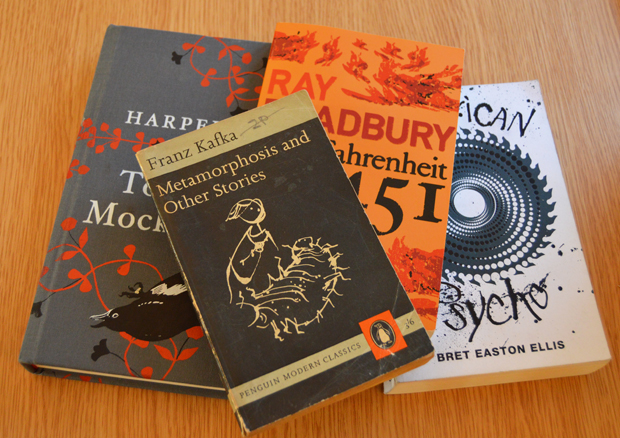
Banned Books (Photo by Aimée Hamilton)
Too many talking animals
You don’t have to have children to imagine what a clichéd kids book might look like. Yes, you’ve guessed right – animated animals. Tigers, mice, dogs – they’re all common in children’s literature. But the Chinese authorities have an uncomfortable relationship with our furry friends.
In 2022 a Hong Kong court sent five people to prison for publishing a series of books called Sheep Village (and of course they banned the books too). To be fair these illustrated books, aimed at kids aged four to seven, didn’t code their political messages well: a flock of sheep (stand-in for Hong Kongers) peacefully resist a savage wolf pack (the guys in Beijing). So this might not be the most absurd example, though it did feel like an absurdly low moment.
However, what was clearly absurd on all levels was the 1931 ban of Alice in Wonderland by the governor of Hunan Province. The book’s crime? Talking animals. Apparently they shouldn’t have used human language and putting humans and animals on the same level was “disastrous”. What unites the CCP with the Republic of China that came before it? Unease around anthropomorphised animals it would seem.
- Jemimah Steinfeld, CEO
Too many banned books
Ban This Book by Alan Gatz, a book about book bans, has been banned by the state flying the banner for banning books. This is not a tongue twister, riddle or code. It is the crystallisation of the absurdity of banning books.
In January 2024, the book was banned in Indian River County in Florida after opposition from parents linked to Moms for Liberty. According to the Tallahassee Democrat, the school board disliked how the book “referenced other books that had been removed from schools” and accused it of “teaching rebellion of school board authority”. When you are trying to reshape the world in line with your own blinkered view it is probably best not to draw attention to it by calling out reading as an act of rebellion. Just a thought.
The book tells the story of Amy Anne Ollinger’s fight to overturn a book ban in her fictional school library. The book’s conclusion leads Amy Anne “to try to beat the book banners at their own game. Because after all, once you ban one book, you can ban them all”.
This tells us something – the self-harming absurdity of book bans is apparent to kids like Amy Anne but not to the prudish administrators and thuggish groups wielding their mob veto like a weapon. Groups like Moms for Liberty and their fellow censors obscure the darkness of our shared history by removing any reference to it and by pretending it did not happen — not by addressing the root causes or working to ensure it does not happen again.
- Nik Williams, policy and campaigns officer
Too Belarusian
In Belarus, numerous books in the Belarusian language by the country’s best classical and modern writers have been banned, especially following the 2020 presidential election and pro-democracy protests. Unbelievably, Lukashenka’s regime — often called the last dictatorship in Europe and backed by Russia — views Belarusian historical, cultural and national identity as a threat.
Many books in Belarusian have been labelled extremist and even destroyed from the National Library’s collection since the protests started in August 2020. This includes Dogs of Europe by Alhierd Baharevich, works by 19th century writer Vincent Dunin-Marcinkievich and 20th century poet Larysa Hienijush, among others.
- Jana Paliashchuk, researcher on Index’s Letters from Lukashenka’s Prisoners project
Too decadent and despairing
Franz Kafka’s The Metamorphosis, possibly the greatest short story ever written, was banned by both the Nazis and the Soviets. Being a Jewish author, the Nazis burned Kafka’s books on their “sauberen” (cleansing) pyres. But in the Soviet Union, his books were banned as “decadent and despairing”. This was clearly a judgement made by officials without much knowledge of the history of the novel, where so many titles are filled with human despair. Without these, we would not get the contrasting light of decadent writers like Oscar Wilde and JK Huysmans.
- David Sewell, finance director
Too mermaidy
One of my favourite books to read with my son is Julian is a Mermaid by Jessica Love. It’s a beautiful picture book where a young boy dreams of becoming a mermaid after seeing a school / pod (collective noun to be determined) of merfolk on the way to the Coney Island Mermaid Parade, then rummages around his nana’s home for a costume.
In various parts of the USA, Julian has been banned. In a school district in Iowa, it was flagged for removal under a law that “bans books that depict or describe sex acts”, which apparently also covers gender identity — there are definitely no sex acts in this book. In other districts, it’s been fully banned due to representing the LGBTQ+ community.
If book banners in the USA are really worried about kids becoming mermaids, then I’d like to know on what grounds. Because, quite frankly, I always wanted to be a mermaid, and if it turns out it was a viable option, I have some regrets. Personally, I’d be more concerned about Julian ripping down his nana’s curtains to make a tail, à la Julie Andrews making costumes for the Von Trapp children.
- Katie Dancey-Downs, assistant editor
Too accurate
In Egypt, Metro, the country’s first graphic novel by Magdy El Shafee, was quickly banned after publication in 2008 for “offending public morals”. This was likely due to the novel’s depiction of a half-naked woman, inclusion of swear words and general portrayal of poverty and corruption in Egypt during the former president Hosni Mubarak’s 30-year rule. The author was charged under article 178 of the Egyptian penal code for infringing “upon public decency” and fined 5,000 LE. It was eventually republished in Arabic in 2012.
- Georgia Beeston, communications and events manager
Too dystopian
Aldous Huxley’s 1932 dystopian classic Brave New World explores an imagined future centred on productivity and enforced “happiness” at the expense of individual freedom. Set in 2540, society has been stripped of families, with babies manufactured synthetically with specific characteristics, then forced into a predetermined “caste” system. People are encouraged to prioritise short-term gratification through casual sex and taking a “happiness” drug called soma, making them blissfully unaware of their imprisonment within the system.
Since its publication nearly 100 years ago, the novel has caused controversy globally. It was initially banned in Ireland and Australia in 1932 for eschewing traditional familial and religious values, then later banned in India in 1967 for its sexual content, with Huxley even being referred to as a “pornographer” for depicting a society that encourages recreational sex. It is still banned in many classrooms and libraries across America for a range of wild reasons, from use of offensive language and sexual explicitness to racism and “conflict with a religious viewpoint”.
But Huxley’s imagined future is one of horror. He uses themes of enforced, unfettered pleasure and a twisted genetic-based class system to express how humans’ complex problems and moral quandaries cannot be solved by scientific advancement alone. The main point of dystopian fiction is to tell a cautionary tale of the levels of exploitation that society could sink to, in order to save the world at large. While it was undoubtedly shocking and crass for its time, the fact that Huxley’s novel still ruffles feathers reveals a complete misunderstanding of allegory.
- Sarah Dawood, editor
Too many lesbians
I first read Radclyffe Hall’s legendary lesbian novel, The Well of Loneliness, published in 1928, with bated breath as a young, closeted queer person. Her portrayal of young woman ‘Stephen’ Gordon and her romance with Mary Llewellyn was wildly liberating and satisfying to read. Of course, as a product of its time it is in many ways outdated and of course laced with problematic values, for example biphobia and misogyny. But it was hugely important in terms of normalising queer relationships over a century ago.
Shortly after publication, the book went to trial in Britain on the grounds of “obscenity” and was subsequently banned — but this is no Lady Chatterley’s Lover. There are no real ‘hot under the collar moments’. The only ‘obscenity’ was the portrayal of two women in a romantic relationship, even though (unlike male homosexuality), lesbianism wasn’t actually illegal in 1928.
- Anna Millward, development officer
Too friendly
The award-winning writer and painter Leo Lionni’s first children’s book Little Blue and Little Yellow (1959) is a short story for young children about two best friends who, one day, can’t find each other. When they meet again, they give each other such a big hug that they turn green.
Despite its important message about the power of love and friendship, the mayor of Venice decided to ban it from all preschools in the province for “undermining traditional family values”. It was one of more than 50 children’s books to have been banned just days after he took up the post after his election in 2015.
- Jessica Ní Mhainín, head of policy and campaigns
Too uncensored
As ironies go, the banning of Ray Bradbury’s Fahrenheit 451 may be the strangest. The novel describes a dystopian future in which books are banned and “firemen” burn any that are found – its title comes from the ignition temperature of paper.
In 1967, a new edition of the book aimed at high schools, known as the Bal-Hi edition, was substantially altered to remove swear words and references to drug use, nudity and drunkenness. Somehow, the censored text came to be used for the mass-market edition in 1973 and “for the next six years no uncensored paperback copies were in print, and no one seemed to notice”, wrote Jonathan R. Eller in the introduction to the 60th anniversary edition of the book.
Readers eventually realised and alerted Bradbury. He demanded that the publisher retract the censored version, writing that he would “not tolerate the practice of manuscript ‘mutilation’”.
- Mark Stimpson, associate editor
Too unflattering
It’s not altogether surprising that UK authorities attempted to prevent the autobiography of former MI5 officer Peter Wright, Spycatcher (co-written by Paul Greengrass), from hitting the shelves. The book did not present British intelligence agencies in a flattering light, and the government’s claims that they were suppressing its publication in the interests of security — rather than to save face — were eventually dismissed by the courts.
However, the ridiculous part about this book banning was that it only applied to England and Wales and the book was freely accessible elsewhere — including Scotland. This led to an absurd situation where newspapers around the world were reporting on the book’s contents while the press in England was subject to a gagging order, despite the information having already been revealed and books being easily shipped into the country. The ban was eventually lifted after it was acknowledged that the book wasn’t exposing any secrets due to its overseas publication.
- Daisy Ruddock, CASE coordinator
Too blasphemous
The most absurd book banning is also, arguably, the most serious in recent history. The Satanic Verses by Salman Rushdie was published in 1988 to deserved critical acclaim. It is a playful and complex novel that examines, among other things, the origins of Islam. The death sentence imposed on the author by Iran’s supreme leader Ayatollah Khomeini was fuelled by, and in turn itself fuelled an ideology that believes that a novel can be blasphemous and its author should be killed. It would be laughable if the consequences weren’t so deadly.
- Martin Bright, editor at large
Anti-SLAPP Conference 2024 | Dublin
About this event
Strategic lawsuits against public participation (SLAPPs) are abusive legal threats and actions brought by powerful and wealthy people against public watchdogs with the aim of silencing them. Due to the high cost of defending a case, public watchdogs can effectively be silenced even when what they have said is accurate and in the public interest. When SLAPPs successfully drive information out of the public domain, it is much more difficult to hold power to account. SLAPPs have proliferated globally in recent years and Ireland has previously been identified as a jurisdiction of concern.
The Council of Europe and the European Union have, this year, introduced measures aimed at countering SLAPPs. All EU Member States now have until May 2026 to transpose the EU Anti-SLAPP Directive into national legislation. The Council of Europe’s non-binding Recommendation, adopted in April, should help ensure that Member States enact the most robust anti-SLAPP legislation possible, while also providing a roadmap for those jurisdictions – like Northern Ireland – that are not subject to the EU Directive.
At this full-day conference, attendees will hear from a wide-range of stakeholders, including campaigners, academics, journalists, lawyers and politicians from across the island, as we discuss how SLAPPs have manifested themselves in an Irish context. The full line-up of speakers will be announced in due course. Subscribe our newsletter to stay informed.
The event is organised by Index on Censorship in association with the Digital Repository of Ireland, TCD Law School, the Council of Europe’s Safety of Journalists’ Platform, the Coalition against SLAPPs in Europe (CASE), and the UK Anti-SLAPP Coalition.