15 Oct 2014 | Press Releases, Uncategorized
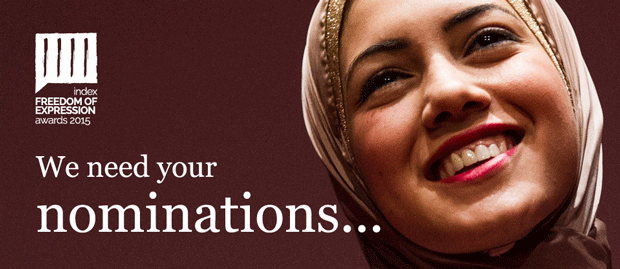
- Awards honour journalists, campaigners and artists fighting censorship globally
- Judges include journalist Mariane Pearl and human rights lawyer Sir Keir Starmer
- Nominate at www.indexoncensorship.org/nominations
Beginning today, nominations for the annual Index on Censorship Freedom of Expression Awards 2015 are open. Now in their 15th year, the awards have honoured some of the world’s most remarkable free expression heroes – from Israeli conductor Daniel Barenboim to Syrian cartoonist Ali Farzat to education activist Malala Yousafzai.
The awards shine a spotlight on individuals fighting to speak out in the most dangerous and difficult of conditions. As Idrak Abbasov, 2012 award winner, said: “In Azerbaijan, telling the truth can cost a journalist their life… For the sake of this right we accept that our lives are in danger, as are the lives of our families. But the goal is worth it, since the right to truth is worth more than a life without truth.” Pakistani internet rights campaigner Shahzad Ahmad, a 2014 award winner, said the awards “illustrate to our government and our fellow citizens that the world is watching”.
Index invites the public, NGOs, and media organisations to nominate anyone they believe deserves to be part of this impressive peer group: a hall of fame of those who are at the forefront of tackling censorship. There are four categories of award: Campaigner (sponsored by Doughty Street Chambers); Digital Activism (sponsored by Google); Journalism (sponsored by The Guardian), and the Arts. Nominations can be made online via http://www.indexoncensorship.org/nominations
Winners will be flown to London for the ceremony, which takes place at The Barbican on March 18 2015. In addition, to mark the 15th anniversary of the Freedom of Expression awards, Index is inaugurating an Awards Fellowship to extend the benefits of the award. The fellowship will be open to all winners and will offer training and support to amplify their work for free expression. Fellows will become part of a world-class network of campaigners, activists and artists sharing best practice on tackling censorship threats internationally.
Jodie Ginsberg, CEO of Index, said: “The Index Freedom of Expression Awards is a chance for those whom others try to silence to have their voices heard. I encourage everyone, no matter where they are in the world, to nominate a free expression hero.”
The 2015 awards shortlist will be announced on January 27th 2015. Judges include journalist Mariane Pearl and human rights lawyer Sir Keir Starmer. The public will be asked to participate in selecting the winner of the Google Digital Activism award through a public vote beginning January 27th 2015. Sir Keir said: “Freedom of expression is part of the bedrock of civilised, democratic society. The Index on Censorship Awards have a material influence on promoting such freedom and both celebrating and protecting those who fight against censorship worldwide. That’s why Doughty Street Chambers chooses Index as its principal charity.”
For more information please contact David Heinemann: [email protected]
_______________________________________________________________________
NOTES FOR EDITORS
About Index on Censorship:
Index on Censorship is an international organisation that promotes and defends the right to freedom of expression. The inspiration of poet Stephen Spender, Index was founded in 1972 to publish the untold stories of dissidents behind the Iron Curtain and beyond. Today, we fight for free speech around the world, challenging censorship whenever and wherever it occurs. Index believes that free expression is the foundation of a free society and endorses Article 19 of the Universal Declaration of Human Rights, which states: “Everyone has the right to freedom of opinion and expression.”
About The Index on Censorship Freedom of Expression Awards:
The Index Freedom of Expression Awards recognise those deemed to be making the greatest impact in tackling censorship in their chosen area.
Awards categories:
Journalism – for impactful, original, unwavering journalism across all media (sponsored by The Guardian).
Campaigner – for campaigners and activists who have fought censorship and who challenge political repression (sponsored by Doughty St Chambers).
Digital Activism – for innovative uses of new technology to circumvent censorship and foster debate (sponsored by Google).
Arts – for artists and producers whose work asserts artistic freedom and battles repression and injustice.
Previous award winners include:
Journalism: Azadliq (Azerbaijan), Kostas Vaxevanis (Greece), Idrak Abbasov (Azerbaijan), Ibrahim Eissa (Egypt), Radio La Voz (Peru), Sunday Leader (Sri Lanka), Arat Dink (Turkey), Kareen Amer (Egypt), Sihem Bensedrine (Tunisia), Sumi Khan (Bangladesh), Fergal Keane (Ireland), Anna Politkovskaya (Russia), Mashallah Shamsolvaezin (Iran)
Digital/New Media: Bassel Khartabil (Palestine/Syria), Freedom Fone (Zimbabwe), Nawaat (Tunisia), Twitter (USA), Psiphon (Canada), Centre4ConstitutionalRights (US), Wikileaks
Advocacy: Malala Yousafzai (Pakistan), Nabeel Rajab (Bahrain), Gao Zhisheng (China), Heather Brooke (UK), Malik Imtiaz Sarwar (Malaysia), U.Gambira (Burma), Siphiwe Hlope (Swaziland), Beatrice Mtetwa (Zimbabwe), Hashem Aghajari (Iran)
Arts: Zanele Muholi (South Africa), Ali Farzat (Syria), MF Husain (India), Yael Lerer/Andalus Publishing House (Israel), Sanar Yurdatapan (Turkey)
You have received this email because email address ‘[email protected]’ is subscribed to ‘AWARDS 2015 Call For Nominations’.
4 Sep 2014 | ArtFreedomWales, Events, News
 Is the space for artistic freedom of expression expanding or shrinking?
ArtFreedomWales is part of Index on Censorship’s programme taking stock of the support for artistic expression across the arts sector in the UK and ArtFreedomWales focuses on the specific issues impacting on Welsh arts and culture.
Join artists from all fields and working at all levels in Wales for an afternoon of participatory debate and open, honest discussion.
Confirmed speakers include:
- Elen ap Roberts (Artistic Director, Pontio Centre of Arts and Innovation)
- Dai Smith (Chair of Arts Council Wales)
- Baroness Kay Andrews (Author of Tackling Poverty through Culture)
- Lleucu Siencyn (CEO Literature Wales)
- David Anderson (Director General of Museums Wales)
- John McGrath (Artistic Director, National Theatre Wales)
WHEN: Thursday 27th November, 1pm – 6pm
WHERE: Chapter Arts Centre – Cardiff (Map/directions)
TICKETS: £5 contribution to costs, available from Chapter Arts Centre Box Office.
#ArtFreedomWales
ArtFreedomWales: Google Hangouts With Artists From Across Wales
In the lead up to this event, we’re hosting online discussions with artists from across Wales. The first, asking whether Wales is a centre for artistic free expression featured Tim Price, Lisa Jen, Kathryn Gray and Leah Crossley. Watch it here.
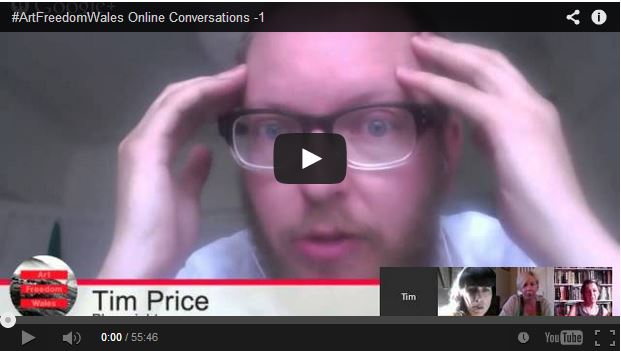
The second, exploring the situation for artists working in Welsh featured Bethan Jones Parry, Arwel Gruffydd, Bethan Marlow, Mari Emlyn and Iwan Williams. Watch it here.
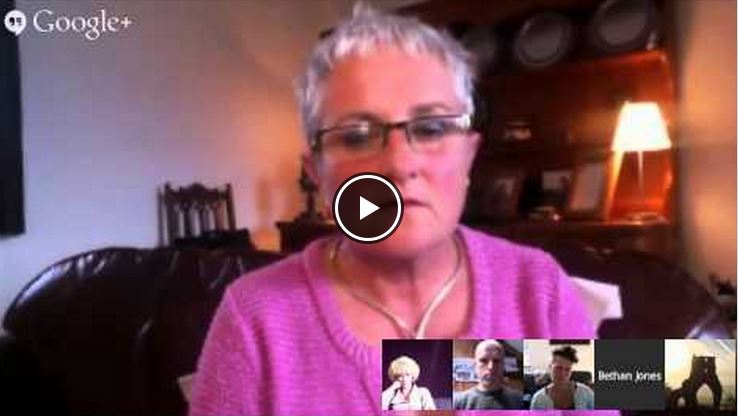
Two further discussions will follow in late September and early October – check back here for details. Collectively, these discussions will inform the agenda for the #ArtFreedomWales symposium.
ArtFreedomWales: Why We Are Doing This.
“Freedom of expression is not self-perpetuating, but needs to be maintained by the constant vigilance of those who care about it.” Michael Scammell – Index on Censorship Magazine 1972
We believe that freedom of artistic expression lies at the heart of artistic practice. Support for artistic freedom allows the artist to push boundaries, to say what is not being said, to imagine the world differently, to act as critic and to speak truth to power. Artistic freedom of expression thrives on risk and experimentation, embracing controversy and diversity of opinion. And there is a vibrant and essential debate triggered by challenging art.
You only have to think of what happens to artists in societies that are not free… But even in countries where freedoms are upheld as a core principle, artistic freedoms are all too easily eroded by social, political and sometimes legal constraints.
ArtFreedom: The UK Programme so far.
In 2013 we held a conference in London ‘Taking the Offensive’ hosted by Jude Kelly at the Southbank Centre to identify and explore the social, political and legal controls that shape our cultural landscape. Nicholas Serota gave an insightful keynote speech and amongst the contributors were lawyer Anthony Julius, Professor Mona Sidiqui, Sir Hugh Orde (President of the Association of Chief Police Officers), Sally Tallant (CEO Liverpool Biennial) and Moira Sinclair (Executive Director of Arts Council England). You can read a report here.
In May 2014, we held a symposium in Belfast exploring these issues in Northern Ireland with playwright Martin Lynch giving an opening provocation to a morning of artist focused debate and discussion.
ArtFreedomWales is funded by Arts Council Wales as part of our UK wide programme looking at freedom of expression in the arts.
Arts Council of Wales supports this programme
28 Aug 2014 | Europe and Central Asia, News
(Image: Nemanja Cosovic/Shutterstock)
I’m on holiday in Ireland, and taking a break from standing up for people’s rights to misattribute quotes to Voltaire and Orwell. This is what people who normally go on about civil liberties battles do on holiday; we revel in the dark side, and engage in orgies of frightful behaviour. For two weeks in August, defence lawyers who normally fight the good fight lock people in cupboards and throw away the keys; anti-surveillance campaigners retreat to their hides high above the city, and just…watch. Digital rights folks take down physical notes of all your Facebook statuses. I once spent a delightful summer phoning people at random and then telling them to shut up when they answered the phone.
It’s a wonderful release, but for understandable reasons, we don’t talk about it. It’s the prime directive of the League of Sanctimony: what happens in those two weeks in August must remain hidden from the world.
Until now, that is. Having grappled with the crippling irony of concealing the truth from Index on Censorship readers, I have decided that you have a right to know about everything I would have banned without a second thought, if only during the last bit of August. In no particular order, here we go:
Newspaper holiday reading lists. Dear writer/reporter/critic: you’re either lying about all those books you’re going to get through during your delightful few weeks in Tuscany/Cornwall/west Cork/Thorpe Park, or you’re telling the truth and making me feel inadequate.
Rainy holidays: Yes, I know I shouldn’t really complain about going to Ireland and experiencing heavy precipitation. I don’t care. I’m doing it anyway.
People who can’t write (of whom there are many).
People who can write better than I can (of whom there are many).
People who think pointing out split infinitives makes them look clever. It doesn’t. Split infinitives are perfectly fine. Just don’t ask me why.
People who are good at explaining grammar and syntax. See above.
People who are good at explaining grammar and syntax but then end up allowing anything, cheerily proclaiming “The thing is, language is evolving all the time.” For God’s sake, make a commitment, man.
Really terrible internet memes. David Icke, former Coventry City goalkeeper turned conspiracy theory bother no 1, is the master of these. Look at this, for example. It’s just a picture of a man with snarky words written over it. That’s not a meme.
Any article in print or online which sets out to prove that a current conflict proves that the writer was correct in his or her position on a previous conflict. Thanks. Helpful.
LinkedIn. I still don’t understand. Still.
The word “Listicle”. What’s wrong with “list”? Or “article”? I could even be happy with “list article.”
Lists. Hang on…
Defensive articles about why one form of entertainment is EVERY BIT AS VALID as other forms of entertainment. Video games are video games. Comics are comics. Neither are novels. Move on.
Those public service “poems” on the London Underground. They have been sent to torment all right-thinking people. Read this, and despair for all of us.
I could go on, possibly forever. But it wouldn’t matter a damn. No one in their right mind would take me seriously. It’s just the furious venting of a cranky old man, shaking his fists at the clouds. And yet, every day, censors, religious or moral or autocratic, demand to be taken seriously.
They contend that they are uniquely qualified to say what others can and cannot see or hear or read. Worse, they tell us they are censoring for our protection. They can read a blasphemous book, or watch a pornographic film, and decide soberly what effect it will have on society. Whereas if the likes of you and I went near these things, the entire world would be transformed into something resembling Ken Russell’s The Devils in about 15 minutes. They think we’re impressionable. They think we’re gullible. They think we’re children.
As the holidays come to a close and we reluctantly switch our brains back on to face the coming winter, let’s not block out the calls for censorship: that, of course, would be hypocritical. But perhaps we can turn the tables on the cries of the censors, smile politely and continue about our grown-up business.
This article was posted on August 28, 2014 at indexoncensorship.org
14 Aug 2014 | News, United Kingdom
Top flight football is back! Back! BACK! After an agonising entire month since the World Cup Final with nothing to sustain people but the made-up soccer tournaments designed to draw American crowds, and the Commonwealth Games, and the England India cricket tests, the people of Britain can relax, and fall trustingly into the loving arms of the Premiership.
Once more, it will be deemed legitimate to spend Saturday afternoons in a pub, watching other men watching football; once more we can spend Saturday nights complaining about Mark Lawrenson and Alan Shearer’s dull observations on Match of the Day; once more Arsenal will be a little disappointing.
I say “once more” but of course the football never really ends, it just sleeps for a few weeks every year. But now it is awake.
At this point, fans of leagues that are not the premiership will be pointing out that their leagues started last weekend, and they’re right.
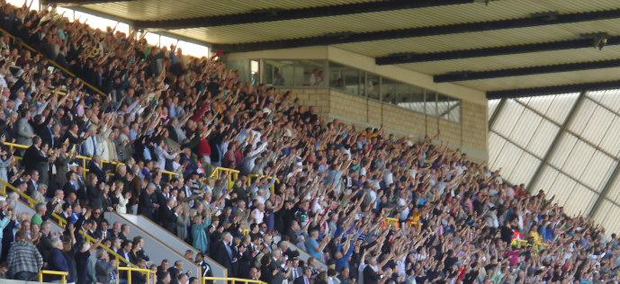
And what was the main story from the (non-Premiership) Football League this week? The news that Millwall fans had upset their Leeds United rivals with a new chants about serial sexual abuser Jimmy Savile, a Leeds native. Not to exactly repeat it, but the chant essentially suggested that Leeds fans may be the offspring of Savile.
Milwall’s manager Ian Holloway criticised his own fans, saying: “Let’s stop and think about what [Savile] has actually done. That’s the most important thing and we don’t see that. ‘Oh, it is a bit of banter’. It isn’t funny, is it? I don’t think so.”
Now clearly, some Millwall fans did find this funny. Or they found the idea of offending Leeds fans funny. Because offending the opposition has for a long time, been part of going to football.
My home team, Cork City, who play in Ireland’s Airtricity League, have a pretty good relationship with Derry City. Derry, despite being based in Northern Ireland, play in the Republic’s league. Their fans are mostly nationalist rather than Unionist, and they are a widely respected group , admired for travelling long distances in large numbers to support their team, and making a lot of noise when they get there.
In spite of all this admiration, Cork fans greet Derry fans, who have literally travelled the length of the country, with the chant “What’s it like to have a Queen?” a dig at the fact that Derry fans live in the United Kingdom whether they like it or not.
It’s certainly calculated to offend, but that is the point of that much-vilified concept, “banter”. It’s part of the contest, complementing the action on the pitch (sometimes bettering it during dull games).
Football banter (or, in modern usage, “bants” or even “#bantz”), can range from the strange to the self-deprecating to the plain awful. When tiny Barnsley FC had a brief glimpse of top-division glory in the 96-97 season, they would sing “Barnsley – it’s just like watching Brazil” (it wasn’t). Fans of lower league Gillingham became famous in the late 90s for a slightly lewd song involving celery, that had absolutely nothing to do with football or Gillingham.
Chelsea fans, or anyone who’s ever been on a District Line underground train on the day of a Chelsea home game, will know the interminable tale of the man (men) who went to mow a meadow.
That’s the more innocent end of things.
Inevitably, things do not stay so innocent.
There’s references to incidents’ in rival clubs’ histories (“who’s that lying on the runway…” referring to the 1958 Munich Air Disaster that killed several Manchester United players), there’s the digs at perceived poverty (“In your Liverpool slums” or, as used happen in the 1980s, fans from southern English teams chanting “Unemployed, unemployed, unemployed” at Northerners. There’s the historical rivalries (Rangers fans singing “The Famine’s Over, Why Don’t You Go Home” at Celtic’s Irish-identifying supporters).
Personal abuse towards players, particularly those regarded as turncoats, can turn vicious: racist, homophobic, and ableist in nature. Rangers goalkeeper Andy Goram, having admitted to mental illness, was subjected to the chant “There’s only two Andy Gorams”. One chant directed at England defender Sol Campbell, who moved from Tottenham Hotspur to north London rivals Arsenal, managed to pack pretty much every modern taboo into three lines.
In the countries of Europe, South America and Africa where it is the majority participation sport, its supporters are not especially worried about upholding the image of the game. Supporters of minority sports will be aware of the constant feeling that one has to talk up your pastime not just as more entertaining, but more edifying than other sports in order to justify your devotion. Hence constant appeals to the spirit of cricket, and the inherent sportsmanship of rugby union (at least when players aren’t gouging each others eyes out).
Football doesn’t have this problem. It doesn’t have to convince anyone of anything. It has the most fans, therefore it is the best sport. Even in countries such as Ireland where actual match attendances are low, the omnipresence of English (and increasingly Spanish) football means fans don’t feel obliged to impress anyone. With that assurance comes a certain cockiness: to adapt the popular chant: “We are football, we’ll do what we want”. Or perhaps “[Everyone] likes us, [so] we don’t [have to] care”.
The game is played to different rules in the soccer stands.
The question is what, if anything, should be done about this. The Scottish government’s attempt to silence sectarian singing at Rangers vs Celtic “Old Firm” games, the Sectarianism At Football Act, ended up in the ludicrous situation of a Partick Thistle fan being arrested for singing a song lampooning the Catholic vs Protestant posturing of the two big Glasgow clubs (“Fuck your Pope and Fuck Your Queen”). The law has been derided as “mince” by one senior sheriff, and the opposition Labour party has vowed to scrap it should they win the next Scottish election.
Meanwhile, south of the border, attempts to stop footballer supporters using the word “Yid” ran into trouble due to the fact that fans of Tottenham – a club with strong Jewish self-identification – quite liked using the word, having re-appropriated the term. It did not help that the campaign was led by writer David Baddiel, himself Jewish, but more importantly in that argument, a Chelsea fan.
Must anything be done at all? I think (and I speak only for myself) that it is reasonable for footballers to be able to go about their working life – i.e. the 90 minutes on the pitch, without being subjected to racial or homophobic abuse, certainly not from players and not from fans either.
But this is only a call to, at most, uphold the law as it stands. Football clubs are private entities that can make their own rules, but they should be wary of cracking down on the songs, the slights, and yes, the top, classic, legendary banter that make football what it is.
As for the idea of specific football laws, as in Scotland? As the song goes: No, nay, never.
This article was posted on August 14, 2014 at indexoncensorship.org