Religion and free speech: it’s complicated
[vc_row][vc_column][vc_column_text]While they exist harmoniously on paper, free expression and religion often conflict in practice, and free speech is often trampled in the name of protecting religious sensibilities — whether through self-censorship or legislation that censors.
History offers many examples of religious freedom being repressed too. Both free expression and religious freedom need protection from those who would meddle with them. And they are not necessarily incompatible.
Over 200 years ago, the United States’ founding fathers grouped together freedom of worship and freedom of speech. The US Constitution’s First Amendment, adopted in 1791, made sure that the Congress couldn’t pass laws establishing religions or prohibiting their free exercise, or abridging freedom of speech, press and assembly.
More recently, both religion and free expression were offered protection by The United Nations Declaration of Human Rights (UNDHR) drafted in 1949. It outlines the ways in which both free expression and religious freedom should be protected in Articles 18 and 19. Article 18 protects an individual’s right to “freedom of thought, conscience, and religion” and the freedom to change religion or beliefs. Article 19 states: “Everyone has the right to freedom of opinion and expression; this right includes freedom to hold opinions without interference and to seek, receive and impart information and ideas through any media and regardless of frontiers.”
Why is it, then, that for centuries — from the Spanish Inquisition to the Satanic Verses — free speech and religion have been cast as opponents? Index on Censorship has explored, and will continue to explore, this crucial question.
Offence
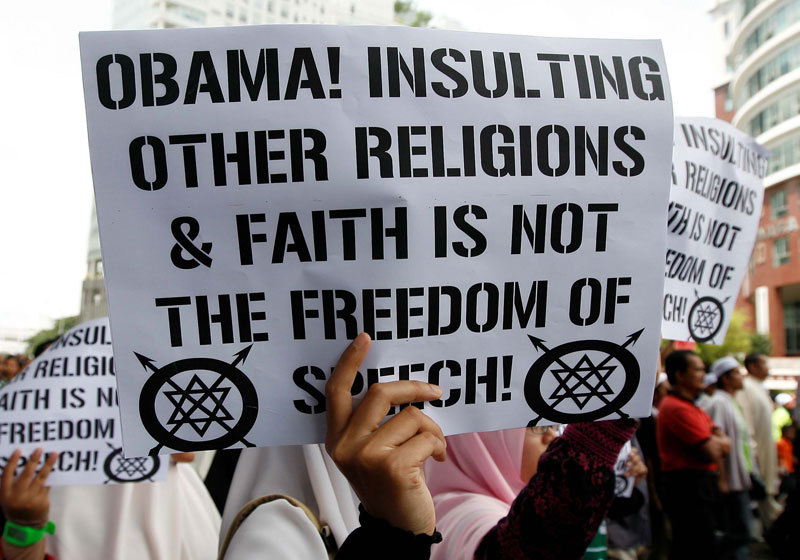
Muslims gathered in Malaysia’s capital to protest against the controversial Innocence of Muslims film (Demotix)
Sporadically explosive conflicts arrise when words or images offensive to believers spark a violent response, the most recent example being the reaction to the controversial Innocence of Muslims film. Index has stated before that the majority of states restrain by law distinct and direct incitements to violence; however, causing offence doesn’t constitute an incitement to violence, much less a good excuse to react with violence. Yet violent protests sparked by the YouTube film led many countries to push for the video to be taken down. As the controversy unfolded, digital platforms took centre stage in an age-old debate on where the line is drawn on free speech.
The kind of connectivity provided by the web means a video uploaded in California can lead to riots in Cairo. Real-time transmission, real-time unrest. It presents a serious challenge for hosts of user-generated content like YouTube and Facebook.
Before the web, British-Indian writer Salman Rushdie’s “blasphemous” 1988 novel — The Satanic Verses — sparked protests and earned its author a death sentence from Iran’s Ayatollah Khomeini, who called upon Muslims to assassinate the novelist, his publishers, and anyone else associated with the book. The Japanese translator of the Satanic Verses was killed, and Rushdie’s Norwegian publisher was shot and wounded, leading some to think twice about publishing works potentially “offensive to Islam”.
These fears were renewed after the 2005 decision of Danish newspaper Jyllands Posten to publish caricatures of the Prophet Muhammad, which were protested about in riots worldwide, largely initiated as a result of agitation by Danish clerics.
The Jewel of Medina, a historical novel about the life of Muhammad’s wife Aisha was due to be published by Random House in the US in 2008, but it was pulled when an academic warned the publishers of a possible violent backlash to the novel. After the UK-based publisher Gibson Square decided to take on the novel, Islamic extremists attempted to firebomb the home of the company’s chief executive. More recently, ex-Muslim and author of The Young Atheist’s Handbook Alom Shaha wrote that initially, staff at Biteback publishing had reservations about releasing his book in the UK. Upon being presented with the book, one staff member’s reaction was, “we can’t publish this, we’ll get firebombed”.
Article continues below[/vc_column_text][/vc_column][/vc_row][vc_row][vc_column][vc_custom_heading text=”Join the Index mailing list and get an exclusive gift” font_container=”tag:p|font_size:28|text_align:left” use_theme_fonts=”yes”][vc_separator color=”black”][/vc_column][/vc_row][vc_row][vc_column width=”1/2″][vc_column_text]
Index on Censorship’s summer magazine 2016
We’ll send you our weekly emails and periodic updates on our events. We won’t share your personal information with anyone outside Index.
You’ll also get access to an exclusive collection of articles from our landmark 250th issue of Index on Censorship magazine exploring journalists under fire and under pressure. Your downloadable PDF will include reports from Lindsey Hilsum, Laura Silvia Battaglia and Hazza Al-Adnan.[/vc_column_text][/vc_column][vc_column width=”1/2″][gravityform id=”20″ title=”false” description=”false” ajax=”false”][/vc_column][/vc_row][vc_row][vc_column][vc_separator color=”black”][/vc_column][/vc_row][vc_row][vc_column][vc_column_text]Protecting religious sensitivities at price of free expression
Many countries have legislation designed to quell religious tensions and any ensuing violence.
India, for example, has a Penal Code with provisions to protect “religious feelings”, making “acts” or “words” that could disturb religious sensitivities punishable by law. However, while such laws exist to address prevent sectarian violence their vagueness means that they can also be used by groups to shut down free expression. This opens up a question, which is when do states have the right to censor for public order reasons even if the actual piece of writing, art or public display is not a direct incitement to violence.
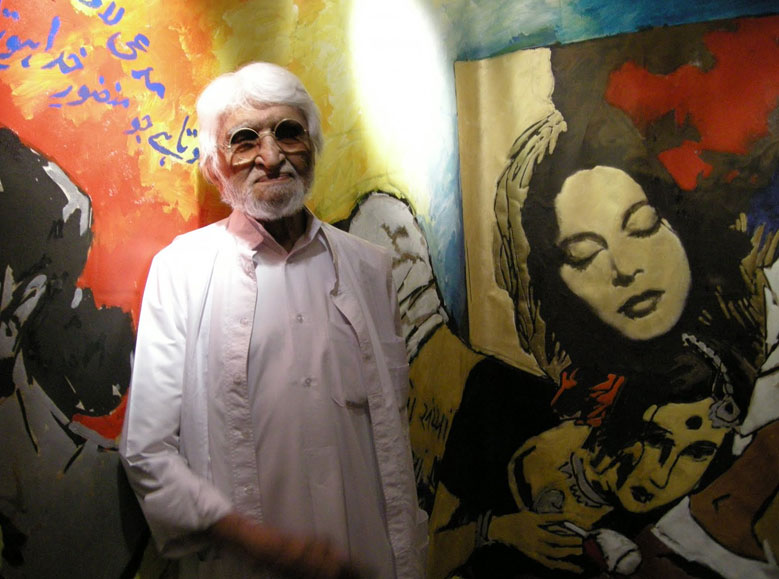
Indian artist and Index award winner was forced to leave his native India in the 1990s after being threatened for his work
In the 1990s, Indian artist and Index award winner MF Husain was the subject of a violent intimidation campaign after painting Hindu gods and goddesses naked. He received death threats and had his work vandalised. Hundreds of complaints were brought against the artist, leading to his prosecution under sections 295 and 153A of India’s Penal Code, which outlaw insulting religions, as well as promoting animosity between religious groups. Locally these laws are justified as an effort to control sectarian violence. While the cases against Husain were eventually thrown out, the spectre of new legal battles combined with violent threats and harassment pushed Husain to flee his home country. He never returned, and died in exile last year.
Across the world restrictions on free expression are imposed using laws designed to protect religious sensitivities.
Pakistan’s blasphemy laws are notorious for being abused to silence and persecute the country’s religious minorities. Although the country’s Penal Code has always had a section on religious offence, clauses added in the 1980s set a high price for blasphemy or membership of the Ahmadi sect of Islam — an Islamic reformist movement. These laws, including a possible death sentence for insulting the Muslim prophet Muhammad, have been slammed by civil society inside and outside of Pakistan.
A report issued in September by the Special Rapporteur on the promotion and protection of the right to freedom of opinion and expression, Frank La Rue, says that blasphemy laws should be repealed. Controls on free speech in order to protect religious sensibility seem to run parallel to controls on religion.
Globally, restrictions on religious expression have increased according to a report released last month by the Pew Research Center. In 2010, the study found that 75 per cent of the world’s population lived in countries where restrictions placed on religious practice were rated as either “high” or “very high”. The study found that the greatest restrictions on religion take place in the world’s most heavily populated countries — India, Egypt, Indonesia, Iran, and Russia stood out on the list.
Outrage and incitement to religious hatred
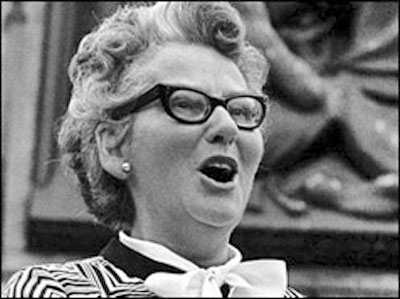
In 1977 Christian campaigner Mary Whitehouse successfully brought charges against the publishers of a magazine that printed a graphic sexual poem about Jesus Christ
In 2007, the UK introduced the offence of “incitement to religious hatred”, which some feared was merely a replacement for the scrapped blasphemy law, made more wide-ranging by covering not just Christianity but all religions. The last conviction under that law was the infamous 1977 Gay News case, where Christian campaigner Mary Whitehouse brought a successful private prosecution against the publishers of Gay News magazine for publishing a poem describing a Roman soldier’s fantasy of sex with Jesus Christ.
In the UK, one of the most pernicious means by which restrictions on free speech have grown tighter has been through the use of incitement laws, both incitement to hatred and incitement to violence and murder. In some cases, as in the outlawing of incitement to religious hatred through the Racial and Religious Hatred Act, the law is being used to censor genuine debate. In other cases, incitement law is being used to shut down protest, as in the convictions of Muslim protestors Mizanur Rahman and Umran Javed for inciting racial hatred and ‘soliciting murder’ during a rally in London against the publications of the Danish Muhammed cartoons. Over the past decade, the government has used the law both to expand the notion of ‘hatred’ and broaden the meaning of ‘incitement’. Much of what is deemed ‘hatred’ today is in fact the giving of offence. And should’t the giving of offence be viewed as a normal and acceptable part of plural society?
In 2009, Ireland created for the first time a specific blasphemy offence. This law states a person is guilty of blasphemy if
“he or she publishes or utters matter that is grossly abusive or insulting in relation to matters held sacred by any religion, thereby causing outrage among a substantial number of the adherents of that religion, and
(b) he or she intends, by the publication or utterance of the matter concerned, to cause such outrage.”
This wording was later used as a template for attempts to introduce the idea of “defamation of religion” as an offence at the United Nations. The attempt to introduce this concept failed, but the UN Human Rights Council did pass a resolution condemning “intolerance, negative stereotyping, stigmatisation, discrimination, incitement to violence, and violence against, persons based on religion or belief”.
On the other hand, according to Frank La Rue, quoted by Journalism & Intolerance said: “blasphemy is a horrible cultural phenomenon but, again, should not be censored or limited by criminal law. I would like to oppose blasphemy in general by being respectful, but that’s something you build in the culture and the traditions and the habits of the people, but not something you put in the criminal code. Then it becomes censorship.”
Crushing religious freedom
Other European countries have had their own free speech versus religion battle when a push towards bans on the veil or niqab began, infringing on choices of Muslim women. France’s controversial ban on the niqab went into effect last year. Offenders must pay a 150 € fine or take French citizenship classes. There have been similar discussions in the Netherlands, Denmark, the United Kingdom, and Belgium. Such bans are not restricted to Europe — in 2010 Syria banned face veils from university campuses. From 1998 – 2010, Turkey banned headscarves from university campuses. In fact, Turkey has a much wider ban on headscarves in public buildings, a ban the government faces difficulties overturning though it would like to. Just as troubling — countries like Iran and Saudi Arabia have strict dress codes for women that visitors must comply with as well.
Both enforced secularism and enforced religiosity constitute a form of censorship; the key word being “enforced” as opposed to “free”. Whether it is tackling enforced religion, religious offence, hatred and incitement to violence, or enforced secularism, only a constructive approach to free speech can genuinely guarantee freedom of conscience and belief, whether in one god, many or none.[/vc_column_text][/vc_column][/vc_row][vc_row][vc_column][vc_basic_grid post_type=”post” max_items=”12″ style=”load-more” items_per_page=”4″ element_width=”6″ grid_id=”vc_gid:1493908381135-56de588f-391f-0″ taxonomies=”78, 4880″][/vc_column][/vc_row]