4 Apr 2008 | Comment
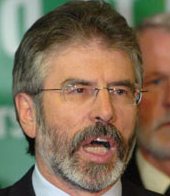 Gerry Adams and Sinn Féin are trying to stifle debate in Belfast’s media, writes Anthony McIntyre
Gerry Adams of Sinn Féin is the current Westminster MP for West Belfast. For decades he rightly campaigned against censorship policies crafted by successive British and Irish governments for the purposes of undermining his party. British readers may recall him as the only member of the House of Commons they could see but not hear. On each occasion that he appeared on TV over a six-year period from 1988, an actor’s voice was used to dub his words. On radio he was neither seen nor heard, the dubbing procedure again in play. It was only one of a range of draconian measures applied to silence him and his party. Former Irish Journalist of the Year Ed Moloney has repeatedly asserted that such censorship prohibited dialogue and consequently prolonged Northern Ireland’s violent conflict.
Although a victim of harsh political censorship, Adams’ disinclination to use this invidious tool of political repression has been less than salutary. Never a figure at ease with even the mildest form of political criticism, he has persistently sought to undermine those who do not see the world through his eyes and who are prepared to voice their misgivings publicly. Virtually everyone who has left Sinn Féin since the signing of the Good Friday Agreement a decade ago has highlighted the suppression of debate among their reasons for quitting. Adams has no record of speaking out against those murdered, kidnapped or beaten by his party’s military wing simply because they chose to dissent from his political project. On occasion Adams has hit out at those daring enough to have a public ‘poke’ at his leadership. Elsewhere he has been on record saying that people should not be allowed to even think that there is any alternative to the Good Friday Agreement. There is no concession to the idea that without audacious thinking, West Belfast intellectual life would be even more restricted than it currently is.
(more…)
1 Feb 2008 | Comment
 Ireland’s new media watchdog will itself be under severe scrutiny, writes Michael Foley
It was a long time coming, but after debates going back to the 1970s, Ireland has finally joined the rest of Europe and has established a press council, which opened for business in January.
The new press ombudsman, Professor John Horgan, and the 13-person press council opened their city centre premises in Dublin following a launch addressed by Minister for Justice Brian Lenihan. At the launch, the minister announced that privacy legislation, which has been approved by the cabinet, would be parked, “in order to allow the press council the opportunity to prove its effectiveness in defending the right to privacy from unwarranted intrusion by the media.”
He continued: “I don’t think I am breaching any state secrets when I tell you that not all my colleagues had boundless enthusiasm for this approach. I would not for a moment dismiss their reservations and, indeed, concern about media intrusion is not exclusive to those of us involved in politics.”
(more…)
6 Dec 2007
Bridging the gap between the monitoring of abuse and effective advocacy for change through facilitation, research, publication, advocacy and new commissioned works.
Index on Censorship is internationally renowned for bringing leading thinkers from the creative communities to tackle the key issues of free expression, as the practitioners most often affected by censorship and most often least protected.
At the same time Index is respected for its rigorous documentation of free expression rights abuses, in partnership with free speech groups in some of the world’s most complex and dangerous regions. This unique combination of research skill and literary intelligence underpins 36 years of effective, timely and valued contributions to the free expression debate. It makes Index simply more accessible, relevant and authoritative on the issues than most media and think tanks.
- Facilitation: Index is an invaluable international partner when it comes to bridging the gap between human rights monitoring and effective advocacy for peaceful change. We give practical support for project development, fundraising, publication, advocacy and local capacity building. This year we are taking a key role in the development of the World Forum for Free Expression, to be held in Oslo and the Amsterdam World Book Capital events in 2009, in particular facilitating the involvement of international experts and advocacy groups; developing project concepts to support Burmese artists, writers and performers as well as media workers.
- Research: Index analyses how and why free speech is filtered and mediated, how the perceptions and positions of opposing communities are represented. This way the positive results of the process can be encouraged, and the negative ones contextualised and challenged – not censored. This year we are researching the links between public politics and the generation of hatred for short term political gain in countries like Turkey, Sri Lanka, Russia, Kenya and Zimbabwe; the cultivation of fear and hate in times of conflict through the spoken and published word, especially in the Middle East; how societies in conflict such as Ireland, Israel, Palestine and South Africa can be dividing or united by open debate on history and heritage; and a study of censorship of creative communities that challenge dissent, in countries like Burma, Iran, Zimbabwe and China.
- Publication: Index plays a key role in the formulation of balanced cases to underpin local campaigns for change, as a respected multi-lingual publisher in print and online and by organizing events to raise awareness or gather key actors and practitioners in free debate. We plan the publication of an updated edition of an Arabic language training guide to election coverage for reporters in the Middle East; publication of a special report on Censorship in the Maghreb; an extensive research, publication and related events programme to inform media industry debate surrounding the national regulation of the Iraqi media; continuing a three year programme to develop an Arabic language edition of Index on Censorship.
- Advocacy: We closely coordinate activities with our many international local partners so that the ideas generated and opinions heard can inform their own advocacy campaigns for peaceful change and fundamental rights to free expression, especially in societies in conflict. This work includes developing a programme of monitoring, publication and advocacy in defence of Latin American journalists facing deadly threats from drug gangs, insurgents and paramilitaries on behalf of a consortium of local media rights groups. We are also developing a programme in support of independent media and judicial groups in the Magreb.
- New works: Index on Censorship works internationally to support the creation of new work, not only articles for print and online, but also new photography, film & video, visual arts and performance – using the act of free expression to defend the right to free expression itself. This includes a European exhibition of Open Shutters, photostories produced by women in Iraq); developing a participatory online arts project for refugees and IDPs in the Middle East based on the participatory exchange of stories and images by mobile phone.
24 Oct 2007 | Comment, News
It hasn’t been a good few days for ‘halfpint’, ‘ian’ and ‘vaughan’, three Sheffield Wednesday supporters who took advantage of the apparent anonymity provided by their usernames to post seriously nasty comments about the club’s directors on the ‘Owlstalk’ discussion site.
Last Friday Judge Richard Parkes QC decided that the posts ‘may reasonably be understood to allege greed, selfishness, untrustworthiness and dishonest behaviour on the part of the claimants’.
(more…)
