23 Apr 2007 | Comment
Ever since Peter Brooke as Northern Ireland Secretary of State made his 1990 statement that Britain had no selfish strategic interest for remaining in Ireland most people have come to accept that Brooke called it pretty much as it was. Northern Irish unionism rather than any imperialist imperative on the part of the British state was what ensured the continuation of partition.
Enter MI5. That situation now demands some reappraisal. With the new MI5 building at Hollywood, County Down, designed to monitor and combat ‘international terrorism’ the British state now has a long term strategic interest in keeping the North within the UK. Having a security service as the fulcrum on which long term political strategy turns is not without considerable consequences for human rights.
This becomes all the more pronounced in the wake of the Northern Ireland’s policing Ombudsman Nuala O’Loan’s damming report on collusion between RUC Special Branch and loyalist murder gangs. Special Branch emerged from that report looking pretty indistinguishable from the terrorist gang, whose murder campaign it effectively managed.
The lesson is simple – those who police society from the shadows are often more shadowy and sinister than the forces they seek to monitor. They are therefore to be trusted only reluctantly and always in the wake of a serious health and safety check which pronounces them fit for democratic purpose.
One crucial body whose task it is in democratic society to perform such health and safety checks, the press, is now being forced on the back foot by a state eager to curb the prowess of the press and enhance the powers of the security services. The recently drafted Policing (Miscellaneous Provisions) Northern Ireland Order allows PSNI personnel to seize notes and electronic records for up to 96 hours. Claiming that new powers are needed because of “the increasingly sophisticated nature of serious crime” the Northern Ireland police guided by the intelligence agencies will now be able to mount surgical strikes aimed at heading off at the pass any journalistic investigation into the activities of the security agencies. The irony of course is that the body most recently exposed as having being up to its neck in terrorism was a crucial element in the British state security apparatus, RUC Special Branch. It is a matter of public record how abusive the security services are whatever their guise. Why increase their scope for abuse?
This move comes at a time when documentation is either, depending on whose ox is being gored, a crucial asset or liability being fought over by contesting sides. MI5 currently want their documents back from the Stevens team, whose task it has been for the best part of two decades to investigate collusion between the security services and armed groups in the island of Ireland. The new legislation currently being proposed will allow the same agencies to pervert the course of justice. It is to curb journalists from publishing their findings and also to intimidate whistleblowers and other sources from providing journalists with the much needed information that would lift the lid on nefarious state activities.
There is of course nothing new about this. The British state has been involved in numerous cover ups since it sent its troops onto Northern Irish streets in 1969. In 1972 Prime Minister Edward Heath set the parameters for justice when he told Lord Widgery on the eve of his inquiry into the bloody Sunday killings to be mindful that the war being waged by the British had a propaganda dimension. Widgery duly obliged and his name has been synonymous with whitewash ever since.
The former Greater Manchester Chief Constable, John Stalker, almost had his career destroyed in the 1980s when he began to investigate RUC shoot to kill operations which were carried out at the behest of the intelligence agencies. Canadian Judge Peter Cory, who in recent years investigated security service collusion, was reportedly furious with the British government’s tardy and obstructive approach to his findings and recommendations.
In other cases, including the 2005 trial of the MI5 agent Denis Donaldson, prosecutions were aborted or alternatively, Public Immunity Certificates were issued by the British state in a bid to ensure that knowledge about informers did not come to public attention. Arguably this was less rooted in concern for the welfare of informers than it was in the need to shield from democratic scrutiny the fact that information received that could have prevented death was in fact not acted upon. This issue is at the heart of concerns over the role of MI5 in relation to the 1998 Real IRA bombing of Omagh town which produced massive civilian casualties.
If democratic scrutiny is to have any currency in Northern Ireland, an unhindered press is a necessity rather than something to be doled out or withdrawn in accordance with the self serving interests of the government of the day. Censorship complementing cover ups might suit the state; it is disastrous for society.
(more…)
15 Mar 2003 | Awards, Awards year slider
[vc_row css=”.vc_custom_1485793747082{margin-top: 50px !important;margin-bottom: 20px !important;}”][vc_column][vc_row_inner][vc_column_inner width=”1/2″][vc_custom_heading text=”FREEDOM OF EXPRESSION AWARDS 2003″ font_container=”tag:h1|text_align:center” use_theme_fonts=”yes” css=”.vc_custom_1485792707295{background-color: #ffffff !important;}”][vc_column_text css=”.vc_custom_1485877361951{background-color: #ffffff !important;}”]
Index on Censorship’s Freedom of Expression Awards exist to celebrate individuals or groups who have had a significant impact fighting censorship anywhere in the world.
Awards were offered in: defence of freedom of expression; circumvention of censorship; whistleblower of the year; for journalistic integrity and an ironic award for services to censorship.
[/vc_column_text][/vc_column_inner][vc_column_inner width=”1/2″][vc_single_image image=”85398″ img_size=”full”][/vc_column_inner][/vc_row_inner][vc_custom_heading text=”WINNERS” font_container=”tag:h2|text_align:center” use_theme_fonts=”yes” css=”.vc_custom_1483465213837{margin-top: 0px !important;}”][vc_row_inner][vc_column_inner width=”1/3″][staff name=”Tony Kevin” title=”International Whistleblower of the Year” color=”#28a7cc” profile_image=”85413″]Tony Kevin, who was working for the Australian Foreign Service for 30 years, became famous for exposing the Australian navy’s role in the death of several hundred refugees following the sinking of the SIEV-X (Suspected Illegal Entry Vessel) in 2001.[/staff][/vc_column_inner][vc_column_inner width=”1/3″][staff name=”Al-Jazeera” title=”Best Circumvention of Censorship” color=”#28a7cc” profile_image=”85411″]The satellite news station Al-Jazeera was honoured for providing news and images that the western media ignored or deemed inappropriate.[/staff][/vc_column_inner][vc_column_inner width=”1/3″][staff name=”Hashem Aghajari ” title=”Most Courageous Defence of Free Expression ” color=”#28a7cc” profile_image=”85414″]Hashem Aghajari is an Iranian dissident who was sentenced to death in 2002 for blasphemy after he spoke out in public not to ‘blindly follow’ Islamic clerics. After international protests his sentenced was reduced to lifetime in prison. He was freed on bail on 31 July 2004.[/staff][/vc_column_inner][/vc_row_inner][vc_row_inner][vc_column_inner width=”1/3″][staff name=”Fergal Keane” title=”Outstanding Commitment to Journalistic Integrity” color=”#28a7cc” profile_image=”38900″]Fergal Keane is an internationally recognised journalist who has reported from some of the world’s major trouble spots from Northern Ireland to Rwanda and is known for his hard-hitting and often moving reports. He was awarded for his coverage of Zimbabwe and his work in general.[/staff][/vc_column_inner][vc_column_inner width=”1/3″][staff name=”Jonathan Moyo” title=”Award for Services to Censorship ” color=”#28a7cc” profile_image=”85412″]Jonathan Moyo, in his position as Minister for Information and Publicity of Zimbabwe, was awarded with this ironic award for stifling the media and suppressing free expression.[/staff][/vc_column_inner][vc_column_inner width=”1/3″][/vc_column_inner][/vc_row_inner][/vc_column][/vc_row][vc_row disable_element=”yes”][vc_column][vc_row_inner][vc_column_inner][/vc_column_inner][/vc_row_inner][vc_custom_heading text=”JUDGING” font_container=”tag:h1|text_align:center” use_theme_fonts=”yes”][vc_row_inner el_class=”mw700″][vc_column_inner][vc_column_text]
Criteria – Anyone involved in tackling free expression threats – either through journalism, campaigning, the arts or using digital techniques – is eligible for nomination.
Any individual, group or NGO can nominate or self-nominate. There is no cost to apply.
Judges look for courage, creativity and resilience. We shortlist on the basis of those who are deemed to be making the greatest impact in tackling censorship in their chosen area, with a particular focus on topics that are little covered or tackled by others.
Nominees must have had a recognisable impact in the past 12 months.
Where a judge comes from a nominee’s country, or where there is any other potential conflict of interest, the judge will abstain from voting in that category.
Panel – Each year Index recruits an independent panel of judges – leading world voices with diverse expertise across campaigning, journalism, the arts and human rights.
The judges for 2005 were:
[/vc_column_text][/vc_column_inner][/vc_row_inner][vc_row_inner][vc_column_inner width=”1/3″][staff name=”Jason Burke” title=”Journalist” color=”#28a7cc” profile_image=”83295″]Jason Burke is a prize-winning author and Chief Reporter for the Observer. Having lived in Middle East and Southwest Asia for more than a decade, Burke has become an expert on terrorism and saw many of the key events described in his books on Al-Qaeda at first hand. His writing gives a critical perspective to the foundations of the ‘War on Terror.'[/staff][/vc_column_inner][vc_column_inner width=”1/3″][staff name=”Geoffrey Hosking” title=”Professor ” color=”#28a7cc” profile_image=”83297″]Geoffrey Hosking is Professor of Russian History at University College London and the author of several books. In 1988, he delivered the BBC Reith Lectures on Gorbachev’s forms and their implications for free speech. He was involved in setting up of voluntary association’s post-Soviet Russia and is now writing a history of Russians in the USSR.[/staff][/vc_column_inner][vc_column_inner width=”1/3″][staff name=”Baroness Helena Kennedy” title=”Barrister” color=”#28a7cc” profile_image=”83293″]Baroness Helena Kennedy has acted in many leading cases including the Brighton Bombing Trial, the Guildford Four Appeal and many of the trials of battered women who kill their partners. She is Chair of the Human Genetics Commission and a member of the World Bank Institute’s External Advisory Council. Her new book Just Law on the changing face of British justice will be published in paperback in March of this year.[/staff][/vc_column_inner][/vc_row_inner][vc_row_inner][vc_column_inner width=”1/3″][staff name=”Hari Kunzru” title=”Journalist” color=”#28a7cc” profile_image=”83296″]Hari Kunzru is a freelance journalist and editor living in London. He has worked as a travel journalist since 1998, writing for the Guardian, Time Out and the Daily Telegraph. His first novel The Impressionist won the 2002 Betty Trask Prize and the 2003 Somerset Maugham award and was also shortlisted for several awards, including the 2002 Whitbread First Novel Award.[/staff][/vc_column_inner][vc_column_inner width=”1/3″][staff name=”Bill Nighy” title=”Actor” color=”#28a7cc” profile_image=”83298″]After training at Guildford School of Dance and Drama, Bill Nighy has won countless awards for his stage and screen performances including the Evening Standard Best Actor Award for Love Actually. Other films include Still Crazy, Lawless Heart, Shaun of the Dead and I Capture the Castle. Most recently he was nominated for an Olivier Award for his stage performance in Blue/Orange.[/staff][/vc_column_inner][vc_column_inner width=”1/3″][staff name=”Chris Woodhead” title=”Writer and academic” color=”#28a7cc” profile_image=”83294″]In 2002, Professor Chris Woodhead resigned as Chief Inspector of Schools in order to be able to speak out on educational and political issues. He now writes for the Sunday Times and other national newspapers and appears regularly on many television and radio programmes questioning half-baked orthodoxies and ridicule the jargon that so often these days passes for thought. He also holds the Sir Stanley Kalm Chair in Education at the University of Buckingham.[/staff][/vc_column_inner][/vc_row_inner][/vc_column][/vc_row]
1 Mar 2003 | Awards
Most Courageous Defence of Free Expression
Hashem Aghajari is an Iranian dissident who was sentenced to death in 2002 for blasphemy after he spoke out in public not to ‘blindly follow’ Islamic clerics. After international protests his sentence was reduced to life in prison. He was freed on bail on 31 July 2004.
Best Circumvention of Censorship
The Satellite news station Al-Jazeera was honoured for providing news and images that the Western media ignored or deemed inappropriate.
International Whistleblower of the Year
Tony Kevin, who was working for the Australian Foreign Service for 30 years, became famous for exposing the Australian navy’s role in the death of several hundred refugees following the sinking of the SIEV-X (Suspected Illegal Entry Vessel) in 2001.
http://www.tonykevin.com.au/
Outstanding Commitment to Journalistic Integrity
Fergal Keane is an international recognised journalist who has reported from some of the world’s major trouble spots from Northern Ireland to Rwanda and is known for his hard-hitting and often moving reports. He was awarded for his coverage of Zimbabwe and his work in general.
Award for Services to Censorship
Jonathan Moyo, in his position as Minister for Information and Publicity of Zimbabwe, was awarded with this ironic award for stifling the media and suppressing free expression.
15 Mar 1973 | Magazine Editions, Volume 2.01 Spring 1973
[vc_row][vc_column][vc_column_text]
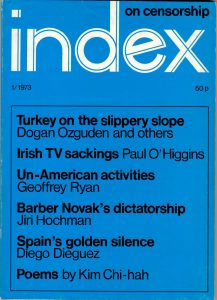
Turkey on the slippery slope, the Spring 1973 issue of Index on Censorship magazine
The present conflict in Northern Ireland has caused problems for television (and other media) in both the United Kingdom and in the Republic of Ireland. How far is it lawful or legitimate for the media to go in their presentation of all aspects of the Northern Irish question? And in particular, how far may they include the views and opinions, including those derived through interviews, of organisations which are outlawed and unlawful in both the Irish Republic and Northern Ireland? Clearly, to understand the current campaigns of violence in Northern Ireland and how peace may ultimately be restored, the views of such bodies as the Provisional Irish Republican Army are very relevant. But it was an attempt to find out something about them that led on 24 November 1972 to the dismissal by the Irish Minister for Posts and Telegraphs of the entire nine-man Authority, or board, responsible for the running of the Irish Broadcasting and Television Service, Radio Telefis Eireann, and their replacement by another group of people.
Paradoxically the Irish Prime Minister, Mr Lynch, described the dismissal of the RTE Authority as an ‘exercise in democracy.’ and as an act which was taken because ‘the Government saw the need for protecting our community’. The specific charge on which the RTE Authority were dismissed was that, by interviewing Sean Mac Stiofain, leader of the Provisional IRA, they had disobeyed a Government direction ‘not to project people who put forward violent means for achieving their purpose’.
The law governing the activities of RTE is to be found in the Broadcasting Authority Act of 1960 (amended in 1966). The RTE has the function of maintaining a national television and sound broadcasting service and as such has a monopoly in the state, there being no alternative television or radio channels. Section 18 of the 1960 Act requires the RTE Authority to secure that, when it broadcasts any information, news or feature which relates to matters of public controversy or is the subject of current public debate, the information, news or feature is presented objectively and impartially and without any expression of the Authority’s own views.
This is somewhat similar to the obligation to which the BBC is subjected, not to editorialise on matters of political controversy. Just as in Britain, where the Postmaster General may order either the BBC or the Independent Broadcasting Authority by notice ‘to refrain from’ transmitting ‘any matter or matter of any class specified in such notice’, the RTE Authority is subject to Ministerial control. Section 31 of the Broadcasting Authority Act 1960 provides:
The Minister may direct the Authority in writing to refrain from broadcasting any particular matter or matter of any particular class, and the Authority shall comply with the direction.
As a back-up to his powers the Minister of Posts and Telegraphs, under Section 6, ‘may at any time remove a member of the Authority from office’, with no need to give any reason.
In exercise of his power under Section 31 the Minister on 1 October 1971 issued a direction requiring RTE to refrain from broadcasting any matter of the following class, i.e. any matter that could be calculated to promote the aims or activities of any organisation which engages in, promotes, encourages or advocates the attaining of any particular objective by violent means.
The reaction of the RTE Authority to the receipt of this direction was to point out the vagueness of the direction, and the difficulties of interpretation, starting with the phrase ‘ any matter that could be calculated to promote’:
Indeed the Authority thinks that the terms of the direction generally are so imprecise as to be unsatisfactory in principle and to place an unfair burden on the Authority …
There is also the lack of geographical limitation as to the activities to which the direction applies. The Authority assumes that the Government would not intend that RTE should not broadcast, for example, interviews with or statements from members of the various liberation movements
around the world. …
The Authority is also concerned about the selective aspect of the Government’s action. Newspapers on sale here regularly carry material equivalent to what RTE could not now apparently carry in the form of broadcast matter. Furthermore, about half the population of the State is within reach of external broadcasting services to which the direction cannot apply.
Despite the Authority’s concern the Minister did not clarify the difficulties of interpretation posed by his direction. The Authority explained the direction to its own staff, inter alia, in the following terms:
The primary intention of the direction is to prohibit the direct participation in broadcasting of persons who through that participation would succeed in promoting the aims or activities of those organisations described in the direction: the direction does not affect the broadcasting of news material which is reportage and analysis of violent events, even where the event is stated to be the action of an organisation of the type referred to in the direction….
The direction does not prohibit current affairs programmes which feature the activities and policies of the organisations in question, included as being relevant to the scope of such programmes, provided the strictest care is taken to have the matter handled in such a manner that reasonable people would not regard the programmes as promoting the aims or activities of these organisations.
[/vc_column_text][/vc_column][/vc_row][vc_row][vc_column width=”1/4″][vc_icon icon_fontawesome=”fa fa-quote-left” color=”black” size=”xl” align=”right”][/vc_column][vc_column width=”3/4″][vc_column_text]
No unfavourable comment was apparently made at any time by the Minister upon the terms of this interpretation by the RTE Authority of the scope of his direction.
[/vc_column_text][/vc_column][/vc_row][vc_row][vc_column][vc_column_text]
In November 1972 the British Prime Minister, Mr Heath, visited Northern Ireland and made an important policy statement on the possible developments in Northern Ireland. As part of their coverage of this, RTE conducted interviews with leading political figures in Northern Ireland and in the Republic. In addition, as Mr Donal O Morain, chairman of the dismissed RTE Authority, explained:
In the interests of comprehensive reportage it was thought desirable to ascertain whether Mr Heath’s statements had altered the viewpoint of the Provisional IRA in any way. The method decided upon was to interview Mr Sean Mac Stiofain and to report in the ‘This Week’ programme of 19 November the substance of his replies.
The RTE Authority was apparently unhappy about certain editorial decisions in connexion with the programme concerned, and their displeasure was conveyed to the staff involved, although it is still not clear publicly in what respect the programme was seen as having gone too far. It was this programme on 19 November which led to the dismissal of the RTE Authority.
The only coherent explanation given by the Minister for his action was in the lower house of the Irish Parliament, Dail Eireann, on 14 December 1972, when he explained that he had a personal responsibility to ensure that opportunity was not given to people of violence to use RTE as a recruiting platform and thereby to increase the death toll in Ireland. It was never explained in what sense the broadcasting of the Mac Stiofain interview encouraged recruiting for the IRA. There was widespread condemnation of the Government’s action. The Irish Times editorialised:
If the Government felt that the RTE Authority could not be counted upon to run an impartial service within the bounds which the present regulations set, it is as clear to others that the Government cannot be trusted to use wisdom in its handling of public communications.
The high-handed and arbitrary conduct of the Irish Government did not come as a bolt from the blue. For a long time the Irish Government has adopted a curious view of the function of RTE. In October 1966 the then Irish Prime Minister, Mr Sean Lemass, told the Irish Parliament:
Radio Telefis Eireann was set up by legislation as an instrument of public policy and as such is responsible to the Government The Government has overall responsibility for its conduct, and especially the obligation to ensure that its programmes do not offend against the public interest or conflict with national policy as defined in legislation. To this extent the Government reject the view that RTE should be, either generally or in regard to its current affairs and news programmes, completely independent of Government supervision … It has the duty while maintaining impartiality between political parties … to sustain public respect for the institutions of Government and, where appropriate, to assist public understanding of the policies embodied in legislation enacted. The Government will take such action … as may be necessary to ensure that RTE does not deviate from the due performance of this duty.
The significance of this statement is sharpened when it is remembered that it was made in reaction to criticism of unlawful interference by a Minister in the broadcasting of material by RTE after the Broadcasting Authority Act had made it clear that the only permissible method of interfering with programme content was by the issue of a direction in writing to the Authority.
A footnote to the dismissal of the RTE Authority is to be found in the case of Mr Kevin O’Kelly, the RTE reporter who had conducted the controversial interview with Mac Stiofain. At the trial of Mac Stiofain for belonging to an illegal organisation, Mr O’Kelly refused to identify the man in court as the Mac Stiofain who had given him the interview. For his refusal Mr O’Kelly was sentenced to prison for three months for contempt of court. This in turn led to protests, including stoppages of work, by journalists and members of the staff of RTE.
The RTE affair underlines the need for the mass media to be shielded against direct interference by Government, a problem which in formal terms has not been resolved in either Britain or Ireland. The responsibilities that broadcasting incurs to provide a wide coverage of differing opinions on controversial issues raise special problems when dealing with unlawful organisations within the State. The notion that mere representation of the views of such bodies necessarily provides an opportunity for recruiting new supporters shows a curious lack of faith in the democratic process on the part of those purporting to be its defenders. In any case, what the public interest requires should not be confused at any one moment with what the Government currently in power considers to be in its interest.
[/vc_column_text][/vc_column][/vc_row]
