1 Mar 2013 | News, Religion and Culture
[vc_row][vc_column][vc_column_text]While they exist harmoniously on paper, free expression and religion often conflict in practice, and free speech is often trampled in the name of protecting religious sensibilities — whether through self-censorship or legislation that censors.
History offers many examples of religious freedom being repressed too. Both free expression and religious freedom need protection from those who would meddle with them. And they are not necessarily incompatible.
Over 200 years ago, the United States’ founding fathers grouped together freedom of worship and freedom of speech. The US Constitution’s First Amendment, adopted in 1791, made sure that the Congress couldn’t pass laws establishing religions or prohibiting their free exercise, or abridging freedom of speech, press and assembly.
More recently, both religion and free expression were offered protection by The United Nations Declaration of Human Rights (UNDHR) drafted in 1949. It outlines the ways in which both free expression and religious freedom should be protected in Articles 18 and 19. Article 18 protects an individual’s right to “freedom of thought, conscience, and religion” and the freedom to change religion or beliefs. Article 19 states: “Everyone has the right to freedom of opinion and expression; this right includes freedom to hold opinions without interference and to seek, receive and impart information and ideas through any media and regardless of frontiers.”
Why is it, then, that for centuries — from the Spanish Inquisition to the Satanic Verses — free speech and religion have been cast as opponents? Index on Censorship has explored, and will continue to explore, this crucial question.
Offence
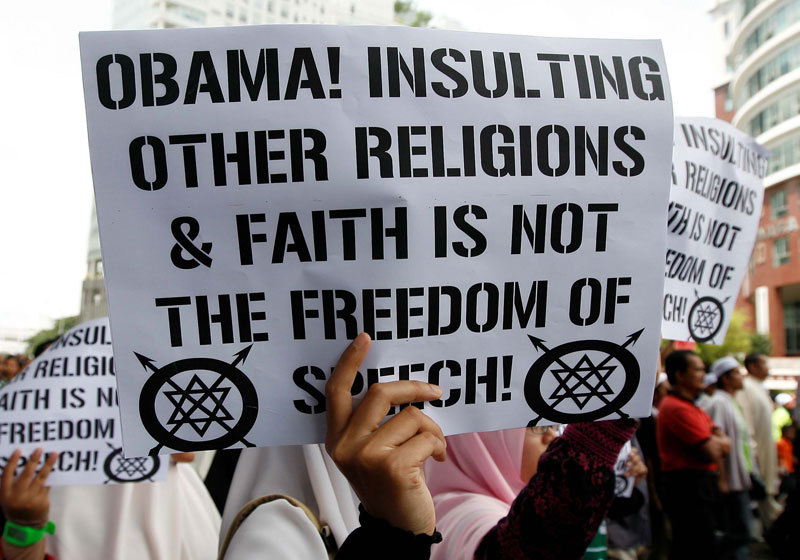
Muslims gathered in Malaysia’s capital to protest against the controversial Innocence of Muslims film (Demotix)
Sporadically explosive conflicts arrise when words or images offensive to believers spark a violent response, the most recent example being the reaction to the controversial Innocence of Muslims film. Index has stated before that the majority of states restrain by law distinct and direct incitements to violence; however, causing offence doesn’t constitute an incitement to violence, much less a good excuse to react with violence. Yet violent protests sparked by the YouTube film led many countries to push for the video to be taken down. As the controversy unfolded, digital platforms took centre stage in an age-old debate on where the line is drawn on free speech.
The kind of connectivity provided by the web means a video uploaded in California can lead to riots in Cairo. Real-time transmission, real-time unrest. It presents a serious challenge for hosts of user-generated content like YouTube and Facebook.
Before the web, British-Indian writer Salman Rushdie’s “blasphemous” 1988 novel — The Satanic Verses — sparked protests and earned its author a death sentence from Iran’s Ayatollah Khomeini, who called upon Muslims to assassinate the novelist, his publishers, and anyone else associated with the book. The Japanese translator of the Satanic Verses was killed, and Rushdie’s Norwegian publisher was shot and wounded, leading some to think twice about publishing works potentially “offensive to Islam”.
These fears were renewed after the 2005 decision of Danish newspaper Jyllands Posten to publish caricatures of the Prophet Muhammad, which were protested about in riots worldwide, largely initiated as a result of agitation by Danish clerics.
The Jewel of Medina, a historical novel about the life of Muhammad’s wife Aisha was due to be published by Random House in the US in 2008, but it was pulled when an academic warned the publishers of a possible violent backlash to the novel. After the UK-based publisher Gibson Square decided to take on the novel, Islamic extremists attempted to firebomb the home of the company’s chief executive. More recently, ex-Muslim and author of The Young Atheist’s Handbook Alom Shaha wrote that initially, staff at Biteback publishing had reservations about releasing his book in the UK. Upon being presented with the book, one staff member’s reaction was, “we can’t publish this, we’ll get firebombed”.
Article continues below[/vc_column_text][/vc_column][/vc_row][vc_row][vc_column][vc_custom_heading text=”Join the Index mailing list and get an exclusive gift” font_container=”tag:p|font_size:28|text_align:left” use_theme_fonts=”yes”][vc_separator color=”black”][/vc_column][/vc_row][vc_row][vc_column width=”1/2″][vc_column_text]
Index on Censorship’s summer magazine 2016
We’ll send you our weekly emails and periodic updates on our events. We won’t share your personal information with anyone outside Index.
You’ll also get access to an exclusive collection of articles from our landmark 250th issue of Index on Censorship magazine exploring journalists under fire and under pressure. Your downloadable PDF will include reports from Lindsey Hilsum, Laura Silvia Battaglia and Hazza Al-Adnan.[/vc_column_text][/vc_column][vc_column width=”1/2″][gravityform id=”20″ title=”false” description=”false” ajax=”false”][/vc_column][/vc_row][vc_row][vc_column][vc_separator color=”black”][/vc_column][/vc_row][vc_row][vc_column][vc_column_text]Protecting religious sensitivities at price of free expression
Many countries have legislation designed to quell religious tensions and any ensuing violence.
India, for example, has a Penal Code with provisions to protect “religious feelings”, making “acts” or “words” that could disturb religious sensitivities punishable by law. However, while such laws exist to address prevent sectarian violence their vagueness means that they can also be used by groups to shut down free expression. This opens up a question, which is when do states have the right to censor for public order reasons even if the actual piece of writing, art or public display is not a direct incitement to violence.
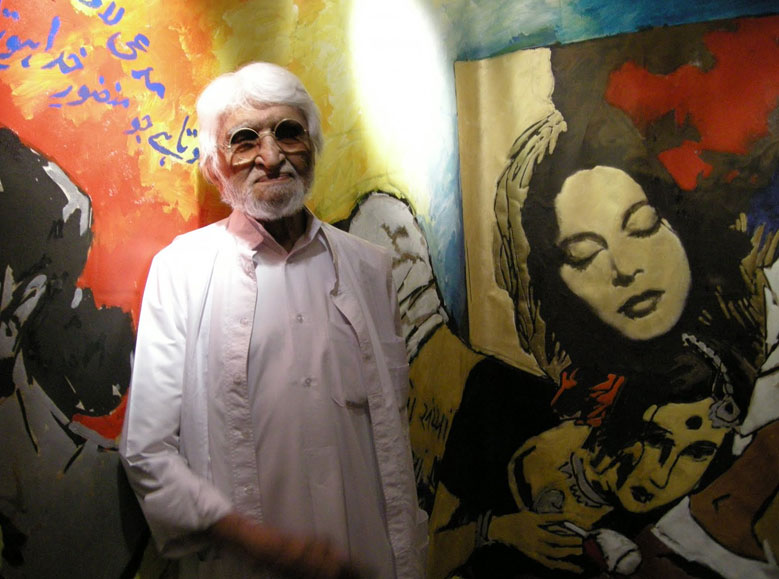
Indian artist and Index award winner was forced to leave his native India in the 1990s after being threatened for his work
In the 1990s, Indian artist and Index award winner MF Husain was the subject of a violent intimidation campaign after painting Hindu gods and goddesses naked. He received death threats and had his work vandalised. Hundreds of complaints were brought against the artist, leading to his prosecution under sections 295 and 153A of India’s Penal Code, which outlaw insulting religions, as well as promoting animosity between religious groups. Locally these laws are justified as an effort to control sectarian violence. While the cases against Husain were eventually thrown out, the spectre of new legal battles combined with violent threats and harassment pushed Husain to flee his home country. He never returned, and died in exile last year.
Across the world restrictions on free expression are imposed using laws designed to protect religious sensitivities.
Pakistan’s blasphemy laws are notorious for being abused to silence and persecute the country’s religious minorities. Although the country’s Penal Code has always had a section on religious offence, clauses added in the 1980s set a high price for blasphemy or membership of the Ahmadi sect of Islam — an Islamic reformist movement. These laws, including a possible death sentence for insulting the Muslim prophet Muhammad, have been slammed by civil society inside and outside of Pakistan.
A report issued in September by the Special Rapporteur on the promotion and protection of the right to freedom of opinion and expression, Frank La Rue, says that blasphemy laws should be repealed. Controls on free speech in order to protect religious sensibility seem to run parallel to controls on religion.
Globally, restrictions on religious expression have increased according to a report released last month by the Pew Research Center. In 2010, the study found that 75 per cent of the world’s population lived in countries where restrictions placed on religious practice were rated as either “high” or “very high”. The study found that the greatest restrictions on religion take place in the world’s most heavily populated countries — India, Egypt, Indonesia, Iran, and Russia stood out on the list.
Outrage and incitement to religious hatred
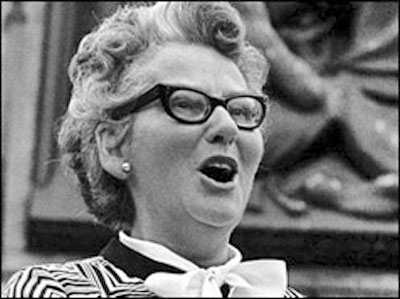
In 1977 Christian campaigner Mary Whitehouse successfully brought charges against the publishers of a magazine that printed a graphic sexual poem about Jesus Christ
In 2007, the UK introduced the offence of “incitement to religious hatred”, which some feared was merely a replacement for the scrapped blasphemy law, made more wide-ranging by covering not just Christianity but all religions. The last conviction under that law was the infamous 1977 Gay News case, where Christian campaigner Mary Whitehouse brought a successful private prosecution against the publishers of Gay News magazine for publishing a poem describing a Roman soldier’s fantasy of sex with Jesus Christ.
In the UK, one of the most pernicious means by which restrictions on free speech have grown tighter has been through the use of incitement laws, both incitement to hatred and incitement to violence and murder. In some cases, as in the outlawing of incitement to religious hatred through the Racial and Religious Hatred Act, the law is being used to censor genuine debate. In other cases, incitement law is being used to shut down protest, as in the convictions of Muslim protestors Mizanur Rahman and Umran Javed for inciting racial hatred and ‘soliciting murder’ during a rally in London against the publications of the Danish Muhammed cartoons. Over the past decade, the government has used the law both to expand the notion of ‘hatred’ and broaden the meaning of ‘incitement’. Much of what is deemed ‘hatred’ today is in fact the giving of offence. And should’t the giving of offence be viewed as a normal and acceptable part of plural society?
In 2009, Ireland created for the first time a specific blasphemy offence. This law states a person is guilty of blasphemy if
“he or she publishes or utters matter that is grossly abusive or insulting in relation to matters held sacred by any religion, thereby causing outrage among a substantial number of the adherents of that religion, and
(b) he or she intends, by the publication or utterance of the matter concerned, to cause such outrage.”
This wording was later used as a template for attempts to introduce the idea of “defamation of religion” as an offence at the United Nations. The attempt to introduce this concept failed, but the UN Human Rights Council did pass a resolution condemning “intolerance, negative stereotyping, stigmatisation, discrimination, incitement to violence, and violence against, persons based on religion or belief”.
On the other hand, according to Frank La Rue, quoted by Journalism & Intolerance said: “blasphemy is a horrible cultural phenomenon but, again, should not be censored or limited by criminal law. I would like to oppose blasphemy in general by being respectful, but that’s something you build in the culture and the traditions and the habits of the people, but not something you put in the criminal code. Then it becomes censorship.”
Crushing religious freedom
Other European countries have had their own free speech versus religion battle when a push towards bans on the veil or niqab began, infringing on choices of Muslim women. France’s controversial ban on the niqab went into effect last year. Offenders must pay a 150 € fine or take French citizenship classes. There have been similar discussions in the Netherlands, Denmark, the United Kingdom, and Belgium. Such bans are not restricted to Europe — in 2010 Syria banned face veils from university campuses. From 1998 – 2010, Turkey banned headscarves from university campuses. In fact, Turkey has a much wider ban on headscarves in public buildings, a ban the government faces difficulties overturning though it would like to. Just as troubling — countries like Iran and Saudi Arabia have strict dress codes for women that visitors must comply with as well.
Both enforced secularism and enforced religiosity constitute a form of censorship; the key word being “enforced” as opposed to “free”. Whether it is tackling enforced religion, religious offence, hatred and incitement to violence, or enforced secularism, only a constructive approach to free speech can genuinely guarantee freedom of conscience and belief, whether in one god, many or none.[/vc_column_text][/vc_column][/vc_row][vc_row][vc_column][vc_basic_grid post_type=”post” max_items=”12″ style=”load-more” items_per_page=”4″ element_width=”6″ grid_id=”vc_gid:1493908381135-56de588f-391f-0″ taxonomies=”78, 4880″][/vc_column][/vc_row]
22 Feb 2013 | Russia
January saw a dramatic escalation of internet filtering in Russia. The League for Internet Safety, an organisation backed by the Kremlin, launched an experiment in the Kostroma region in central Russia in which 29 local internet service providers signed new contracts with users, giving them access only to a sanitised internet – in other words, websites included on a “white list”. Those wishing to surf beyond the confines of the white list are required to notify their provider explicitly.
At the start of the experiment the white list included about 500,000 sites; by the end of the experiment, scheduled for April, it is expected to include up to 1 million.
The Ministry of Communications and Mass Media has stated that it does not support the experiment and considers it unnecessary in the light of existing legislation, in which Roskomnadzor, the Federal Agency for Supervision of Telecomms, Information Technologies and Mass Communications, plays a central role.
Communications minister Nikolai Nikiforov declared: “There is only one legitimate procedure for filtering of harmful content — the one operated by our subordinate agency Roskomnadzor. If operators impose restrictions, which are not covered by the law, they violate the rights of subscribers. Moreover, our country constitutes a single indivisible information space, and a specific region can not construct its citizens’ access to information under a different set of rules.”
But the League seems to have been unaffected by this comment. Its initiative was proudly presented at the Safe Internet Forum in Moscow on 8 February, attended by Russian MPs and high-placed officials, and mentioned by a Russian representative at the Organisation for Security and Co-operation in Europe conference Internet 2013 — Shaping policies to advance media freedom held in Vienna on 14 and 15 February.
Extremism
On 22 January the central district court of Volgograd accepted a demand from the Volgograd regional prosecutor’s office to recognise as extremist two websites that published books by the Turkish theologian Said Nursi listed on the Federal List of Extremist Materials. Once the court’s decision comes into force, the websites will also be added to the list.
It was reported on 23 January that the Ordzhonikidze district prosecutor’s office of Yekaterinburg had found a publicly accessible website featuring the lyrics of the song “Every Day, Under the Sign of Death” by the Norwegian black metal band Zyklon B and the anti-Semitic tract Poisonous Fish: Zionists and Freemasons in Japan by A Klimov, recognised by courts as extremist. The site also included several other extremist items. The prosecutor’s office filed 15 writs against the ISP AKADO-Yekaterinburg, demanding that access to this website be limited. The proceedings came to an end because of the ISP’s voluntary compliance with the prosecutor’s demands.
The Arkhangelsk regional prosecutor’s office reported on 24 January that its audit of ISPs to check compliance with anti-extremist legislation had found a publicly accessible electronic translation of the Jehovah’s Witnesses’ tract What Does the Bible Really Teach?, declared extremist by the Rostov regional court. The prosecutor filed a writ against the regional branch of the ISP VimpelCom, demanding that access to this material be blocked. The ISP voluntarily complied with the request, and the case was dropped.
On 29 January it was reported that the Dolzhansky district prosecutor’s office in the Orel region had found that the regional branch of the ISP Rostelecom was providing access to a website listed on the Federal List of Extremist Materials, and to another that contained instructions on making explosives and drugs. The prosecutor’s office filed a writ demanding that access to the identified sites be restricted. Despite the ISP’s argument that the website’s owner should be responsible for monitoring content, the district court granted the prosecutor’s request.
Gambling and online casinos
It was reported on 18 January that the Voronezh city prosecutor’s office had identified a website that could be used for online gambling. It filed writs against several ISPs, including MegaFon, Tele2, MTS and Kodotel, demanding that they limit access. The court ordered the ISPs to comply.
The Omsk regional prosecutor’s office announced on 22 January that after an audit of ISPs’ compliance with the gambling ban, the central district prosecutor’s office in Omsk had sent several demands to ISPs that access to gambling sites be restricted.
On 22 January it was announced that the Chernovsky district prosecutor’s office in Chita had identified more than a dozen publicly accessible websites that provided online casino services. The prosecutor filed a writ with the district court demanding that the local ISP limit access to the identified websites. The ISP voluntarily blocked the sites.
The prosecutor’s office in Ivanovo reported on 24 January that the Teykovo interdistrict prosecutor’s office had filed five writs against the ISP Gorizont for providing access to gambling websites. The prosecutor’s office demanded that access to these sites be blocked.
On 1 February the Tula regional prosecutor’s office announced that the prosecutor’s office of the Sovetsky district had reviewed implementation of legislation on gambling. Four writs were filed against the ISP Altair Tula demanding restrictions of access to online casinos, which were accepted by the Sovetsky district court.
On 1 February the Pskov regional prosecutor’s office announced that it had decided that the regional branch of the ISP Rostelecom was responsible for blocking access to gambling sites.
Schools, students, and a beauty salon
The Tambov regional prosecutor’s office announced on 9 January that the Oktiabrsky district prosecutor’s office had found a computer located in a beauty salon that allowed access to websites containing extremist material. The salon’s ISP, Lanta, has been instructed to cease the violations and bring disciplinary charges against those responsible.
On 14 January it was announced that the Komi Republic had launched a content filtering system for computers that provide students with access to the internet. The system covers 285 educational institutions of the republic and 150 computers used for home-schooling of children with disabilities. The goal is to prevent schoolchildren from accessing online information that “is incompatible with the objectives of education and training”. Lists of acceptable and unacceptable sites will be maintained jointly by the republic’s government and staff of educational institutions. The content filtering system is to be extended to cover all the Komi Republic schools.
It was reported on 15 January that bailiffs had ordered the management of four schools in the Kurumkansky district of Buryatia (in Kurumkan, Baragkhan and Sakhuli) to comply with court decisions on limiting students’ access to banned sites. Content filters have been installed.
On 18 January it was reported that the ministry of education and science of the Volgograd region had signed an agreement with the local branch of Rostelecom for the ISP provider to assume responsibility for filtering students’ access to websites containing dangerous material. Rostelecom provides internet access for 85 per cent of the region’s schools.
The Moscow regional prosecutor’s office announced on 18 January that the Yegoryevsk town prosecutor’s office had conducted an audit of compliance with legislation by local schools. The audit had established that in three schools in the district installed filters did not provide sufficient protection from extremist material. The prosecutor’s office has demanded that the head of the local administration ends the violations and brings disciplinary charges against those responsible.
On 21 January it was announced that the department of information technology of the Moscow city government will provide all city schools with wireless internet access by the end of February. The company that won the contract for implementation of this programme, MGTS, must also provide content filtering in order to protect students from extremist, pornographic and other harmful material.
Drugs
It was announced on 8 January that the Pervomaisky district court of Kirov had accepted the demand of the Leninsky district prosecutor’s office that the regional branch of the ISP Rostelecom block access to a website that contained information about cultivation of hemp and producing a psychoactive substance from it.
On 10 January it was announced that the Simonovsky interdistrict prosecutor’s office in Moscow had identified several websites that contained information on illegal drug distribution. The prosecutor’s office filed three writs against the ISP AMT Group Telecom, demanding that access to these websites be restricted by adding an IP-address filter on its router. The Khamovniki district court dismissed them on the grounds that restricting access to the sites would also deprive users of access to other sites. The prosecutor’s office appealed the decision. The Moscow city court subsequently reversed the district court’s judgment and ordered the provider to restrict access to the sites.
On 14 January the Kirov regional prosecutor’s office reported that a court had granted a request by the Oktyabrsky district prosecutor’s office to order the ISP Rostelecom to limit access to a website containing information about drugs and psychotropic substances. The court’s decision has not yet come into force.
On 16 January it was reported that the Berezovsky district prosecutor’s office in the Khanty-Mansiysk autonomous area (also known as Yugra) had found several publicly accessible sites that promoted illegal drugs or contained extremist or pornographic material. The prosecutor’s office filed a writ against the ISP Rostelecom demanding that access to these websites be blocked.
It was reported on 22 January that the Nizhny Novgorod regional prosecutor’s office had identified several websites that promote distribution of illegal substances. The prosecutors of Nizhegorodsky and Sovetsky districts of Nizhny Novgorod and the city prosecutor’s offices of Arzamas and Vyksun filed writs against multiple service providers, demanding that the identified websites be blocked.
And the rest…
On 3 January Roskomnadzor added the blog kazantripreport, hosted on the portal lj.rossia.org, to its register of banned sites. The creator of lj.rossia.org had agreed to remove the page on 2 January, having discussed doing so since 28 December. The notification from Roskomnadzor arrived a week after the page had been removed. The management of lj.rossia.org accused the user kazantripreport of spamming and using the resource for commercial purposes. In addition, the blog had published reviews of an illegal substance, as well as Russian translations of Philip Greave’s book The Pedophile’s Guide to Love and Pleasure: a Child-lover’s Code of Conduct.
On 6 January Roskomnadzor notified the online encyclopedia lurkmore.to that the address for one of its articles had been included on the register of banned sites. The article discussed various ways to commit suicide in a satirical manner. The management of lurkmore.to has since removed the article and intends to appeal the ban in court. Roskomnadzor had taken similar measures against the online encyclopedia on previous occasions.
On 10 January Roskomnadzor notified Ilya Dronov, the manager of SUP Media’s LiveJournal Russia project, that the blog of Rustem Agadamov had been added to the register of banned sites. Propaganda for suicide was cited as the reason for the ban. The post in question was a photo report, dated March 2012. It depicted an attempted self-immolation of a Tibetan independence activist in protest against the visit of the president of China. Access to the page has been restricted. The administration of LiveJournal Russia intends to appeal Roskomnadzor’s decision.
7 Feb 2013 | News, Uncategorized
A woman in Timbuktu says she was lashed by Islamist militants for talking to a man who wasn’t her husband. Salaka Djicke was caught talking to her lover on 31 December last year and was then sentenced to 95 lashings by a Islamic tribunal on 3 January. Djicke fell in love with the married man after he accidentally called when dialling a wrong number more than a year ago, and their relationship quickly blossomed. When Islamic extremists occupied Northern Mali in April 2012, Shariah law was quickly implemented, forbidding women from communicating with men. Her punishment was captured on film by local residents. The man — who Dijcke didn’t name in fear of rebel fighters returning — remains in Mali’s capital after fleeing the night they were discovered. Prior to France’s intervention in Northern Mali earlier this year, Islamist militants introduced strict Shariah law, issuing punishments such as flogging and stoning for perpetrators.

— Is this how you remember Michelangelo’s David? A town in Japan want to preserve the statue’s modesty
On 6 February, a radio station owner was murdered in Paraguay. Marcelino Vázquez was shot by unknown assailants as he left work at Sin Fronteras 98.5 FM in the city of Pedro Juan Caballero. He was on his way from the radio station to a local night club he also owned, but was stopped by two men on a motorcycle and shot several times. While Sin Fronteras is predominately music-focused, it features a regular news show covering a variety of issues. A parliamentary coup in June 2012 and the subsequent removal of President Fernando Lugo has had a negative impact on freedom of information and expression in Paraguay.
Lawyers for three members of Russian punk band Pussy Riot are appealing their convictions at the European Court of Human Rights. Representatives for Maria Alekhina, Yekaterina Samutsevich and Natalia Tolokonnikova are in Strasbourg today (7 February), after they filed a complaint on 6 February against their two year prison sentences. They said the convictions violated four articles of the European Convention on Human Rights: the right to free speech, fair trial, liberty and security and the prohibition of torture.The trio was first sentenced following their “punk-prayer” performed at Moscow’s main cathedral in February 2012 protesting Vladimir Putin’s return to power.
A radio journalist was shot on his way to work in Peru on 6 February. At the time of the attack, Juan Carlos Yaya Salcedo was driving to the Radio Max station where he worked, in the town of Imperial. He was shot in the leg by an unknown assailant and is expected to make a full recovery and return to work soon. Yaya, who hosts radio show Sin Escape (Without Escape), has never faced threats in the past but police said the attack was likely the result of his journalistic work, as the perpetrators didn’t attempt to steal anything. Yaya said the attack could have resulted from his reporting on the poor construction of a community building in the nearby town of Nuevo Imperial.
Residents of a town in Japan have complained about the erection of replica statues of Michelangelo’s David, requesting that he wear underpants. Okuizumo citizens told town officials that the 16-foot renaissance sculpture’s exposed penis could frighten their children, as some of the replicas, funded by a local business man, were installed in a local park where children often play. Most of the town’s 15,000 residents approved the Renaissance art tributes, and no plans have been made to clothe the statue. Japan has stringent laws regarding nudity. While watching and distributing porn is legal in the country, the country’s authorities request that genitalia be pixelated.
7 Feb 2013 | News, Uncategorized
It’s not easy for cinema goers in China. Film censorship is hardly a new phenomenon under the communist regime, but following the heavy editing of two new films — Skyfall and Cloud Atlas — audiences have called for a reform to China’s censorship standards.
The latest James Bond film opened on 21 January after a two-month delay. 007 directors were keen to appease China’s strict censors, with arial shots of Shanghai filling the screens, but the film was still left with several significant and slightly awkward cuts.
Scenes involving prostitution and the shooting of a Chinese security guard have been removed, and subtitles were changed to hide references to torture by Chinese security forces. It’s not the first time the James Bond creators have felt the wrath of China’s film board — a reference to the Cold War was removed from Casino Royale in 2006. But German-produced film Cloud Atlas fared far worse at the hands of China’s censors when it was released on 31 January. Thirty eight minutes of the films total running time was slashed — comprising mostly of homosexual and heterosexual love scenes, but also including scenes the censors felt confused the plot.

— Skyfall is one of the many films to fall foul to film censorship in China
It takes a lot to win over China’s heavy handed censors. In a deal with Hollywood in February 2012, Chinese film censors agreed to approve 34 foreign films a year — rather than the previous 20. It symbolised a promising development for directors, who are increasingly motivated to break into China’s lucrative film market following a slump in box office sales in recent years.
But film makers are often willing to sacrifice free speech in favour of breaking into China’s market. Last year, Red Dawn directors replaced a Chinese army attack on the UK with North Korean soldiers just before its release, a move typical of Hollywood directors — who are often keen to include positive references to China to win over authorities. DreamWorks Animation had a similar idea, joining forces with Chinese producers to develop Kung Fu Panda 3 in time for its 2016 release.
All imported films have to go through China’s State Administration of Radio, Film and Television (SARFT), and few remain unscathed. Movies dealing with obscenity, religion, gambling, the supernatural and drinking, to name a few — are addressed with scrutiny by SARFT, meaning that many blockbusters are altered or refused entirely.
China has no motion picture rating system, meaning that all films must be suitable for family viewing. It doesn’t always explain some of the decisions for cinematic alteration though.
In 2010, James Cameron’s Avatar was pulled from some cinemas in its 2D form, amidst speculation that the film’s displacement and land eviction references would cause political unrest, or make people think about forced removal.
Following the 3D relaunch of another Cameron classic — Titanic — in April 2012, censors were quick to edit the film. The famous scene where Leonardo Di Caprio sketches a nude Kate Winslet is edited to show Winslet from the neck up alone. SARFT said in a statement that the measure was taken to avoid cinema goers attempting to reach out and caress Winslet’s three dimensional breasts.
China overtook Japan to become the world’s second largest film market last year, with a box office valued at $2 billion (£1.3 billion) in 2011 — and is expected to surpass the US’s by 2020. Hollywood has become entrapped in the hope of success in China, and the expansion hasn’t come without controversy. The Securities & Exchange Commission opened an investigation last year into allegations that US film studios newly established in China were secured through illegal payments to Chinese officials.
Much of the Chinese public are anti-propaganda and express their frustration at missing the whole truth — movie piracy is common and means objectors can usually find an illegal, uncensored copy of a desired film. Free speech and film go hand in hand and Hollywood has always been a staunch defender of the First Amendment. So It’s worrying that economic interests are increasingly foregoing freedom of expression.
