13 Dec 2019 | Magazine, Magazine Contents, Volume 48.04 Winter 2019
[vc_row][vc_column][vc_custom_heading text=”With contributions from Jeffrey Wasserstrom, Miriam Grace Go, Tammy Lai-ming Ho, Karoline Kan, Rob Sears, Jonathan Tel and Caroline Lees”][/vc_column][/vc_row][vc_row][vc_column][vc_column_text]
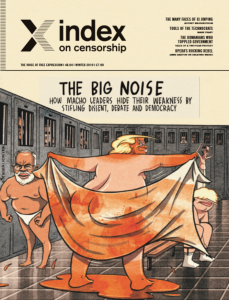 The Winter 2019 issue of Index on Censorship magazine looks at the current pack of macho leaders and how their egos are destroying our freedoms. In this issue Rappler news editor Miriam Grace Go writes about how the president of the Philippines, Rodrigo Duterte, tries to position himself as the man by being as foul-mouthed as possible. Indian journalist Somak Goshal reports on how Narenda Modi presents an image of being both the guy next door, as well as a tough guy – and he’s got a large following to ensure his message gets across, come what may. The historian Jeffrey Wasserstrom considers exactly who the real Chinese leader Xi Jinping is – a man of poetry or military might? And Stefano Pozzebon talks to journalists in Brazil who are right in the firing line of Jair Bolsonaro’s vicious attacks on the media. Meanwhile Mark Frary talks about the tools that autocrats are using to crush dissent and Caroline Lees looks at the smears that are becoming commonplace as a tactic to silence journalists. Plus a very special spoof on all of this from bestselling comedic writer Rob Sears.
In our In Focus section, we interview Jamie Barton, who headlined this year’s Last Night at the Proms, an article that fits nicely with another piece on a new orchestra in Yemen from Laura Silvia Battaglia.
In our culture section we publish a poem from Hong Kong writer Tammy Lai-ming Ho, which addresses the current protests engulfing the city, plus two short stories written exclusively for the magazine by Kaya Genç and Jonathan Tel. There’s also a graphic novel straight out of Mexico.
[/vc_column_text][/vc_column][/vc_row][vc_row][vc_column][vc_custom_heading text=”Special Report”][/vc_column][/vc_row][vc_row][vc_column][vc_column_text]Will the real Xi Jinping please stand up by Jeffrey Wasserstrom: China’s most powerful leader since Mao wears many hats – some of them draconian
Challenging Orbán’s echo chamber by Viktória Serdült: Against the odds a new mayor from an opposition party has come to power in Budapest. We report on his promises to push back against Orbán
Taking on the lion by Stefano Pozzebon: With an aggressive former army captain as president, Brazilian journalists are having to employ bodyguards to keep safe. But they’re fighting back
Seven tips for crushing free speech in the 21st century by Rob Sears: Hey big guy, we know you’re the boss man, but here are some tips to really rule the roost
“Media must come together” by Rachael Jolley and Jan Fox: Interview with the New York Times’ lawyer on why the media needs to rally free speech. Plus Trump vs. former presidents, the ultimate machometer
Tools of the real technos by Mark Frary: The current autocrats have technology bent to their every whim. We’re vulnerable and exposed
Modi and his angry men by Somak Ghoshal: India’s men are responding with violence to Modi’s increasingly nationalist war cry
Global leaders smear their critics by Caroline Lees: Dissenters beware – these made-up charges are being used across borders to distract and destroy
Sexism is president’s power tool by Miriam Grace Go: Duterte is using violent language and threats against journalists, Rappler’s news editor explains
Stripsearch by Martin Rowson: Putin, Trump, Bolsonaro – macho or… nacho?
Sounds against silence by Kaya Genç: Far from a bad rap here as Turkey’s leading musicians use music to criticise the government
Un-mentionables by Orna Herr: The truths these world leaders really can’t handle
Salvini exploits “lack of trust” in Italian media by Alessio Perrone: The reputation of Italian media is poor, which plays straight into the hands of the far-right politician
Macho, macho man by Neema Komba: A toxic form of masculinity has infected politics in Tanzania. Democracy is on the line
Putin’s pushbacks by Andrey Arkhangelskiy: Russians signed up for prosperity not oppression. Is Putin failing to deliver his side of the deal?[/vc_column_text][/vc_column][/vc_row][vc_row disable_element=”yes”][vc_column][vc_custom_heading text=”Global View”][vc_column_text]Trying to shut down women by Jodie Ginsberg: Women are being forced out of politics as a result of abuse. We need to rally behind them, for all our sakes[/vc_column_text][/vc_column][/vc_row][vc_row][vc_column][vc_custom_heading text=”In Focus”][vc_column_text]Dirty industry, dirty tactics by Stephen Woodman: Miners in Brazil, Mexico and Peru are going to extremes to stop those who are trying to protest
Music to Yemen’s ears by Laura Silvia Battaglia: Could a new orchestra in Yemen signal the end of oppressive Houthi rule? These women hope so
Play on by Jemimah Steinfeld: The darling of the opera scene, Jamie Barton, and the woman behind a hit refugee orchestra, discuss taboo breaking on stage
The final chapter by Karoline Kan: The closing of Beijing’s iconic Bookworm has been met with cries of sadness around the world. Why?
Working it out by Steven Borowiec: An exclusive interview about workplace bullying with the Korean Air steward who was forced to kneel and apologise for not serving nuts correctly
Protest works by Rachael Jolley and Jemimah Steinfeld: Two activists on how their protest movements led to real political change in Hungary and Romania
It’s a little bit silent, this feeling inside by Silvia Nortes: Spain’s historic condemnation of suicide is contributing to a damaging culture of silence today[/vc_column_text][/vc_column][/vc_row][vc_row][vc_column][vc_custom_heading text=”Culture”][vc_column_text]Hong Kong writes by Tammy Lai-ming Ho: A Hong Kong poet talks to Index from the frontline of the protests about how her writing keeps her and others going. Also one of her poems published here
Writing to the challenge by Kaya Genç: Orna Herr speaks to the Turkish author about his new short story, written exclusively for the magazine, in which Turkish people get obsessed with raccoons
Playing the joker by Jonathan Tel: The award-winning writer tells Rachael Jolley about the power of subversive jokes. Plus an exclusive short story set in a Syrian prison
Going graphic by Andalusia Knoll Soloff and Marco Parra: Being a journalist in Mexico is often a deadly pursuit. But sometimes the horrors of this reality are only shown in cartoon for, as the journalist and illustrator show[/vc_column_text][/vc_column][/vc_row][vc_row][vc_column][vc_custom_heading text=”Index around the world”][vc_column_text]Governments seek to control reports by Orna Herr: Journalists are facing threats from all angles, including new terrorist legislation[/vc_column_text][/vc_column][/vc_row][vc_row][vc_column][vc_custom_heading text=”Endnote”][vc_column_text]Culture vultures by Jemimah Steinfeld: The extent of art censorship in democracies is far greaten than initially meets the eye, Index reveals[/vc_column_text][/vc_column][/vc_row][vc_row][vc_column width=”1/3″][vc_custom_heading text=”Subscribe”][vc_column_text]In print, online, in your mailbox, on your iPad.
Subscription options from £18 or just £1.49 in the App Store for a digital issue.
Every subscriber helps support Index on Censorship’s projects around the world.
 SUBSCRIBE NOW[/vc_column_text][/vc_column][vc_column width=”1/3″][vc_custom_heading text=”Read”][vc_column_text]The playwright Arthur Miller wrote an essay for Index in 1978 entitled The Sin of Power. We reproduce it for the first time on our website and theatre director Nicholas Hytner responds to it in the magazine
READ HERE[/vc_column_text][/vc_column][vc_column width=”1/3″][vc_custom_heading text=”Listen”][vc_column_text]In the Index on Censorship autumn 2019 podcast, we focus on how travel restrictions at borders are limiting the flow of free thought and ideas. Lewis Jennings and Sally Gimson talk to trans woman and activist Peppermint; San Diego photojournalist Ariana Drehsler and Index’s South Korean correspondent Steven Borowiec
LISTEN HERE[/vc_column_text][/vc_column][/vc_row]
29 Nov 2019 | Russia, Russia Incident Reports
[vc_row][vc_column][vc_column_text]
Index on Censorship’s Monitoring and Advocating for Media Freedom project tracks press freedom violations in five countries: Azerbaijan, Belarus, Russia, Turkey and Ukraine. Learn more.
[/vc_column_text][vc_custom_heading text=”21 Incidents” use_theme_fonts=”yes”][/vc_column][/vc_row][vc_row][vc_column][vc_column_text]
State-run Channel One cut out blogger’s joke about police

Ivan Urgant’s evening talk show edited out a joke about the police by blogger Danila Poperechny.
29 October – YouTube blogger Danila Poperechny said that his joke about the police was edited out of an episode of the late-night show Vecherny Urgant (Evening Urgant) at the state-owned Channel One.
After public outcry, the presenter Ivan Urgant showed the deleted joke in the next episode of the program. Poperechny’s joke alluded to the police raids carried out at the concerts of independent artists considered disloyal to the ruling government, and the fact that such artists would rarely appear on state-owned television stations.
Links:
https://twitter.com/Spoontamer/status/1188921512528613376
https://meduza.io/news/2019/10/30/v-vechernem-urgante-pokazali-vyrezannuyu-shutku-danily-poperechnogo-o-politsii-tsentra-e-v-ney-net
https://meduza.io/news/2019/10/30/v-vechernem-urgante-pokazali-vyrezannuyu-shutku-danily-poperechnogo-o-politsii-tsentra-e-v-ney-net
Categories: Censorship
Source(s) of violation: Government/State Agency/Public official(s)/Political party
Bookstore chain refused to sell an issue of Diletant history magazine dedicated to Molotov-Ribbentrop pact
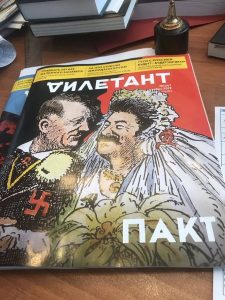
The Diletant history magazine that a bookstore chain refused to sell because it covered the Molotov-Ribbentrop pact. Credit: Alexey Venediktov via Twitter.
28 October – Bookstore chain Molodaya Gvardia refused to sell an issue of the Diletant history magazine dedicated to the Treaty of Non-aggression between Germany and the Union of Soviet Socialist Republics, known as the Molotov-Ribbentrop pact. Alexey Venediktov, editor-in-chief of Ekho Moskvy radio station, which supports the publication of the magazine, wrote about Molodaya Gvardia’s stance on Twitter.
The bookstore’s press office told Znak.com that they were concerned about potential problems with the authorities related to the article 20.3 of the Administrative code, which bans the reproduction of Nazi symbols. The cover of the magazine is a reproduction of a 1939 American caricature depicting Adolf Hitler and Josef Stalin as a bride and groom.
Vitaly Dymarskiy, editor-in-chief of Diletant magazine, told Telegram channel Rasstriga that he interpreted the bookstore’s decision to be an act of self-censorship.
Gennady Zyuganov, leader of the Russian Communist party, claimed that he would sue the magazine and would file a complaint to Roskomnadzor. He reportedly told the Telegram channel Podyem that the prosecutor should investigate and put those responsible in jail.
On 28 October, the State Historical Museum cancelled the monthly lecture organized by Diletant magazine, citing disagreement with the views expressed in the last edition. The museum’s press service reportedly told Interfax news agency that it was a “principled position” on the part of the museum’s management, after they became aware of the magazine’s content.
Links:
https://twitter.com/aavst/status/1187302972876832768/photo/1
https://www.bbc.com/russian/news-50213831
Categories: Censorship
Source(s) of violation: Government/State Agency/Public official(s)/Political party
CEO of Karelia firm sued local journalist over article about his bonus
25 October – Pavel Degtyarev, CEO of Karellesprom, filed a million rubles ($15,630) defamation lawsuit against Svetlana Lysenko, a journalist with the local website Vesti Karelii, Stolicaonego.ru reported. The Karelia republic is a majority shareholder of Karellesprom.
Degtyarev claimed that Lysenko’s July article entitled “Spoon of tar in a barrel of forest honey: why did the director of Karellesprom receive a 26 million ruble ($406,383) bonus?” damaged his professional reputation. Degtyarev didn’t deny receiving the bonus.
In the article, Lysenko questioned the ethics of the bonus, arguing that Republic of Karelia is not wealthy enough to grant such premiums to management.
Links:
https://stolicaonego.ru/analytics/gendirektor-karellesproma-zahotel-poluchit-million-s-zasluzhennogo-zhurnalista-karelii/
https://vestikarelii.ru/kapit/lozhka_degtja_v_bochke_lesnogo_meda/
https://www.parkgagarina.info/index.php/obshchestvo/regiony-rossii/30437-kareliya-poluchil-26-millionov-premii-mozhno-i-v-sud-podat-na-zhurnalista.html
Categories: Subpoena / Court Order/ Lawsuits
Source(s) of violation: Known private individual(s)
Yekaterinburg journalist accused of insulting authorities
21 October – Yekaterinburg-based journalist and political analyst Fedor Krasheninnikov was accused of insulting the authorities, Meduza reported.
On 21 October, policemen went to Krasheninnikov’s home to officially summon him to the police department. When the journalist arrived at the local police department with his lawyer, they were told that somebody named Salavat Khaziev had filed a complaint against Krasheninnikov for insulting the authorities on his Telegram channel. In it, Krasheninnikov allegedly criticized the prolongation of the arrest of Leonid Volkov, former head of the campaign for opposition politician Alexey Navalny, and called the judges who sentenced him prostitutes.
The journalist denied any wrongdoing. He said that he didn’t know the identity of the person who filed the complaint against him. Krasheninnikov reportedly told Meduza that he attributed the origin of the case to local authorities’ “unhealthy concerns” about him. According to Meduza, he said that the authorities constantly call him names and scold him in pro-government anonymous blogs. In his commentary to Kommersant, he said that his comments about Volkov were private and emotive.
According to reports, a court will determine the future of the complaint.
Links:
https://meduza.io/feature/2019/10/28/na-politologa-i-zhurnalista-fedora-krasheninnikova-zaveli-delo-ob-oskorblenii-vlasti-iz-za-posta-v-telegrame-my-s-nim-pogovorili?utm_source=facebook.com&utm_medium=share_fb&utm_campaign=share&fbclid=IwAR27tVoo5fLwnB0664GVD9MX_H8TiUsIDXLw36qTjr-Z5g7RC8JCDezxIUg
https://www.kommersant.ru/doc/4141118
Categories: Subpoena / Court Order/ Lawsuits, Criminal Charges/Fines/Sentences
Source(s) of violation: Police/State security, Known private individual(s)
Court refused to force Roskomnadzor to register opposition politician’s media outlet
24 October – Ostankinsky District Court refused to force Roskomnadzor (the Russian state media regulator) to register a media outlet founded by opposition politician Dimitry Gudkov.
Its editor-in-chief Alexey Obukhov filed a complaint to the court after the registration of his media outlet was refused numerous times. Obukhov said that among Roskomnadzor’s reasons were that he didn’t bring proof that he didn’t have a second citizenship and that he didn’t indicate the zip code in one of the documents. During the hearing, a Roskomnadzor representative said that Obukhov didn’t prove that he hadn’t been previously incarcerated.
Obukhov said that he had brought all the documents previously requested by Roskomnadzor to the court. The judge suggested that he re-apply for registration. Obukhov has been trying to register Gazeta Gudkova newspaper as an official media outlet since March 2019.
Links:
https://t.me/azlet1/223
https://tvrain.ru/news/sud_otkazalsja_objazat_roskomnadzor_zaregistrirovat_gazetu_dmitrija_gudkova-496103/?fbclid=IwAR2_cnt8EWJpSMmvs0DCLIhoxreGwm2ORwhAUWALIUyjkZ5rXnTe5A4X7FY
https://tvrain.ru/news/na_roskomnadzor_podali_v_sud_iz_za_otkaza_v_registratsii_gazety_gudkova-494840/?fbclid=IwAR3_KR30UhaPBrTk-0T_2MJb-jtfuRLlCiRVnkfPEtDoA5sqQD8GNGSGGks
Categories: Legal Measures
Source(s) of violation: Government/State Agency/Public official(s)/Political party, Court/Judicial
Grani.ru reporter assaulted while working on a story about a housing scheme
24 October – Andrey Novichkov, reporter with independent media outlet Grani.ru, was assaulted by two unknown men while working on a story about a state-funded housing scheme, Mediazona reported.
Novichkov was accompanying the deputy of the Moscow city parliament Elena Shuvalova, who came to inspect one of the houses, which were built for those eligible for free housing (families with more than 3 children, disabled people, military personnel, orphans, etc.). According to the investigation of the Anti-Corruption Foundation, however, the apartments in the house were given to dozens of Moscow officials and supporters of the city’s mayor, Sergey Sobyanin.
When the deputy and the journalist entered the house and took photos, four men came out of an apartment, which reportedly belongs to the deputy head of Moscow city parliament Olga Timofeeva, and assaulted the journalist. They tried to push him inside the apartment, threatening to break his tablet and lock him inside. Mediazona published a video of the assault. When Shuvalova went to call the police, the assailants released the journalist.
Links:
https://zona.media/news/2019/10/24/dom?fbclid=IwAR0YcVFtTaUMGLuD2w5Je4fb5j4k2kfS1Fvuj6HjxofMP7-JkLwzSxk4W1Y
https://tvrain.ru/news/na_deputata_mosgordumy_i_zhurnalista-496084/
https://www.facebook.com/elenashuvalova.ru/posts/1163759710481949
https://navalny.com/p/6147/
Category: Physical Assault/Injury, Intimidation
Source(s) of violation: Unknown
Editor-in-chief of NewsVo.ru fined twice for alleged ‘obscene’ language in the blog section of the site
23 October – Evgeniya Sibirtseva, editor-in-chief of Vologda local media outlet NewsVo.ru was fined 5,000 rubles ($78) for alleged ‘obscene’ language in a reader’s blog of the news website, 7×7 reported. The journalist reportedly said that she was never notified about the hearing, and found out about the court’s decision post-factum via a text message from her bank, which informed her that a fine had been withdrawn. Sibirtseva said that she was charged the same fine twice – from two different bank accounts. She was told that the second charge would be returned to her account.
She told 7×7 that in 2019 NewsVo.ru was fined for obscene language in the blogs section of the website three times. “It’s just an excuse to fine the media and fill the officials’ pockets,” Sibirtseva said in a statement at NewsVo.ru.
Links:
https://7×7-journal.ru/articles/2019/10/24/vologodskie-pristavy-dvazhdy-spisali-s-glavreda-regionalnogo-izdaniya-shtraf-za-mat-v-bloge-karelskoj-obshestvennicy?fbclid=IwAR06i8tskSsWy4SpmKyijSNze9OXOiRuSj7l2u3YxI_ogSTHLM9534iUngY
https://newsvo.ru/blogovo/123118
https://lenizdat.ru/articles/1156425/
Category: Criminal Charges/Fines/Sentences
Source(s) of violation: Government/State Agency/Public official(s)/Political party
Rossiya channel withdraws episode of a show covering the collapse of a dam at Krasnoyarsk gold mine

State-owned Rossiya channel withdrew an episode of Pryamoy Efir, which covered the story of a dam that collapsed in a gold mine in the Krasnoyarsk region.
23 October – State-owned Rossiya channel withdrew an episode of the talk show Pryamoy Efir, after it had been shown live and in full to viewers in Siberia and the far eastern regions of Russia, Krasnoyarsk outlet NGS24.RU reported. The episode covered the story of a dam that collapsed in a gold mine in the Krasnoyarsk region (Siberia) in October and caused the deaths of at least 15 people.
Live shows on Russian television are broadcast in the furthermost eastern time zone first, and then replayed in the same time slot in more time zones that are further west. The episode of Pryamoy Efir, which is hosted by the prominent TV presenter Andrey Malakhov, was withdrawn and not shown in the more westerly time zones. It was replaced with another episode of Pryamoy Efir.
A reporter from NGS24.RU took part in the show. The outlet reported that the episode was removed because of a call Rossiya received from the authorities. NGS24.RU published a fragment of the deleted show, in which Malakhov was reading out the results of an express test of the water probe from Seiba river, where the dam collapsed, indicating highly abnormal presence of chemicals, including mercury. Ecologists who took part in the show reportedly suggested that this may have been caused by the use of outdated technologies in the gold mine and that the chemical leaks could seriously threaten the ecology of the Krasnoyarsk region.
The Rossiya press office said that the Pryamoy Efir episode was only ever intended for broadcast in the far eastern regions.
Links:
https://ngs24.ru/news/more/66280972/?fbclid=IwAR0iDWrlmo9deMMIb8CTuFEdFaSghfhr-AgbARPpT4h6Gktr12itQetT6d8
https://www.bbc.com/russian/news-50157041
https://www.bbc.co.uk/news/world-europe-50108413
Category: Censorship
Source(s) of violation:
Journalist detained in Krasnodar region
22 October – Gleb Pyanykh, former NTV journalist and TV presenter who is currently running his own YouTube channel with reports on politics and the economy, was detained in the Krasnodar region, RBC reported.
Pyanykh went to Dinskaya village to work on a story about a villa that was illegally built on agricultural lands, which allegedly belongs to the governor of the Krasnodar region, Veniamin Kondratyev. The journalist was stopped near the villa by a uniformed security guard, who questioned Pyanykh about his work and demanded that he go to the security office. At the same time, another man in plain clothes arrived in a car and blocked the way out. When Pyanykh started to film what was going on with his mobile phone, the men let him drive away.
However, after 500 meters the journalist’s car was stopped by police. They said that they received a call from the villa’s security guards and demanded that the journalist write an explanatory note about his activities. The policemen detained Pyanykh for about an hour and then released him without charge.
Links:
https://www.rbc.ru/politics/22/10/2019/5daf184e9a7947d00f05acac?fbclid=IwAR3yngMmwi3v7_yp8EZdBbKzPEuMYQnsWismzNUyDGb85_FdokXrogAJjwY
https://www.youtube.com/watch?v=P_5tjz9KHCI
Category: Arrest/Detention/Interrogation, Blocked Access
Source(s) of violation: Police/State security, Private security
Novaya Gazeta reporters assaulted at hunting centre in Moscow region
19 October – Svetlana Vidanova and Artyom Raspopov, correspondents with independent newspaper Novaya Gazeta, were assaulted while working on a story about the illegal training of hunting dogs, Novaya Gazeta reported. Wild animals in Solnechnogorsk district of Moscow region were reportedly being hunted and killed during the trainings.
The journalists were accompanying animal rights activists when they were inspecting the area around the illegal training centre and found two fox skulls and a dead dog. When they entered the centre’s premises, the security guards approached Vidanova, twisted her arms, punched the camera and took her press card. The guards also took away Raspopov’s mobile phone and threw it over the fence, twisted his arms and pushed him out of the centre’s gate.
Police were called to the scene, but did not interfere while the assault was ongoing. The journalists received medical attention and filed a police report.
Links:
https://www.novayagazeta.ru/news/2019/10/19/156252-na-territorii-pritravochnoy-stantsii-v-moskovskoy-oblasti-napali-na-na-zoozaschitnikov-i-zhurnalistov-novoy?utm_source=fb&utm_medium=novaya&utm_campaign=-na-territorii-pritravochnoy-stantsii-kr
https://www.facebook.com/novgaz/photos/a.136917239684305/3217048941671104/?type=3&theater
Category: Physical Assault/Injury
Source(s) of violation: Private security
Roskomnadzor banned a report about a nationalist rally published 6 years ago
17 October – Russian state media regulator Roskomnadzor notified Tayga.info about the inclusion of their article about a 2013 nationalist rally in Novosibirsk in the list of banned materials, Tayga.info reported.
The article entitled “Novosibirsk divided into two Russian rallies” was published on 4 November 2013. Explaining the ban, Roskomandzor cited a Yekaterinburg court’s decision from 5 April 2018, which ruled that the article contained an extremist slogan. However, the slogan in question was deemed to be extremist by the court only in 2017, four years after the publication. The 2018 trial was initiated by the local prosecutor’s office. Tayga.info was never notified about the hearing before receiving Roskomnadzor message on 17 October 2019.
Tayga.info’s editors removed the rally slogan from the article, along with two photographs where it’s visible. They are consulting lawyers about the matter. In a statement, the website’s editorial team said that they didn’t consider the post-factum removal of information, which at the time of publication was not banned, to be legal.
Links:
https://tayga.info/149498?fbclid=IwAR16jH060QEZvJmQD45e9aSR1wwYCO_tGszBD1k_5FehW-o1SPUG3UMcwmU
https://tayga.info/114408
https://zheleznodorozhny–svd.sudrf.ru/modules.php?name=sud_delo&name_op=case&_id=219599949&_deloId=1540005&_caseType=&_new=0&srv_num=2
Category: Legal Measures
Source(s) of violation: Government/State Agency/Public official(s)/Political party
13 Yekaterinburg journalists barred from covering trial on murder of local woman
17 October – Lenisnky district court of Yekaterinburg approved an appeal filed by prosecutors and supported by defense to close the trial on the murder of a local woman, Ksenia Katorgina, to the press and the public, MK-Yekaterinburg reported.
The journalists were removed from the courtroom. They were also prevented from filming the three suspects in the court’s halls, and were told not to film them through the windows when they were brought to the court.
Links:
https://eburg.mk.ru/incident/2019/10/17/nachalsya-sud-po-vybory-mery-presecheniya-dlya-podozrevaemykh-v-ubiystve-katorginoy-zhurnalistov-ne-pustili.html
https://www.e1.ru/news/spool/news_id-66273460.html
https://74.ru/text/criminal/66273460/
Category: Blocked Access
Source(s) of violation: Court/Judicial
Journalist of Samarskaya Gazeta forced to quit after publicly revealing city mayor’s efforts to censor the newspaper
17 October – Maxim Melnikov, journalist with Samara newspaper Samarskaya Gazeta, was forced to quit his job after publicly criticizing the editorial standards of the newspaper, which he said bowed to pressure imposed by officials from Samara’s mayor’s office.
On 10 October, a video from a local journalism conference was published with a 10-minute speech from Melnikov, in which he said that he published an ironic post on Samarskaya Gazeta’s official Vkontakte account about a street that was flooded due to a burst pipe.
Within 30 minutes of Melnikov having posted the comment, Samarskaya Gazeta’s editor-in-chief reportedly received a call from the city mayor’s office demanding that the post be deleted. According to Melnikov, that the editor and the unnamed official negotiated a deal that the outlet would keep the post, but publish only positive news about the incident in the following two or three days.
After the video of his conference speech was published, he was asked by the newspaper’s management to resign. The journalist reportedly expressed frustration that the authorities censor people who speak about problems, rather than trying to solve them.
Links:
https://www.facebook.com/story.php?story_fbid=2710398908992030&id=100000658419213&sfnsn=mo
https://zona.media/news/2019/10/17/mlnkv?fbclid=IwAR0dGzSCvePc3ziDVz42BBo6Pt5p3RL4oxyuZDpkkV_vsmZm8fZ7g8L5DLA
https://www.youtube.com/watch?v=-5RgWCstaIg&t=0s&fbclid=IwAR1QGckR5iPrq78gUYxGPF_fkDsws-e-tHGe1-V0ANXgcnM_vR_mOEaxKoE
Category: Censorship
Source(s) of violation: Employer/Publisher/Colleague(s)
Police searched the homes of journalists in relation to Anti-Corruption Foundation case
15 October – Police searched the homes of four journalists in different Russian regions, as part of a money-laundering probe into opposition politician Alexei Navalny’s Anti-Corruption Foundation, reported multiple outlets.
In the early hours of 15 October, police raided the home of Alexey Seregin, a Mari El-based journalist working for Idel.Realii. He told Idel.Realii that the police conducted a 3-hour search of his home and seized his personal belongings, including a computer, a mobile phone and a recorder. Seregin said that he had covered Navalny’s activities in the Mari El region, but had never worked with the politician’s Anti-Corruption Foundation.
A second Idel.Realii journalist, Dmitry Lubimov, wrote in a Facebook post that police carried out a simultaneous raid of his Yoshkar-Ola apartment, where he has not lived since February. Lubimov believed it was an attempt to put pressure on him and prevent him from his carrying out his work, which included covering Navalny’s activities.
A simultaneous raid was also carried out at the Smolensk home of Alexey Volkov, editor-in-chief of local website Keytown.me. Keytown.me had published news articles about the activities of the local office of Navalny’s political movement. Police told Volkov that the search would be conducted in connection with the money laundering case against the Anti-Corruption Foundation. When Volkov asked how he was connected to the money laundering investigation against the Anti-Corruption Foundation, police said: “This is what we will find out”. The search lasted two hours, during which the police threatened Volkov’s wife that they’d take away their two children, including their 4-month-old baby, if she didn’t sign a non-disclosure agreement. The police seized the journalist’s personal belongings, among them two computers, a hard drive, a mobile phone and all bank cards, even the one that was used for receiving children’s welfare. After the raid, the journalist was reportedly questioned for an hour by the investigator of the Investigative Committee of Smolensk region. Volkov subsequently told 7×7 that he had nothing to do either with the Anti-Corruption Foundation or with the local office of Navalny’s movement, and only covered them in the news.
On the same day in Vladimir, the police searched the editorial office of local press club Dovod. Its journalists were questioned over the case against the Anti-Corruption Foundation. The police seized laptops and computers, and the smartphone of the editor-in-chief, Kirill Ishutin.
On 16 October, police searched the home of Arkhangelsk-based journalist Yaroslav Varenik, seizing the hard disk of his computer, his notebook and his phone, 29.Ru reported. Varenik was taken to the police department for questioning and then released the same day.
In the days that followed, police searched the Moscow headquarters of the Anti-Corruption Foundation and the homes of the employees of its 30 regional offices.
Links:
https://www.idelreal.org/a/30223538.html?fbclid=IwAR1fS0Os9OcKVnacVV2WqIbKHD98PkGNS9_TYo-Xx8GGxlGXl-223tr4vgA
https://www.facebook.com/lemuyel/posts/2494914360562191?__tn__=H-R
https://29.ru/text/politics/66272740/
https://meduza.io/news/2019/10/16/v-arhangelske-u-zhurnalista-izdaniya-29-ru-proveli-obysk-po-delu-fbk-eto-uzhe-chetvertyy-takoy-sluchay-za-dva-dnya?utm_source=facebook.com&utm_medium=share_fb&utm_campaign=share&fbclid=IwAR3XddAIXFMofeyy74HENB6xsPClnKeZ-wK1vEp5r35oGfXHXsRUeI9rcp8
https://7×7-journal.ru/articles/2019/10/15/v-smolenske-sledovateli-prishli-s-obyskom-k-redaktoru-novostnogo-sajta-keytown-me-po-delu-fbk?fbclid=IwAR1cVKvdlHwUE379eAhIqwFHPBjQT2ZSNz0wQGahauE0JurA6PHAQR2SCOg
https://www.dovod.online/v-redakcii-dovod-prohodit-obysk/
Category: Arrest/Detention/Interrogation
Source(s) of violation: Police/State security
Proekt journalists received threats after publishing story on Russian mercenaries in Libya
15 October – Roman Badanin, the founder and editor-in-chief of investigative media outlet Proekt, told Reuters about the surveillance, hacking attacks, and threats that Proekt journalists have been subjected to following the publication of a story about Russian mercenaries in the Libyan Civil War earlier this year.
According to Badanin, the journalists who worked on that investigation received explicit threats of physical violence via email. He said that attempts to hack the journalists’ accounts on Facebook, Telegram and Gmail were also made. Badanin referred to an incident in which Maria Karpenko, a Proekt reporter based in Saint Petersburg, was followed by an unidentified man who was filming her. Badanin said he believed that it was useless to report the threats to the police, and that he believed that publicity might be a better way to protect the journalists.
Since March Proekt has published reports on the activities of a Russian mercenary group known as CHVK Vagnera and linked to Saint Petersburg businessman Evgeny Prigozhin. The press service of his firm Konkord Management & Consulting refused to give a comment to Reuters.
Links:
https://www.proekt.media/investigation/prigozhin-libya/
ttps://ru.reuters.com/article/topNews/idRUKBN1WU252-ORUTP
https://tvrain.ru/news/zhurnalisty_proekta-495495/?fbclid=IwAR1tmNVK1QkUSVwLNDRcWhKJ5mt99OUT1MxGn_lPl_2aMCutwsFVheJvwfo
Category: Intimidation, DDoS/Hacking/Doxing
Source(s) of violation: Corporation/Company, Known private individual(s), Unknown
Yaroslavl journalist’s car burnt out
13 October – On the night of 12 October, the car of Marina Borbat was set on fire and burnt out, Regnum news agency reported. Borbat is the director of Yaroslavl regional broadcaster DIA-TV. Borbat believes the arson could be related to a previous conflict with a local crime boss.
According to Igor Yamshikov of the All-Russia People’s Front movement, posting on the Yaroslavl branch’s Facebook page, said they believe that the arson attack was linked to Borbat’s journalistic activities.
According to Yamshikov, Borbat had a run-in with a crime boss, after her filming equipment went missing while she was covering a story on 26 September 2017. Borbat reportedly filed a complaint to the police, and a similar complaint was filed by the editor of Severyanka local newspaper, but the police did not find any wrongdoing on the part of the crime boss.
In a separate case, the crime boss was reportedly found guilty of hooliganism and sent to prison. He is due to be released shortly. Borbat said that while she had no evidence that the damage of her car was linked to the crime boss, she knew that several people who had conflicts with him had their cars burnt out.
Links:
https://lenizdat.ru/articles/1156388/?fbclid=IwAR3NNblx_QVDyjP6NA5Us1nLJ9kFdUPym4Li3v9rQrcSK66pSH88Y18z8mI
https://regnum.ru/news/accidents/2748889
https://sobesednik.ru/proisshestviya/20191016-u-redaktora-telekanala-v-yaroslavskoj-oblasti-sgorela-mashina
Category: Intimidation/Attack to Property
Source(s) of violation: Unknown
MBH Media journalist detained in Moscow
7 October – Nikita Maslovsky, a reporter with MBH Media, was detained along with Bessrochny Protest [Eternal Protest] activists while covering their activities in Moscow, MBH Media reported. The activists were planning to stage an anti-Putin protest at Kutuzovsky Prospekt imitating president Putin’s funeral, but were intercepted by the police.
Although Maslovsky was just covering the demonstration, he was also detained by police. He had tried to show police his press identification, but they ignored it. They refused to state the reason for his detention. Maslovsky was taken to a police van, where police tried to confiscate his phone. After more than five hours, the journalist was released without charge.
Links:
https://mbk-news.appspot.com/news/v-moskve-polic/
https://tvrain.ru/news/v_moskve_zaderzhali_aktivistov_bessrochnogo_protesta_i_zhurnalista_mbh_media-495002/?fbclid=IwAR3yPwVy0kYM8_xz4Ed5AkuB3toi3bkjT4M_6GQf6EK4JYGEyzYgajG–lA
Category: Arrest/Detention/Interrogation
Source(s) of violation: Police/State security
Editor of Magadan media outlet Vesma assaulted in his house
3 October – Andrey Grishin, chief editor of independent online news agency Vesma, was beaten on the staircase of his apartment building in Magadan, Vesma reported.
Around 10:30 am, a young man knocked on Grishin’s door, saying that he had accidentally crashed into his car in the courtyard and asking the journalist to come down with him. When Grishin came out, there were two other men waiting. They attacked him and after reportedly punching him 15-20 times, one of them said to him: “Do you understand? Don’t write anything like that anymore”. The journalist said he didn’t sustain any serious injuries and that he didn’t know which particular story they were referring to.
Updates:
18 October – Magadan police reportedly detained two male suspects, aged 19 and 27. Both are pleading guilty. The police opened a criminal case against them under article 116 of Russia’s Criminal Code (physical violence).
21 October – Telegram channel Sovest Gubernatorov [Governors’ Conscience] reported, citing the police sources, that the testimonies of the detained suspects were classified, and the case against them was downgraded to an administrative violation due to the possible involvement of a local deputy Eduard Kozlov from the ruling party United Russia. According to the Telegram channel, the suspects mentioned in their testimony that Kozlov was the mastermind of the attack.
Links:
http://vesma.today/news/post/10616-v-magadane-napali-na-redaktora?fbclid=IwAR1nx8X-x-wQDOZt_q6fPCO5LEJbUNJCBFch7blp2P3f4WydnuppRVeLgfE
https://www.svoboda.org/a/30207298.html
https://49.xn--b1aew.xn--p1ai/news/item/18646886/
https://t.me/guber2
http://vesma.today/news/post/11006-v-telegram-kanalakh-poyavilas-versiya-
Category: Physical Assault/Injury, Intimidation
Source(s) of violation: Unknown, Known Private Individuals
Editors of Pskov outlets summoned for questioning over Prokopeva case
3 October – Maxim Kostikov, editor-in-chief of Ekho Moskvy-Pskov radio station, and Alexander Savenko, editor-in-chief of Pskovskaya Lenta Novostey, were summoned for questioning to the police department over Svetalana Prokopeva’s case, Novaya Gazeta reported.
In September Prokopeva, a radio journalist with Ekho Moskvy, was charged with justifying terrorism over her comments about Arkhangelsk FSB office bombing, which she made on the radio late last year.
Due to a non-disclosure agreements, the editors were not in a position to discuss the nature of the questioning. On 1 October both outlets, along with a dozen other media outlets, published an open letter written by Prokopieva.
Links:
https://www.novayagazeta.ru/news/2019/10/03/155836-glavredov-eha-moskvy-v-pskove-i-pskovskoy-lenty-novostey-vyzvali-na-dopros?fbclid=IwAR35jLnpf1nb-uTMRM6RIaHhhv6IJmAz9y0s4d7A2Ya_el92cwG9qfaECIQ
https://t.me/shlosberg/4021
Category: Arrest/Detention/Interrogation
Source(s) of violation: Police/State security
Armed policemen visited office of Chernovik newspaper in Dagestan
2 October – Armed officers of the Dagestan Investigative Committee came to the editorial office of the Makhachkala-based newspaper Chernovik, MBH Media reported. The officers demanded that two offices – those of the editor-in-chief and the paper’s founder – be opened, but because they were at a forum in the city of Perm at the time, the offices remained locked.
The deputy editor-in-chief Magomed Magomedov reportedly said that the Dagestan Investigative Committee’s actions were in the framework of the criminal case against Chernovik journalist, Abdulmumin Gadzhiev, who was detained in June on terrorism charges. On 23 July Gadzhiev was charged under article 205.1 of the Criminal Code (financing terrorism).
Links:
https://t.me/chernovik/12532
https://tvrain.ru/news/v_redaktsiju_dagestanskoj_gazety_chernovik_prishli_siloviki-494656/?fbclid=IwAR3PKP65tgFKQWmkPCRL20Qgc4CDVFWIIasScpkpAI37Mb0c5YIejC9FaH0
https://mbk-news.appspot.com/news/iloviki/
Category: Legal Measures
Source(s) of violation: Police/State security
Roskomnadzor blocked website of news agency Fergana
1 October – Roskomnadzor, the Russian state media regulator, blocked access to the website of news agency Fergana without any prior notification, Fergana reported.
Maria Dubnova, Fergana’s editor-in-chief, said that the block came as a complete surprise and that they would investigate the situation. She said that Fergana had already sent a request to Roskomnadzor asking to explain why the access to the website was limited without warning.
Fergana has been covering Central Asia since 1998, and is currently banned in Tajikistan.
Update:
8 October – Roskomnadzor unblocked the website of Fergana news agency after they deleted a news story about a Kyrgyz man’s suicide published in February this year. The agency learned that they were prosecuted for that particular story with the help of Roscomsvoboda project, as the regulator never replied to the agency’s inquiries. Roskomnadzor is known to block websites that publish stories on suicide in which the method is mentioned.
Links:
https://fergana.agency/news/111306/
https://meduza.io/news/2019/10/01/roskomnadzor-zablokiroval-sayt-agentstva-fergana?utm_source=facebook.com&utm_medium=share_fb&utm_campaign=share&fbclid=IwAR0DOdQKH3dbkpqbma2i9pLkFWd-ifyg_RbVA9oNF3e58G-3jr53YJWYIT4
https://www.novayagazeta.ru/news/2019/10/11/156056-roskomnadzor-snova-zablokiroval-sayt-informatsionnogo-agentstva-fergana
https://www.bbc.com/russian/news-49903556
Category: Legal Measures
Source(s) of violation: Police/State security[/vc_column_text][/vc_column][/vc_row][vc_row][vc_column][vc_basic_grid post_type=”post” max_items=”4″ element_width=”6″ grid_id=”vc_gid:1575023592087-f59638a3-3b6f-7″ taxonomies=”8996″][/vc_column][/vc_row]