2 Dec 2013 | Digital Freedom, News, Pakistan, Politics and Society

Urooj M, a former DJ on a Pakistani FM radio channel, also a film aficionado, was incredulous when she found the Pakistan Telecommunication Authority (PTA) had blocked the Internet Movie Database (IMDb).
She tweeted: “SERIOUSLY #PAKISTAN, WHY ON EARTH WOULD YOU BAN #IMDB!!! COME ON, SERIOUSLY!!!???!!!! #FirstYoutubeNowIMDB #WTF.”
This widely used online entertainment news portal, a prominent source of reliable news and box office reports regarding films, television programmes and video games from all over the world, was blocked on 19 November, but the ban was lifted by 22 November.
Pakistan is notorious for blocking websites. It has banned more than 4,000 websites for what it considers objectionable material, including YouTube, in 2012 for a film that was deemed blasphemous by Muslims around the world. In 2011, in a particularly ill-thought-out move it announced censoring text messages containing swear words. In 2010, after a decision by the Lahore High Court, Facebook was blocked as a reaction to the ‘Everybody Draw Muhammad’ page that was seen as offensive to the prophet.
Users were given no reason for this sudden and selective ban. However, Omar R. Quraishi, a journalist had tweeted: “PTA official declined to give specific reason for ban on IMDB – said is placed for 3 reasons: “anti-state”, “anti-religion”, “anti-social”.
While these “targeted bans” are small irritants in his life, as he can easily by pass them, Ali Tufail, 26, a Karachi-based lawyer, finds them wrong on principle as he sees them infringing upon the fundamental rights of the citizen as given in Article 19 and 19 A of Pakistan’s Constitution.
He said the government must give users sound “reasons” why they block a certain website and “what benchmarks or what standards are used to come to the decision to enforce these sudden bans” and if there is a committee that takes these decisions, “we must be told who these people are.”
The same was endorsed by Nighat Dad of Digital Rights Foundation (DRF). “We strongly oppose any form of censorship employed on citizens, curbing their basic right to information.”
However, netizens believe the ban was enforced to block the movie trailer for The Line of Freedom, a film that highlights the issue of the crises in Balochistan province showing Baloch separatists abducted by Pakistani security agencies without charges in a bid to stamp out rebellion.
“Our team did a quick survey with the help of tweeters around the country,” said Dad. “We checked various other movie titles but only Line of Freedom seemed to be blocked on IMDb and several other websites were accessible otherwise.” The DRF termed it an “unprecedented event” because the government had “used all sorts of means to curb the dissidents’ views” from Balochistan.
“I didn’t even know there was a movie by this title which was giving the government so much heartburn and so I just had to see what was so unsavoury that the government had to block the entire website,” said Dad who watched the whole 30 minutes or so of it by circumventing the various firewalls. “This is what happens, when you forcibly close the internet, word gets around and people get curious!”
Malik Siraj Akbar, editor of the online Baloch Hal, who sought asylum in the United States, is not surprised at the ban. His own newspaper was blocked in November 2010 and even now the ban has not been completely lifted, he says. “Since 2010, it has been available in some parts of the country and not others and access has not been very consistent,” he said adding there were hundreds of other Baloch websites, “mostly those supportive of the nationalists that have been blocked”.
But Tufail added: “This is one battle which the government would find difficult to win as newer, maybe more objectionable [to Pakistani state] websites, will keep popping up which they would never be able to keep pace with,” terming such bans an “exercise in futility”.
There could be some truth in the story of the ban on the Baloch film. Because their voices remain unheard, several family members made a 700km journey on foot from Quetta to Karachi to see if that would make a difference.
Naziha Syed Ali, a journalist at English-language daily Dawn, had recently visited Awaran, a stronghold of the separatists in Balochistan, which had been badly affected by the earthquake on September 24. She said she got a sense of “hostility expressed mainly towards the army and paramilitary rather than Pakistan per se. Then again, the army is seen as a symbol of the country, so it’s pretty much the same thing.”
Ali said “More than fear, they don’t want to take help from what they see as an occupation force.”
According to her the “feelings of alienation have been greatly exacerbated by the issue of the missing people and the kill-and-dump tactics”.
In addition, while Ali found there to be “sufficient food for now”, there was dire need for health services and proper shelter “as the tents that have been distributed are not warm enough for winter”.
The problem is the army is not allowing international and local non-governmental organisations to carry out any relief work there. Instead, the charities run by religio-political organisations and even banned outfits are seen freely roaming about. For years, the state has kept a stony silence over the issue of the disappearances of the Baloch nationalists. Rights group say if the state lets the various organisations into the region, their dark secrets about grave human rights abuses, for now a national shame, may become a problem for it on the international front.
This article was published on 2 Dec 2013 at indexoncensorship.org
20 Nov 2013 | News, Pakistan, Politics and Society
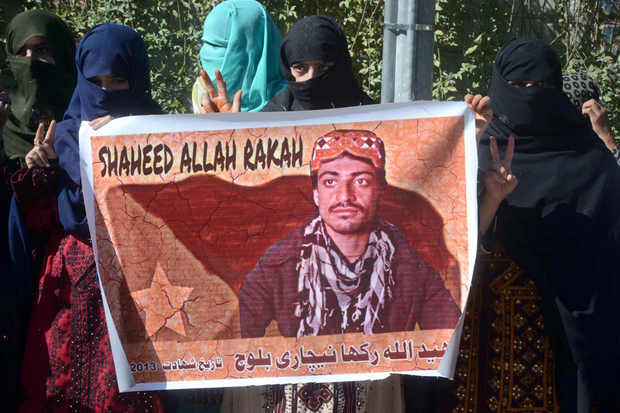
Members of Baloch Shohada Committee lighten candles during a protest against Baloch genocide on the occasion of Youm-e-Shohada-e-Baloch. (ppiimages / Demotix)
Farzana Majeed holds Pakistani media as responsible for the disappearances of thousands of Baloch nationalists as the state security apparatus, labelling it a “very willing accomplice.”
29-year old Majeed is among the two dozen people on a long march organised by the Voice of Missing Baloch Persons (VOMBP) which has protesting for the last four years. They are demanding the return of their loved ones, who they allege have been illegally apprehended and detained by Pakistan’s intelligence and security agencies.
“The media should be the voice of the victims and report on the atrocities committed on our people; instead they are pressured into silence by the state”, she said.
The march began on October 27 from Quetta in Balochistan covering a distance of almost 700 km, and will reach Karachi, in the Sindh province, by the end of the week. There, outside the Karachi Press Club, they will hold an indefinite sit-in and hunger strike. The marchers started with covering anywhere between 35 to 40 km/day, but blisters and illness are slowing down progress to barely 25km a day.
The mineral-rich Balochistan is the largest of the four provinces of Pakistan, and was an independent state until 1947, when Pakistan annexed its eastern side and Iran its western side. For many Baloch families, since the disappearances began more than a decade back, life has not been the same.
According to Qadeer Baloch who founded the VOMBP, around 18,000 Baloch nationalists, including doctors, professors, politicians and students, have been abducted since 2001. “We have received mutilated corpses of 1,500 of them.”
Farzana Majeed’s brother Zakri was abducted four years ago from the city of Mastung. He was the vice president of the Baloch Students Organisation (Azad), a nationalist student group raising awareness of the rights of the Baloch on campuses. Despite holding a double master’s in biochemistry and Balochi language, Majeed said her life has been put on “on hold” and her three siblings and mother rendered “homeless” since Zakri’s disappearance. She hasn’t heard any news of him for three years.
Baloch’s own son Jalil Reiki, the information secretary of Baloch Republican Party, was picked up in 2009. Almost two years and eight months later, his tortured and bullet-riddled body was found.
“The disappearances started way back in 2001 during president Pervez Musharraf’s rule but this human rights abuse came on public radar in 2004-05 after the women — mothers, sisters and wives — started coming out and began protesting,” explained Malik Siraj Akbar, editor of online English newspaper The Baloch Hal. He said Baloch women hardly ever come out publicly and so when they did, they were bound to be noticed.
“Except for BBC, and a couple of English national dailies, no other media is supporting us,” said Baloch, who is leading the march. The lukewarm response, however, has failed to deter the marchers. “It is a way of teaching our coming generation the value of speaking up,” Baloch told Pakistan’s Dawn newspaper.
“Some of our friends in the media have disclosed that the intelligence agencies have warned and threatened them from covering our peaceful protest; others have been told that we are causing bad publicity internationally,” he added.
Akbar, who has taken asylum in the United States after most of his friends and colleagues were killed, said: “I know the agencies have been threatening the protesters with dire consequences and forcing them to shut down their camps and end the rally.” However, he added that he was not aware of any “threats or pressure on the media from the agencies and the government”.
But according to the chairperson of the independent Human Rights Commission of Pakistan, Zohra Yusuf, “journalists in Balochistan are under pressure from the Frontier Corps [federal reserve military force], the Baloch separatists as well as the religious extremists”.
Mazhar Abbas, a former secretary general of the Pakistan Federal Union of Journalists, speculated that the poor coverage of the march, as well as the issue of disappearances, may be due to the “influence used on media barons by the intelligence agencies”.
While he emphasised the electronic media had covered the Supreme Court hearings around the issue at length, he found it had never been tackled properly from a human rights angle. He lamented the “non-professional” attitude of the print media which did not find the issue grave enough to do investigative reporting on it.
The missing are no longer an “exciting” story so they are not covered by the national media, Akbar said. “Unfortunately, nobody seems to care much about it in a country where dozens of people are killed every day,” he said.
Zohra Yusuf also said the urban-based media did not seem particularly interested in the issue as it was more “ratings oriented”.
As for the on-going march not able to attract media’s attention, Abbas suggested that had it been led by “known political or nationalist figures”, it would have automatically lured the media to it.
A recent HRCP report, based on a fact-finding mission to Balochistan, stated that while the people of the province have pinned their hopes on the new government to address the problems, especially regarding the “grave human rights violations”, many do not see any visible policy change “within the security and intelligence agencies”, as the “kill-and-dump policy” continued.
According to Malik Siraj Akbar, while the ongoing long march isn’t any different from past demonstration, it is the “first major protest” since the new governments in the province and the centre took over the reins.
“The long march reflects the new government’s failure to resurface the missing persons and normalise the situation in Balochistan,” he pointed out.
This article was originally published on 20 Nov 2013 at indexoncensorship.org
15 Nov 2013 | News, Pakistan
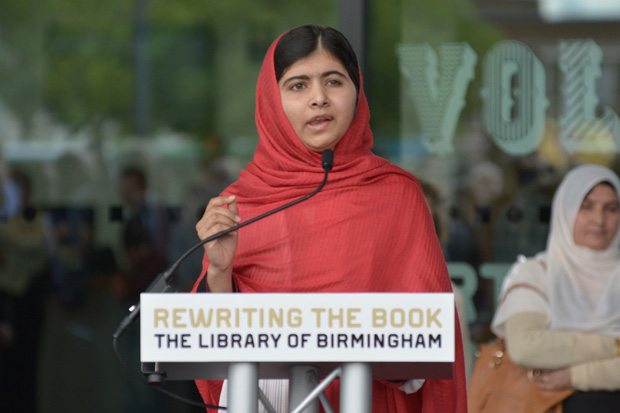
Malala Yousafzai opened the Library of Birmingham in September. Her own book is now banned in Pakistani private schools. (Image Michael Scott/Demotix)
“My friend told me Malala is not a Pakistani or a Muslim; her real name is Jennifer and she is a Christian,” said ten-year old Fatemah, conspiratorially. “But I don’t believe her one bit,” she added waving the book “I am Malala”. She is reading the autobiography of Malala Yousafzai, the young Pakistani girl who survived an assassination attempt by the Taliban.
The rather precocious 10-year old went on to say the book “gave me something important to reflect on… That what I had always taken for granted, like education, does not come that easily for thousands.” She found Malala to be a “real hero” for standing up for what she believed in. Fatemah may just be ten but her views are reflective of the debate raging in Pakistan today, especially in the media, after the book surfaced and was subsequently banned in some private schools.
On 10 November, the All Pakistan Private Schools Federation (APPSF), announced the decision to ban the book from member schools for “being against the injunctions of Islam and the constitution of Pakistan”. The book will not be kept in the library of any of its schools and no co-curricular activities, including debates, will be held on it, Kashif Mirza, chairman of the APPSF told Index. Almost 25 million children, 10 million of which are girls, study at the federation’s 152,000 private school. They employ 7,250,000 teachers, 90 percent being women. The book has not officially been banned by the Pakistani government in state schools, but is not part of any school’s curriculum.
Yousafzai has been bagging one award after another internationally. In Pakistan, where the entire nation had rooted for her to win the Nobel Peace prize, the book has led to a slight dimming of that adulation. Having British award-winning journalist Christina Lamb’s name on the cover as co-author hasn’t helped. “Lamb is reputed to be both anti-Pakistan and anti-Islam,” Mirza said.
Dr AH Nayyar, a noted educationist, said the reaction of the private school owners was that of “weak-kneed people” who are more worried about their “business interests” than what “is right and what is wrong”.
Rumana Hussain, a former principal of a private school who has written and illustrated several children’s books, finds it tragic that “the 25 million students who attend private schools in the country will not read the book. The millions who attend public schools, where the book isn’t banned but won’t be taught, bought or stocked, will not read it either.”
She lamented: “All of them will be deprived of the chance to read the account of a young Pakistani girl’s struggle for education – not only for herself but also for every Pakistani girl, every child – and get inspiration from her story.”
“We are not against girls education or against Malala,” argued Mirza. “On the contrary, we are a great supporter of Malala’s mission of girl’s education and have always advocated for liberal, enlightened and empowered women. When Malala was shot, for the first time in the history of private schools, we held a strike and closed all schools.”
Today, however, Malala seems to have lost favour in the eyes of Mirza and many others who think like him.
“I have read the book and find it hard to believe that a child who of just 16 has so much knowledge of international affairs,” he said, implying that the west has used her “confused state of mind” to grind their own axe.
Dr Nayyar finds this argument hard to digest. “The book was written by a non-Muslim. How does her writing make Malala a tool in the hands of the west?”
But what exactly has Malala or Lamb written that has half of Pakistan in a tizzy?
“She has shown disrespect to Prophet Muhammad by not using Peace be Upon Him after his name. She speaks of [former Pakistani president] Zia ul Haq bringing the Islamic law of reducing the women’s evidence to half into the court. She can’t comment on that as it’s in the Quran and no more can be said about it. She also talks about her father referring to Satanic Verses and believing in freedom of expression. We can’t have young impressionable minds reading her, having her as her role model and going astray,” Mirza said adamantly.
What he failed to mention was that all this had happened during her father’s college days when he took part in a debate of whether Satanic Verses should be banned and burned. The Satanic Verses controversy, also known as the Rushdie Affair, was the heated and frequently violent reaction of some Muslims to the publication of Salman Rushdie’s novel, first published in the United Kingdom in 1988. While few Pakistanis may have read the novel, most have been led to believe that it is an insult to Islam because it disparaged the honour of the Prophet Muhammad.
Malala’s father, while finding the book offensive to Islam had the courage to suggest, to a packed room of fellow students: “First, let’s read the book and then why not respond with our own book.”
Nayyar found absolutely nothing wrong with what Malala has stated. “That minorities are often attacked in Pakistan and that Ahmedis regard themselves as Muslims while the government does not; every word of these statements is true. Even the quoted statement of her father about Rushdie’s book Satanic Verses is praise-worthy; face a blasphemic book with a good book of your own,” he said.
“I think the ban is condemnable even if it applies to a few thousand schools,” said Zohra Yusuf, chairperson of the independent Human Rights Commission of Pakistan. “We should be opening up young minds, not shutting them. Malala’s story should be a great inspiration for students,” she added.
“I did not find anything objectionable in the book itself,” said Farah Zia, the editor of English daily The News’ magazine The News on Sunday section. “The only problem I had was the voice of the book, that switched between a 16 year old and a mature one,” added the mother of two.
While the ban has not been enacted across the board yet, she finds it ridiculous. Still, she hopes the controversy may make many curious enough to pick up the book and read it. On the other hand, she says the “atmosphere of fear being artificially created” may stop publishers from translating the book into local languages.
This article was originally posted on 15 Nov 2013 at indexoncensorship.org
11 Nov 2013 | News, Pakistan
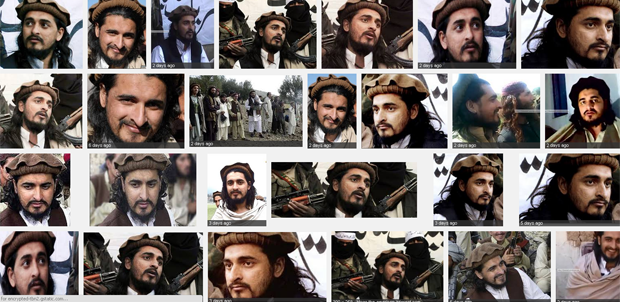
When Shamsheer Khan, learnt about the drone strike on Hakimullah Mehsud, the Pakistani Taliban supremo, on Nov 1, the 45-year old taxi-driver in Karachi, went to the mosque and prostrated before God to help the young fighter. “I prayed that if he were fighting a jihad against the Americans, Allah should protect him and if he had expired in way of jihad, to elevate him to the highest position of an Islamic fighter.”
Mehsud was killed in a US drone strike in the Dande Darpakhel, in the North Waziristan tribal region of Pakistan, bordering Afghanistan. He had succeeded Tehrik Taliban Pakistan’s (TTP) Baitullah Mehsud, in 2009, after the latter was killed in a similar attack by the drones.
Mehsud has claimed to have orchestrated several fatal attacks on the Pakistan army and also had a hand in the 2010 suicide attack in Afghanistan in which seven CIA agents were killed.
Strangely, Khan’s empathy for a perpetrator of violence finds resonance across the country where anger against drones is high, a reason for such an extreme anti-American sentiment.
Shortly after Mehsud’s death was confirmed, leaders from religious-political parties like the Jamaat-i-Islami’s (JI) Munawar Hasan called him a “martyr” and Jamiat Ulema-i Islam’s (JUI) Fazlur Rehman went a step further saying anyone killed by US is a martyr.
The taxi driver justified the violence saying: “When the leaders of this country have sold their souls to the West, somebody has to bring them back to the true path of Islam and if violence is what is needed, then be that.”
But Mosharaf Zaidi, a political analyst has no illusions that Mehsud is none other than a “mass murderer.” Calling Mehsud “a martyr was a grave tactical error and a dangerously immoral thing to do,” he said, adding. “The TTP is a terrorist organisation that deserves neither any sympathy from Pakistan, nor from any other country,” he added.
Zahid Hussain, defence analyst and author blames it on a “complete disarray” he sees in Pakistan’s policy. “Nawaz Sharif wants to normalize relations with the US, but there is no clarity on how he wants to deal with the issue of rising militancy in Pakistan that also threatens the US interests in the region.”
When news of Mehsud’s death reached the rulers, the narrative changed slightly. Though not directly empathising with the TTP, Pakistan’s interior minister, Chaudhry Nisar said the drone attack had scuttled the peace process that the government was about to start with the Taliban. Imran Khan, also in favour of talks with the Taliban, threatened stopping the NATO supply line going through Khyber Pakhtunkhwa province, where his party, the Pakistan Tehreek-e-Insaf (PTI) is ruling, if drone strikes did not end.
“The TTP shura [council] had frequently derided the notion of peace talks and, even before the death of Mehsud, had not committed to negotiations,” pointed out said Dr Pervez Hoodbhoy, noted peace activist and an academic.
Still, if negotiations have to happen, Zaidi said these “must begin with the organisation’s [TTP] acceptance of the Pakistani constitution and the sovereignty of the Pakistani republic over Pakistani territory.” He, however, was sceptical of saying “no sign of such an acceptance” seemed to exist.
To a nation, in the throes of daily violence, last week’s events have only led to historic bewilderment bordering on the dangerous. A wave of confusion seems to have enveloped the people blurring the distinction between a hero and a villain.
“It only confuses an already shattered national discourse in Pakistan about rule of law, national sovereignty and a bright future for Pakistani children,” said Zaidi.
Hoodbhoy finds Mehsud being termed a martyr incredulous. “It indicates some kind of collective mental disorder!” he said, adding: “The Pakistani mind, whipped into hyper anti-Americanism by the media and parties like PTI and JI, appears to have lost its sense of balance.”
To Zaidi, Pakistan’s handling of the TTP has been nothing short of tragic. He puts the blame squarely on both the government and political leaders who helped “create a narrative in which Mehsud, seems to have become a victim of drones.” He said the drone strikes would not exist if the Pakistani state had taken care of the criminals and terrorists that have been “festering and building up in FATA and beyond since well before 9/11”.
With the new TTP leader Mullah Fazlullah though, there is little doubt among the Pakistani people over who their foe and versus friend is. Fazlullah had virtually held the valley of Swat hostage and embarked on a systematic, violent movement to wipe out dissent back in 2007-2009. Last year it was his men who had shot Malala. Eventually the army had to step in and flush him and his followers out of the region.
To Hoodbhoy, this change of guard has given the Pakistani state a “narrow window of opportunity to hit Fazlullah and his band of terrorist thugs before he consolidates his power.”
But, he questioned: “Will we be able to find the courage and strategic wisdom? He answered it himself with a grim: “I doubt it!”
On 10 Nov, the Inter Services Public Relations, which is the official PR cell of the army, condemned the use of the word martyr to describe Mehsud, saying it misleading and irresponsible.
This article was originally published on 11 Nov 2013 at indexoncensorship.org
