8 Mar 2017 | Digital Freedom, media freedom featured, News, Syria
[vc_row][vc_column][vc_custom_heading text=”This is the first of a series of articles from the Index on Censorship magazine archives exploring the erosion of media freedom around the world.
Writing in the summer 2016 issue of the magazine, Syrian citizen journalist HAZZA AL-ADNAN explored the realities of reporting in a country where a pseudonym and bulletproof vest offer little protection from constant danger” google_fonts=”font_family:Libre%20Baskerville%3Aregular%2Citalic%2C700|font_style:400%20italic%3A400%3Aitalic”][/vc_column][/vc_row][vc_row][vc_column][vc_column_text]
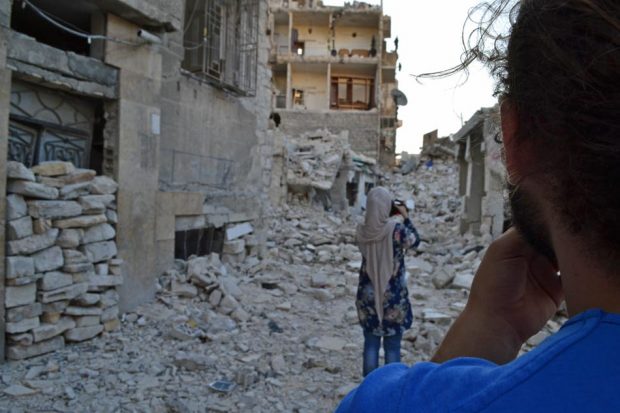
Aleppo: Somehow destroyed buildings and massacres become part of the daily view and even marks to guide people to places. (Photo: Zaina Erhaim)
“THE PSEUDONYM HELPS me to feel safe,” said Ali, a citizen journalist who works under a false name in Syria’s government-held regions. “I always pretend to be completely loyal to Bashar al-Assad’s regime while at the same time I am documenting the abuses perpetrated by his government against the activists and civilians.” Because of fear, many of the journalists inside Syria work under pseudonyms, especially in the government-held areas and those controlled by IS.
Despite the dangers of working as a journalist in Syria, there are still many who strive to report the truth, while trying to minimise the risks to themselves as much as possible. They receive some support and training from Western institutions, from time to time. But most work with local or Middle Eastern media agencies.
“If your aim is to report the truth, you cannot work in areas under government control, because it doesn’t want the truth to come out. You can work in the opposition-controlled areas, but you have to keep hidden from the government forces’ aircraft, and the Russian aircraft, and the IS organisation’s intelligence apparatus,” said Mounaf Abd Almajeed, 26, who works for Fresh Radio, a radio station in Idlib, northwest Syria.
“The government accuses us of terrorism, and the majority of the armed opposition factions do not look upon us favourably, because they confuse intelligence work with journalism,” Abd Almajeed added. “We always have to convince these factions that we are journalists, and not agents of the intelligence organisations of the US or Saudi Arabia or Qatar and so on.”
Some armed opposition factions are extreme Islamists, some of them are moderate Islamists and some of them belong to civilian or secular groups, and there is a state of cold – and sometimes hot – war among them. Abd Almajeed thinks that even if a journalist can gain the trust of a particular faction, the battle is not yet won, because he must now convince the other factions that he has not picked a side or become an agent.
Abd Almajeed tries to minimise the risks of the work by wearing a helmet and bullet-proof jacket when going to areas where clashes are taking place. He rarely works at night for fear of being kidnapped, and he doesn’t ever go to areas held by IS or the government. He believes these precautions have helped him to avoid many injuries, especially around seven months ago, when he was covering one of the battles between government and opposition forces around Aleppo, in northern Syria. When the trench that he was hiding in was targeted in an air raid, which he believes was conducted by Russian aircraft, four journalists were killed, but Mounaf was only slightly injured.
Abd Almajeed believes that Western media NGOs could do more to help by offering the required support to journalists inside opposition areas, but rather have confined their support to Syrian press organisations outside the country.
[/vc_column_text][/vc_column][/vc_row][vc_row equal_height=”yes” content_placement=”middle” el_class=”text_white” css=”.vc_custom_1488903767246{background-color: #dd1f1f !important;}”][vc_column width=”1/2″][vc_custom_heading text=”Protect Media Freedom” font_container=”tag:p|font_size:28|text_align:left” use_theme_fonts=”yes” css_animation=”fadeIn” link=”url:https%3A%2F%2Fwww.indexoncensorship.org%2Fdefend-media-freedom-donate-index%2F|||”][vc_column_text]
We monitor threats to press freedom, produce an award-winning magazine and publish work by censored writers.[/vc_column_text][/vc_column][vc_column width=”1/2″ css=”.vc_custom_1488903306764{background-image: url(https://www.indexoncensorship.org/wp-content/uploads/2013/08/newspapers.jpg?id=50885) !important;background-position: center !important;background-repeat: no-repeat !important;background-size: cover !important;}”][/vc_column][/vc_row][vc_row][vc_column][vc_column_text]
But Ahmed Jalal, 35, editor of the local magazine Al-Manatarah, does not agree. He thinks that the diminished support is due to concern for the safety of their employees, and Syrians working with them, after the country became so dangerous for journalists.
As for the burden of responsibility laid on the journalists inside Syria, Jalal said: “In the early stages of the revolution we did not have a great responsibility to convey the truth to the international community because the door was open to journalists from all over the world, and many of them came in and reported the truth to their communities. But after a year or two of the revolution everything changed because Bashar al-Assad succeeded in getting his propaganda message across to the West that he was fighting terrorists and that the alternative to him was chaos and terrorism.”
Jalal believes that IS’s pursuit of journalists, and execution of some of them, forced Western agencies to withdraw their correspondents, and then the opposition factions’ media made repeated mistakes until the world began to view the Syrian conflict as a “sectarian war between the Alawites and the Shi’a on the one hand and the Sunnis on the other, or as a fundamentalist Islamic revolution that crossed borders, and not a people’s revolution”.
Jalal sighed, took a drag on his cigarette, and continued: “Our responsibility has become great, it is now up to us to convince the international community that we are reporting the truth, which can be expressed as the aspirations for freedom and justice of a people that a criminal regime is killing – and this is what compels us to risk our lives.”
Working under a pseudonym and wearing bullet-proof jackets is all journalists inside Syria can do to minimise the risks, according to Jalal, because nobody recognises the immunity of journalists, and nobody respects the international laws and conventions governing their work. He said: “We are in a jungle … all we can do is persevere, coping with the fear and the grief. However much we try to minimise the risks; hardly a week goes by without our losing a friend or colleague, who has died covering some battle or other, or in the bombing of civilians by government forces or their allies, or in an execution by Da’esh [IS].”
The editor said: “Hardly a day goes by without our seeing the dead body of a child torn apart by Bashar al-Assad’s aircraft.” In the opposition-held areas, ordinary citizens do not look upon journalists favourably.
Jalal added: “Every time we go to take a photograph we encounter people who refuse and say ‘You media people take photos and rake in the money and we get bombed by Bashar al-Assad’s planes because of you taking pictures.’”
Many journalists inside Syria want their output to reach the international community. “Unfortunately, it rarely gets through because most of the journalists in these areas do not possess English or the skills to communicate with the outside world, so when talking to the world they rely on compassion rather than understanding,” said Jalal.
Jalal wishes the armed opposition factions would invite Western media organisations into their areas and provide them with protection. And if that is impossible, then he asks “powerful news agencies like Reuters, Agence France-Presse and the Associated Press, and powerful networks like the BBC and CNN” to put trust in local journalists or citizen journalists in these areas.
Ahmed said: “We have now got good journalists inside the opposition-held areas who have received training from Western institutions such as the Institute for War and Peace Reporting and Reporters Without Borders and the CFI [run by the French Ministry of Foreign Affairs], and we now have training centres in these areas; all that we lack is the trust of the powerful Western agencies and the networks in us.”
[/vc_column_text][/vc_column][/vc_row][vc_row][vc_column][vc_column_text]
Translated by Sue Copeland
The writer of this piece, Hazza al-Adnan, was introduced to Index on Censorship by our 2016 Freedom of Expression Award winner Zaina Erhaim.
Erhaim won the journalism award for using her own skills to train other Syrians to be able to tell their stories too.
Erhaim told Index: “Hazza attended the first training I did in Idlib suburb. He is a lawyer and had no experience in journalism at all. After the training, he started publishing on our website [the Institute of War and Peace’s Damascus Bureau], and when their local radio station Fresh was established, he started working as an editor with them. He writes for many Syrian websites and has passed the training I gave to him to more than 30 others.”
[/vc_column_text][vc_column_text]This article appeared in the summer 2016 issue of Index on Censorship magazine. [/vc_column_text][/vc_column][/vc_row][vc_row content_placement=”top”][vc_column width=”1/3″][vc_custom_heading text=”Danger in truth: truth in danger” font_container=”tag:p|font_size:24|text_align:left” link=”url:https%3A%2F%2Fwww.indexoncensorship.org%2F2016%2F05%2Fdanger-in-truth-truth-in-danger%2F|||”][vc_column_text]The summer 2016 issue of Index on Censorship magazine looks at why journalists around the world face increasing threats.
In the issue: articles by journalists Lindsey Hilsum and Jean-Paul Marthoz plus Stephen Grey. Special report on dangerous journalism, China’s most famous political cartoonist and the late Henning Mankell on colonialism in Africa.[/vc_column_text][/vc_column][vc_column width=”1/3″][vc_single_image image=”76282″ img_size=”medium” alignment=”center” onclick=”custom_link” link=”https://www.indexoncensorship.org/2016/12/fashion-rules/”][/vc_column][vc_column width=”1/3″ css=”.vc_custom_1481888488328{padding-bottom: 50px !important;}”][vc_custom_heading text=”Subscribe” font_container=”tag:p|font_size:24|text_align:left” link=”url:https%3A%2F%2Fwww.indexoncensorship.org%2Fsubscribe%2F|||”][vc_column_text]In print, online. In your mailbox, on your iPad.
Subscription options from £18.
Every subscriber helps support Index on Censorship’s projects around the world.
 SUBSCRIBE NOW[/vc_column_text][/vc_column][/vc_row][vc_row][vc_column][three_column_post title=”Media Freedom” category_id=”9044″][/vc_column][/vc_row]
7 Mar 2017 | Digital Freedom, Mapping Media Freedom, News
[vc_row][vc_column][vc_column_text]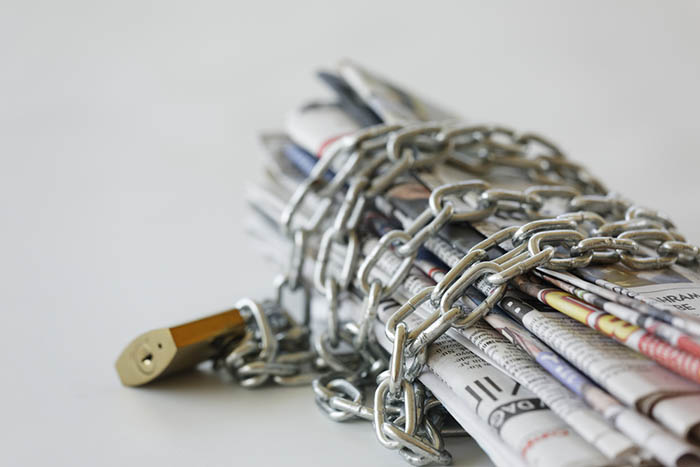
Each week, Index on Censorship’s Mapping Media Freedom project verifies threats, violations and limitations faced by the media throughout the European Union and neighbouring countries. Here are recent reports that give us cause for concern.
The German foreign intelligence services, the Bundesnachrichtendienst (BND), has allegedly been wiretapping over 50 journalists and editorial departments of major international news organisations.
The report, published in the weekly magazine Der Spiegel, revealed that the BND has been monitoring phone numbers and emails of journalists from organisations such as BBC and the New York Times since 1991.
Although journalists in Germany are protected by constitutional rights including the right to source confidentiality and witness-refusal, the German parliament recently passed a law in October 2016 which legally allows the government to target and surveil foreign journalists.
DJV, the German journalist union, issued a press release in which the BND informed the union that they were only looking at “operational aspects” of its work that would be “exclusively against Federal Government or against the competent bodies of the German Bundestag”.
Eleven Russian law enforcement officials including three FSB officers, an investigator, and four police officers, raided the Moscow apartment of Zoya Svetova, an activist and journalist for Open Russia and the New Times.
Lawyers Marina Andreyeva and Anna Stavitskaya reported via a Facebook post that Svetova’s computers, memory cards, and other devices were searched in connection to an investigation and criminal case against Mikhail Khodorkovsky, an exiled businessman whom Svetova has been linked to. Khodorkovsky, a known foe of the Kremlin, served 10 years in prison following a trial for financial charges before being pardoned by President Vladimir Putin.
According to the lawyers and Svetova’s colleagues at Radio Free Europe, documents collected during the search are still being processed as of 28 February.
[/vc_column_text][/vc_column][/vc_row][vc_row equal_height=”yes” content_placement=”middle” css=”.vc_custom_1488894676585{background-color: #d5473c !important;}” el_class=”text_white”][vc_column width=”1/2″][vc_column_text]
[/vc_column_text][/vc_column][vc_column width=”1/2″ css=”.vc_custom_1488894634520{background-image: url(https://www.indexoncensorship.org/wp-content/uploads/2017/02/MMF_report_2016_cover.jpg?id=85855) !important;background-position: center !important;background-repeat: no-repeat !important;background-size: cover !important;}”][/vc_column][/vc_row][vc_row][vc_column][vc_column_text]
Mehman Huseynov, a popular video blogger, was sentenced to two years in prison for defamation charges by the Surakhani district court.
Huseynov was detained on 9 January in Baku for allegedly violating administrative rules for sharing videos which claimed to expose corruption among Azerbaijani officials. He was held for five days and the court fined him 200AZN (€100) for disobeying the police upon arrest. Huseynov was convicted of lying about being tortured while in detention, claiming that police officials places a bag over his head and repeatedly assaulted him.
Huseynov is known as an investigative journalist who focuses on uncovering corruption among Azerbaijani government officials and has been monitored by authorities for several years. Huseynov is also the first person to be arrested on slander charges in Azerbaijan.
Radio Vesti, the largest national professional radio channel in Ukraine, has lost its broadcasting license in the capital Kyiv as well as the Kharkiv city area as a result of a ruling by the National Radio and TV Council.
According to Ukrinform, the National Council Deputy Chairman Juliana Feschuk said that Radio Vesti failed to comply with two warnings to change its program concept and failure to comply with quotas for Ukranian language broadcasts. The law requires 50 per cent of broadcasts to be in Ukranian but Radio Vesti reportedly had 49.22 per cent. The term of the license ended on 13 February.
Marina Bakumenko, the head of Radio Vesti’s legal department, said that the company has filed an appeal through the Frankivsk district court of Lviv.
The National Union of Journalists in Ukraine said that approximately 90 per cent of the staff and 100 employees could lose their jobs as a result of the decision.
Journalist Aleksandar Todevski and cameraperson Vladimir Zhelcheski of Alon, a news website, were allegedly assaulted by protesters during a pro-opposition protest in Skopje. The two were taken to the hospital and a camera was damaged as a result of the assault.
Reports by various news outlets including private national broadcaster Telma and the news website SDK.mk, unidentified protesters beat and kicked the Todevski and Zhekcheski during a protest in front of the Assembly of the Republic of Macedonia. Protesters were rallying in support of the former ruling party VMRO-DPMNE in opposition to the formation of a new coalition government.
Although the assailants were photographed by other media crews, police have reportedly not looked into an investigation. Journalist associations in Macedonia, including OSCE Representative on Freedom of the Media Dunja Mijatovic, condemned the incident, saying that recent attacks on journalists are constantly being overlooked by authorities.[/vc_column_text][/vc_column][/vc_row][vc_row][vc_column][vc_column_text]
Click on the bubbles to view reports or double-click to zoom in on specific regions. The full site can be accessed at https://mappingmediafreedom.org/
[/vc_column_text][/vc_column][/vc_row]
2 Mar 2017 | Digital Freedom, Europe and Central Asia, Mapping Media Freedom, News, Sweden
[vc_row][vc_column][vc_column_text]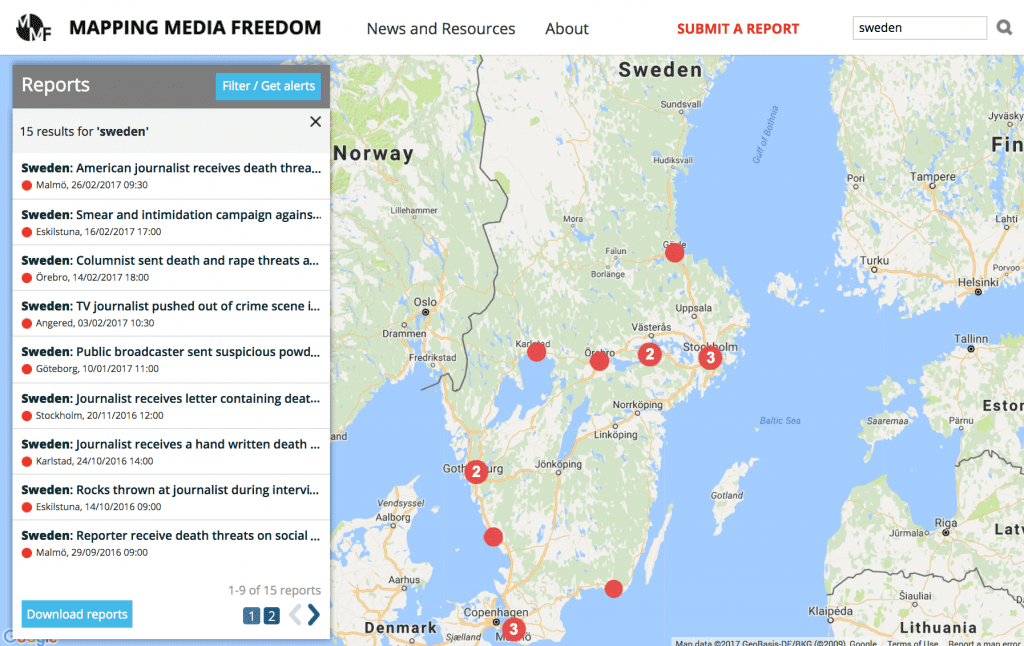
With a well-developed public service TV and Radio sector, press subsidies and political stability, being a journalist in Sweden is a touch easier than many other places around the world. Sweden is also relatively good at protecting journalists, and though they have had their disagreements, the state and political parties are broadly supportive of open, well-funded journalism. As a foreign correspondent, it is also a refreshingly easy country to work in, with people usually willing and ready to talk to the press.
A spectre that has haunted Swedish journalism for decades is anti-democratic extremism, a phenomenon given new impetus by the rise of mainstream nationalist politics in recent years. Journalists have been labelled as “cultural Marxists” and members of the so-called pk-elit, shorthand for the politically correct elite, by members of old white power organisations and the newer alt-right movements alike.
Much of the far-right view Sweden’s generally liberal newspapers and its public broadcasters as part of a shadowy agenda that is failing to report on the real issues, covering up crimes by immigrants and mounting a propaganda campaign against nationalist movements. As well as specific journalists, hatred of the media, in general, is widespread. The result is an ongoing campaign of intimidation and death threats.
Local journalists at Nerikes Allehanda, the local newspaper for the town of Örebro in central Sweden, were recently issued with death threats after reporting on Peter Springare, a local policeman who had posted on social media about immigrants causing crime in the city on 3 February. Springare was hailed as a brave whistleblower, but reporters and the newspaper’s leader writer received a wide range of abuse for discussing both the correctness and ethics of his statements. Shortly before Christmas, journalist Robert Laul received death threats after criticising controversial right-wing journalist Niklas Svensson’s reporting of undocumented migrants.
Similarly, white powder – which turned out to be harmless – was sent to Janne Josefsson, a Swedish investigative journalist based at public broadcaster SVT in Gothenburg last month. Authorities had to evacuate the entire studio building, severely disrupting the work of SVT’s news teams. The package also contained an anonymous death threat. Josefsson and his colleagues at the Uppdrag Granskning investigative show are known for reporting on all aspects of Swedish society, from the far right to organised crime, and are no strangers to intimidation.
The Swedish journalists’ union has documented how attacks on journalists are on the rise. This is troubling for a country that has long cast itself as a refuge for persecuted media workers from Russia, East Africa and elsewhere. In spring 2016 a survey of members of Swedish Radio’s journalistic corps and reporters at the association of newspaper publishers TU found that one in three had been subject to some kind of threat in the previous year.
Although a great number of those threats came from the populist right and more established neo-Nazis, journalists in Sweden have also been harassed by both criminal gangs and radical Islamist groups in recent months. In the town of Gävle north of Stockholm for example, Anna Gullberg from local paper Gefle Dagblad received a death threat in response to the paper’s investigation of a radical mosque, with the perpetrator finally sentenced last week.
These threats are more serious than the torrent of abuse and the attempts to undermine journalistic integrity on Twitter felt by reporters around the world. In Sweden, it is not difficult to find out where people live or locate their social media profiles. As a result, many journalists have been forced to either apply for the removal of their personal details from public databases or move home. A Swedish tradition that places journalists prominently at the heart of an open society with relative respect for difference of opinion is under serious threat.
Lisa Bjurwald, a media commentator, author and part owner of industry news site Medievärlden has warned that “journalists avoid writing about racist political parties and neo-Nazi groups for example because they can’t deal with the storm and volume of hate mail” in a recent newspaper interview.
The underlying questions though are how many of these alleged threats carry any risk, and does it really matter if they do? Journalists in Sweden increasingly feel as if their safety is routinely threatened as part of their work, however genuine the threat may be.
In the sea of online abuse there may only be a handful of real, tangible threats, but knowing what is casual intimidation or egotistical posturing and what is a genuine risk to the safety of journalists and their families is almost impossible. In 2015 Niklas Orrenius, one of Sweden’s leading reporters and the star journalist at newspaper Dagens Nyheter, temporarily left the country with his family after a series of threats connected to his coverage of an anonymous far-right blogger. A well-known racist activist had photographed himself outside the front door to Orrenius’ apartment and uploaded the picture to the web with a promise to come back.
With threats like this, most journalists are understandably unwilling to call the bluff of Sweden’s armchair warriors.
[/vc_column_text][vc_row_inner equal_height=”yes” content_placement=”middle” css=”.vc_custom_1488908025353{margin-top: 25px !important;margin-bottom: 25px !important;background-color: #dd3333 !important;}” el_class=”text_white”][vc_column_inner width=”1/2″][vc_custom_heading text=”Defend Media Freedom” font_container=”tag:p|font_size:28|text_align:left” use_theme_fonts=”yes” link=”url:https%3A%2F%2Fwww.indexoncensorship.org%2Fdefend-media-freedom-donate-index%2F|||”][vc_column_text]SUPPORT INDEX ON CENSORSHIP
Reporters working to share the truth are being harassed, intimidated and prosecuted – across the globe.[/vc_column_text][/vc_column_inner][vc_column_inner width=”1/2″ css=”.vc_custom_1488908111801{background-image: url(https://www.indexoncensorship.org/wp-content/uploads/2013/08/newspapers.jpg?id=50885) !important;background-position: center !important;background-repeat: no-repeat !important;background-size: cover !important;}”][/vc_column_inner][/vc_row_inner][vc_column_text]
Click on the bubbles to view reports or double-click to zoom in on specific regions. The full site can be accessed at https://mappingmediafreedom.org/
[/vc_column_text][/vc_column][/vc_row][vc_row][vc_column][vc_basic_grid post_type=”post” max_items=”4″ element_width=”6″ grid_id=”vc_gid:1488908132919-7c688c97-6409-9″ taxonomies=”9008, 6564″][/vc_column][/vc_row]
1 Mar 2017
[vc_row equal_height=”yes” css=”.vc_custom_1487955099221{margin-right: -15px !important;margin-left: -15px !important;}”][vc_column css=”.vc_custom_1487955108553{margin-right: 15px !important;margin-bottom: 15px !important;margin-left: 15px !important;background-color: #ffffff !important;}”][vc_custom_heading text=”DEFEND MEDIA FREEDOM” font_container=”tag:h1|text_align:center” use_theme_fonts=”yes”][vc_custom_heading text=”SUPPORT INDEX ON CENSORSHIP” font_container=”tag:h1|text_align:center” use_theme_fonts=”yes”][vc_column_text]
Reporters working to share the truth are being harassed, intimidated and prosecuted – across the globe.
Index on Censorship is a nonprofit fighting against these corrosive attacks on press freedom.
Index documents threats to media freedom in Europe via a monitoring project and campaigns against laws that stifle journalists’ work.
[/vc_column_text][/vc_column][/vc_row][vc_row][vc_column width=”1/3″][staff name=”Mapping Media Freedom” title=”Documenting threats to the press in Europe and neighbouring countries” profile_image=”85817″]Mapping Media Freedom – a major Index on Censorship project and a joint undertaking with the European Federation of Journalists, partially funded by the European Commission – covers 42 countries, including all EU member states, plus Bosnia, Iceland, Kosovo, Macedonia, Montenegro, Norway, Serbia, Turkey, Albania along with Ukraine, Belarus, Russia, and Azerbaijan. The platform was launched in May 2014 and has recorded over 3,900 incidents threatening media freedom.
“The precarious state of press freedom across the globe is underlined by the volume of verified incidents added to Mapping Media Freedom in 2017. The spectrum of threats is growing, the pressure on journalists increasing and the public right to transparent information is under assault. People who are simply trying to do their job are being targeted like never before. These trends do not bode well for 2018.” — Joy Hyvarinen, Index on Censorship head of advocacy[/staff][/vc_column][vc_column width=”1/3″][staff name=”Changes to the Official Secrets Act” title=”Proposals to update spy laws a threat to journalism” profile_image=”81191″]Proposed legislation that could see journalists and whistleblowers sentenced up to 14 years for leaking official documents has no place in a democracy. The proposals were drawn up by the Law Commission as part of a review of the Official Secrets Act and would cover any data that affects the UK’s national and international interests, including economic interests. The public’s right to know about the Brexit negotiations, for instance, could be put into jeopardy if these proposals were brought into force.
“It is unthinkable that whistle blowers and those to whom they reveal their information should face jail for leaking and receiving information that is in the public interest. It is shocking that so few organisations were consulted on these proposed changes.” — Jodie Ginsberg, CEO, Index on Censorship[/staff][/vc_column][vc_column width=”1/3″][staff name=”Section 40, Crime and Courts Act” title=”Section 40 would allow the corrupt to silence investigative journalists” profile_image=”85827″]Section 40 is part of the Crime and Courts Act 2013, which deals with a whole range of issues but also implemented some of the recommendations contained in the Leveson Report into phone hacking by newspapers. Index on Censorship strongly opposes the introduction of section 40.
Section 40 addresses the awarding of costs in a case where someone makes a legal claim against a publisher of “news-related material”. The provision means that any publisher who is not a member of an approved regulator at the time of the claim can be forced to pay both sides’ cost in a court case — even if they win.
“If such laws were introduced in another country, British politicians would be speaking out against such shocking media censorship.” — Rachael Jolley, editor, Index on Censorship magazine[/staff][/vc_column][/vc_row][vc_row equal_height=”yes” css=”.vc_custom_1474531377622{margin-right: -15px !important;margin-left: -15px !important;}”][vc_column width=”1/3″ el_class=”text_white” css=”.vc_custom_1487957370833{margin-right: 15px !important;margin-bottom: 15px !important;margin-left: 15px !important;background-color: #f21400 !important;}”][vc_column_text]
A gift of £20
ensures a verified attack is mapped publicly
[wpedon id=100537]
[/vc_column_text][/vc_column][vc_column width=”1/3″ el_class=”text_white” css=”.vc_custom_1487957380442{margin-right: 15px !important;margin-bottom: 15px !important;margin-left: 15px !important;background-color: #f21400 !important;}”][vc_column_text]
A gift of £100
enables an official report to pressure governments
[wpedon id=100538]
[/vc_column_text][/vc_column][vc_column width=”1/3″ el_class=”text_white” css=”.vc_custom_1487957389388{margin-right: 15px !important;margin-bottom: 15px !important;margin-left: 15px !important;background-color: #f21400 !important;}”][vc_column_text]
A gift of £1000
supports extensive fieldwork to identify and confirm reported violations
[wpedon id=100539]
[/vc_column_text][/vc_column][/vc_row][vc_row css=”.vc_custom_1474531692548{margin-top: 30px !important;margin-bottom: 30px !important;}” el_class=”mw700″][vc_column][vc_column_text]
UK donors can also give to Index on Censorship by making a bank transfer.
Sort Code: 16-58-10 Account number: 20110063
Outside the UK and cannot access Paypal? Please email [email protected]
[/vc_column_text][vc_column_text]
If you are a US donor and would like more information about tax deductible charitable giving to Index, please contact [email protected]. Index works with CAF American Donor Fund.
[/vc_column_text][/vc_column][/vc_row][vc_row equal_height=”yes” content_placement=”middle” css=”.vc_custom_1487172040880{margin-top: 15px !important;margin-right: 0px !important;margin-bottom: 15px !important;margin-left: 0px !important;background-color: #ee3424 !important;}” el_class=”text_white”][vc_column width=”1/2″ css=”.vc_custom_1478508145989{padding-top: 60px !important;padding-bottom: 60px !important;background: #000000 url(https://www.indexoncensorship.org/wp-content/uploads/2012/01/art-and-the-law-banner.jpg?id=80742) !important;background-position: center !important;background-repeat: no-repeat !important;background-size: cover !important;}”][vc_row_inner][vc_column_inner][/vc_column_inner][/vc_row_inner][/vc_column][vc_column width=”1/2″ css=”.vc_custom_1474534568795{padding-top: 0px !important;padding-bottom: 0px !important;}”][vc_custom_heading text=”Sponsor the Awards” font_container=”tag:h2|font_size:24|text_align:left” use_theme_fonts=”yes”][vc_column_text]If you would be interested in sponsorship – including sponsorship of our Digital and Arts Awards – please contact Helen Galliano – [email protected][/vc_column_text][/vc_column][/vc_row][vc_row equal_height=”yes” content_placement=”middle” css=”.vc_custom_1487172040880{margin-top: 15px !important;margin-right: 0px !important;margin-bottom: 15px !important;margin-left: 0px !important;background-color: #ee3424 !important;}” el_class=”text_white”][vc_column width=”1/2″ css=”.vc_custom_1487609489413{padding-top: 60px !important;padding-bottom: 60px !important;background: #ffffff url(https://www.indexoncensorship.org/wp-content/uploads/2016/11/2017-awards-logo-white.jpg?id=85472) !important;background-position: center !important;background-repeat: no-repeat !important;background-size: contain !important;}”][vc_row_inner css=”.vc_custom_1487609333823{background-position: center !important;background-repeat: no-repeat !important;background-size: contain !important;}”][vc_column_inner][/vc_column_inner][/vc_row_inner][/vc_column][vc_column width=”1/2″ css=”.vc_custom_1474534568795{padding-top: 0px !important;padding-bottom: 0px !important;}”][vc_custom_heading text=”Freedom of Expression Awards 2017″ font_container=”tag:h2|font_size:24|text_align:left” use_theme_fonts=”yes” link=”url:https%3A%2F%2Fwww.indexoncensorship.org%2F2016%2F11%2Fawards-2017%2F|||”][vc_column_text]Celebrate the courage and creativity of some of the world’s greatest journalists, artists, campaigners and digital activists[/vc_column_text][/vc_column][/vc_row]
