2 Jun 2016 | Mapping Media Freedom, News, Russia
In Russia, business interests are protected by the state. When human rights violations or environmental damage are reported, nepotism and corrupt dealings between officials and business usually plays a large role. In these cases, no matter how serious the allegations or how strong the evidence, business owners skirt trouble while journalists and bloggers face real problems.
When copper and nickel ore deposits were discovered on the banks of the Khopyor River near a nature reserve in the Voronezhskaya oblast in 2012, the Ural Mining and Metallurgic Company (UGMK) was selected to exploit the deposits. Local residents and environmentalists protested when the company began prepping the site for extraction. Opponents were convinced that the development would cause environmental damage to the reserve and the river. Despite the objections, regional authorities granted UGMK permission to proceed with the project. In summer 2013 protests turned violent with clashes between the protesters and police and security hired by the company.
Research conducted by environmental activists and journalists uncovered alleged ties between UGMK’s owners, Iskander Makhmudov and Andrey Bokarev, and Kremlin-connected businessmen including Gennadi Timchenko and Vladimir Yakunin, close friends of the Russian president Vladimir Putin. The investigators also disclosed the involvement of several European companies.
Following the disclosures, two local activists, Mikhail Bezmensky and Igor Zhitenev, who published the information were accused of attempting to solicit a bribe from the company in order to halt the protests. Both were arrested and jailed. One more blogger, who faced threats, fled Russia and received political asylum in the EU.
Local mass media controlled by the department of property relations of the Voronezh region began spreading the allegation that a group of outsiders was trying to destabilise the situation. A Volgograd MP and businessman Oleg Pakholkov, sponsored by UGMK, launched Khozyaistvo Chernozyemya, a weekly newspaper with a circulation of about 60,000.
The paper routinely devoted five or six pages to laudatory coverage of nickel mining on the Khopyor, while the public protests were presented as a dirty competitive technique, an anti-state provocation, or a personal PR campaign of the protest activists. Other articles were about the positive experience of the Ural Mining and Metallurgic Company, the benefit of the project for the regional economy and its environmental safety.
Despite the ongoing protests mounted by opponents and periodic disclosures of corruption revealed by independent investigations UGMK continues to work on extracting the ore. The local activists still hope that Russia’s economic crisis, the collapse of commodity prices and their protests will help them stop the mining.
The UGMK investigations is just one example of the potential risks that journalists and bloggers face when they start publishing about Russia’s businesses.
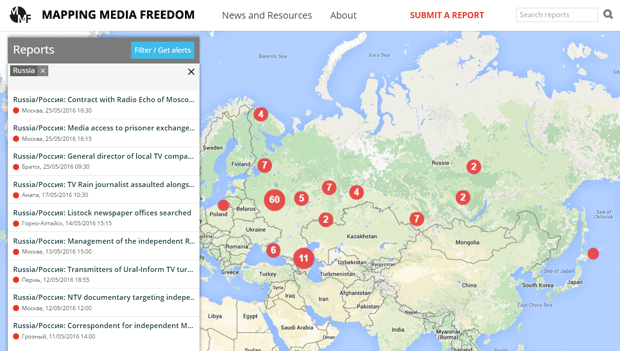
In fact, a considerable part of the media rights violations in Russia reported to Mapping Media Freedom are against journalists who are prevented from reporting about corporations.
Officials and Putin-connected business owners who have been named in the Panama Papers leak have so far received full protection in the Kremlin-backed media while independent journalists and bloggers who reported on the disclosures have been accused of “undermining Russian interests for Western money” and face legal charges.
Aleksei Navalnyi, an opposition leader and the author of dozens of high-profile investigations into misconduct and corruption committed by state corporations has been charged three times since 2012 with crimes that he has not committed, including defamation and fraud.
The state has almost officially recognised that Navalnyi has been persecuted for his investigations. In 2013 Vladimir Markin, a spokesperson for Russia’s investigative committee, told the pro-Kremlin newspaper Izvestia that accusations against Navalnyi would not have been raised had the blogger not “teased power”.
In the last two months, three cases of journalists being targeted by corporate interests have been reported to Mapping Media Freedom.
On 12 April, while covering truckers who were protesting against the actions of transport company Omega, its director Evgeni Rutkovski attacked journalist Anton Siliverstov. When Siliverstov asked Rutkovski to comment on the protest, Rutkovsky forced Siliverstov from the office. The journalist said he would record the incident on his phone, at which point Rutkovski snatched the journalist’s device, refused to give it back and called security.
Two days later, reporter Igor Dovidovich was assaulted by the head of Gaz-Service, a gas company he was investigating. His TV crew was also attacked by the firm’s employees.
The month ended with state oil company Rosneft filing a judicial complaint against BiznessPress for an article which, the firm said, is “false and represents baseless fantasies of journalists or their so-called sources”.
Without support from news organisations or media laws to look to for protection, bloggers are often more vulnerable than journalists. While those reporting these crimes are often defenceless, those committing them often benefit.
28 Jan 2016 | Mapping Media Freedom, News, Russia
(Image: /Demotix)
Russia’s media freedom has declined under the government of Vladimir Putin. The president and his allies have used a cloak of legislative legitimacy to target potential opposition to his rule. Mapping Media Freedom correspondents Ekaterina Buchneva and Andrey Kalikh explore what this means for two important sectors of the Russian media.
Print and broadcast media
By Ekaterina Buchneva, Mapping Media Correspondent
Under Russia’s law on mass media amended in autumn 2014, foreign owners are restricted to 20% of shares in media organisations in the country. Its authors said that the legislation would halt the West’s “cold information war”. The law has triggered major changes in the Russian media market and, as critics warned when the law was passed, was used to replace international investors with locals loyal to the Kremlin.
The Russian edition of Forbes magazine, formerly owned by German media conglomerate Axel Springer and known for its independent editorial policy, was sold to businessman Alexey Fedotov, who immediately said that the publication was “too focused on politics” and should cover more business news. In January 2016, the magazine named Nikolay Uskov as its new editor-in-chief. Uslov, a former editor-in-chief of the Russian edition of GQ, has never worked in business journalism.
Finland’s Sonoma Independent Media, America’s Dow Jones and the UK’s Pearson also had to sell their shares in Vedomosti, the main business newspaper known for its critical opinion pieces. Now the paper’s new — and only — owner is Demian Kudryavtsev, a business partner of oligarch Boris Berezovsky, who died in 2013, and a former chief executive of major Russian publishing house Kommersant. Kudryavtsev also purchased The Moscow Times, the country’s only English-language daily. Some journalists were concerned about the origin of the money Kudryavtsev used in the deal and suggested that there was another buyer behind him.
The media ownership law also affected a number of glossy magazines, which, as one of the law’s author said, “squeeze articles favorable to the West and the fifth column in between news about cars and glamorous watches”, and entertainment television channels. CTC Media sold 75% of its shares to loyal to the Kremlin oligarch Alisher Usmanov, who also owns the Kommersant publishing house.
The Russian broadcasters of CNN, Cartoon Network and Boomerang, as well as 11 television channels of Discovery group, came under the control of Media Alliance, 80% of which belongs to National Media Group. The president of NMG, which also owns a number of Russian media organisations, including RenTV, Channel Five, Izvestia newspaper and 25% of Сhannel One, is Kirill Kovalchuk, a nephew of Putin’s old friend Yuri Kovalchuk.
Tightening control over foreign publishers
In addition, in December 2015, another bill with new amendments to the “law about mass media” was introduced into the Russian State Duma. It contains more limitations for media organisations, some of them refer to foreign publishers.
The bill suggests new legal background — violation of anti-extremism legislation — for denying or revoking distribution permit for foreign publishers. Among the ones that now have such permits are Frankfurter Allgemeine Zeitung, China Daily, European Weekly, GQ, Cosmopolitan, Esquire, Tatler, Vogue, and some papers from CIS (Commonwealth of Independent States) countries, including Expert.Ukraine magazine.
“The problem is vagueness and inconsistency of the anti-extremism legislation itself and the practice of its implementation by the Russian authorities,” says Damir Gainutdinov, lawyer of Inter-regional Association of Human Rights Organisations “Agora”.
“It is primarily about Article 1 of the Federal Law on Countering Extremist Activity, which gives a definition of extremism, extremist materials, etc. In practice, this definition is used not only for hate crimes but also, for example, criticism of the Russian authorities. Condemnation of the Crimea annexation is recognised as calls for infringement of the territorial integrity of Russia, as it was in the case of Rafis Kashapov (Tatar activist from Tatarstan, who was convinced in September 2015 to three years in jail for posting informational materials criticising Crimea annexation), and criticism of the United Russia is recognised as the incitement of hatred to a social group, as it was in the case of prohibition of video clips by Navalny (a few activists were found guilty of distribution of extremist materials for posting a video by opposition leader Alexey Navalny titled ‘Let’s recall manifest-2002 to crooks and thieves’, on social media). Therefore, any unenthusiastic article published by foreign media may be recognised as a violation of anti-extremist legislation. Another thing is that this applies only to the print media. Since February 2014, it works much easier with websites; they can be just blocked by orders of the general prosecutor office.”
According to the bill, the foreign publishers also will have to pay a fee for issuing a distribution permit. The authors explained that it would “eliminate the unfair advantage of the founders of foreign publications that provides them with more favorable business conditions”.
Another bill, that was already approved by the State Duma, requires Russian media organisations to inform Roskomnadzor (The Federal Service for Supervision in the Sphere of Telecom, Information Technologies and Mass Communications) about foreign funding, including funding from foreign states, international organisations and Russian NGOs that were considered “foreign agents”. The minimum amount of money that should be declared is 15,000 roubles (less than $200). Penalties for not notifying Roskomnadzor will be fines of 30-50,000 roubles (about $400-600) for officials and the amount of money received for companies. A repeated violation will be punished with a fine of 80,000 roubles (about $1,000) and triples amount of money received.
This bill resembles the one adopted in June 2012 by the Russian State Duma, requiring NGOs to register as “foreign agents”, says Damir Gainutdinov. “First, it is a simple registration and then more and more new burdens will be introduced, for example, state bodies will deny accreditation of such media organisations, officials will be banned from giving them interviews and answering their questions … An additional mandatory audit and special checks of staff could be introduced, who knows what else.”
The bill about foreign funding could affect a number of media platforms – from Colta.ru that cover art and culture to Mediazonа that highlights problems of the Russian justice and the penal system.
Limitations for founders of media organisations
Another block of amendments introduces a new restriction for media founders. It suggests that those, who have unspent or unexpunged convictions for crimes against the constitutional order, public security and public safety, can not found a media organisation.
Those crimes include a number of criminal articles – from hooliganism and repeated violation of rules of organising or holding rallies and demonstrations to espionage and treason. But the most tricky ones are incitement of hatred and abasement of human dignity (Article 282 of the Criminal Code of Russia), public calls for extremism (Article 280) and public calls for infringement of the territorial integrity of Russia (Article 280.1), says Damir Gainutdinov. “These articles are used for persecution of dissenters. In absolute numbers, there are not many cases like this against journalists, but such practice is developing gradually – Stomaknih, Yushkov, Kashapov”.
However, these limitations could not prevent dissenters from taking part in media management at different positions. For example, Pussy Riot members Nadezhda Tolokonnikova and Maria Alekhina, who were convinced for hooliganism, founded Mediazona platform, but as Tolokonnikova told RBC newspaper, they were not officially registered as founders as they had foreseen possible legal problems.
Internet
By Andrey Kalikh, Mapping Media Correspondent
Russia’s environment for freedom of expression on the internet has declined precipitously since 2002 when the law on Counteracting Extremism was adopted. The definition of extremism used in the law is vague and overly broad, according to Aleksandr Verkhovski, an expert on extremism from the SOVA Information and Analytical Centre in Moscow. Verkhovski said that the law was written to keep independent media, oppositional political parties, and “not official” religious confessions under control.
In 2012, the anti-extremism law was amended to empower Roskomnadzor, the state media and communication watchdog, to launch the United Register of Banned Websites. The modifications also enabled the agency to add websites that have “extremist content” without judicial approval. Once a site is added to the list, Russia’s internet services providers are obliged to block it. Within days of the changes, several independent media outlets and political opposition sites websites and blogs — Grani.ru, Ej.ru, Alexei Navalny’s blog — were blacklisted in the country.
On 30 December 2015 a district court in the Siberian city of Tomsk sentenced blogger Vadim Tyumentsev to five years in prison for two videos he posted on his YouTube page.
In the first video, the blogger criticised the local government’s decision to raise the cost of fares on the city’s public transport. In the second video, he said that authorities help refugees from eastern Ukraine more than they help local residents.
The court recognised both of Tyumentcev’s videos as “having extremist character”. Ekaterina Galyautdinova, the presiding judge, gave Tyumentsev a sentence even longer than the prosecutor had pursued. She also banned Tyumentsev from posting online for three years.
The Tyumentcev case is far from the first time that a blogger has been subjected to a prosecution. In 2007, Savva Terentyev, a blogger from the Siberian city of Syktyvkar, was sentenced to a large fine for “offending a social group” – in this case, the local police force – by writing about bad behaviour and human rights abuses committed by officers. In 2012, Maxim Efimov, a blogger from Petrozavodsk, Republic of Karelia, faced prosecution after he posted an article under the headline.
In 2012, Maxim Efimov, a blogger from Petrozavodsk, Republic of Karelia, faced prosecution after he posted an article under the headline “Karelia is tired of priests”, in which he criticised the leadership of the Russian Orthodox Church. Efimov left Russia and was subsequently granted political asylum in Estonia.
That same year the Prosecutor General Office blocked the website and blog of Alexei Navalny, blogger and opposition leader, for allegedly calling “for mass disorders”. Navalny was sentenced to the administrative detention for 15 days and faced other accusations related to his political activities.
“Bloggers law”
In August 2014, the Russian State Duma adopted a number of amendments to communication legislation. The so-called “bloggers law” required sites with more than 3,000 visitors a day to register with Roskomnadzor and observe the same rules as much larger media outlets.
Under the amendments, all site owners and social media users are required to disclose their names and email address on their websites. Owners and users must keep all the information published on the web including personal data for at least six months and immediately submit to the law enforcement bodies on demand.
Moreover, Roskomnadzor received the right to request personal information from all site owners and users.
Most recently, as of 1 January 2016, the “bloggers law” requires all websites and social media platforms to keep all personal data of Russian users on servers within Russian territory. Failing to do this means Roskomnadzor can block the site or service. Companies can either comply or cease doing business in Russia.
According to the Roskomnadzor spokesman Vladimir Ampelonski, some foreign companies submitted to the requirement and brought their servers to Russia. However, some companies — Google, Facebook and Apple — have defied implementing this change. Facebook representatives met with the authority’s deputy chief, Aleksandr Zharov. At the meeting the company said it will not observe the law because it is “economically disadvantageous”, the Vedomosti newspaper reported.
Empowering the FSB
After Putin’s re-election in 2012, Russian security service FSB’s powers were considerably expanded. Articles of the Criminal Code of the Russian Federation on high treason, espionage and disclosure of state secrets were widened and made ever more vague by introducing language on cooperation with any “foreign organisation, or their representatives in hostile activities to the detriment of the external security of the Russian Federation”.
The FSB has further tried to make investigative journalism more by lobbying members of the State Duma to pass a draft law limiting access to information on commercial real estate transactions. If passed, the law would make it impossible to uncover cases of illicit enrichment by government officials.
This article was originally published on Index on Censorship.
5 Jan 2016 | Lithuania, Mapping Media Freedom, mobile, News
RTR Planeta, a Russian language channel broadcasting in Lithuania, has repeatedly run into conflict with the country’s television regulator.
In December, the Lithuanian Radio and Television Commission ordered RTR Planeta to be moved to paid TV packages after it broadcast material that the agency said instigated racial hatred and warfare. The programme in question was the 29 November episode of Sunday Evening with Vladimir Solovyov, which discussed the downing of a Russian plane by the Turkish airforce.
Russian MP Vladimir Zhirinovsky, who was a guest on the programme, said Turkish people were “a nation of wild barbarians,” and said that Turkey should be “brought to its knees” through military attacks.
“We need an air raid on any part of Turkey (…), the Turkish army must be destroyed,” said Zhirinovsky.
This is the second time the programme has prompted the regulator to take action. In April 2015, RTR Planeta was blocked from broadcasting for three months for allegedly “inciting discord and warmongering” over the conflict in Ukraine.
The content in question included a tirade against the Baltic countries by ultra-nationalist Russian politician Vladimir Zhirinovsky on the Sunday Evening With Vladimir Solovjev programme. Zhirinovsky said that Poland and the Baltic states would be “wiped out” should a war break out between Russia and NATO.
Although Lithuanian politicians and media experts agreed on the inflammatory nature of RTR Planeta content, especially the comments made by Zhirinovsky, some media pundits have expressed doubt over the decision to shut the channel down for three months. It resumed broadcasting on 13 July 2015.
In April, Audris Matonis, news service director at Lithuania’s national LRT broadcaster, rejected criticism that the ban was excessive and amounted to censorship. He insisted that “all should realise that what they’re advocating is non-compliance with Lithuanian law”.
But Gintautas Mazeikis, director of the Political Theory Department at Vytautas Magnus University in Kaunas, took issue when speaking to Delfi.lt. “Do we want and seek diplomatic and other means to influence Russian channels, or are we only trying to co-operate with cable TV service providers so they change their packages and broadcast more Polish or Ukrainian TV?” he said. “Do we want to explain and encourage critical thinking among speakers of Ukrainian, Belarusian, Russian and Polish who live in Lithuania?”
Aidas Puklevičius, a journalist and author, insisted that the broadcast ban may not have been the best decision and reasoned that the situation should improve once the generation of people who speak only Russian as a foreign language gives way to one which is more fluent in English.
“Russia will then lose its only vehicle for exporting soft power, something it has very little of,” Puklevičius said to Delfi.it. “Russia did not invent Pepsi Cola, nor jeans, nor Hollywood. Russia’s only strength is its ability to play on Soviet nostalgia.”
Media professionals in Lithuania have increasingly found themselves taking sides in the Ukraine conflict.
“Unfortunately, Russia-Ukraine warfare has become part of journalism in Lithuania and not surprisingly, all the Lithuanian news, except for some reports on the State Lithuanian TV, are concerned with the same issue: how atrocious the Kremlin-backed Russian insurgents are and how courageous the Ukrainians are,” a Lithuanian journalist, who agreed to speak on the condition of anonymity, told Index on Censorship. “Why is it happening? In any warfare, you’d expect analysis and different points of view, but none of it could be found on Lithuanian TV.”
The journalist said he had stopped watching Lithuanian TV news and has switched to German TV channels which air many different views on the conflict.
In January 2015, Dainius Radzevicius, the chairman of Lithuania’s Union of Journalists, wrote a commentary piece in which he said “polarisation of the media is something we all have to admit is happening, and it has been very palpable for the last couple of years not only in the Lithuanian media but elsewhere too”.
Radzevicius said the problem began as a result of economic conditions, but it is fueled by the geopolitical situation, including the conflict in Ukraine.
“Against this backdrop, we may now have less of a variety of opinions on the radio waves, the TV screens or the newspaper pages; but it is necessary to resist the powerful and obtrusive propaganda coming from the East, therefore, what I call our ‘white propaganda’ is necessary during the times,” he said in the piece.
Mapping Media Freedom
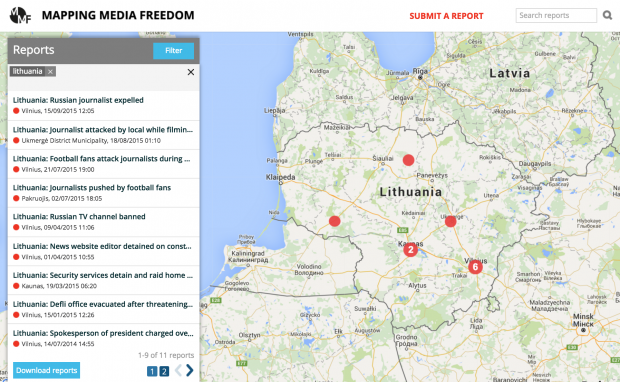
Click on the bubbles to view reports or double-click to zoom in on specific regions. The full site can be accessed at https://mappingmediafreedom.org/
|
4 Jan 2016 | Estonia, Mapping Media Freedom, mobile, News
In late November 2014, Estonia’s parliament made a historic decision to launch a Russian-language TV-channel as part of ERR, Estonia’s public broadcaster. A year later the channel is a reality: ETV+, ERR’s third channel debuted on 28 September.
The launch passed quite quietly, compared to the reaction that greeted the decision to create the channel. There were discussions about what the opening of a Russian-language channel in Estonia would mean. Would it be a tool of government propaganda or a knitting together of Estonia’s two communities, Estonian and Russian speakers into one community? From Russia there were clear expectations of a counter-weight to Russian media, which is widely followed by Estonia’s Russian speakers.
Speaking at a media conference hosted by ERR in June 2015, the ETV+ chief editor Darja Saar — a Russian project manager with no media experience — described the goals of the new channel: “We gave up the classical media rules from the very beginning, when we decided that we are not going to tell people what is right or wrong. Instead, we will follow people’s wishes – they are tired of just words and want deeds.”
The new TV channel aims not only to be an informer, educator and entertainer in the mould of a classical public service broadcasting channel but a leader in society and a hands-on problem solver.
In its two months on air, though, ETV+ has operated mostly as a traditional TV-channel offering morning programmes, debates, films and news. As required by law, all programmes are subtitled in Estonian. While geared toward Estonia’s Russian speakers, the station’s audience is mostly ethnic Estonians. In its debut week, ETV+ attracted 294,000 viewers. Ethnic Estonians accounted for 217,000 of the total and the other 77,000 were other ethnicities. On an average day during its first week 97,000 watched ETV+. On 28 September, its first day, 120,000 tuned in to sample the new station’s offerings.
ERR board member Ainar Ruussaar pointed out that ETV+ is a long-term project to improve Estonian society and was not about ratings. Yet the failure to draw a larger share of the Russian-speaking audience in the country may put that mission in jeopardy.
ERR has a fraught history with Russian-language programming. Promotion of Estonian language and culture has always been one of its core values. This served it well while it was under the Soviet system. Later, it countered Russian propaganda. But while times changed, ERR did not sufficiently move away from its core. In the early 2000s, the broadcaster, then under budgetary pressures, cut its slate of offerings in Russian. For years after its sole Russian-language production was a little-watched news programme.
In 2007, there was a serious discussion about launching a new Russian-language station after the 27 April violence sparked by the removal of the Bronze Soldier, a World War II memorial in Tallinn’s city centre. Then the political decision in favour of the Russian-language channel in Estonian Television was only one step away and there was readiness in the Russian-speaking audience to watch it. But as the riots faded, funding to get the project off the ground faltered and the opportunity to tie Russian speakers into ERR was missed. The country’s then prime minister Andrus Ansip said it was too difficult to compete with Russian TV channels so ERR’s Russian-language offerings would be limited to radio.
ETV+ is dancing on the razor’s edge. If it covers politics too much it will raise the ire of politicians who could cut its funding. Too much pro-government propaganda could turn off the Russian-speaking audience. Lurking in the background are ratings challenges that could force it to air infotainment and entertainment programmes.
As ETV+ turns two months old, it remains to be seen how it will develop. But connecting with Estonia’s Russian-speaking citizens must be its first goal.
This article was originally posted at indexoncensorship.org
This article was updated on 5/1/16 to clarify ETV+’s viewership numbers.
Mapping Media Freedom
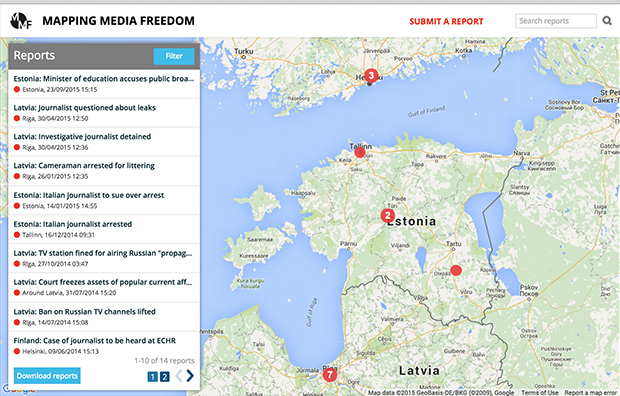
Click on the bubbles to view reports or double-click to zoom in on specific regions. The full site can be accessed at https://mappingmediafreedom.org/
|
