Ben Jennings: Russia’s propaganda machine
This week cartoonist Ben Jennings takes on Vladimir Putin’s information war.
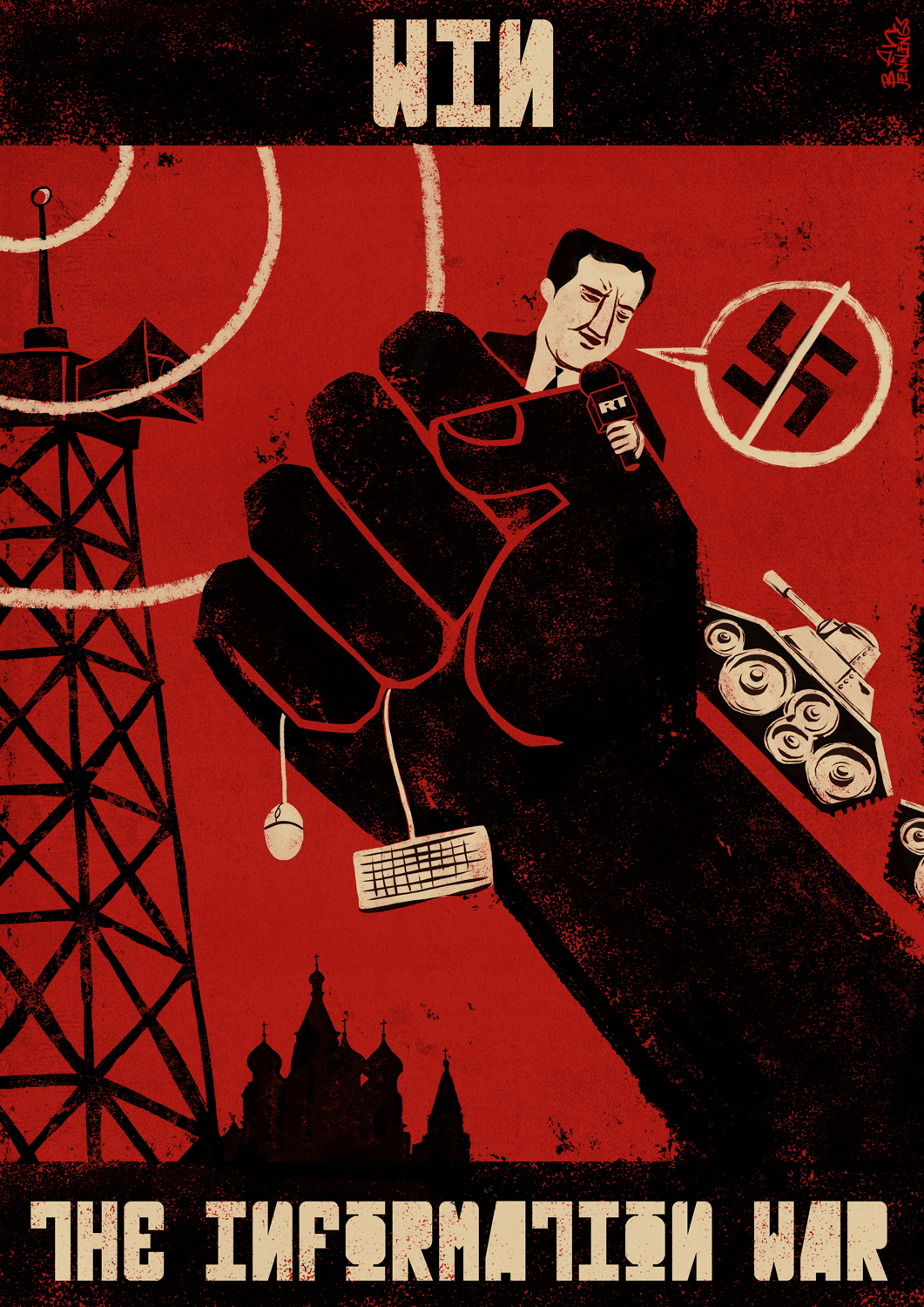

This week cartoonist Ben Jennings takes on Vladimir Putin’s information war.
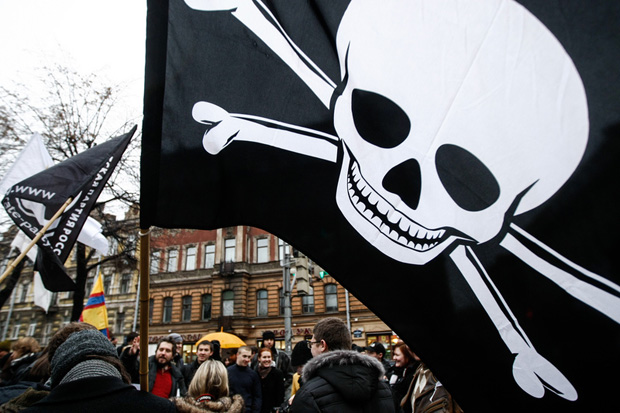
A 2012 protest against internet censorship in St. Petersburg (Image: Mike Kireev/Demotix)
It’s been a bad week for the internet in Russia. On Monday, the founder and CEO of VKontakte — “Russian Facebook” — claimed to have been pushed out and that Putin loyalists are now in charge of the site. On Tuesday, the Duma adopted controversial amendments to an information law, targeting bloggers. On top of that, on the same day, opposition figure Aleksei Navalny was found guilty of slander over a Twitter post.
Pavel Durov said in a statement on Monday that not only had he been fired from VKontakte, but he had learned about it from the press. He added that Kremlin loyalists Igor Sechin and Alisher Usmanov now had “complete control” over the social network, and that “Probably, in the Russian context, something like this was inevitable”. He revealed in an interview with TechCrunch that he’s left Russia, and has no plans to come back — labelling the country “incompatible with internet business at the moment”. VK, as it is known, is not the go-to platform for political expression, its users are generally quite young. However, the site has recently found itself in the spotlight of President Vladimir Putin’s regime, both over groups and accounts connected to the ongoing conflict in Ukraine, and, Durov claims, over Navalny‘s page.
Meanwhile, claimed to be a counter-terrorism measure, the new law forces any site with more than 3,000 daily visitors to register with authorities. It will then be considered a mass media outlet, with the potential of being subjected to blocking and fines for anything from failing to verify information posted, to using curse words. Bloggers could also be held responsible for comments posted by third parties on their site, while anonymous blogging may or may not be banned. If enforced, it would “curb freedom of expression and freedom of social media, as well as seriously inhibit the right of citizens to freely receive and disseminate alternative information and express critical views,” said the OSCE Representative on Freedom of the Media, Dunja Mijatovic.
While the amendment has yet to be signed into law, it appears to have already made an impact. Russia’s biggest search engine Yandex has removed its ranking of the country’s most popular bloggers, saying it is because the blogsphere has peaked and is losing ground to social media as a discussion platform. Incidentally, their decision was announced only days before the Duma representatives made theirs.
But these cases are merely the latest chapters in the ongoing saga of Russian internet censorship. While to some extent, the authorities have kept an eye on the internet since its inception, there was a time not long ago when their attention was firmly fixed on controlling the traditional media. But as TV news turned into little more than government propaganda machines (see the bizarre spectacle that is RT) Russians started looking for alternative platforms for real debate. Unsurprisingly, they found them on the internet, and it proved a relatively free space. The remarkable popularity of blogging site LiveJournal in Russia is one result of this; the rise of independent online news providers like Lenta.ru another.
But even then, there were those who realised the regime would turn its attention to the internet as soon as it clocked onto its potential power. And sure enough — the wave of internet repression we’re seeing today is widely believed to have started with the protests surrounding the elections securing Putin’s third term in power. Like the Arab spring, here too the internet was an effective organising tool.
Since then, continuous blocking and takedowns have been supplemented by more large-scale crackdowns, like the 2012 blacklisting of websites, and the range of attacks on online news sites, such as Lenta.ru, TVRain and Ekho Moskvy, early this year. And while there are immediate and obvious effects of putting government loyalists in powerful media positions or simply shutting down outlets that show any sign of dissent from the official line, these actions also pose less overt threats to free expression.
“We should understand one thing — while technically these initiatives look not very sophisticated, in fact the entire strategy is very efficient because it provokes the rise of self-censorship among users, ISPs and even global platforms,” renowned Russian investigative journalist Andrei Soldatov explained to Index. “Many are becoming more and more cautious facing government pressure on the internet, not very predictable, and thus extremely dangerous.”
There is little reason to believe that authorities will call it a day with their latest moves. “Every time we wonder, is it possible to have more propaganda and more pressure, but then it turns out it is possible,” Tonia Samsonova, a correspondent for Ekho Moskvy and TVRain told Index. She says people used to believe they lived in a free society, or one that was on its way to becoming free, but then the situation deteriorated. And every time they think they’ve hit rock bottom, “someone is knocking from the underground and we realise we can go lower and lower and lower in terms of freedom,” she says. “And I think there is a lot of room for making things worse for internet freedom in Russia.”
Soldatov believes a possible next step involves forcing the likes of Google and Twitter on to Russian soil: “It’s very probable, given that some prominent Russian MPs already started putting global platforms under pressure (using as pretext the protection of personal data of Russian citizens against NSA espionage). The very last initiative was to forbid Facebook in Russia until the company relocates its servers with Russian citizens data on Russian soil, notably in Siberia, because it might help develop this region.” This initiative has not yet been made into a draft bill, but Soldatov says “the trend is quite obvious”.
Indeed, on a related note, recently passed legislation orders websites — including foreign ones with Russian users — to keep six-month records of user activity, and for that to be made available to the authorities. Whether big internationals like Facebook will comply when challenged remains to be seen.
“Their ultimate goal is to have no oppositional thinkers posting,” says Samsonova. With few signs of widespread public opposition to the authorities’ previous repressive moves, further erosion of internet freedom on the path towards this goal seems likely.
This article was posted on 25 April 2014 at indexoncensorship.org
(Image: /Demotix)
Censorship of anti-war sentiment in Russia now uses a mixture of state-sponsored media attacks, arms-length loyalists, crooked think tanks and legal strong-arming – but is it working?
Politonline, a website well-known for its support of Putin, has produced an article with the top twenty most “negative” news sources in Russia. Editors claim to have pioneered a methodology which can gauge “emotional sentiment and tone” in online articles. Politonline don’t elaborate on how the algorithm has been put together, or indeed the source data they used. However some of the keywords used have been published, including the words “annexation” and “support for Crimea.”
Meanwhile, a prominent academic has been publically slammed by a pro-Putin think tank, in a pro-Putin newspaper, after he compared Hitler’s strategy in Anschluss with the annexation of Crimea. Professer Andrei Zubov was also dismissed by his employers – the Moscow Institute for International Relations. The Institute for Democracy and Co-operation, the think tank who critiqued the article, included a list of American academics who had lost their jobs over their political views – although many had been fired for comments which were overtly racist, sexist, or incited hate.
The man who blew the whistle on Putin’s invasion in Crimea, Lev Shlosberg, has also been targeted by his opponents. Some of the masked paratroopers now in Crimea were originally based in his home region : Shlosberg helped alert the media when the invasion began. A legislator and newspaper editor, he has since been accused of being a “fifth columnist” and “traitor.” In an interview on the Russia 1 television channel, Putin’s press secretary Dmitri Peskov adopted a similar strategy when he smeared dissenters as “professional critics” and a “nano-fifth column.”
Alexey Navalny, a lawyer, blogger and pro-reform opposition politician has also faced penalties. A lengthy article he published on his blog regarding Crimea prompted authorities to accuse him of breaking the terms of his house arrest. Authorities then blocked access to the site, and warned citizens that anyone promoting his article online would be subject to unspecified sanctions.
Protesters brave enough to go on the streets are also being met with state-sponsored aggression. Tanya Lokshina, Russia Program Director and Senior Researcher at Human Rights Watch, told Index that “anti-war protesters have been subject to arbitrary detention, harassment, intimidation, and even physical attacks.”
Between February 21st and March 4th, the NGO allege that police detained well over a thousand peaceful protesters in Moscow alone. Courts ordered at least fifteen of them to serve ten days of administrative detention for alleged failure to obey police orders, and fined dozens of others for participating in unauthorized public gatherings. The majority are still awaiting administrative court hearings. Other cities have seen similar policing tactics and unfair judicial process.
“Many wondered what a post-Sochi crackdown might look like,” Hugh Williamson, Europe and Central Asia director at Human Rights Watch told Index. “These detentions, the crackdown under way on the media, and violent attacks against dissenters by unidentified assailants paint a stark picture of what is going on in Russia right now.”
So is all this working? In December, Putin’s popularity was at its lowest since 2000, according to a report on the Reuters website. Polling conducted by the Levada Agency showed that “61 percent of respondents voiced approval for Putin’s performance in November, down from 64 percent in October and the previous low this year of 62 percent, recorded in January.”
It’s also notable that before the Crimea crisis escalated, the Russian people were indifferent to Euromaidan. Another Levada poll showed that 63% of Russians didn’t sympathise with either Yanukovych or the protesters.
However a poll by VTsIOM, conducted in March after troops had moved into Crimea, showed that Putin’s approval ratings had leapt up. VtsIOM is state-run but according to Russian politics analyst Mark Adomanis, “remains one of the most widely respected polling outfits in Russia.”
Crimea has sent Putin’s poll numbers skyrocketing,” says Adomanis, who writes a column for Forbes about Russian politics and economics. “Levada currently has him at a little over 80%, his highest level since 2010.”
“Other agencies have shown a similar rebound in his numbers – pretty much everyone agrees that the poll numbers are the best in a long time.”
Adomanis also commented on the lack of media, political and academic freedom surrounding the Ukraine crisis.
“Even in democratic societies there’s always a concern that polling can be heavily influenced by the nature of media coverage. It’s definitely more of a concern in Russia, given the heavy-handedness with which the authorities manage the press
“You can’t totally separate the biased coverage from popular support, but I don’t think one can fully explain the other.”
So Putin’s strategy in Crimea has played out well politically. It’s hard to know what the polls would have been like had the press been able to fully criticise his actions, or had street protests been allowed to go on unhindered. It’s also likely that the long-term economic impact of the annexation will be great enough to push polls down again in the future. However, the tactics used by the authorities to keep dissent out of the public psyche appear well-rehearsed and difficult to counter. A quick review of any Russia Today bulletin, compared with multiple on the ground sources in Kiev, Crimea and eastern Ukraine, reveal that the Russian public are not getting the full picture about their leaders international transgressions.
This article was published on April 14, 2014 at indexoncensorship.org
(Image: /Demotix)
At a conference in Prague last Spring, I listened as the wife of a former diplomat quizzed a Russian journalist on Russian politics. An old Cold War hand, she was keen to discover what motivated Putin and his cadre. Was it some hankering after communism? Was it plain nationalism?
The journalist, displaying the scepticism bordering on cynicism that, ironically, is often found among journalists bravely reporting in monstrous circumstances, shrugged. It would be a mistake, she suggested, to ascribe any value or ideology, even one as meagre as nostalgia, to the current Kremlin. Putin’s regime is about power and money and absolutely nothing else. There is no Putinism. There is just gangsterism.
It’s probably worth keeping this in mind while we fret over the geopolitics of Putin’s Crimean Anschluss. Indeed more than that, it’s clearly a point of view that merits more study. Unfortunately, one recent study of Putin’s gangster tendencies has been suppressed: not by the Kremlin, but by a UK academic publisher living in fear of England’s libel laws.
Karen Dawisha, Director of Miami University’s Havighurst Center for Russian and Post-Soviet Studies, was set to publish a book on Putin’s gangster connections. One hesitates to use the dread stock book review phrase “timely and relevant”, but in this case it seems difficult to avoid it. The proposed subtitle “How, why and when did Putin decide to build a Kleptocratic and Authoritarian Regime in Russia and what is its Future?” gives a pretty good impression of what the book would contain.
According to Ed Lucas at the Economist, Dawisha’s publishers, Cambridge University Press, has taken fright at the prospect of a book actually investigating gangsterism among Putin and his cronies, and decided it will not publish the book.
In a letter to Dawisha, published by the Economist, John Haslam of CUP noted:
“After discussion with legal colleagues who have reviewed the typescript from both a US and UK legal perspective, I’m afraid that our view is that we are not in a position to proceed with your book. The decision has nothing to do with the quality of your research or your scholarly credibility. It is simply a question of risk tolerance in light of our limited resources.”
Haslam goes on:
“We have no reason to doubt the veracity of what you say, but we believe the risk is high that those implicated in the premise of the book—that Putin has a close circle of criminal oligarchs at his disposal and has spent his career cultivating this circle—would be motivated to sue and could afford to do so. Even if the Press was ultimately successful in defending such a lawsuit, the disruption and expense would be more than we could afford, given our charitable and academic mission.”
This is depressing reading, and sadly familiar.
Six and a half years ago, Cambridge University Press was faced with a similar problem, and reacted in a similar fashion, i.e. capitulation.
Back then, publishers’ dreams were tormented not by Russian gangsters but Saudi bankers. Sheikh Khalid Bin Mahfouz was the scourge of Fleet Street’s inhouse legal teams. The Saudi, who had bought Irish citizenship from kleptocrat Taoiseach Charles Haughey, was notorious for issuing threats and writs to any publication or publisher that so much as mentioned him – particularly when it came to suggestions that he may have been linked, either personally or financially, to Osama Bin Laden.
Everyone I mentioned in that last paragraph is dead now, by the way, which is why I feel no qualms about writing about any of them.
When Index first wrote about Bin Mahfouz there were many, many fraught discussions and even arguments about how to proceed. That’s a big part of what campaigners, lawyers and hacks mean when they talk about the “chilling effect” of defamation laws. The knowledge of working on something that could be ruinuous not just personally, but for an entire publication, can make you queasy and put your colleagues on edge. The fact that Bin Mahfouz, worth over $3.2 billion dollars, could have tied up even the biggest publications in endless, expensive litigation tended to put people off. Even when people did publish, in the end they always backed down in the face of the Sheikh’s muscle. His personal website featured an entire section dedicated to apologies hastily issued by terrified newspaper legal departments after Bin Mahfouz threatened them with a trip to the High Court.
Anyway, in 2007, CUP were about to publish a book on funding for Islamist terror, called Alms For Jihad. Bin Mahfouz got wind of it, and issued the usual threats via his lawyers, Kendall Freeman. CUP apparently jumped through a few hoops, asking the book’s American authors, Robert O Collins and J Millard Burr to compile a letter countering the claims in bin Mahfouz’s book. But in the end they pulped the book and recalled library copies. It was a low point, but in a curious way, some good came out of it. The Alms For Jihad case was among those that highlighted the serious problems with English defamation law. Not long after the pulping of Alms For Jihad, the first stirrings of the Libel Reform Campaign began. On 1 January 2014, a new defamation law came into force.
So why are we seeing a repeat of the Alms For Jihad debacle with this book on Putin and his cronies?
The new law should make it harder for foreign litigants to sue in London, and it should make them prove that they have suffered genuine damage. Without having seen the contents of the book (CUP say there is no reason to doubt the veracity of Dawisha’s claims about Putin’s circle, while simultaneously refusing to stand by their author), one would imagine that, particularly given US and European moves against Putin’s inner circle, the book would have had a decent chance in court.
But the new law will need to be tested. It may be that while the legal barrier to putting up a spirited defence of free speech in court has been considerably lowered, the mental block remains for many publishers. Only a strong early ruling under the new law will shake this off.
But who’s going have the first go?
This article was published on April 10, 2014 at indexoncensorship.org