14 Jan 2014 | News, Russia
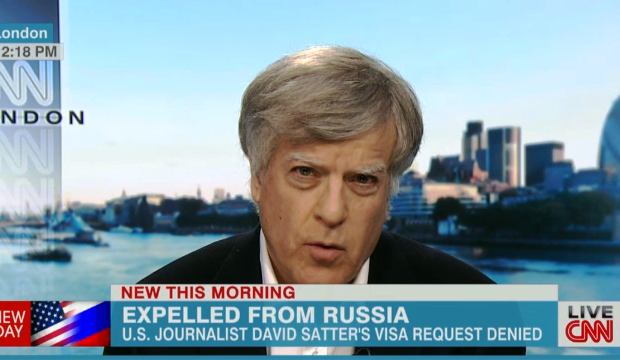
Fielding calls in the back of a London black cab, American journalist David Satter is a busy man.
Satter, who has reported on Soviet and Russian affairs for nearly four decades, was appointed an adviser to US government-funded Radio Liberty in May 2013. In September, he moved to Moscow. But at Christmas, he was informed he was no longer welcome in the country — the first time this has happened to an American reporter since the cold war.
Since Monday night, when the news of his expulsion from Russia broke, he’s been talking pretty much non stop, attempting to explain the manoeuvres which led to him being exiled from his Moscow home.
A statement issued by the Russian foreign ministry claims that Satter had violated Russian law by entering the country on 21 November, but not applying for a visa until 26 November.
Satter dismisses this as “nonsense”, saying he had been assured that a visa that had expired on 21 November would be renewed the following day, with no gap. As it happened, the visa was not renewed on time, “in order to create a pretext”, he tells Index.
To cut a short cut through a labyrinthine tale of bureaucracy: Satter says he left Russia in order to gain a new entry visa, which he could then exchange for a residency visa as an accredited correspondent for Radio Liberty.
He was repeatedly told this visa had been secured. Eventually, on 25 December, he was told that he had a number for a visa, but not the necessary invitation to accompany it. “Kafkaesque”, he calls it. The embassy official had never heard of this happening before. And, as Satter points out, he would not have been issued a number for a new visa in December if it had not been approved.
Eventually, he was told to speak to an official named as Alexei Gruby, who told him that “the competent organs” (code, Satter says, for the FSB) had decided that his presence in Russia was not desirable, language normally reserved for spies. “And now we see I have been barred for five years.”
“The point is, I urge you not to get caught up in their bureaucratic intrigues…the real reason was given to me, in Kiev, on 25 December.”
Is this just another example of FSB muscle flexing?
“Possibly. I’ve known them for a number of years, and I can’t always understand what they’re doing. Usually what they do is not very good…”
This is not Satter’s first brush with the Russian secret services. In a long career with the Financial Times, Radio Liberty and other outlets, he has experience of the KGB and its sucessor. “In 1979, they tried to expel me, accusing me of hooliganism. They once organised a provocation in one of the Baltic republics in which they posed as dissidents. I spent a couple of days with them, thinking I was with dissidents – I was really with the KGB. It’s a long history. It’s in my movie. We showed it in the Maidan [December’s anti-government protests in Ukraine]. Maybe they didn’t like that.”
Satter’s film, the Age of Delirium, is an account of the fall of the Soviet Union.
Is this expulsion a personal thing? Or a move against Radio Liberty? “It’s hard to say whether it’s me, or Radio Liberty, or both.”
Satter is concerned at leaving behind research materials and belongings in Moscow, saying it is likely his son, a London-based journalist, will have to go to Russia to collect them “unless they reverse their decision, which I hope they do”.
In spite of the recent amnesty that saw Pussy Riot’s Nadezhda Tolokonnikova and Maria Alyokhina released from prison, as well as opposition figure Mikhail Khodorkovsky, the diagnosis for free speech in Russia is not good. Alyokhina dismissed her release as a “hoax”, designed to prove Putin’s power. Meanwhile, state broadcaster RIA Novosti has been dissolved and reimagined as “Rossia Segodnya” (“Russia Today” – no coincidence it bears the same name as the notorious English language propaganda station), with many fearing closer Kremlin control.
One Russian journalist I spoke to felt that, ahead of the Sochi games, the expulsion of Satter is a message to all journalists: no matter how experienced, well-known, and well-supported you are, you are still at the mercy of the authorities.
This article was posted on 14 Jan 2014 at indexoncensorship.org
20 Dec 2013 | News, Politics and Society, Ukraine
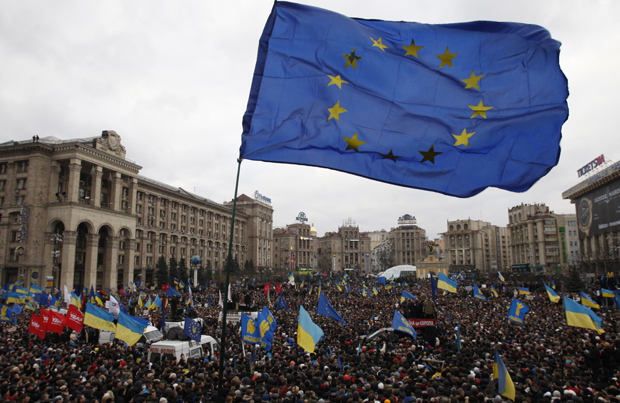
(Photo: Anatolii Stepanov / Demotix)
The coverage of Ukrainian protests in the Russian media suggests a centralised anti-EU message and has provoked outrage in Kiev.
At first, Russian TV channels appeared to broadcast inaccuracies only on the numbers taking part in the demonstrations. Despite clear evidence on the ground that tens of thousands or even hundreds of thousands were taking part, Russian reporters described scenes as “a few hundred protesters.”
Russia’s state-run First Channel then chose to dramatise Ukraine’s alleged descent into anarchy with a montage depicting combat scenes from Yugoslavia in the early 1990s, accompanied by a morbid musical soundtrack.
Komsomolskaya Pravda, a popular Russian daily, led on Tuesday with “Ukraine may split into several parts” with an illustrative map to depict the predicted chaos. The next day, a headline read “Western Ukraine is preparing for civil war.”
Overall – the message from the state-controlled Russian media seems to have been – “Ukraine is suffering at the fate of dangerous opposition militants.”
Putin has lent his weight to the propaganda, describing unrest in Kiev as “more of a pogrom than a revolution” and calling protesters “well-prepared and trained militant groups.”
“Ukraine is like a liner going in a circle,” commented a high-profile Russian journalist this week. “The passengers are calmed by the fact that Europe is near, there is not far to go. In reality the economic collapse of the whole country lies ahead…Passengers will be hurt. Some will not survive.”
The journalist quoted is Dmitry Kiselyov, who Vladimir Putin recently named as head of a re-launched Russia Today — as part of the take-over of previous state broadcaster RIA Novosti.
The shutdown of RIA Novosti was seen as a further degradation in the impartiality of the Russian media — despite being state-owned it had offered some balanced reporting on Russian domestic and foreign policy.
Media analysts in Russia have commented that Kiseylov’s appointment to Russia Today, now the sole government news agency, may have derived from his loyal allegiance to Putin and his ability to propagandise in his favour.
In support of recent anti-homosexual legislation passed by the Russian government, Kiselyov had commented.
“Fining gays is not sufficient -– they should not be allowed to give blood, or sperm and in case of a car accident, their hearts should be burnt or buried as useless”
Kiselyov’s assessment on Maidan went further than his dubious ship analogy — suggesting on his weekly TV show that Sweden, Lithuania and Poland may be manipulating events behind the scenes as revenge for a battle the Russians won in the early 18th century, a battle that happened to be fought in present-day Ukraine.
“It looked like thirst for revenge for Poltava,” argued Kiseylov, citing the name of a battle that took place in 1709.
He then labelled Ukrainian opposition leader and boxer Vitali Klitschko, and his brother Vladimir, as “gay icons,” before describing the “ancient African military techniques,” which the protesters were apparently employing.
He also accused protesters of aggressively firing tear gas at police (when multiple Ukrainian and European media sources confirmed the opposite was correct), and said that opposition leaders had brought students to the protest as sacrificial lambs for the security forces. In fact, police had gone out and savagely beaten groups of students hours before.
Finally, he describes the “writers” of the revolution as a Ukrainian-American-European conspiracy, against Russia.
Skewed Russian coverage has not gone unnoticed in Ukraine. A journalist interrupted a live broadcast from Rossiya 24 – handing over a fake “Oscar” statue in recognition of the “lies and nonsense” that was being reported.
Before being pushed off frame, the Ukrainain Vitaly Sedyuk was able to blurt out “We love Russians but after the way you covered events….”
The Russian reporter ended his piece still holding the fake Oscar statue in his hand.
In contrast to relatively objective reporting in Ukraine, the reporting of Kiseylov and other Russians, combined with a media landscape which has now lost most of its independent voices, indicates the strongest move yet towards total state control of the Russian media.
This article was published on 20 Dec, 2013 at indexoncensorship.org
9 Dec 2013 | News, Religion and Culture, Russia
(Photo illustration: Shutterstock)
Olga Khvostunova of Interpreter Magazine reports on media ownership in Russia
Recent history of the Russian media shows how the media system was preconditioned by the country’s political development. In the 1990s the Russian media system underwent major transformations following the collapse of the Soviet Union. The media were introduced into new realities: the market economy, the end of ideological control of the Communist Party, political pluralism, the development of new public institutions, et al. Fascinated by the seemingly ideal Western model of the press, Russian media borrowed most of its characteristics: freedom of speech, private ownership of the media outlets, similar legislation, distance from the state, public influence, and a watchdog role.
Still, development of the new Russian media system in the direction of the Western ideal was constrained by the deeply rooted cultural and professional traditions of Russian journalism. “For centuries, journalism as a social institution in Russia has been developing free from economic considerations while the role of the economic regulator has been carried out by the state which in turn secured the paternalistic foundation in journalism… [In the 1990s] the state, while liberating the economic activity in the media, was not ready to relax control over the content. This has produced practically unsolvable tension for the media themselves trying to function both as commercial enterprises and as institutions of the society.” [Ivanitsky]. The role of the state in the Russian media system has been and remains dominant.
After the new Law on Mass Media was adopted in 1991, thus effectively establishing guarantees for independence of the media and the freedom of speech, the first stage of privatization of the media market followed. In the early 1990s, as the country was going through an acute financial crisis, state funding of the media was cut manifold, which, in its turn, led to drastic cuts in circulation numbers and staff. As some scholars note, a whole generation of Soviet journalists were forced to change profession. At the same time, numerous private media companies were created driven by the forces of the free market; many old media outlets were privatized, reformatted and re-purposed.
Despite the fact that Russian political and social institutions underwent major formal changes during the transition period, there was no systemic change in the informal practices. As the new elites were fighting for redistribution of power and economic wealth, the country’s transformation reminded more of the “democratic civic masquerade” [Gross] rather than presented real change. The “masquerade” could also be observed in the media system. Creation of formal procedures of interactions between the media and the state did not destroy traditional informal relations between journalists and officials.
As the country acquired relative political and economic stability by mid-90s, the second stage of the media privatization began under President’s Yeltsin “polycentric” political model. “Polycentric” model was based on the balance of various power centers—oligarchs, industrial-financial groups, and regional state administrations. During this period the media enjoyed relative freedom and independence from the state, however, the new owners and managers of the media enterprises used them quite instrumentally—to manufacture favorable public opinion. Both political and business elites saw the media as weapons to gain political capital. On various occasions, business elites would barter the loyalty of their privatized media for economic and political perks. As Boris Berezovsky, one of the owners of ORT (Public Russian Television, now renamed to Channel One) of the time acknowledged, he “never got financial profits from ORT… Political profits were endless, economic—none.” [Resnyanskaya].
During this period the struggle among the elite clans was often reflected in the media in the form of “black” and “grey” PR, and kompromat wars. The elites seemed to recognize the advantages of the media in this struggle and aspired for converting these advantages into concrete benefits and moves in the power play. But the media could provide even more leverage for political purposes. Election campaigns—national, regional and local—would be impossible to win without the support of the media. The struggle for political power culminated in 1996 presidential elections, in which the incumbent President Yeltsin went to the runoff with the leader of the Russian Communist Party Gennady Zyuganov. In this historical standoff, Yeltsin managed to win by a small margin.
Much of the credit for this victory is attributed to the new liberal Russian media outlets that actively endorsed the incumbent president, despite his health problems and a much publicized alcohol addiction. Among these media were NTV, Russia’s first independent TV-channel that was considered one of the most objective and highly professional television networks in 1994-96, and Kommersant, one of the first business dailies in Russia. At the time NTV was a part of MediaMost media holding owned by an influential Russian oligarch Vladimir Gusinsky; and Kommersant Daily belonged to another influential oligarch and advisor to President Yeltsin—Boris Berezovsky. Thus, the media played a crucial role in the drive of the public opinion in favor of Yeltsin and in his eventual victory.
The third stage of the evolution of the media system in Russia started with Vladimir Putin’s rise to power in 2000. The new Russian president transformed the country’s political system from “polycentric” to “monocentric” under the slogan of increasing stability and security—the issues that brought him substantial public support. By building the so-called “power vertical” Vladimir Putin eliminated all alternative political forces and established control over the government, the parliament, the judiciary, and the media system to secure stability of the new regime. In early 2000s various state agencies took financial or managerial control over 70 percent of electronic media outlets, 80 percent of the regional press, and 20 percent of the national press [Vartanova]. As a result, Russian media continued to be used as tools of political control but now these “tools” were no longer distributed among competing political parties and businesses, but remained concentrated in the hands of a closed political circle that swore loyalty to President Putin.
Overall, during this period the political discourse in Russia deteriorated, and the public debate in the media was either substituted by the imitative forms1 or squeezed out from the popular media outlets, such as television and dailies with large circulation, to the publications with much smaller readership, like Novaya Gazeta, or to the internet. Under the pressure from the new Kremlin’s elite, in 2001 Boris Berezovsky was forced to sell his share of ORT to Roman Abramovich, another Russian oligarch, who claimed his loyalty to Vladimir Putin. The symbolic culmination of the new elite’s war for media control was the government’s takeover of MediaMost holding (its most valuable asset was NTV) in 2002 by Gazprom Media—a subsidiary of Gazprom, the largest state-owned corporation in Russia.
At the same time, during this period, Russian media became an integral part of the global media community following the process of global convergence and homogenization. “While the media were exercising its policies to make TV less politically engaged, the advertising and media business easily filled ‘empty’ niches of political programming with entertainment content.” [Vartanova] Under the new conditions of the monocentric political system, it was a natural process: the state enjoyed the benefits of controlling the political discourse, and the media welcomed financial inflow from the booming advertising industry in Russia.
One of the key characteristics of Russia’s political system under Vladimir Putin’s rule is informal subjecting of the legislative and judicial branches of power to the executive branch, controlled by the President. This hierarchy helped the President to achieve his goal—to establish control over the entire political process, eliminate possible risks of competition, and restructure the system of checks and balances. By silencing a group of powerful non-conforming businessmen2, Vladimir Putin sent a clear message to the business community to distance themselves from politics and thus established control over corporate Russia. From now on, only those who complied with his political line and demonstrated loyalty and support were allowed to continue their business as usual.
The state learned to utilize a wide selection of political, economic and legal tools to put pressure on and intimidate the media [Vartanova]. Some of them are:
- providing personal privileges or access to closed sources of information; preferential treatment for certain media outlets and journalists;
- acquiring state ownership in media outlets or establishing indirect control through ownership by private companies whose owners are loyal to the state;
- banning access to official events and press conferences, refusal to provide requested information;
- bringing legal suits against media outlets and journalists on the grounds of defamation, libel, et al.;
- penalizing the media and suspending the license;
- using legal sanctions, such as tax or customs legislation, fire safety and sanitary regulation.
Application of these techniques transformed Russian media system into a restricted homogenous field, where only state-controlled media outlets were allowed to operate on the national scale. The regime allowed for limited operations of the independent media (the press and the internet media) to absorb the protest mood3.
Because of the constrained political environment, Russian media were unable to resist the pressure from the state and succumbed to the well-known propaganda and conformism pattern according to which they’ve been operating in the Soviet times. The period of the relative freedom of press ended with Vladimir Putin ascension to power, it was too short for the Russian media to become a strong democratic institution and a watchdog.
It is noteworthy that today’s situation differs from the Soviet times. Russia is no longer a closed country, Russian media are exposed to the free flow of information and the developments of the global media market, and Russian journalists are aware of the media’s role in the free world. Therefore, by choosing to serve as propaganda tools to receive benefits from the state, by abandoning their public duty to report the truth, the majority of the media voluntarily chose to engage in corrupt practices.
Deterioration of the public political discourse is a direct result of the lack of political pluralism and competition. As it happens in all closed regimes, political discourse in Russia transformed from an open political communication into the state’s narrative. As a result, the content of political discourse became flat and dull.
Considering general disillusionment of the Russian citizens in politics and in their own abilities to influence political process or bring about change, public interest shifted from politics to the entertainment segment, which drives the expansion of the entertainment segment. Another reason for this expansion is commercialization of the global media market driven by advertising industry and aimed at stimulating consumption. As mentioned above, the diminishing political discourse created an information vacuum in Russia that, with lack of other alternatives, had been filled with entertainment content. Eventually, this process led to tabloidization of the media and the prevail of the popular media formats that appeal primarily to the mass audience.
Russian Media MARKET and the Global Trends
The outlook of the Russian media market provides an insight into the type of information Russian media produce and the public consumes. It shows that entertainment content has filled the empty niche of the political programming. At the same time, while political and investigative journalism is declining in Russia, Russian media market is booming due to the high inflow of advertising money. Today, Russia ranks ninth in the top-10 media markets in the world, and in 2013 its market growth rate is estimated to be at 12 percent—the highest rate across the top ten media markets (see Table 1).
Table 1. Top-10 Media Markets
-
|
Ranking
(2013, est.)
|
Country
|
Growth Rate
(2012*)
|
Growth Rate
(2012**)
|
|
1
|
United States
|
+4%
|
+3%
|
|
2
|
China
|
+6%
|
+7%
|
|
3
|
Japan
|
+3%
|
+3%
|
|
4
|
United Kingdom
|
+4%
|
+3%
|
|
5
|
Germany
|
-1%
|
0%
|
|
6
|
Australia
|
-1%
|
+1%
|
|
7
|
Brazil
|
+13%
|
+9%
|
|
8
|
France
|
-4%
|
0%
|
|
9
|
Russia
|
+13%
|
+12%
|
|
10
|
Italy
|
-12%
|
-5%
|
Source: Aegis Global Report.
* Compared to 2011; ** Compared to 2012.
According to Aegis Global Report, the high growth rate of the Russian media market is driven by the growth of the advertising market, especially in the premium sector (companies with the annual advertising budget of more than 3 billion rubles, or ~$100,000). Industries, such as medicine and IT, have demonstrated the highest growth of 18 and 13 percent respectively. The 2014 Sochi Olympic Games is expected to give the market an additional boost next year.
Television
The ownership structure of the Russian media market shows that the national media outlets with the highest audience reach are controlled by the state, primarily—television.
Television in Russia is the leading source of information. 99 percent of Russian households have at least one TV-set, and about 94 percent of Russians watch TV on a daily basis [Vartanova]. The core of the TV market consists of 19 federal channels available to more than 50 percent of population. The top-five channels by the audience reach are: Perviy Kanal (Channel One), Rossiya 1, NTV, TNT and Pyatiy Kanal (Channel 5).
Russian television is a mixture of two models—one is state-controlled (major TV channels are either owned by the state or by businessmen and companies loyal to the state); the other model is purely commercial—it provides entertainment content. Regardless of the ownership structure, Russian television is mostly financed through advertising and sponsorship [Vartanova].
The chart below shows that the three main channels—Perviy Kanal (Channel One), Rossiya 1 and NTV—have the highest audience reach: 14.2 percent, 13.7 percent, and 13.5 percent respectively.
All three TV channels are controlled by the state: the majority share of Channel One belongs to Rosimuschestvo (the Federal Agency for State Property Management). Other shareholders include National Media Group (controlled by the structures of Yuri Kovalchuk, Chairman of the Board of Rossiya Bank, one of the largest banks in Russia, and Vladimir Putin’s personal friend; and Roman Abramovich, owner of Chelsea football club and Putin’s ally). Rossiya 2 is a part of VGTRK (All-Russia State Television and Radio Broadcasting Company) which is owned by Rosimushchestvo. NTV is also controlled by the state through Gazprom Media. TNT and Pyatiy Kanal that come respectively fourth and fifth in the top TV channels by audience reach, are also controlled by the state. TNT belongs to Gazprom Media, while Channel 5 is controlled by National Media Group.
Top TV Channels Audience Reach, 2012-2013
Download (DOCX, 165KB)
Print Press
According to the recent Report of the Russian Guild of Press Publishers, the total circulation of print media outlets in Russia is around 7.8 billion copies, including 2.7 billion copies of national dailies, 2.6 billion—of regional copies, and 2.5 billion—of local press copies. Similar to the television segment, the press market is divided between the two media models: quality dailies and weeklies that are mostly business oriented and have relatively small readership; and popular newspapers and magazines that are inclined to tabloidization.
For the last five years, the share of print press has been steadily decreasing. In the first half of 2013, the circulation of national newspapers and magazines went down by 7.5 percent, while its market share shrank by 6 percent. The main reasons for that were the recession following the 2008 financial crisis, growth of the share of internet media, ban of advertising alcohol beverages (since January, 2013) and the expected ban of advertising tobacco products (projected to come into force in 2014). Tobacco and alcohol companies were among the major contributors in the print market profits.
The structure of the print press market is much more diverse in terms of ownership, but publications with entertainment content, glossy fashion magazines, tabloids, et al. are dominating the market.
The results of 2012 TNS survey on the audience reach of the Russian publications presented in Table 2 reveal a number of current trends: 1) the newspaper with the largest audience reach in Russia is a classified daily (Iz Ruk v Ruki); 2) it is followed by Metro—a freesheet daily intended primarily for commuters; 3) the third is Rossiyskaya Gazeta, an official source of political information provided by the state; owned by Rosimushchestvo; 4) out of top ten outlets, only two newspapers provide quality political/business content—Kommersant (8th) and Vedomosti (9th), while other newspapers cover entertainment sector.
It is noteworthy that Izvestia, a well-known, respected Soviet brand, was acquired by the National Media Group in 2011. The new owners pronounced it to become a state-controlled competitor of Kommersant and Vedomosti. Izvestia covers Russian politics, but as one of its owners and editor-in-chief Aram Gabrelyanov told in an interview,4 his newspaper has three forbidden topics: the president, the prime minister, and the patriarch. Another detail that needs to be mentioned is that even though Kommersant gained its reputation of the first independent quality daily in Russia, in 2006 it was acquired by Alisher Usmanov, head of Metallinvest Management Company. Mr Usmanov was ranked 1st in the Forbes’ Top-200 Richest Businessmen in Russia in 2013, and openly supports Vladimir Putin. In the context of the Russian political system, such ownership suggests that Kommersant’s coverage of politically sensitive issues can be managed by application of the so-called “administrative resource,” a.k.a. pressure from the Kremlin.
Table 2. Top Dailies in terms of Audience Reach* (All-Russia)
|
Newspaper |
Audience Reach (thousands of people)
|
%
|
| 1 |
Iz Ruk v Ruki (From Hand to Hand) |
3242.9
|
5.4
|
| 2 |
Metro |
1932.1
|
3.2
|
| 3 |
Rossiyskaya Gazeta |
1060.3
|
1.8
|
| 4 |
Moskovsky Komsomolets |
1048.1
|
1.7
|
| 5 |
Sport-Express |
523.9
|
0.9
|
| 6 |
Sovietsky Sport |
418.9
|
0.7
|
| 7 |
Izvestia |
334.9
|
0.6
|
| 8 |
Kommersant |
219.9
|
0.4
|
| 9 |
Trud (Labor) |
196.9
|
0.3
|
| 10 |
Vedomosti |
134.6
|
0.2
|
Source: TNS Russia, NRS, 2012
* Komsomolskaya Pravda did not participate in this survey, but according to the public data, its daily circulation is around 655,000 copies, Friday edition—2.7 million.
Table 3 provides evidence that the Russian readers lack interest in political issues. All top ten weeklies with the largest audience reach in Russia are popular publications with mass appeal (i.e. Argumenty i Fakty, Komsomolskaya Pravda, Moya Semiya) and tabloids (i.e. Zhizn, Express Gazeta). Weeklies that provide serious analysis of the current political issues are scarce on the market. Few examples are Kommersant-Vlast, Expert, and the New Times, but the first two magazines are owned by the oligarchs who openly support the President. Kommersant-Vlast is produced by Kommersant Publishing House that, as mentioned above, is owned by Alisher Usmanov. Expert is a part of Expert Media Holding that is owned by Oleg Deripaska’s Basic Element and a Russian state corporation—Vnesheconombank.
Table 3. Top Weeklies in terms of Audience Reach* (All-Russia)
|
Newspaper |
Audience Reach (thousands of people)
|
%
|
| 1 |
Argumenty i Fakty (Arguments and Facts) |
6389.3
|
10.6
|
| 2 |
Komsomolskaya Pravda |
5287.1
|
8.8
|
| 3 |
Teleprogramma |
4890.1
|
8.1
|
| 4 |
777 |
4399.0
|
7.3
|
| 5 |
Orakul (Oracle) |
2230.7
|
3.7
|
| 6 |
Moya Semiya (My Family) |
1806.0
|
3.0
|
| 7 |
Moskovsky Komsomolets (MK + TV) |
1744.6
|
2.9
|
| 8 |
Zhizn (Life) |
1710.1
|
2.8
|
| 9 |
MK Region |
1532.2
|
2.5
|
| 10 |
Express Gazeta |
1250.4
|
2.1
|
Source: TNS Russia, NRS, 2012
At the same time the audience preferences across Russia differ from those of the population of the large cities. Table 4 shows this difference for Moscow audience. Moskovsky Komsomolets is the second most popular newspaper in Moscow. Even though the newspaper has a mass media appeal and tends to tabloidization, sometimes it publishes sharp political commentaries. The newspaper is owned by its editor-in-chief Pavel Gusev, who also holds several official positions, such as head of the Moscow Union of Journalists, member of the Presidential Human Rights Council, and member of the Russian Public Chamber. Still, private ownership of the newspaper allows for certain freedom in terms of political discourse.
Another difference is that Novaya Gazeta appears eighth in the top ten most popular newspapers in Moscow. Novaya Gazeta is one of the very few newspapers on the market that produces high standard pieces of investigative journalism. It is owned by the members of the editorial board; minority shares belong to Russian businessman Alexander Lebedev and former Soviet president Mikhail Gorbachev.
Table 4. Top Dailies in terms of Audience Reach* (Moscow)
|
Newspaper |
Audience Reach (thousands of people)
|
%
|
| 1 |
Metro |
1164.1
|
11.6
|
| 2 |
Moskovsky Komsomolets |
685.8
|
6.8
|
| 3 |
Rossiyskaya Gazeta |
210.5
|
2.1
|
| 4 |
Sport-Express |
171.8
|
1.7
|
| 5 |
Sovietsky Sport |
167.5
|
1.7
|
| 6 |
Iz Ruk v Ruki |
138.9
|
1.4
|
| 7 |
Izvestia |
119.2
|
1.2
|
| 8 |
Novaya Gazeta |
112.1
|
1.1
|
| 9 |
Kommersant |
110.4
|
1.1
|
| 10 |
Vedomosti |
91.7
|
0.9
|
Source: TNS Russia, NRS, 2012
Radio
Radio is the growing segment of the Russian media market. According to Vartanova, the main reasons for the increase in number of the radio stations are advancements in broadcasting of commercial music, and fragmentation of the audience. Aegis Global Report shows that in 2012 radio segment of the advertising market in Russia increased by 23 percent, but in the first half of 2013 the growth slowed down to 14 percent.
The majority of the Russian radio stations broadcast music and entertainment content. According to 2012 VTsIOM survey, Russkoye Radio is the most popular radio station in Russia, followed by Europa Plus and Autoradio. Out of 15 radio stations that are listed in the ranking, only three broadcast political talk shows: Mayak, Radio Rossiya, and Ekho Moskvy. Mayak and Radio Rossiya are state-owned (Rosimushchestvo), while Ekho Moskvy is owned by Gazprom Media. Still, Ekho Mosvky allows for members of opposition to participate in some its programs and to voice criticisms of the regime.
Table 5. Most Popular Radio Stations
| # |
Radio Station |
Audience Reach
|
| 1 |
Russkoye Radio (Russian Radio) |
14%
|
| 2 |
Europa Plus |
11%
|
| 3 |
Avtoradio |
10%
|
| 4 |
Mayak |
9%
|
| 5 |
Radio Shanson |
8%
|
| 6 |
Radio Rossiya |
7%
|
| 7 |
Dorozhnoye Radio (Road Radio) |
5%
|
| 8 |
Radio Dacha |
4%
|
| 8 |
Retro FM |
4%
|
| 9 |
Hit FM |
3%
|
| 9 |
Dynamite FM |
3%
|
| 9 |
Yumor FM (Humor FM) |
3%
|
| 10 |
Ekho Moskvy |
2%
|
| 10 |
Love Radio |
2%
|
| 10 |
Militseyskaya Volna (Police Wave) |
2%
|
Source: WTsIOM, 2012
Internet
Internet market in Russia shows extremely positive dynamic. In the first half of 2013, internet advertising grew by 30 percent, which is the highest increase across all media.
As the chart below shows, the increase of the internet share has been quite dramatic. In 2007, the share of internet of the Russian media market did not exceed 3 percent, while by 2012 it has amounted to 19 percent. Over the same period, the share of the print press dropped by 9 percent, and radio—by 3 percent, while the share of television decreased by 1 percent.
Structural Change of the Russian Media Market (market percentage)

Source: Aegis Global Report.
However, it’s noteworthy that the share of internet grows not only because new users acquire access to the internet, but also because of the increase in the number of connection points. Today, every fourth internet user in Russia has three or more devices connecting them to the internet. Meanwhile, the number of Russian citizen who have access to internet hardly exceeds 50 percent5. But as shown at the chart below, the average daily reach of popular Russian internet resources (Yandex, Mail.ru, Vk.com) is actually higher than that of Perviy Kanal.
Source: Aegis Global Report
Table 6 shows the most popular websites of the Russian internet (RuNet) by their audience reach. Yandex tops the list, being the most popular Russian search engine and accumulating 34 websites on its platform. Yandex’s primary competitor Mail.ru comes third, but two other websites of the Mail.ru Group (odnoklassniki.ru and Moi Mir) are rated fifth and sixth.
Popular internet media (as opposed to internet search engines and social media) are at the bottom of the Top-15 list. Rbc.ru and Qip.ru belong to a privately owned RBC Holding, while Ria.ru is an internet platform of RIA Novosti, a state-owned news agency. Kp.ru is a part of Komsomolskaya Pravda Holding is owned by ESN Group, associated with a state transportation company—Russian Railways.
Table 6. RuNet’s Most Popular Internet Websites
|
Website |
Operator |
Monthly Audience Reach* (thousands visits) |
| 1 |
Yandex.ru |
Yandex |
29166.2
|
| 2 |
Vk.com |
VKontakte |
29143.3
|
| 3 |
Mail.ru |
Mail.ru Group |
27065.2
|
| 4 |
Google (ru + com) |
Google |
26036.4
|
| 5 |
Odnoklassniki.ru |
Mail.ru Group |
25264.9
|
| 6 |
Moi Mir (my.mail.ru) |
Mail.ru Group |
22830.5
|
| 7 |
LiveJournal.com |
SUP Media |
16139.4
|
| 8 |
Rutube.com |
RuTube |
15096.5
|
| 9 |
Avito.ru |
AVITO |
14552.8
|
| 10 |
Liveinternet.ru |
Klimenko & Co |
11290.8
|
| 11 |
Kinipoisk.ru |
Kinopoisk |
10634.3
|
| 12 |
Rbc.ru |
RBC Holding |
9995.7
|
| 13 |
Qip.ru |
RBC Holding |
9709.4
|
| 14 |
Ria.ru |
RIA Novosti |
9106.6
|
| 15 |
Kp.ru |
Komsomolskaya Pravda |
8823.7
|
Sources: TNS, Tasscom, March 2012
Today, Russian internet is quite diverse in terms of forms of ownership, which allows for greater freedom of expression and variety of information sources.
This article was originally posted on 6 Dec 2013 at interpretermag.com and is reposted here with permission.
Footnotes:
22 Nov 2013 | News, Russia
This autumn the Russian authorities have made it clear that they are intent on extending the blocking of websites. In September, two prominent State Duma members of the ruling United Russia party, Robert Shlegel and Maria Maksakova, submitted amendments to an anti-piracy law, prohibiting illegal distribution of movie. These entered into force on 1 August. The deputies propose to supplement the law with measures that protect the copyright of musicians, writers and computer program developers.
In November, Andrei Lugovoi, a MP from the rightwing nationalist Liberal Democratic Party, submitted a bill proposing the extrajudicial blocking of sites containing calls for riots or extremist activities, including calls to take part in public events held deemed to be in violation of the established order. Hitherto, such sites have been subject to blocking by a court order. This initiative was met with general approval by members of the State Duma.
Extremism
Chechen prosecutor seeks to block anti-Putin article
On 23 September the Chechen Republic prosecutor announced the filing of writs against internet service providers (ISPs), demanding restrictions on access to a website publishing the anti-Putin polemic “Putin’s plan is Russia’s misfortune”. The article is on the Federal List of Extremist Materials.
Chechen prosecutor moves against ISPs over Islamist material
On 11 September the Chechen Republic prosecutor announced the filing of writs to restrict access to a website featuring the Islamist piece “Zaiavlenie komandovaniia mudzhakhidov Vilaiata Galgaiche” (Statement of the Mujahideen commanders of Vilayata Galgaiche), which is on the Federal List of Extremist Materials. The defendants were not identified in the report.
Smolensk prosecutor starts proceedings against ISP for video
On 11 September it was reported the Leninsky district prosecutor had issued a writ to the ISP MAN Set for allowing public access to videos included on the Federal List of Extremist Materials. The ISP complied with the writ and those responsible for allowing access faced disciplinary charges.
MTS receives a order to block video in Altai Republic
On 10 September the Gorno-Altaysk city court granted the Altai Republic prosecutor’s motion demanding that the ISP Mobilnye Telesystemy restrict access “to an extremist video clip posted on 16 websites”. The clip in question was not specified. The decision was made in the absence of the defendant.
Moscow court orders ISPs to block sites
On 25 September the Moscow city prosecutor reported that the Kuzminsky district court had accepted the demand of the Kuzminskaia interdistrict prosecutor that the ISPs Click and Obiedinennye Lokalnye Seti limit access to five websites that made available Hitler’s Mein Kampf. The prosecutor also demanded a block on a website containing citizens’ personal data.
Krasnodar moves against extremist posts on social network
On 25 September the Krasnodar regional prosecutor reported that the Adlersky district court in Sochi had accepted the demand of the district prosecutor that it define two Islamist texts published on the VKontakte social network as extremist.
Prosecutors move against website in Chechnya
On 11 September the Urus-Martanovsky district prosecutor filed a lawsuit demanding that ISPs limit access to a website for publishing the video Videovestnik Russkoi Molodezhi (the Youth Messenger), included on the Federal List of Extremist Materials. The case is pending.
Blogs targeted in Ulyanovsk
On 25 September the Ulyanovsk regional prosecutor reported that the Zavolzhsky district prosecutor had issued writs demanding the ISPs ER-Telecom Holding and Rostelecom cease offering access to the websites kcblog.info and t-kungurova.livejournal.com. Both are legally recognised as extremist [for being aliases] for the Chechen militants’ website Kavkazcenter.
Education and schools
Kamchatka schools told to shield students
On 13 September it was reported that the Petropavlovsk-Kamchatsky city prosecutor had issued demands that several schools install content filters to prevent access to websites containing extremist propaganda.
Lipetsk schools allowed access to banned sites
On 27 September it was reported that the Dankovskaia interdistrict prosecutor in Lipetsk region had demanded the director of Dankov Secondary School No 1 eliminate violations of the child protection law. An inspection had revealed that the internet filtering system installed on school computers was not blocking access to websites about drugs, pornography and suicide. It also allowed access to the texts of songs included in the Federal List of Extremist Materials.
Blind students ‘could read Mein Kampf’ in Omsk school
On 17 September it was reported that the Omsk city prosecutor had identified a number of violations at Boarding School No 14 for visually impaired children. In particular, the school computers allowed access to Hitler’s Mein Kampf, included on the Federal List of Extremist Materials, as well as to websites containing pornographic images, violence and drug propaganda.
University fined for banned site breach
On 3 September it was reported that the Sverdlovsk regional arbitration court had accepted the demand of a fine for B N Yeltsin Ural Federal University, issued by the Ural regional office of the watchdog Roskomnadzor. The university had failed to submit an application for an access code to the register of banned websites. As a result, students had access to resources included on the register. The court imposed a fine of 30 thousand rubles on the university. The court’s decision has not yet entered into force.
Suicide propaganda
Penza prosecutor tries to block suicide prevention
On 11th September it became known that the local Penza’s prosecutor office asked the court to block access to the website Pobedish.ru (“You win”). The website is part of Perezhit.ru group – a suicide prevention resource that works with psychologists, psychiatrists, forensic experts and the clergy.
Kaliningrad prosecutor moves against suicide sites
On 23 September it was reported that the Moskovsky district court of Kaliningrad had received a prosecutorial request that the ISP TIS-Dialo restrict access to several websites describing methods of committing suicide.
Drugs and alcohol
Facebook almost blocked for advertising smoking blends
The Russian branch of Facebook came close to being blocked for publishing advertisements for illegal smoking blends in September, according to reports from the Itar-Tass news agency, citing Facebook’s Russian press service. Facebook said users had reported the ads for smoking blends on 16 September and the company had been unable to do so because of a technical glitch. The incident followed a warning from the Federal Antimonopoly Service (FAS) that it intended to inspect social networking sites for ads for banned substances. The media watchdog Roskomnadzor subsequently warned Facebook that it had been provisionally placed on the register of banned websites and would be shut down if it did not remove the ads. Facebook announced on 19 September that it removed the offending content.
Reports filed on ISPs in Kurgan
On 18 September it was reported that the Kurgan regional office of Roscomnadzor had compiled reports on two ISPs that were not blocking access to websites advertising illegal drugs.
Yekaterinburg complains about alcohol advertising
On 17 September it was reported that Sergei Trushin, deputy head of the Yekaterinburg administration, had sent a letter to the regional office of the interior ministry requesting action against websites advertising the sale of alcohol. The Ministry of Internal Affairs shut down the sites and the people behind them were fined.
Gambling and casinos
Yekaterinburg ISP loses appeal
On 3 September it became known that the Sverdlovsk regional court had accepted the demand of the Kirovsky district prosecutor in Yekaterinburg that the ISP VympelCom-Communications block five gambling websites based on foreign servers. The demand had been accepted by a district court but the ISP had appealed.
Eight gambling sites blocked in Tomsk
On 12 September the Tomsk regional prosecutor announced that the Strezhevoy town prosecutor had filed a lawsuit against the ISP Danzer demanding restrictions on access to eight online casinos. The ISP complied by blocking the sites.
Rostelecom blocks William Hill
On 5 September Rostelecom blocked its subscribers’ access to the largest UK betting website, williamhill.com. The ISP Qwerty in Moscow and the surrounding region also blocked access to the site.
Rostelecom subscribers could not access the website’s primary domain, online casinos or online poker sites. Instead, they saw a message announcing that the domain had been blocked by court order or that the address had been placed on the register of banned websites.
Torrents and piracy
Moscow court bans 11 torrent sites
On 5 September Moscow city court accepted the claim of NTV-Profit against 11 online torrent sites — free-torrents.org, inetkino.org, rejtinga.net, nnm-club.me, hotbase.org, x-torrents.org, goldenshara.com, rutor.org, torrnado.ru, torrent-shara.org, nntt.org – that were distributing the popular Russian-made films Vor (The Thief), Krutoi Povorot (Sharp Turn) and Interny (The Interns).
Portal avoids block for streaming
On 5 September Moscow city court accepted a request by the Central Partnership Sales House requesting to block the torrent portal Rutracker.org to prevent it distributing the American films Now You See Me and Taken 2. Rutracker removed the films and avoided being blocked.
And the rest
Pussy Riot icon banned
On 9 September it was announced that the Tsentralny district court had granted a request by the Zheleznodorozhny district prosecutor of Novosibirsk to declare an icon-like image of Pussy Riot, created by the artist Artyom Loskutov, banned from distribution via the internet. The image has been added to the register of banned websites.
Block on inaccessible site demanded
On 24 September it was announced that the Yegoryevsk city court had granted the city prosecutor’s motion against Yegoryevskaia Telekommunikatsionnaia Kompaniia (Yegoryevsk Telecommunications Company) to limit access to an online casino website. Earlier, the same court had ruled in favour of the provider, but the prosecutors challenged the decision, and the Moscow regional court sent the case back for retrial. The Yegoryevsk city court ordered the provider to restrict access to the site, but the access to the website was found to already be blocked – perhaps, by the online casino’s owner or another operator. However, the court insists that Yegoryevskaia Telekommunikatsionnaia Kompaniia should be the one to implement access restrictions. The court provided no advice on how to block an already inaccessible site.
Stavropol prosecutor seeks block on e-library for one book
On 25 September the Stavropol regional prosecutor reported that the Novoaleksandrovsky district prosecutor had filed a claim in Leninsky district court against the Stavropol regional branch of Rostelecom, demanding restrictions on access to the website royallib.ru. The site provides public access to the book Skiny: Rus probuzhdaetsya (Skinheads: Rus Is Awakening) by Dimitri Nesterov, which is on the Federal List of Extremist Materials
Roscomnadzor blocks porn site
On 13 September it was reported that Roscomnadzor had included the porn site redtube.com on the register of banned websites. The reason for placing the site on the register was not specified, but it might have been because it published a cartoon entitled “Hentai school girls fucking for better grades”.
TV channel targeted in Moscow
On 6 September it was announced that the central investigations directorate of the ministry of internal affairs in the Moscow Region had demanded that the website of Dozhd (Rain) TV channel be blocked for violation of Part 2 of the Criminal Code Article 282 (“incitement to hatred or hostility and humiliation of human dignity”). TV Dozhd is the country’s most popular online TV news channel and is relatively independent. The exact nature of the material deemed objectionable was not reported. The Ru-Center domain registrar confirmed the existence of the police request, but, since the request was filled out incorrectly, the TV channel website was not blocked. Interior ministry representatives subsequently denied the reports. The administration of Dozhd also stated that they had received no such orders from the ministry of internal affairs.
Saratov ISP ordered to ban ads for bankrupt company
On 6 September it was reported that the Kirovsky district prosecutor in Saratov had filed a lawsuit against the ISP Saratovskaia Sistema Sotovoi Sviazi (SSSS) demanding that it restrict access to an internet portal advertising a bankrupt company. The ISP refused to block the relevant IP address because it was also used by three unrelated sites. In addition, the provider stated that it had no control over IP address changes, while an advertiser could always change it. However, the court granted the prosecutor’s claim and ordered the ISP to restrict access to the site.
ISPs fined in Moscow and Saratov
On 3 September it was announced that the Moscow arbitration court had fined the ISP KMC Telecom and that the Saratov regional arbitration court had fined the ISP Hemikomp for ignoring the requirement to sign up to the register of banned websites. In both cases, the decisions were made based on evidence from the media watchdog Roskomnadzor. It said the ISPs’ reluctance to register and block access to websites listed on the register was in violation of Part 3.14 of the Administrative Code (entrepreneurial activity without state registration).
Amur ISPs reported for non-compliance
On 14 September it was reported that the Amur office of Roscomnadzor had filed administrative responsibility reports against the following ISPs: Amurtelekom, A- Link, Transsvyaztelekom, Inter.kom, KRUG, GudNet, Moia Komputernaia Set, Gorodok, and Edinaia Gorodskaia Set. Roscomnadzor demanded penalties for their failure to comply with the register of banned websites. If the violation is not addressed, each provider faces a fine of up to 40,000 rubles.
Consumer protection site temporarily blocked
On 26 September it was reported that www.i-zpp.ru, a consumers’ rights website, had been added to the register of banned websites. The addition was triggered by the decision of the Salekhard city court of 18 April 2013 to block access to websites containing extremist materials. The consumer protection website had been blocked because it had the same the IP- address as extremist websites. In late September the site was, once again, accessible from Moscow.
Owner loses appeal against ban
On 20 September it became known that Vladimir Kharitonov, the owner and administrator of the website Novosti elektronnogo knigoizdaniia (News of electronic book publishing, digital-books.ru), had filed an appeal with the Moscow city court against Roskomnadzor’s decision to include it on the register of banned websites. Kharitonov had previously attempted to appeal the decision, but the Tagansky district court dismissed his appeal in March. The Moscow city court did the same in September. The owner of the website intends to appeal to the European Court of Human Rights.
Prosecutor blocks 15 Omsk sites
On 17 September it became known that the Omsk city prosecutor had succeeded in blocking 15 websites. Previously, the Tsentralny district court had dismissed the claim of the Omsk city prosecutor demanding that the local branch of Rostelecom restrict access to 15 sites selling certificates and diplomas. The prosecutor appealed the decision and the Omsk regional court overturned the lower court’s decision and ordered the internet provider to block the websites.
This article was originally posted on 22 Nov 2013 at indexoncensorship.org

