23 Feb 2026 | Europe and Central Asia, News, Slovakia
The day of Ján Kuciak’s anniversary is still traumatic for this country in the heart of Europe. But neither the president, nor the head of the national parliament, nor the prime minister said a one word about Kuciak nor his fiancée, archaeologist Martina Kušnírová, nor their assassination. In eight years, the prime minister Robert Fico has not once mentioned his name publicly. He mostly talks only about “that journalist” and spreads conspiracy theories and lies about the killing.
I and many others talked about Ján Kuciak on Saturday 21 February 2026, at one of the 30 commemorative demonstrations all around Slovakia. I travelled to Zlaté Moravce about 80 minutes’ drive from capital Bratislava, where local civic activists regularly organise political protests against the populist right-wing government.
I knew Ján personally; I was honoured to host the only public appearance of his very short, but breathtaking career in January 2017. Almost no one knew his name at that time. Where do Slovak millionaires hide their money? was the title of his awesome speech. It was an unforgettable masterclass on innovative data journalism. Ján, an extraordinary talent of his generation, had searched for, read, processed and analysed large public datasets from ministries and government offices to uncover corruption and explain tax frauds and reported on it in his unusually complex stories.
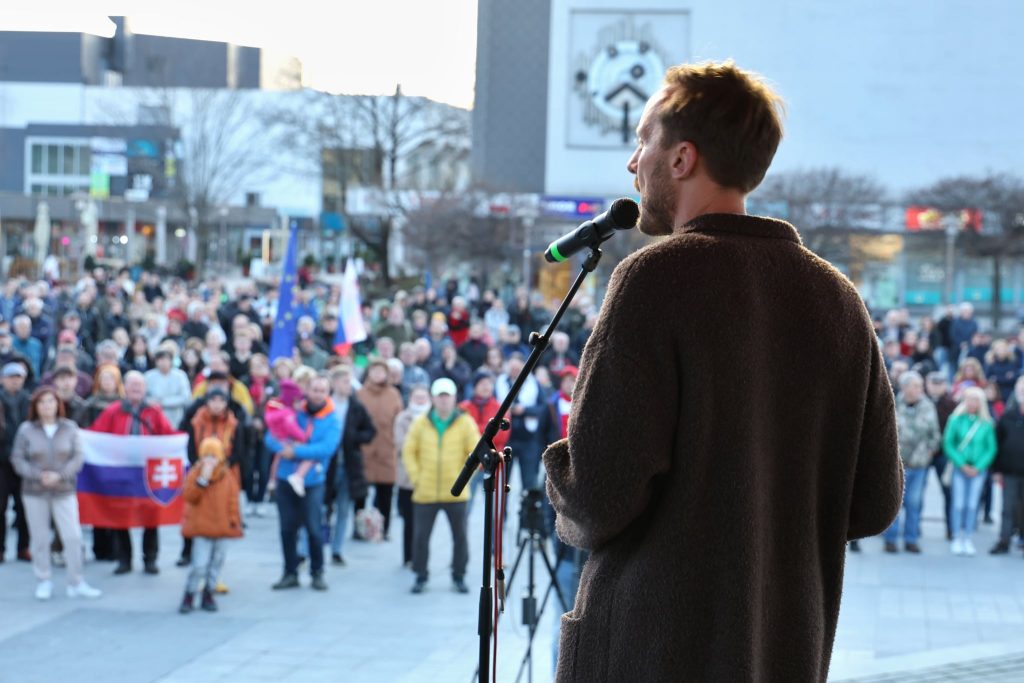
Author Michal Hvorecký speaks to a crowd on the eighth anniversary of Jan Kuciak’s murder
In his editorial office, he visualised the collected data in an old-school analogue way drawing with pencils on huge pieces papers spiderwebs of connections full of notorious oligarch names and their criminal networks. He acted as our very first digital-age watchdog. He put the information into context and explained how top members of the governing Party Smer and their sponsors and affiliated post-Soviet style businessmen – many still in power after all these years – stole huge sums and moved the money to tax havens like Cyprus. He also investigated the suspected theft of EU funds destined for eastern Slovakia by the members of Italian mafia.
Ján Kuciak uncovered that the corruption in Slovakia doesn’t only mean petty bribes, but something much deeper and more dangerous – state capture. Corruption as a system. His stories told us how Robert Fico turned democracy into a mechanism for his own enrichment and the power. Party Smer functioned – and unfortunately still does – like a cartel.
Since 2020 we have known how Ján was killed and by whom. But who ordered the assassination? Who wanted to silence him at all costs? We still do not know, and we need to know. Ján exposed a form of corruption so deeply entrenched that it threatened the rule of law and democracy.
Recently, Slovakia’s Special Criminal Court reopened the murder case for the third time. Hopefully, the court will learn from its previous errors and thoroughly examine all the evidence.
To this day, I am convinced that Ján Kuciak could have lived. If the state had acted. If Minister of Interior Robert Kaliňák – today a Minister of Defence – had not laughed at him and refused to demand a police investigation. Ján was openly threatened by influential oligarch and controversial media tycoon Marián Kočner. As a journalist he filed a criminal complaint. It didn’t help. Police refused to assist and protect him. A couple of months later Ján was executed with a single bullet to the heart and Martina with the shot to the head.
Recently, one of the businessman Ján Kuciak was intensively reporting about, Jozef Brhel, founder and sponsor of Smer, was accused of leading an organised criminal group that laundered dirty money from state contracts for years, and in February 2026, he was finally found guilty.
What Ján taught us is to never give up the fight for justice and to speak up about state capture, the most dangerous mutation of corruption. The 21 February is our annual reminder that freedom and the rule of law cannot be taken for granted. Slovakia has a strong civic society ready for widespread protest whenever necessary, and a free critical media, both also thanks to Ján. Good writing can still change the world and make it a better place, as his major work, published posthumously, proved.
“One day, Slovakia will wake up,” Ján wrote. I hope this day is very near.
20 Feb 2026 | Austria, Europe and Central Asia, Hungary, News, Slovakia
When I left Hungary on Sunday, the US secretary of state Marco Rubio had just arrived in Budapest for talks with the prime minister Viktor Orbán to give him the USA’s full-throttled support. Hungary has been somewhat of a touchstone for the MAGA movement and Rubio told Orbán that US Hungarian relations were entering “a golden age” and that if Orbán needed anything, the US would consider providing it. There are elections in Hungary just after Easter and it looks likely, if the polls are to be believed, that the more pro-EU opposition leader Péter Magyar will win. There is restrained optimism among many liberals in Budapest although nothing in this part of the world is a done deal. The week I was there, Magyar was going big on the theme that he had been lured into a honey trap and some Kompromat video Russian-style was going to be released. Only a grainy black and white still of a double-bed captured by a ceiling camera ever emerged. Even with a Magyar win, it will be difficult to unravel the total capture of institutions (universities, the media and the cultural centres) by billionaires and those loyal to Orbán’s Fidesz. I heard some 30-something American men in black bomber jackets in Budapest’s Jewish quarter loudly complaining in English that the “young people” in Hungary wanted to tax those billionaires, but they simply didn’t understand how the country relied on them. We are examining the implications on freedom of expression of all these Hungarian developments in the next magazine.
This part of Europe, which was once the Habsburg Empire, feels in flux. People, and particularly young people, are fighting back to claim their rights to be heard. Liberal forces in Slovakia are mobilising, even while the far-right leader Robert Fico is attempting to “normalise” the cultural sector, taking money away from any arts institution considered to be too “activist”. Meanwhile in Vienna, the situation to the east is waved away in the coffee houses as being unimportant, or at least an issue which will resolve itself. A famous saying about the city is: “When the world comes to an end, move to Vienna because everything happens there 20 years later.” There are fears here about an over-dependence on an increasingly unfriendly USA, particularly when it comes to digital platforms and servers – the USA could turn them all off with a flick of a switch if Europe doesn’t toe the line – and a frustration that France and Germany are not working as one to build European solidarity against hostile forces in China and Russia. And then there is a question of the rise of the far-right parties in Europe, including in Austria itself. From the end of World War Two, it was the USA which acted as a liberal guarantor for free expression in western and then eastern Europe. The old order is breaking up, the EU is weakened and ordinary people are having to decide whether those rights are still worth fighting for.
18 Feb 2026 | Europe and Central Asia, News, United Kingdom
Each generation has its resentments and irritations with the previous one. The baby boomers rebelled against post-war austerity, and their fury fuelled the student revolutions that swept the world in 1968. In some senses, they were the lucky ones. In the UK, free higher education and cheap housing made the boomers rich and comfortable. My own peers, Generation X, sneered at their smug complacency as we were hit by recession, the Poll Tax and Thatcherism. But some also benefitted from the unleashing of the free market, or rather the housing market. The millennials that followed were the first digital natives. They were hopeful and idealistic, but they were also the first generation to be saddled with crippling student debt.
These generations had little in common, but one thing they rarely felt, in the West at least, was silenced.
At the launch event for our Gen Z edition of Index on Censorship at the University of Essex recently it was striking how many ways the panellists felt their voices had been muffled and contained, if not outright censored. The speakers at the event (Has Gen Z Been Silenced On and Off Campus) could not have been more diverse, but they each felt restrictions on their free expression keenly. Sariah Lake, head of editorial at Essex Student Union’s Rebel Media said while she recognised that in some parts of the world, young people’s voices were being genuinely censored, for her the key issue was the influence of social media. “We are losing focus, we are getting distracted, we are just going to repost things,” she said. “Overcoming distraction, connecting with the real world, connecting with originality is what we can do to maintain freedom of speech.”
Adil Zawahir, an Indian lawyer working on a master’s degree in human rights law, said the situation was different for overseas students. “In the West, and the UK in particular, the curtailment of speech is not due to a fear of repression, it is more because of the fear of social ostracization and the anxiety you may feel after you’ve spoken out.” He added that international students have a double problem. “We share the social anxiety, but in addition to that, every time we think about speaking out, in the back of our minds is our status in this country. It is a temporary status. We are always subject to what the government decides for us.”
For Yelyzabeta Buriak, a journalism student from Ukraine who has written about her experience for the latest edition of Index, her situation as a refugee from a war zone brought with it extra concerns and restrictions. She said she avoided discussing the topic of Ukraine altogether for the first year in this country. “I’ve been carrying a feeling of guilt: for being safe here while my parents and friends are still in Ukraine in a very dangerous area,” she said. “You have this feeling of guilt, and you are always careful with words. You think ten times before saying something.” Sometimes, according to Buriak, the biggest silences are not caused by the law or university policy. “Sometimes it is self-censorship, sometimes it is fear, guilt and online judgement and sometimes its is paperwork and systems.”
An important reminder of the wider international context was provided by Merick Niyongabo, President of the Politics Society at Essex, who celebrated the Gen Z revolutions in Nepal, Bulgaria and Kenya but also pointed to the internet shutdowns being used across the world to silence dissent. “It’s important we raise the voices of those who are not being heard, the voices of those in Iran and Russia, who are going through repression, but not able to publish what they are writing or express their views because of censorship.”
A launch event for the Index on Censorship Gen Z issue was also held at Liverpool John Moores University, where the students mainly discussed a campaign to make LJMU a “Pro-Choice Campus”. A report of the event can be found on the Mersey News Live website, which is run by students at the university.
The event at University of Essex was to launch the Winter 2025 issue of Index on Censorship, Gen Z is revolting: Why the world’s youth will not be silenced, published on 18 December 2025.
17 Feb 2026 | Europe and Central Asia, Features, Ukraine, Volume 54.04 Winter 2025
This article first appeared in the Winter 2025 issue of Index on Censorship, Gen Z is revolting: Why the world’s youth will not be silenced, published on 18 December 2025.
For Ukraine’s Gen Z, the war has created two kinds of silence: one under sirens and the other under guilt.
Those who stayed live through air raid alerts and numb routine; those who left watch from abroad – scrolling through updates, unsure what to say to the people they love back home. Both carry their version of survival, and both are having to learn to speak to each other again.
In Dnipro, Dasha Buldenko, 19, says she has grown used to fear.
“You get used to the sirens, you get used to the explosions. You stop feeling anything,” she tells me. “We live in totally different worlds now.”
For her, life has narrowed to a quiet persistence: staying, coping and enduring without expecting understanding from those who left Ukraine.
“People who moved abroad forget where they came from,” she says, frustrated by what she calls the “pity” tone of returning friends.
“They see a different world, different opportunities. We don’t have those because of war.”
Mark Neshta, a 21-year-old student at the University of Essex in the UK, describes another kind of distance: the one between empathy and experience.
“You just can’t truly understand how it feels,” he admits. “At the beginning, I was deeply depressed that my country was going through such horror while I was sitting safely 1,000km away.”
He calls it “a strange cognitive dissonance” when “you’re physically abroad but all you care about, all you live by, is news from Ukraine. You consume it only through the internet or through conversations with loved ones who stayed”.
Over time, that guilt has turned into a determination to define himself more clearly. Living abroad, he says, has made him think about what it means to represent Ukraine.
“When people ask where I’m from, I want them to see more than war, to see culture, history, identity.”
He even switched to speaking Ukrainian, though he grew up speaking Russian. “I don’t think living abroad is what caused that,” he says. “It was the war itself.”
Both voices show the same wound from opposite sides.
Those inside Ukraine hide their pain behind fatigue. Those outside hide their guilt behind activism or composure. When they talk, it is not politics that divides them but the need to censor emotion, to sound strong, to sound grateful, to avoid hurting each other with what the other cannot understand.
What does that do to identity? For Dasha, being Ukrainian “just is”.
She says: “We are all Ukrainians; we stand for our own, regardless of language barriers.”
For her, it is a fact of staying and surviving. For Mark, it is something to articulate and explain. One holds on by living it, the other by translating it.
In the end, both sides are searching for the same thing: to be understood.
“People just need to actually listen to each other,” Dasha says.
