18 Feb 2008 | Comment, News
Despite the extension of her visa, novelist Taslima Nasrin remains confined to a room in an undisclosed location, writes Sanal Edamaruku
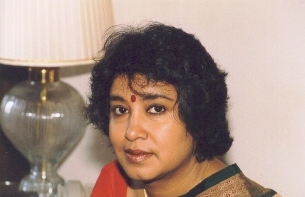
The good news first: India has granted a visa extension to exiled Bangladeshi writer Taslima Nasrin. For now, the nightmare of an ill and desperate Taslima being forcefully expelled from her adoptive home of seven years. “All I want to do is live peacefully in this country. I have nowhere else to go,” Taslima recently wrote. When the showdown began and time was running out, Rationalist International started an international campaign and appealed to the prime minister of India. Within three days, our appeal had been supported by more than 3,800 letters from India, USA, Canada, Australia and all over Europe. The Forum for the Protection of Free Speech and Expression, led by Mahashweta Devi, Arundhati Roy, Ashish Nandy and Girish Karnad published an open letter to the prime minister, supported by many writers and intellectuals. Under public pressure, the government of India allowed her to stay.
The success, however, is tarnished. Now comes the bad news. While staying in India, Taslima Nasrin’s life will — according to a statement from the foreign ministry — be restricted to the “status quo”. And that is what horrifies her. The “status quo” describes a rather inhuman situation. For nearly three months now, the government of India has kept Taslima in complete isolation at an undisclosed location near Delhi. Nobody, not even she herself, knows her exact whereabouts. Guarded by officials, she has not even been allowed to meet close friends. Her only connections to the outer world are her mobile phone and laptop.
(more…)
8 May 2007 | News
Freedom House’s annual report Freedom of the Press, released last month, caused an outcry over the state of local media in Russia. Freedom House, a leading American civil rights watch-dog, put Russia on 164th place among 195 countries, and named the country “Not Free”. International press-freedom groups supported this evaluation: according to New-York based Committee to Protect Journalists, Russia is the second most dangerous country for journalists; Reporters without borders say that this country is 147th among 168 states, in terms of press freedom.
On 3 May, Koïchiro Matsuura, UNESCO’s Director-General, accused Russian authorities for the growing number of journalists’ murders and impunity, in the conference speech in Medellin, Colombia. Terry Davis, Secretary General of the Council of Europe released an accusatory statement on human rights suppression in Russia, highlighting the unsolved murder of the prominent journalist Anna Politkovskaya.
In response, the local officials and pro-Kremlin experts are persistently reminding that Russian journalists and authorities do not need any evaluation from the outside world to serve the public’s needs.
On the same day, Elena Zelinskaya, the vice-president of Media Union, (a Russian NGO uniting and supporting local media companies), and deputy chair at the Public Chamber’s Committee for Communications, Information Policies and Press Freedom, told the independent radio station Ekho Moskvy about a new project, Index of Press Freedom. The Russian Public Chamber and Public Opinion Research Center (VCIOM) will study the situation in the local media. The project participants are still to define the methods for this research, but Zelinskaya mentioned the economical level of each Russian region, the quality of journalists’ education, and regional practice of the rule of law as the criteria for such evaluation. ‘It seems to us that the evaluations that any foreign organization offers, are mostly based on the opinions… the experts’ views,’ Zelinskaya says. ‘We would like to use facts for our analysis. Our task is to understand what is going on in our country.’ According to Zelinskaya, the Public Chamber must ‘control’ press freedom in Russia, and the project aims to reveal the factors that influence freedom in media.
Anatly Kucherena, the chairman of Public Chamber’s Committee for Public Control over the law enforcement agencies, and the leader of Civil Society public movement, told Russian newspaper Kommersant daily that on Monday, May 7, he would send papers to Brussels for registering the new Association of human rights organisations. Human rights activists from Belgium, Germany, Austria, Italy, USA will participate in this association, which ‘will monitor civil freedoms in the West and prepare ratings, similar to those, where Russia is represented as an outsider.’
Denis Dragunsky, the editor of political journal Kosmopolis, says: ‘Russian press is obviously less free then in Finland and Sweden, for instance, but Russia is a European country, observing human rights and freedoms.’
Boris Reznik, the deputy chairman of the State Duma Committee for Informational Policies, told the local media that he was sceptical ‘such ratings’. ‘It is not clear what criteria are used for these reports,’ Reznik said. ‘At the same time, we should recognize that we are not totally successful in press freedom development. But the question is whether the journalists themselves need freedom. Today many media companies refuse to be free voluntarily. It is easier for them to be obedient.’
The majority of Russian journalists though believe that the local media is heavily censored. The Guild of Press Publishers, a nonprofit partnership of Russian publishers of printed media and industry suppliers, conducted a survey titled Media Market and the Prospects of Civil Society in Russia, which showed that around 70% of Russian journalists recognize the fact of censorship of the local media. Initially, the research aimed to prove that since Perestroika (Mikhail Gorbachev’s liberal reforms) started, Russian media transformed from propaganda into the true reporting, but the polls do not support this hypothesis. Virtually all Russian journalists deny the existence of press freedom in Russia. As for the public, only 27% of Russian citizens trust local media.
(more…)
15 Apr 1984 | Magazine Editions, Volume 13.02 April 1984
[vc_row][vc_column][vc_column_text]

The April 1984 issue of Index on Censorship magazine.
By Olle Wästberg
Index on Censorship has received about fifty letters and postcards about what is called ‘The Felderer Case’.
Swedish courts found Dietlieb Clüwer Felderer guilty of ‘Agitation against an ethnic group’, according to the Swedish Penal Code, Chapter 16, Paragraph 8, which reads as follows:
‘If a person publicly or otherwise in a statement or other communication which is spread among the public threatens or expresses contempt for a group of a certain race, skin colour, national or ethnic origin or religious creed, he shall be sentenced for agitation against an ethnic group to imprisonment for a maximum of two years or, if the offence is petty, to pay a fine.’
The law is very seldom used. Felderer is the first Swedish citizen to get a prison sentence of this length — 10 months.
The charge against Felderer was as follows: ‘Felderer has on each of several copies of written material, dealing with the subject of the Auschwitz concentration camp in Poland, fastened a strand of hair and a piece of soap, and in some cases also a condom, and in one case a piece of a nail. He wrote on each copy that the piece of soap consisted of pure Jewish fat with the scent of Hungarian Jew. In several cases he stapled an apparently used condom and wrote that it had been used by a named representative of Jewish victims on a visit to a Nazi brothel. Felderer sent these communications to recipients in Sweden, Holland, Austria, Germany, Canada and the USA.’
A few examples from Felderer’s mailings: He published a caricature of a Jew, naked, with the following caption (his spelling is given): ‘The naked truth. Childrens’ contest. The name of this handsome-looking fellow is Zyklon B. Goldman. In 1944’s beauty contest at AUSWITCH he was unanimously selected as the prettiest chap of AUSWITCH. Mr Zyklon B. Goldman has just come out of the gas chamber, spick-and span, for his 16th time. Each time he is looking better and better. Each time he is getting healthier and healthier. Mr Zyklon B. Goldman really digs the AUSWITCH gas. How did he look before he entered the gas chamber? Dress Mr Zyklon B. Goldman up and send us your picture. FIRST PRIZE: Sweets for a total of 100 kronor or our book Auschwitz Exit, Vol 1.’
Pamphlets with soap and the text ‘Pure Jewish Fat — Scent: Hungarian Gas Chamber 3, Birkenau’ were posted to different organisations and museums for victims of the Nazi era.
Individual Jews who had been victims of Nazi persecution were sent offensive material. For example, Gideon Hausner, the prosecutor, was sent a used condom with the message that it had been used by Simon Wiesenthal on his 239th visit to a Nazi brothel during the Hitler era.
To see if Mr Felderer’s mental state was such that he should get exemption from punishment the court asked that he be given a psychiatric examination. However, Felderer was found sane. Felderer was not charged for his opinion that Jews were not killed during the Nazi era.
[/vc_column_text][/vc_column][/vc_row][vc_row][vc_column width=”1/4″][vc_icon icon_fontawesome=”fa fa-quote-left” color=”black” size=”xl” align=”right”][/vc_column][vc_column width=”3/4″][vc_column_text]
He was not charged for thinking that ‘what was gassed was lice’. He was charged for the way he was expressing contempt for the Jews and spreading his material.
[/vc_column_text][/vc_column][/vc_row][vc_row][vc_column][vc_column_text]
NOTE
The letters received by Index support Felderer and characterise him as a victim of the establishment, a political prisoner. A group in Sweden called ‘European Human Rights’ disseminates material on his behalf and claims to be working for freedom of speech. It vilifies Amnesty, PEN and others for ‘working covertly to destroy freedom of speech’. Felderer is an adherent of the ‘Institute for Historical Review’, a US-based group which puts out pamphlets and books denying the existence of the Nazi holocaust and asserting that it is all a hoax by Zionists seeking support for Israel. Felderer is a friend of David McCalden who works from California where he runs ‘Truth Missions’ and promotes the letter campaign for Felderer. These anti-semitic groups use the terminology of liberal protest, human rights bulletins or academic life, as appropriate, to suggest respectability and innocence. The booklists of the Institute for Historical Review, for example, include reputable academic and journalistic books.
[/vc_column_text][/vc_column][/vc_row][vc_row][vc_column width=”1/3″][vc_column_text]The winter 2017 Index on Censorship magazine explores 1968 – the year the world took to the streets – to discover whether our rights to protest are endangered today.
With: Ariel Dorfman, Anuradha Roy, Micah White[/vc_column_text][/vc_column][vc_column width=”1/3″][vc_single_image image=”96747″ img_size=”medium”][/vc_column][vc_column width=”1/3″][vc_column_text]In print, online. In your mailbox, on your iPad.
Subscription options from £18 or just £1.49 in the App Store for a digital issue.
Every subscriber helps support Index on Censorship’s projects around the world.
 SUBSCRIBE NOW[/vc_column_text][/vc_column][/vc_row]
