24 Apr 2014 | Ireland, News, Politics and Society, Turkey, United Kingdom
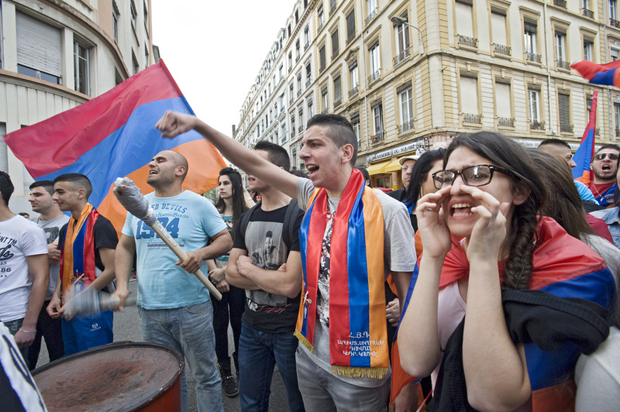
Armenian protesters in Lyons accused Turkey of supporting Islamic rebels in an attack on Kessab, an Armenian majority town located in Syria, on the Turkish border. (Image: Benjamin Larderet/Demotix)
It is, as Zhou Enlai might have said, probably too early to tell how significant Tayyip Erdogan’s comments alluding to the Armenian genocide will be.
The Turkish prime minister seems to have broken one of his country’s great taboos. In a statement translated into nine languages, the AK leader said: “It is with this hope and belief that we wish that the Armenians who lost their lives in the context of the early 20th century rest in peace, and we convey our condolences to their grandchildren.”
“Having experienced events which had inhumane consequences — such as relocation — during the First World War, should not prevent Turks and Armenians from establishing compassion and mutually humane attitudes among towards [sic] one another.”
According to Anadolu, Turkey’s state news agency, Erdogan also commented: “In Turkey, expressing different opinions and thoughts freely on the events of 1915 is the requirement of a pluralistic society as well as of a culture of democracy and modernity.”
This is not, you will have noticed, an apology. Offering condolence is not at all the same as expressing remorse. Though some would say it is not Erdogan’s duty to express remorse; he is the prime minister of the modern republic of Turkey, not the Ottoman Empire under which the alleged slaughter of over 1.5 million Armenian Christians in 1915 took place.
And some are utterly contemptuous of Erdogan’s statement: Reuters quotes the Armenian National Committee of America describing the statement as an “escalation” of Turkey’s “denial of truth and obstruction of justice”.
But let us assume that a) Erdogan is in a position to speak for Turkey past as well as present, and b) there is, at the kernel of this, an attempt at reconciliation with Armenia and the Armenian diaspora.
The very mention of the events are significant against the backdrop of the Turkish Penal Code’s controversial Article 301, which forbids insulting “the Turkish nation”. That law has in the past, effectively barred discussion of the genocide, and created a environment where simply identifying as Armenian within Turkey was seen as a provocative act.
The most famous victim of this culture was Hrant Dink, the editor of Agos who was assassinated in January 2007.
Dink saw himself as Turkish-Armenian, and his newspaper was bilingual. He was a firm believer in the potential for dialogue in bringing some reconciliation between Turks and Armenians. He also believed such dialogue could only take place in an atmosphere free of censorship, to the extent that he vowed that he would be the first person to break a proposed French law making denial of the Armenian genocide a crime (a cheap political trick aimed at both currying favour with the Armenian community in France and creating a barrier for Turkey’s proposed entry into the EU).
Ultimately, Dink believed that progress could only be made if we were able to talk freely and access historical debate without impediment or fear.
History, like science, is a process rather than a dogma. And like science, one’s interpretations of history can vary based on both the evidence available and the prevailing mood.
For a long time after the creation of the Irish state, for example, the teaching of history in schools was simple. I recall one primary school history text which seemed to consist entirely of tales of the terrible things foreigners had done to the Irish: first the Vikings, then the Normans, and finally the English. The book finished pretty much where the 1919 War of Independence began. The last page featured the words of the national anthem and a picture of the national flag.
Sympathetic portrayals of English people, and British soldiers in particular, were thin on the ground — Frank O’Connor’s tragic short story Guests of the Nation being one of the very few.
Since the late 1990s peace process, both fictional and historical perspectives on Ireland’s relationship with Britain have changed. Some of the novels of Sebastian Barry, for example, attempt to tell stories of people who were neglected and even vilified in nationalist, Catholic, post-independence Ireland. Part of the plot of Paul Murray’s Skippy Dies has a Catholic school history teacher attempting to get his pupils interested in Irish soldiers who fought for Britain in World War I. Meanwhile, a recent book by nationalist historian Tim Pat Coogan, attempting to paint the Irish potato famine as deliberate genocide rather than cruel neglect, was given short shrift, in spite of the fact that this would have been a mainstream view until relatively recently — one must only listen to the sickly sentimental lyrics of rugby anthem The Fields of Athenry, penned in the 1970s, to understand the appeal of that victim status to the Irish imagination. Wrongs were certainly done in Ireland, but the relationship between the two nations was a hell of a lot more complex than the oppressor/oppressed line that was spun for so many years.
There was no official sanction on differing views of Anglo-Irish relations, but politics permeated the debate. Likewise with the recent intervention of British education secretary Michael Gove on the issue of how World War I is taught in schools. Gove claimed that the idea of a pointless war in which a moribund (figuratively) ruling class led moribund (literally) working class boys to their graves was a modern lefty invention. He was wrong, in that that view had been common even in the 1920s, but his opponents were equally adamant in their insistence that there could only be one view of World War I. None of this discussion was accompanied by new evidence on either side.
At the extreme end of this hyper-politicisation of history are the Holocaust denial laws of many European countries, and laws on glorification of the Soviet era in former Eastern bloc.
In his cult memoir Fuhrer-Ex, East German former neo-nazi Ingo Hasslebach described how, growing up in the DDR, with its overwhelming anti-fascist narrative, nazi posturing was the ultimate rebellion. In the modern era, France’s prohibition on nazi revisionism has led some young north African immigrants, alienated from the French nation state, to see anti-semitism and the quasi-nazi quenelle gesture as the ultimate “fuck you” to the authorities.
Taboos about discussing events of the past breed bad history and bad politics. For the sake of Turkey, and the rest of us, Erdogan should be held to his words on the necessity of free speaking and free thinking.
This article was originally posted on 24 April 2014 at indexoncensorship.org
3 Apr 2014 | News, Politics and Society, Turkey

(Image: Mukets/Shutterstock)
Imagine you wake up one day, start your day as usual; you go on the tube with the Metro at hand and read the news on your way to work. Today, however, you learn that the Serious Fraud Office and Metropolitan Police have detained 47 people, including officials from the Department for Communities and Local Government, the Department for Environment, Food and Rural Affairs and the Westminster City Council, as well as the sons of four British ministers. They were all implicated together with real estate developers and the general manager of Bank of England and an Iranian businessman. Moreover, the minister of state for Europe became a potential suspect of bribery related to the Iranian businessman’s dealings in the country. The police confiscated some £10.5 million as money used for bribery during the investigation.
After all that you’ve learned, you start believing that there will be a great change in Britain. Everyone is excited to tell each other the new developments and they start waiting. Waiting…Waiting… After you witness the shoe boxes filled with millions of pounds found next to the money counters and money safes in the houses of the sons of the ministers and the general manager of Bank of England. And after the images of those shoe boxes and money safes start filling social media pages, and people all around Britain start leaving shoe boxes in front of the Bank of England, you start thinking that humour is the only way for the people to maintain their mental health. On social media, only this corruption and of course the shoe boxes, are discussed. The shoe box becomes a dangerous weapon, and when those carrying empty shoe boxes or those who leave them on the street or even those who sell them are arrested, you realise that for Britain, the shoe boxes are much more dangerous than a bribery scandal. For a moment, you wonder if there are any empty shoe boxes at your home, you hesitate to share it with anyone. Even if what’s been happening surprises you, you try to keep your cool. After all, as a nation you are known for your nonchalant attitude.
On 21 December, in total 91 people were detained in the investigation; 24 of them were arrested. You turn on Sky News with curiosity, and you hear that the investigation is part of a so called parallel government coup d’état planned by foreign powers trying to hinder Britain’s developing economy. You find it a little weird that the prosecutor leading this investigation, who is now accused by the government of planning a coup is the same one Prime Minister called a “hero” a few years back. But you don’t lose your resolve… You want to understand what is really happening.
Several newspapers report that a new investigation was expected on 25 December, possibly involving the prime minister’s sons, as well as certain Al- Qaeda affiliates from Saudi Arabia. The police officers in Scotland Yard, newly appointed by the government just a few days before, refuse to carry out the orders from this new investigation’s prosecutor. Similarly, the director of public prosecutions does not approve this new operation either. The man originally behind this second investigation, the prosecutor, is dismissed in the following hours of the same day and immediately a new one is assigned.
It was understood that a second wave of arrests was planned according to this second investigation, and a list was leaked to the press. At midnight on 7 January, a government decree was announced, which removed 350 police officers from their positions, including the chiefs of the units dealing with financial crimes, smuggling and organised crime. The influential leader of a social movement described these investigations as a purge of the country. The prime minister described the corruption investigation as a “judicial coup by the parallel government” by those jealous of his success — namely the secretive leader, backed by foreigners.
Since the beginning of the investigations, the Conservative Party government has been trying to exile both the police forces and the responsible prosecutors, thought to be related to the investigations. Unfortunately, those policemen and the prosecutors who replaced the previous “parallel government” policemen and prosecutors, were found to be also members of the parallel government by those in power. Then, they levelled accusations at these new officials and exiled them as well.
The Home Office and the Ministry of Justice changed the legal judgement regulations during the investigation period. The prime minister blamed the investigation on an international conspiracy and vowed revenge on the aforementioned group; here had been hostility between the prime minister and its leader. The prime minister also threatened the US ambassador to the UK with expulsion, because of his critical comments.
The home secretary and the chancellor of the exchequer, both of whose sons were arrested in the corruption operation, resigned together on the morning of the 25 December. That same afternoon, the secretary of state for environment, food and rural affairs resigned from office and as a member of parliament. Four hundred and fifty policemen in the specialist crimes and operations department were exiled and journalists were banned from entering New Scotland Yard.
Three members of parliament resigned from the Conservative Party on 26 December because of the ongoing scandal. These three ex-members of the Conservative Party were each separately under investigation by the party’s disciplinary committee, accused of opposing the party’s own regulations. They all resigned before the committee reached a verdict.
To understand what’s happening, you now constantly follow social media. However, everything’s happening so fast and it’s so incomprehensible that you have to ask yourself: is this real? You calmly wait, expecting the resignation of the government. In fact, during this wait, you read Beckett’s “Waiting for Godot” once again. It feels as though nothing’s happening in Britain, the news only written about on social media pages seems like it’s about a different country. When you get on the tube, you see that those who don’t use social media are clueless, and some who are aware believe that the prime minister has been set up despite all the evidence. It makes you wonder whether it’s the train moving really fast, as if it’s disappearing, or your mental health.
A voice recording said to be of a telephone conversation between the prime minister and his son, is at the centre of the latest political storm. In the conversation, the pair allegedly discusses how to hide large sums of money on the day the police raided houses as part of the corruption inquiry into the prime minister’s government.
Of course, you immediately listen to the recording and don’t know what’s worse — what is being discussed or the pathetic state the prime minister’s son is in. Even though a report from a US sound company was used to try and prove that the recordings were fake, the same company, whose name was revealed later, claimed that they prepared no such report. Still, even though the money discussed is billions of dollars, you are overcome with grief and overwhelmed by the sound of the prime minister’s son’s voice as he says “daddy”…
You think this is the final straw. After this, the government will definitely resign. But there is no movement. It’s as if Beckett has taken control, writing the fate of Britain but this time it’s called “Waiting for Resignation.” We all wait. While waiting, we feel sorry for the Prime Minister’s son. After the empty shoe boxes, you understand how dangerous the word “daddy” can be.
During all this, the fact that you are slowly losing your cool results in an identity crisis. You realise your talent for handling all situations with edgy, British humour is inadequate, which bothers you. But then you see the jokes on Facebook and Twitter, you see the cartoons depicting the situation and you feel relief that your country’s talent for humour has exponentially grown over the course of this huge scandal.
After the release of the first recording, you no longer have time to stop by at a pub for a drink, go to a football game or anything else… You feel like you’re in the middle of a ping-pong game between the new recordings and the perception the government is trying to impose against them. When you read tweets that say “can you hold the agenda for two minutes, I have to use the bathroom” a smile creeps up from your demoralised heart and you realise it’s right.
After the tapes, the world doesn’t end, the government doesn’t resign, the parliamentary questions asked by the opposition are left unanswered in parliament, where the attempts at projecting an illusion of normalcy fails; iPads and punches flying, adding some liveliness.
Suddenly you realise that most Brits are addicted to the prime minister’s tapes. The anxiety surrounding the country when there is no tape that day featuring the prime minister or the ministers worries you.
In the meantime, when you listen to a recording of a conversation between the prime minister and someone from Sky News, you finally believe that this is it. Because you learn that the prime minister personally interferes with the news. Soon after, you find out that the prime minister calls not just Sky News but also Channel 4 and ITV to scold the directors of these media outlets. It doesn’t surprise you to learn the next day that newspapers run the headlines by him, before publishing anything. You don’t know what’s more shocking, the talent of the prime minister or the surrender of the media. You are constantly conflicted because even after all this, there is nothing. When the prime minister makes an announcement saying “of course I’ll interfere” you begin doubting yourself. You think that maybe you and people like you are the weird ones… You seriously start questioning what is normal and not.
But the news cycle doesn’t give you any time to continue doubting yourself. So you think, maybe you should just fly to the North Pole for a while. Maybe if you get away far enough, you can see things more clearly but you can’t. Because now the ping-pong game is over and you are living life on the back of a galloping horse… So nauseating.
Now, social media channels determine the order of the day so the prime minister has to find a way to control it. It’s not surprising that a new internet law is prepared so quickly. You are still so sure that in a democratic country like the United Kingdom, such a controversial law — allowing the government to shut down any internet site without the approval of a court — would never pass in parliament. You can’t imagine it any other way. If it does, you want to believe the Queen would use her power to veto it. However, you are disappointed once again. The law is passed and approved. The Queen makes a statement: “I know that some clauses in this bill are against the law, but I believe the parliament will amend those in time.” In order to make sure your ears aren’t deceiving you, that you understand what’s been said, you listen to the statement over and over again. When you finally realise that you understood right the first time, you are reminded of the “Matrix” movie and think “is someone making everyone take the blue pill?” If you take the blue pill, you believe the illusion, anything that’s absurd becomes normal; if you take the red pill you will think all that was normal is actually absurd…
You secretly question your friends in the pharmaceutical business while you still wait for something to happen… Slowly you start having headaches, because you can’t sleep anymore. You are getting annoyed at listening to yet another fury-induced berating of the crowd by the prime minister. Always angry, always provocative… On the other hand you still wonder “is this the side effect of the blue pill?”
While you try to maintain a healthy mind, the prime minister, once again furious, yells out: “Enough with this Twitter, I will ban all of it” and you think “no way!” But it has been months since you actually saw that line you thought wouldn’t be crossed because there was “no way…”
You start missing the tapes one by one, because there is no way you can keep up, even if the days had more hours. After showering that morning, you reluctantly open your computer to peruse Twitter; you are met with the message: “The access to the site you are trying to open has been blocked.” Now you have to learn the new jargon, understand what DNS is and download new applications, like you have the time. You find it normal that the number of users in the UK increase after the Twitter ban. After you read the tweet by the Queen saying “I hope the ban will be lifted soon” your suspicions are confirmed: everyone took the blue pill.
When the reactions to the ban pour in from within the UK and outside, the prime minister becomes bolder and claims: “The whole world will see how strong we are. We brought Twitter to its knees.” You just don’t understand. Understanding, comprehending, thinking and analysing… Your brain short circuits from all the pressure and all you can do is just laugh.
You are not surprised that YouTube is also banned. There are no longer any straws left, the camel’s back has been broken for months… There is no more waiting… You rip the pages of “Waiting for Godot.” Whoever it may be, you cannot explain away the power-hungry. You cannot blame the blue pill anymore. You feel exhausted and empty.
You understand how far a mind so warped can go for power, and as a result of ever growing anger. This time you focus on the elections, five days away. This time you know you will definitely vote. Your mind is divided. One side says “this is really the end. The Prime Minister will not stay in power after this. His votes will decrease this time.” The other side starts “if he gets more than 40 % of the vote…” You don’t even want to think about it. This election is very important for the future of the whole country… When you go on Twitter, you see “this is not just an election it’s an IQ test” and all you can do is smile.
After months of such tension, what do you feel when you see that the prime minister’s party has received over 43% of the votes?
No further questions…
This article was posted on April 3, 2014 at indexoncensorship.org
3 Apr 2014 | Denmark, News, Politics and Society, Turkey
Kurdish broadcaster Roj TV has lost another battle in its long and controversial fight to stay on air. Denmark’s Supreme Court last month ruled to uphold the ban on the Kurdish-language broadcaster, which had been transmitting programs from Denmark to Europe and the Middle East since 2004. Roj TV’s former director, Imdat Yilmaz has announced plans to take the case to the European Court of Human Rights (ECHR).
The broadcaster had long been a sore spot in relations between Denmark and Turkey, with the latter viewing the broadcaster as a mouthpiece for the Kurdistan Worker’s Party (PKK) – which is considered a terrorist organisation by the US and EU. However Kurds – a minority group making up between 10 and 23 per cent of the Turkish population – have long felt the heavy hand of the Turkish state on their language and culture.
Since the station’s launch, Turkey’s radio and TV authority – the ominously named Radio and Television Supreme Council – made a number of formal complaints to Denmark against the broadcaster. These had, until 2010, been dismissed by Denmark’s Radio and Television Board on the basis that “contested clips do not contain, in the opinion of the Board, incitement to hatred due to race, nationality, etc. In more than one clip, democracy, democratic solutions, democratic revolution and the like are even mentioned.”
But in 2010, Danish authorities did bring criminal charges against Roj TV – on the grounds that it was promoting terrorism. Roj TV was then convicted in 2012 by the Copenhagen City Court.
But controversially, Denmark’s decision to prosecute Roj TV on these charges was detailed in a leaked official document. The diplomatic document appearing to describe a deal struck between Turkish authorities and the then Danish Prime Minister – offering the closure of Roj TV in exchange for Turkey supporting the appointment of the then Prime Minister Anders Fogh Rasmussen to NATO secretary general in 2009.
The document refers to the Danish Radio and Television Board’s failure to find incitement to hatred or violence in Roj TV’s content, and so urges for Danish authorities to “think creatively about ways to disrupt or close the station, should criminal prosecution prove unachievable in the short term.”
Also mentioned is the need for “…some new evidence or approach that can shield them against charges of trading principle for the former prime minister’s career.”
Rasmussen, who is now NATO secretary general, has denied agreeing to shut the station.
The Wikileak document can be read in full here.
Roj TV have admitted maintaining contacts with to the PKK, but deny they are a mouthpiece for the organisation, or that they received funding from it. The station’s former general manager, Manouchehr Tahsili Zonoozi, has previously commented: “We are an independent Kurdish broadcaster. Our job is to be journalists.”
Last month’s decision by Denmark’s Supreme Court marks a line of increasingly punitive rulings against the broadcaster. The legal battle started with just a fine in the Copenhagen City Court in 2012 – the court found no legal basis to follow the prosecution’s recommendation that the station’s broadcasting license be revoked.
The appeal to the Eastern High Court in 2013 saw its broadcasting rights confiscated indefinitely and the existing fine increased, causing Roj TV and its parent company to file for bankruptcy.
Now that the ruling has been upheld by Denmark’s Supreme Court, the station plans to take the case to the ECHR, with Roj TV’s former director Imdat Yilmaz telling Danish newspaper Arbejderen that he hopes “instead of connecting Roj TV to ‘terrorism,’ the court may relate it to ‘freedom of speech”.
Kurdish-language programmes were banned in Turkey until 2002 and, until 2008, Kurdish-language programs were restricted to 45 minutes per day. TRT 6, Turkey’s first Kurdish-language station and part of the Turkish Radio and Television Corporation, was launched in 2008 and broadcasts Kurdish programmes that promote the Turkish state and counter PKK.
This article was posted on April 3, 2014 at indexoncensorship.org