8 Jan 2026 | Europe and Central Asia, News, United Kingdom
Marie Colvin, Pierre Zakrzewski, Simon Cumbers – just a few of the journalists killed whilst reporting from some of the most dangerous places on earth.
Between 2000 and 2022, 16 UK journalists were killed while reporting from warzones, and a new campaign is set to honour these newsgatherers with both a physical and digital monument.
The campaign, titled On the Record, is running a competition to decide on the design of the monument, with entries open until 9 January. Judging will take place in March and a planned unveiling during spring 2027.
The National Memorial Arboretum, which describes itself as “the UK’s year-round centre of remembrance” is set to host the memorial, alongside existing pieces dedicated to the armed services.
Sarah Sands, former editor of BBC Radio 4’s Today programme and Chair of Trustees for the campaign, stressed the importance of the journalist as a physical witness during conflicts.
She said: “Their role in testimony and truth-telling seems incredibly important at the moment… the sense of someone who’s there, for no other reason than to observe and tell and bring back the truth and let the world know what’s happening.”
Among the other trustees is former BBC foreign editor Jon Williams, executive director of the Rory Peck Trust, a charity providing support to freelance journalists and which was set up following the 1993 death of freelance cameraman Rory Peck.
Discussing the importance of the proposed monument, Williams said: “The sacrifices that people make in service of finding out the facts and verifying the truth is a public service that all of us should be grateful for and those who pay the ultimate price deserve to be remembered.”
“More journalists have been killed in 2025 than at any time in history of journalism, and so it’s not as if the problem is going away. If anything, it’s getting worse.”
The CPJ reported 127 journalists and media workers killed globally last year, surpassing the previous record set in 2024.
Williams went on to say: “It’s about remembering the collective endeavour of journalism and the importance of eyewitness reporting. And the best way to do that is to salute those who’ve lost their lives in the service of the truth.”
Williams talked about his connection to photojournalist Tim Hetherington, who was killed whilst covering the Libyan civil war in 2011: “He was a little bit younger than me, but we’ve grown up pretty close to each other, just north of Liverpool. And in fact, when I took Mark Thompson to Libya in the autumn of 2011 we went to Misrata and laid some flowers at the site where Tim had been killed.”
Index on Censorship works closely with the Tim Hetherington Trust as well as Liverpool John Moores University to provide a fellowship to a freshly graduated journalist each year.
The physical monument will not include names, however an online digital tribute, which Williams described as a “living memorial”, will include names as well as contributions from family and colleagues.
Williams said: “Nobody should have to die in the service of the truth alone, and we try to ensure that nobody does.”
Karola Zakrzewska got involved with the campaign after her brother Pierre was killed whilst reporting for Fox News in Ukraine. She said: “Just before he died, we were talking to him, and were saying, ‘It’s getting a bit dangerous now.’
“He said: ‘No, I’ve got to stay. I’ve got to stay to tell people what Putin’s doing.’”
She described how war journalists like her brother want to keep reporting because they have to continue to tell the stories.
“They have to put themselves, unfortunately, at risk to be able to bring us the stories back as we watch it on our very comfortable sofas, in our very comfortable lives,” she said.
“But without them, we wouldn’t know what was happening. It’s incredibly important that we just spend a minute as we walk past and remember them, or just take a couple of minutes thinking about why they’re the guys who tell us what’s happening in the world.”
The project aims to raise £1 million, with half going to the monument itself and the rest to its upkeep. Already having received pledges by organisations such as Bloomberg and News UK, according to Sands, the campaign is still seeking donors.
The On the Record website can be found here.
15 Sep 2022 | Mexico, News
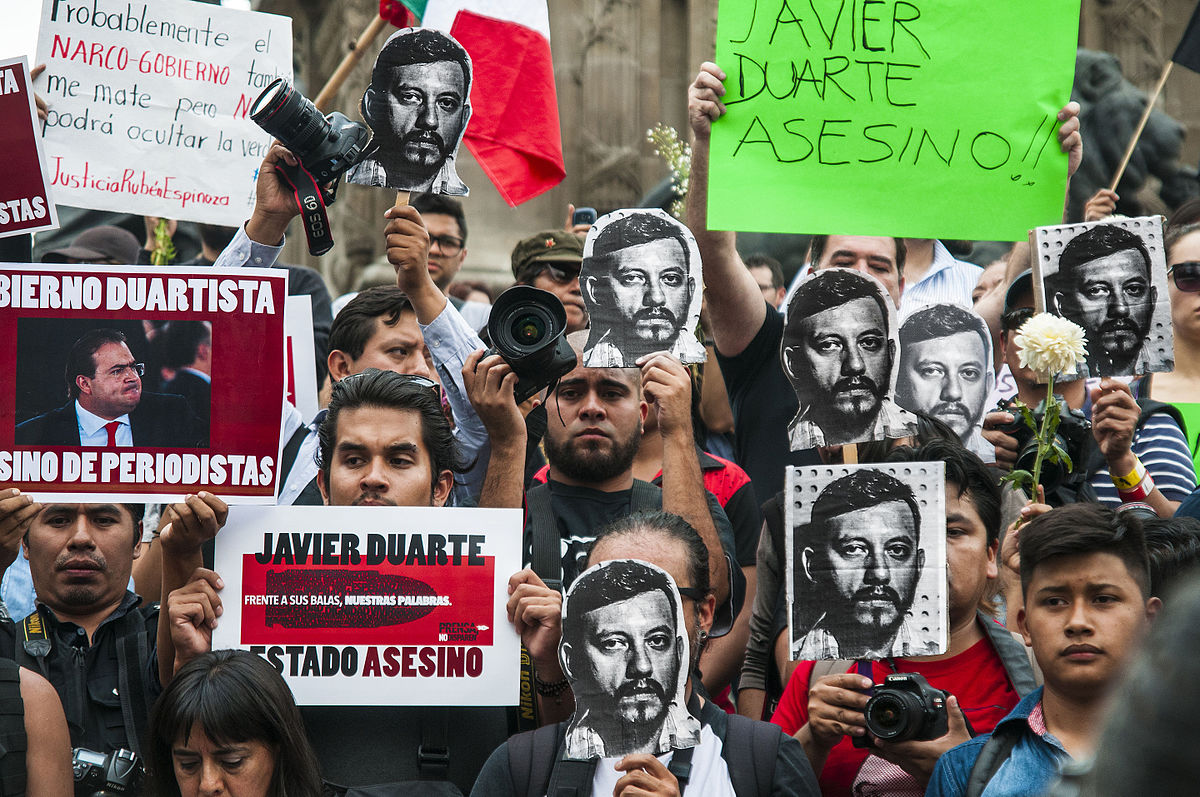
People march in the streets of Mexico to protest the death of journalist and photographer Rubén Espinosa, killed in Mexico City in 2015. Photo: Eneasmx/wikimedia commons
Mexico has long been a ruthless place for journalists and press freedom. According to the international human rights organisation Article 19, 156 journalists have been murdered in Mexico since 2000. Of the total, 144 were men and 12 were women. In April 2017, the journalist Duncan Tucker revealed in Index on Censorship magazine that it was really common for the newsrooms of local media to have drug cartel spies and informants infiltrated as staff members. Threats from corrupt government officials were also a daily problem for the Mexican press.
“Without a drastic change, Mexico and its journalists will face an even bleaker future,” Tucker wrote. Sadly, five years on this drastic change has not arrived in Mexico. Eleven journalists have lost their lives so far this year in the country due to their work. The most recent example is Juan Arjón López, who was killed with a blow to his head in the state of Sonora, in August.
One of the most dangerous regions for journalists in Mexico is the state of Veracruz: between December 2010 and November 2016, when Javier Duarte was governor of the state, 18 journalists were killed. A well-known case was the death of Regina Martínez Pérez, a journalist who investigated corruption in Veracruz and its connection with drug cartels. Her body was found in her flat on 28 April 2012, strangled to death. Four years later, Duarte resigned as governor following a series of corruption scandals, which led to a nine-year sentence in jail.
To understand more about this situation, Index talked to Mexican journalist Témoris Grecko, who currently lives in Mexico City and is a columnist for Aristegui Notícias, and a contributor to other media including Milenio Daily, La Octava TV and Rompeciento TV. In 2020 Grecko’s book, Killing the Story: Journalists risking their lives to uncover the truth in Mexico, was published.
Drug cartels seem to be a massive threat across Mexico. What is the relationship between them and the government or public officials?
The first thing I’d like to point out is that there is a bit of a myth regarding narco-trafficking in Mexico. Of course, it exists and there are many criminal gangs, but it’s not to be blamed for everything and that’s what happens. If a woman is killed or a journalist is killed, or something terrible happens, you can’t only blame the narco-trafficking and that’s it. And the narcos serve to mask many other activities. Many of the gangs are secondarily dedicated to narco-trafficking. Maybe they are in different kinds of smuggling, or they are doing illegal logging. Narcos are believed to be opposed to the government, but the real international mafias are in many governments, criminal gangs are usually related to people who work in the government, either in the Mexican government or the American. And in this way, the narcos need to be blamed for what happens to journalists of course, but organisations that are working with freedom of speech, such as Reporters Without Borders (RSF) and the Committee to Protect Journalists (CPJ), have collected data that shows that most aggressions are coming from official figures, maybe from politicians, political parties, police, the army or other authorities.
What kind of story can be the most dangerous one for journalists to work on?
There is crime-related journalism. But also, journalists who are exposing activities from mega companies. Maybe mining or logging companies or companies who are doing labour exploitation, and of course activities of politicians. For instance, we suspect Rubén Espinosa [who worked for the investigative magazine Proseco], a photographer murdered in 2015 in Mexico City, was killed by people linked to the then governor of the state of Veracruz, Javier Duarte. And this is because he felt very uncomfortable with some of the pictures that Rubén had published, that didn’t show Duarte in the life he wanted to be seen [the best example is a photo that Espinosa took for the left-wing news magazine Proceso, which showed Duarte’s white shirt with his name embroidered on it and a police cap written “Governor”]. And there have been journalists obviously murdered by criminal gangs, such as Javier Valdez [who became known for covering drug cartels], killed in 2017 in the state of Sinaloa.
Is there a particular region in Mexico that you consider the most dangerous for journalists?
By far the state of Veracruz. Two-thirds of the killings have happened there since 2010 and then there are other very dangerous states, such as Sinaloa, Guajaca and Tamaulipas. But sometimes it is not only about killings, but other types of aggression. For instance, maybe in the state of Tamaulipas they don’t kill so many journalists, but they are regularly beaten up or threatened. Persecuted somehow. Tamaulipas is the best example of what we call a silence zone. A place where politicians and criminal gangs control the news. They have people that we call ‘enlaces’, who work as press officers for these powerful people. And they are in touch with the journalists to tell them what can be published and what cannot. And also they suggest, which is actually an imposition, some news or photographs that they want to see published.
Have you ever been threatened due to your work as a journalist in Mexico City?
Not in Mexico. While working in the Middle East, Africa and Asia, yes [Grecko has covered conflicts in places like Libya, Egypt, Iran, Syria, Palestine, Congo and The Phillippines], but not in Mexico.
How do you manage to keep yourself safe in this ruthless environment?
First of all, there is a massive difference between living in the capital and other states. With my team and my crew, when we go to work in risky states, we have security protocols which include making sure our sources are safe, using secure communication channels, and studying entry and exit ways. We monitor each other. We try to spend the least possible time there. We don’t really tell anyone what we are doing. We are also very careful in trying to keep our sources safe. And in my case, as a more public person, exposure should be a bit of a shield to protect, even if it’s never enough.
What do you believe could be done to overcome this situation and make Mexico a safer place for journalists?
There are different initiatives. For twelve years we’ve had a mechanism for the protection of human rights defenders and journalists [called The Special Prosecutor For Attention to Crimes Committed against Freedom of Expression, or Feadle in Spanish, it was created in 2010 to tackle the increase in attacks, particularly murders, against journalists and its measures have included panic buttons for threatened journalists, installed security cameras at their homes and bodyguards in extreme situations]. This has saved some lives and protected some people, but also has had very resounding failures. Also, the problem with this mechanism is that it shouldn’t exist. It is needed due to Mexican justice’s failure to take the aggressors of journalists to accountability. What we really need is that the justice system and prosecutors really go after those who are committing these aggressions, and these crimes and take them to jail. I think that less than 1% of crimes committed against journalists in Mexico are actually punished, meaning that the potential aggressors have no deterrent. And they know that they can get away with it. This is something that encourages them to perpetrate these crimes. The Special Prosecutor For Attention to Crimes Committed against Freedom of Expression and its office is more of a problem for us than a help. They rarely do their most basic work. Only when there’s great public or political interest putting pressure on them. They tend to dismiss the journalistic work of a victim as a cause of the crime and tend to suggest sexual or romantic causes instead. They need to remove everyone from the head of the Office and try to rebuild it from scratch. And put people there who are professional and who really want to do their jobs. What they are actually doing is making life more difficult for journalists.
Have you ever thought of leaving the country for good?
I’ve lived in several countries due to work. But no, I don’t feel personally threatened in Mexico. I could leave at any time, but this is not something that obscures my daily life. I’m fine with that. In Mexico City journalists have a privilege. It shouldn’t be like this, but we have the privilege of security. There are other things threatening us here, other ways of hurting us here. Photographers who cover street protests, for example, have a degree of risk. But we have to use this privilege to focus on the journalists working in risky and dangerous areas. In this century in which so many journalists have been killed in Mexico, only one was in Mexico City [Rubén Espinosa], but it was a crime linked to the state of Veracruz. He came to Mexico City to find refuge here, but sadly they came after him.
