14 Apr 2008 | News
On 11 April, seven leading Slovakian dailies – SME, Pravda, Hospodarske, Noviny, Novy Cas, Plus 1 Den and Uj Szo published issues with nothing on the front page apart from a black-bordered editorial criticising the country’s new media law.
(more…)
14 Apr 2008 | Comment, News, United Kingdom
 Should publications only run ads that match their principles, asks Peter Wilby
Many readers and some journalists believe editors should apply the same principles to advertising as they do to editorial copy. If an ad is violently at variance with the publication’s philosophy, they think, it should be spiked. So when I was editor of the New Statesman (1998-2005), I received frequent complaints about our accepting ads from, for example, arms manufacturers, tobacco companies, nuclear power firms, and fast, child-maiming, planet-polluting cars.
In reply, I would make several points. First, if we didn’t accept what little advertising was available to a magazine of 25,000 circulation, the impoverished New Statesman wouldn’t exist at all. Our right-wing rival, the Spectator, which appeared to think smoking, nuclear power and driving at 120mph guaranteed long life and eternal health, would be strengthened. Second, if an arms company wanted to help finance a magazine that was vehemently opposed to arms sales, why should I object? Third, it was in editorial’s interests to maintain a wall between itself and advertising. I would never trim an editorial line, or pull an article, to please an advertiser, nor would the advertising department ask me to. Equally, I wouldn’t interfere in advertising’s affairs. Fourth, providing advertisers’ activities were legal and their copy was not indecent, offensive or libellous, they were entitled to their say. To refuse an advertisement because I disliked what it was selling or the opinions it represented would be an act of censorship.
So what would I have done about an ad from the far-right British National Party, with its history of racism and anti-Semitism? This dilemma faced Geoff Martin, editor of the Hampstead & Highgate Express — which serves an area with a large Jewish population — in the run-up to the London mayoral elections. Despite protests from journalists, readers and local councillors, one of whom denounced him for the ‘shameless pursuit of profit over principle’, Martin accepted a BNP ad. However, the editor of the Hackney Gazette, part of the same group, Archant, and serving an area with a large black population, had apparently refused it. ‘The BNP,’ Martin wrote in a column in the same issue, ‘is a legally constituted political party. . . to tolerate those we vehemently disagree with is the hallmark of a truly open, egalitarian and democratic society.’
(more…)
9 Apr 2008 | News, United Kingdom
Motor racing supremo Max Mosley has failed in his attempt to stop the News of the World from publishing an extract from a video of him with several prostitutes on its website.
(more…)
4 Apr 2008 | Comment
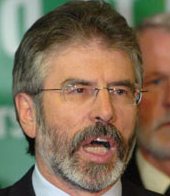 Gerry Adams and Sinn Féin are trying to stifle debate in Belfast’s media, writes Anthony McIntyre
Gerry Adams of Sinn Féin is the current Westminster MP for West Belfast. For decades he rightly campaigned against censorship policies crafted by successive British and Irish governments for the purposes of undermining his party. British readers may recall him as the only member of the House of Commons they could see but not hear. On each occasion that he appeared on TV over a six-year period from 1988, an actor’s voice was used to dub his words. On radio he was neither seen nor heard, the dubbing procedure again in play. It was only one of a range of draconian measures applied to silence him and his party. Former Irish Journalist of the Year Ed Moloney has repeatedly asserted that such censorship prohibited dialogue and consequently prolonged Northern Ireland’s violent conflict.
Although a victim of harsh political censorship, Adams’ disinclination to use this invidious tool of political repression has been less than salutary. Never a figure at ease with even the mildest form of political criticism, he has persistently sought to undermine those who do not see the world through his eyes and who are prepared to voice their misgivings publicly. Virtually everyone who has left Sinn Féin since the signing of the Good Friday Agreement a decade ago has highlighted the suppression of debate among their reasons for quitting. Adams has no record of speaking out against those murdered, kidnapped or beaten by his party’s military wing simply because they chose to dissent from his political project. On occasion Adams has hit out at those daring enough to have a public ‘poke’ at his leadership. Elsewhere he has been on record saying that people should not be allowed to even think that there is any alternative to the Good Friday Agreement. There is no concession to the idea that without audacious thinking, West Belfast intellectual life would be even more restricted than it currently is.
(more…)
