12 Aug 2013 | News
Writer and broadcaster Kenan Malik and art historian and educator Nada Shabout on one of the art world’s most contentious debates

Mark Boardman/www.mark-boardman.com
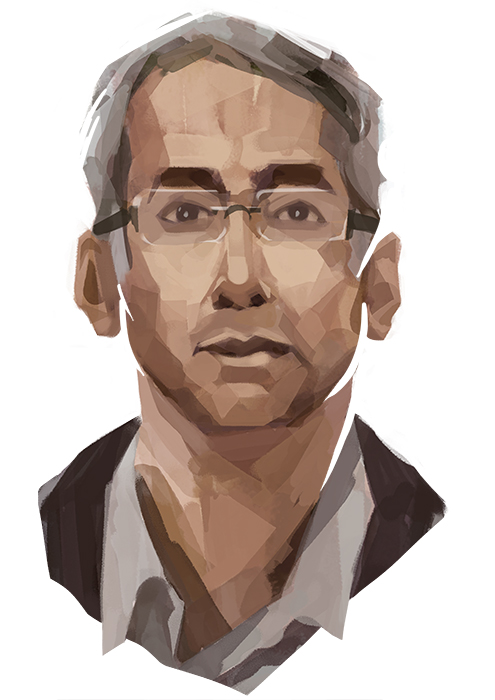
Dear Nada,
I regard free speech as a fundamental good, the fullest extension of which is necessary for democratic life and for the development of other liberties. Others view speech as a luxury rather than as a necessity, or at least as merely one right among others, and not a particularly important one. Speech from this perspective needs to be restrained not as an exception but as the norm.
The answer to whether religious and cultural sensibilities should ever limit free expression depends upon which of these ways we think of free speech. For those, like me, who look upon free speech as a fundamental good, no degree of cultural or religious discomfort can be reason for censorship. There is no free speech without the ability to offendreligious and cultural sensibilities.
For those for whom free speech is more a luxury than a necessity, censorship is a vital tool in maintaining social peace and order. Perhaps the key argument made in defence of the idea of censorship to protect cultural and religious sensibilities is that speech must necessarily be less free in a plural society. In such a society, so the argument runs, we need to police public discourse about different cultures and beliefs both to minimise friction and to protect the dignity of individuals, particularly from minority communities. As the sociologist Tariq Modood has put it, “if people are to occupy the same political space without conflict, they mutually have to limit the extent to which they subject each others’ fundamental beliefs to criticism”.
I take the opposite view. It is precisely because we do live in a plural society that we need the fullest extension possible of free speech. In such societies it is both inevitable and important that people offend the sensibilities of others. Inevitable, because where different beliefs are deeply held, clashes are unavoidable. And they should be openly resolved, rather than suppressed in the name of “respect” or “tolerance”.
But more than this: the giving of offence is not just inevitable, but also important. Any kind of social change or social progress means offending some deeply-held sensibilities. Or to put it another way: “You can’t say that!” is all too often the response of those in power to having their power challenged. The notion that it is wrong to offend cultural or religious sensibilities suggests that certain beliefs are so important that they should be put beyond the possibility of being insulted or caricatured or even questioned. The importance of the principle of free speech is precisely that it provides a permanent challenge to the idea that some questions are beyond contention, and hence acts as a permanent challenge to authority. The right to “subject each others’ fundamental beliefs to criticism” is the bedrock of an open, diverse society, and the basis of promoting justice and liberties in such societies. Once we give up such a right we constrain our ability to challenge those in power, and therefore to challenge injustice.
The question we should ask ourselves, therefore, is not “should religious and cultural sensibilities ever limit free expression?” It is, rather, “should we ever allow religious and cultural sensibilities to limit our ability to challenge power and authority?”
Best wishes,
Kenan
Mark Boardman/www.mark-boardman.com
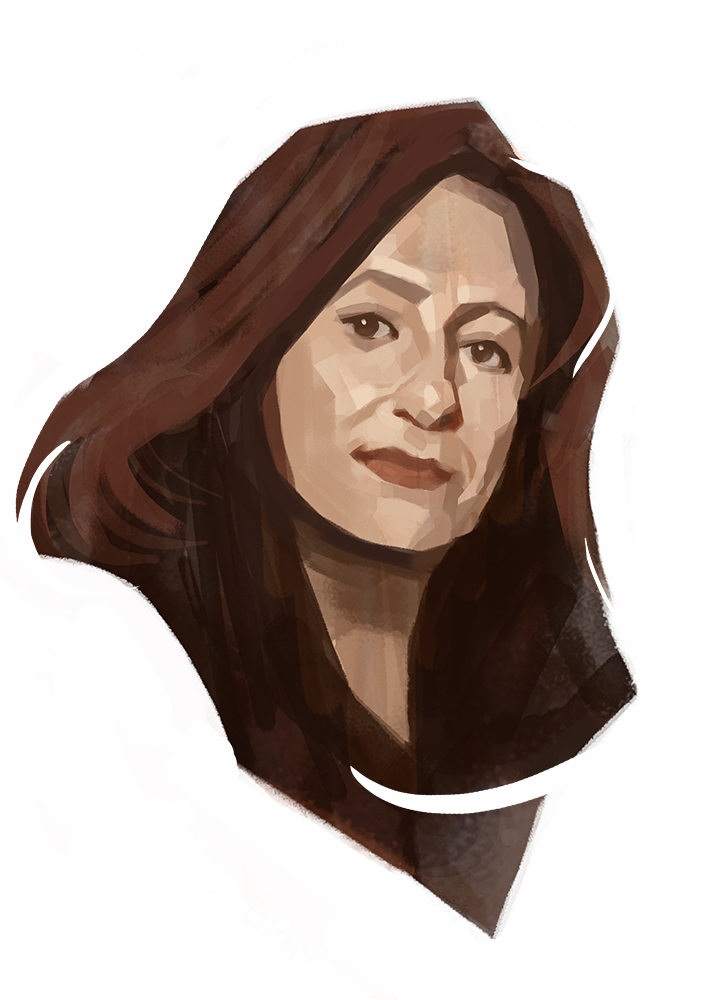
Dear Kenan,
I too regard free speech as a fundamental good and as necessary. On the surface, thus, the simple and direct answer to the question of whether religious and cultural sensibilities should ever limit free expression should be an unequivocal NO! However, the reality is that the question itself is problematic. While free expression, and let’s think of art in this specific case, will always push the limits and “reveal the hidden”, consideration and sensitivity, including religious and cultural sensibility, should not be inherently in opposition. By positioning it as such, the answer can only be reactive. I thus disagree with your argument.
A quick note on “censorship”. Yes, we all hate the word and find it very offensive. It is a word loaded with oppression, but the reality is that censorship in some form exists in every facet of life, personal and public. It is not that one needs to restrict speech in a plural society but that this plurality needs to find a peaceful way of co-existing with respect and acceptance, as much as possible — not tolerance; I personally abhor the word tolerance and find that it generally masks hatred and disdain. No belief is above criticism and nothing should limit our ability to challenge power and authority.
I suppose one needs to decide first the point of this criticism/free expression. Does it have a specific message or reason, and how best to deliver it — or is it simply someone’s personal free expression in the absolute? And if it is someone’s right to free expression, then why is it privileged above someone else’s right — religious and cultural sensibility being someone’s right to expression as well?
For example, and I will use art again, there is a problem when art/the artist is privileged as “genius”, with rights above other citizens — except not really, since the artist is subject to other limitations that may not be religious or cultural, like those of the tradition of expression, funding, law and so on. This is not to say that a religion should dictate expression. We should remember, though, that the marvel of what we call Islamic art was achieved within full respect of Islamic religious sensibilities, but also pushed the limits and critiqued simplicity in interpreting these sensibilities.
Perhaps my view here is less idealistic and more practical, but I see many unnecessary attacks on all sides that do not accomplish anything other than insult and inflame. All I’m saying is that expression is always achieved through negotiations, including limitations.
All the best,
Nada
Dear Nada,
I’m afraid that I was no clearer at the end of your letter than I was at the beginning about your actual stance on free speech. You say you ‘regard free speech as a fundamental good’ and that the answer to “whether religious and cultural sensibilities should ever limit free expression should be an unequivocal NO!” You then, however, go on seemingly to qualify that unequivocal stance but without actually specifying what it is that you wish to qualify. Where should the line be drawn when it comes to the issue of what is and is not legitimate free speech? Who should draw that line? And on what basis? These are the critical questions that need answering. You write: “It is not that one needs to restrict speech in a plural society but that this plurality needs to find a peaceful way of co-existing with respect and acceptance”. It’s a wonderful sentiment, but what does it actually mean in practice? Should Salman Rushdie not have written The Satanic Verses so that he could find “a peaceful way of coexisting with respect and acceptance”? Was the Birmingham Rep right to drop Gurpreet Kaur Bhatti’s play Behzti after protests from Sikhs? Should Jerry Springer: The Opera ever have been staged (or broadcast)?
You suggest that “one needs to decide first the point of this criticism/free expression. Does it have a specific message or reason, and how best to deliver it — or is it simply someone’s personal free expression in the absolute?” Again, I am unclear as to the point you’re making here. Are you suggesting here that speech is only legitimate if it has “a specific message or reason”? If so,who decides whether it does? During the controversy over The Satanic Verses, the philosopher Shabbir Akhtar distinguished between “sound historical criticism” and “scurrilously imaginative writing”, and insisted that Rushdie’s novel fell on the wrong side of the line. Do you agree with him? If not, why not? You ask: “If it is someone’s right to free expression, then why is it privileged above someone else’s right — religious and cultural sensibility being someone’s right to expression as well?” This seems to me a meaningless question. A “sensibility” is not a “right”, still less a “right to expression”. If your point is that all people, whatever their religious or cultural beliefs, should have the right to express those beliefs, then I agree with you. That is the core of my argument. What they do not have is the “right” to prevent anybody expressing their views because those views might offend their “sensibilities”.
A final point: to defend the right of X to speak as he or she wishes is not the same as defending the wisdom of X using speech in a particular fashion, still less the same as defending the content of his or her speech. Take, for instance, The Innocence of Muslims, the risibly crude and bigoted anti-Muslim video that provoked so much controversy and violence last year. I would defend the right of such a film to be made. But I would also question the wisdom of making it, and would strongly challenge the sentiments expressed in it. There is a distinction to be drawn, in other words, between the right to something and the wisdom of exercising that right in particular ways. It is a distinction that critics of free speech too often fail to understand.
Best,
Kenan
Dear Kenan,
Nicely said! I believe we are ultimately saying the same thing. It is that “distinction” that you outline in your last paragraph that I call a negotiation between all sides, cultures, etc. My answer is not clear because the issue is not simple! I am saying that it is not a black and white binary divide nor can one “draw a line”. And yes, “who should draw that line? and on what basis?” is critical and essential. I believe that should be reached through negotiation. The “wisdom” of something to exist is as important as its right to exist. But there is also the question of responsibility. Free speech cannot be “inherently good” or bad. The person who utters that speech must claim responsibility for its use and effects. The examples you cite above are not all equal. Yes, they all have the right to exist. But let’s think a bit about the Danish cartoons about the Prophet Mohammed as another example. Were they not an attack aimed to inflame Muslim communities? Was it not part of Islamophobia?
Was the aim not to ridicule and play off people’s fears and prejudices? How were they a critique of Islam? What was the point? It is not that “it is morally unacceptable to cause offence to other cultures” as you once said, but the how and why are just as important as the right to cause that offence. I agree with you that the fear of consequences has become a limitation, but that isperhaps because free speech has been abused.
Perhaps I am looking at this from a different point of view. As an educator, I often face the situation, equally here in the US and in the Middle East, of how to argue a point that has become of specific cultural/religious/political sensitivity to my students. If I offend them here, they will stop listening; in the Middle East, I will not be allowed to continue. What would I gain by doing that? By negotiation I test the limits and push gently. At least in academia, I think we are at a point where we have to teach our students to not get offended by an opposing opinion and to be able to accept various opinions and to be able to accept criticism. I don’t think I can achieve that through shock alone!
Best, Nada
Dear Nada
You write that your “answer is not clear because the issue is not simple”. Perhaps. But surely, if the answer is not simple, that only places a greater imperative to make one’s answers as clear as possible?
You believe that we are “ultimately saying the same thing”. I am not so sure that we are. So, let us try to work out where we do agree and where we don’t.
There are two questions we are debating. The first is about the legal limits to free speech. My view is that the law should not in any way protect cultural or religious sensibilities. All speech should be legal except where it directly incites violence. I assume that is your position, though you have never actually stated it as such. Do we agree on that?
The second question is about how we can define speech that is legally acceptable but morally distasteful. You say that where we draw the moral line “should be reached through negotiation”. But negotiation with whom? And on what basis?
You raise a series of questions about the Danish cartoons, and imply that the cartoons were not legitimate speech but created merely to provoke, and hence should not have been published. You don’t, however, actually say that. So, to clarify, is that your view?
Exactly the same questions were, as I pointed out in an earlier letter, asked about The Satanic Verses, and many came to the same conclusions about Rushdie’s novel: that it was Islamophobic, designed to provoke and inflame Muslim communities, that it ridiculed Islam and played off people’s fears, and so on. The philosopher Shabbir Akhtar described it as an “inferior piece of hate literature”. The liberal Ziauddin Sardar wrote that reading the novel felt like being “raped”. The novelist Rana Kabani insisted that it played upon ancient Islamophobic stereotypes.
In the case of both The Satanic Verses and the Danish cartoons, the majority of Muslims, certainly initially, stayed indifferent to the issue. A vocal minority transformed both into global controversies. So, what does “negotiation” mean in this context? Muslim objection to The Satanic Verses was as deep and as broad as that to the Danish cartoons. Yet, you seem to think that it was right to publish the novel but not the cartoons. Why? And please don’t say “My answer can’t be clear because the issue is not simple”.
In any case, the questions that you raise — Is it Islamophobic? Is the aim merely to ridicule? etc — are different from the question that we are actually addressing: “Should religious or cultural sensibilities ever limit free speech?”. There is, in my view, a moral imperative on free speech advocates to challenge racist and other bigoted speech. I certainly do not that think that about speech that offends cultural or religious sensibilities. On the contrary, the moral imperative is often to transgress such boundaries. It is the conflation of racism and bigotry, on the one hand, and of cultural and religious sensibilities, on the other, that is the problem. Opponents of free speech often conflate these two issues in an attempt to establish a spurious legitimacy for their arguments against the giving of offence.
Best wishes,
Kenan
Kenan Malik is a writer and broadcaster. His latest book is From Fatwa to Jihad: The Rushdie Affair and its Legacy (Atlantic Books)
Nada Shabout is associate professor of art education and art history at the University of North Texas and director of the Contemporary Arab and Muslim Cultural Studies Institute
17 Apr 2013 | Russia
Self-censorship has poisoned Russian media, art and other spheres.
In the past few years, criminal prosecution of artists and new laws have made it clear for those who criticise the Kremlin or Russian Orthodox Church in their creative work, will face consequences for portraying either of these institutions negatively.

A Russian artist came under fire for depicting members of Pussy Riot as religious icons
Just last week, the State Duma passed two controversial laws in the first hearing. One forbids obscene language in movies, books, TV, and radio during mass public events. The other stipulates criminal punishment — including five years in prison — for “insulting believers’ feelings”. Both laws, as far as human rights activists are concerned, limit artists’ freedom of expression, and encourage self-censorship.
Index spoke to three notable artists to find out how the art community deals with self-censorship, and the ever-increasing restrictions on freedom of expression in Russia.
Artyom Loskutov, an artist from Novosibirsk, is famous for holding “monstrations” — flash mobs with absurd slogans like “Tanya, don’t cry” and “Who’s there?”. In 2009, he was arrested on drug possession charges, but he claims that the marijuana was planted on him by police. A blood test proved that he had not taken any drugs, and his fingerprints were not found on the package. Three years on, he faced three administrative cases, and paid a 1000 rouble fine for creating icon-like images of Pussy Riot members Nadezhda Tolokonnikova and Maria Alekhina and placing them on billboards. He was accused of insulting believers. He is currently appealing the court ruling in the European Court of Human Rights.
The artist told Index that the cases against him are acts of censorship, but vows to remain defiant and continue with his work:
The icons idea concerned two kinds of mothers: one mother is honoured as a saint, the two others — Tolokonnikova and Alekhina — were thrown in prison. The authorities, including the court, are becoming more insane, and one wouldn’t want to cause persecutions. But I can’t say that given that, I refuse to implement any of my plots. In the 90s my generation felt that we had nothing, except free speech, and all the 2000s attempts to take it away meet nothing but incomprehension
In 2010, The prosecutor’s office in Moscow’s Bassmany district examined the works of Moscow-based artist Lena Hades, “Chimera of Mysterious Russian Soul” and “Welcome to Russia”. Russian nationalists appealed to the authorities claiming these paintings insult Russians. The case did not go to court, but Hades told Index that Russian galleries feared exhibiting her paintings after the incident.
“Galleries are afraid of financial sanctions,” Hades says, “Although 95 per cent of my paintings are about philosophy rather than about social events, they are only exhibited in Tretyakov Gallery and Moscow Museum of Modern Art”.
Despite reduced chances of her work being exhibited, Hades still painted Pussy Riot’s members, and went on a 25-day hunger strike against their prosecution. The artist is no fan of self-censorship, even if it comes at a cost. According to her, no artist that responds to reality can accept self-censorship:
This is not courage, this is aristocratic luxury of doing what you want. Self-censorship is more harmful for a modern Russian artist than censorship. He is frightened of scaring away galleries and buyers and prefers to paint landscapes with cows — anything far enough from real social life
Artist Boris Zhutovsky has a long-standing relationship with censorship. In 1962, he was slammed by then Soviet leader Nikita Khrushchev, who banned work by Zhutovsky and his colleagues. For several years following the incident, the artist faced difficulties in finding employment, and his work was not exhibited in the USSR.
Zhutovsky continues to court controversy today: in the past few years he has painted the trials of Russia’s most well-known political prisoners, businessmen Mikhail Khodorkovsky and Platon Lebedev, who were first convicted in 2005. He explained Russia’s culture of self-censorship to Index:
Self-censorship is based on fear, and the amplitude of this fear has changed throughout my life. In the times of Stalin, it was the fear of the Gulag and execution. In the times of Khruschev it was the fear of loosing a job or a country – a person could be forced to leave the Soviet Union. After Perestroika the fear shrank, and now the fear which nourishes self-censorship is the fear to anger your boss
He is optimistic that a younger generation of artists will not accept self-censorship as a standard, as the the era of Putin is far from that of Stalin, but only time will tell.
17 Apr 2013 | Newswire
Self-censorship has poisoned Russian media, art and other spheres.
In the past few years, criminal prosecution of artists and new laws have made it clear for those who criticise the Kremlin or Russian Orthodox Church in their creative work, will face consequences for portraying either of these institutions negatively.
A Russian artist came under fire for depicting members of Pussy Riot as religious icons
Just last week, the State Duma passed two controversial laws in the first hearing. One forbids obscene language in movies, books, TV, and radio during mass public events. The other stipulates criminal punishment — including five years in prison — for “insulting believers’ feelings”. Both laws, as far as human rights activists are concerned, limit artists’ freedom of expression, and encourage self-censorship.
Index spoke to three notable artists to find out how the art community deals with self-censorship, and the ever-increasing restrictions on freedom of expression in Russia.
Artyom Loskutov, an artist from Novosibirsk, is famous for holding “monstrations” — flash mobs with absurd slogans like “Tanya, don’t cry” and “Who’s there?”. In 2009, he was arrested on drug possession charges, but he claims that the marijuana was planted on him by police. A blood test proved that he had not taken any drugs, and his fingerprints were not found on the package. Three years on, he faced three administrative cases, and paid a 1000 rouble fine for creating icon-like images of Pussy Riot members Nadezhda Tolokonnikova and Maria Alekhina and placing them on billboards. He was accused of insulting believers. He is currently appealing the court ruling in the European Court of Human Rights.
The artist told Index that the cases against him are acts of censorship, but vows to remain defiant and continue with his work:
The icons idea concerned two kinds of mothers: one mother is honoured as a saint, the two others — Tolokonnikova and Alekhina — were thrown in prison. The authorities, including the court, are becoming more insane, and one wouldn’t want to cause persecutions. But I can’t say that given that, I refuse to implement any of my plots. In the 90s my generation felt that we had nothing, except free speech, and all the 2000s attempts to take it away meet nothing but incomprehension
In 2010, The prosecutor’s office in Moscow’s Bassmany district examined the works of Moscow-based artist Lena Hades, “Chimera of Mysterious Russian Soul” and “Welcome to Russia”. Russian nationalists appealed to the authorities claiming these paintings insult Russians. The case did not go to court, but Hades told Index that Russian galleries feared exhibiting her paintings after the incident.
“Galleries are afraid of financial sanctions,” Hades says, “Although 95 per cent of my paintings are about philosophy rather than about social events, they are only exhibited in Tretyakov Gallery and Moscow Museum of Modern Art”.
Despite reduced chances of her work being exhibited, Hades still painted Pussy Riot’s members, and went on a 25-day hunger strike against their prosecution. The artist is no fan of self-censorship, even if it comes at a cost. According to her, no artist that responds to reality can accept self-censorship:
This is not courage, this is aristocratic luxury of doing what you want. Self-censorship is more harmful for a modern Russian artist than censorship. He is frightened of scaring away galleries and buyers and prefers to paint landscapes with cows — anything far enough from real social life
Artist Boris Zhutovsky has a long-standing relationship with censorship. In 1962, he was slammed by then Soviet leader Nikita Khrushchev, who banned work by Zhutovsky and his colleagues. For several years following the incident, the artist faced difficulties in finding employment, and his work was not exhibited in the USSR.
Zhutovsky continues to court controversy today: in the past few years he has painted the trials of Russia’s most well-known political prisoners, businessmen Mikhail Khodorkovsky and Platon Lebedev, who were first convicted in 2005. He explained Russia’s culture of self-censorship to Index:
Self-censorship is based on fear, and the amplitude of this fear has changed throughout my life. In the times of Stalin, it was the fear of the Gulag and execution. In the times of Khruschev it was the fear of loosing a job or a country – a person could be forced to leave the Soviet Union. After Perestroika the fear shrank, and now the fear which nourishes self-censorship is the fear to anger your boss
He is optimistic that a younger generation of artists will not accept self-censorship as a standard, as the the era of Putin is far from that of Stalin, but only time will tell.
25 Mar 2013 | Volume 42.01 Spring 2013
Against a backdrop of heavy austerity measures in Greece, free speech and the right to protest are being both challenged and undermined. The policies are the result of agreements between the government and the so-called troika, made up of the European Commission, the International Monetary Fund and the European Central Bank. Since 2010, steps taken to restore fiscal balance have led to the impoverishment of large segments of society and unemployment has reached new highs: 26.8 per cent in October 2012. At the same time, the rise of the neo-Nazi party Golden Dawn, with an agenda of targeting immigrants, homosexuals and “dissidents” of all kinds, has created palpable social tensions. Police repress protests and political activity by a range of groups, including anarchists and leftists, a fact that has been widely documented. These tactics have been regarded by many as evidence that the government is adopting an authoritarian stance when it comes to criticism and dissent.
The current government, run by Prime Minister Antonis Samaras’s conservative New Democracy Party, took office in June 2012. In a report published in July 2012, Police Violence in Greece: Not just “Isolated Incidents”, Amnesty International stated:
The failure of the Greek authorities to effectively address violations of human rights by police has made victims of such violations reluctant to report them. … Between 2009 and the first months of 2012, numerous allegations have been received regarding excessive use of force, including the use of chemical irritants against peaceful or largely peaceful demonstrators, and the use of stun grenades in a manner that violates international standards.
In the report, Amnesty made “urgent recommendations to the Greek authorities”, urging them to ensure that police “exercise restraint and identify themselves clearly during demonstrations” and calling for them to improve “safeguards for those in custody and creating a truly independent and effective police complaints mechanism”. The mainstream media — owned mainly by business leaders seen as having a cosy relationship with politicians — have censored or fired journalists who have attempted to speak out about the costly bailout agreements with the troika.
Those who have reported on allegations of police brutality, such as Kostas Arvanitis and Marilena Katsimi of the Greek state-owned public radio and television broadcasting corporation ERT have also been targeted. On 9 October 2012, Thanos Dimadis, a correspondent for Greek TV and radio station SKAI, reported that bailout payments had been only “partial” and carried out “under a regime of strict economic surveillance”. Later that day, he received instructions from SKAI TV news director Christos Panagopoulos not to include that information in the afternoon and evening news reports. The text of his story was removed from SKAI TV’s website. Dimadis’s report was annoying for the government, which was keen to prevent details about the bailout from becoming public. Payments from the troika had been suspended since June, after a partial tranche was released. The authorities were worried that the public would believe that payments were conditional on even more stringent austerity measures. Dimadis complained to SKAI’s news directors, threatening to resign if they did not back up his report. He eventually quit.
Dimadis told me that senior management at SKAI argued that the reason they withdrew his report was that the prime minister’s office had dismissed it as false. Moreover, Dimadis’s reactionwas described by SKAI as “over the top”.
Censoring the news
The government’s modus operandi is best illustrated by the Kostas Vaxevanis case. Vaxevanis, an investigative journalist and publisher of Hot Doc magazine, was arrested on 28 October 2012 for publishing the names of over 2000 Greek citizens who held Swiss bank accounts, dubbed the “Lagarde list”. The story focused on alleged tax evasion by wealthy Greeks during a time of economic crisis.
“A few months ago, before the release of the ‘Lagarde list’ and my aggressive arrest, there was an organised attempt to destroy my professional reputation: a publication presenting a fake receipt attempted to incriminate me as being on the payroll of the National Intelligence Service (EYP). I realised I was under heavy surveillance and one night I was ambushed by strangers at my home,”Vaxevanis told me in an interview.
During our discussion, on 26 December 2012, Vaxevanis said free speech in Greece was coming under attack yet again: “It’s not something new. When you have ongoing dealings between politicians and businessmen who own media groups, then it comes as no surprise that journalists are driven to self-censorship. Take a look, for example, at the non-existent coverage of the Reuters story on the Piraeus Bank case. You have such a big story, but what you see in the newspapers instead is an advertisement by the bank.” 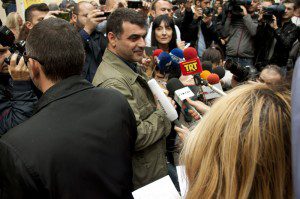
On 1 November, Vaxevanis was acquitted and cleared on changes of violating privacy laws. But two weeks later, the prosecutor’s office ordered a retrial, claiming the original verdict was “legally flawed”. He could face up to two years’ imprisonment if he is sentenced. In April 2012, Reuters reported on an investigation into documents, including financial statements and property records, relating to Michalis Sallas, executive chairman of Piraeus Bank, and his wife, Sophia Staikou. The press report said “the couple may also be emblematic of the lack of transparency and weak corporate governance that have fuelled Greece’s financial problems”.
But according to journalist Apostolis Fotiadis, no major national or international media outlet reported on the lawsuit filed by Piraeus Bank against Reuters, though the New York Times anda couple of independent journalists attended the trial, including Fotiadis. The ruling is still pending.
On 29 October 2012, a popular morning talk show on the Greek state broadcasting corporation, ERT, was suddenly suspended, following a decision by ERT’s general director of news, Aimilios Liatsos. Shortly before the show was dropped, Kostas Arvanitis, co-presenter of the programme, and his colleague Marilena Katsimi had made comments on air about the minister of public order’s response to an article published in the British newspaper the Guardian written by Helena Smith.
Arvanitis told me:
I’ve been working as a journalist for 25 years. I’ve never experienced anything like this — not to this extent and with such intensity, at least. I consider what happened as aggressive meddling by the political system. It’s becoming more and more clear: every question that is different, every perspective that is different is considered provocative. You can understand what’s happening if you take a careful look at the media coverage of strikes.
Influential columnists and unsigned editorials very often neglect the reasons lower and middle working classes decide to go on strike. Instead of shedding light on their requests, these outlets prefer to present the strikes as instances of “abusing the public space” or “disturbing public peace”. This is the typical official government response as well. In the broader context, of course, this approach fails to report on the growing pressure on workers — on those who still have a job but with reduced salaries, and on those without one.
A Guardian article written by Maria Margaronis was published on 9 October and mentioned allegations of police brutality against protesters. It also referred to and confirmed an earlier article,published on 28 September, written by Helena Smith, that quoted ‘analysts, activists and lawyers’ as saying that the “far-right Golden Dawn party is increasingly assuming the role of law enforcement officers on the streets of the bankrupt country, with mounting evidence that Athenians are being openly directed by police to seek help from the neo-Nazi group”.
Margaronis also wrote:
Fifteen anti-fascist protesters arrested in Athens during a clash with supporters of the neo-Nazi party Golden Dawn have said they were tortured in the Attica General Police Directorate (GADA) — the Athens equivalent of Scotland Yard — and subjected to what their lawyer describes as an Abu Ghraib-style humiliation. If it hadn’t been for the Guardian stories, it is highly unlikely that Golden Dawn’s purported connection with the police would have reached a foreign audience — or the Greek public. The fact that these claims never made the Greek press and that Arvanitis was censored for simply commenting on one of the articles shows just how prevalent censorship is in Greece today.
Dimitris Katsaris is a lawyer for four of the protesters who alleged that they were tortured in GADA after they were arrested during the 30 October protest. He says the way the situation has been handled is a clear “indication of censorship … interviews with the anti-fascists took place in a climate of terror; at the end, the policemen tried to grab me and push me away while I was complaining to them. All of this has been recorded.” However, the censorship didn’t stop there.
Ignoring the truth
Minister of Public Order Nikos Dendias claimed on SKAI TV talk show New Folders on 16 October that the Guardian report on police brutality was false, and threatened to sue the British paper if no proof of torture was found. He questioned the source of the photographs in Margaronis’s article — which showed an injured protester — and claimed that since the anti-fascists hadn’t gone on record with their names and reports, and hadn’t filed a lawsuit against the police, the Guardian was not justified in publishing the story.
Dendias also denied assertions that the arrested protesters were afraid to go on record because they had been threatened by police or extremist Golden Dawn supporters. According to Katsaris, although SKAI and the New Folders’ presenter Alexis Papahelas were already in possession of the photographs indicating police brutality at the time they interviewed Dendias, they did not report on the evidence or broadcast the photographs; had it not been for SYRIZA MP Dimitris Tsoukalis’s intervention on the show, the photos wouldn’t have been shown on air. “From the moment the Guardian’s report was published,” Katsaris says, “I was in contact with New Folders’ editor-in-chief. A week before the show I was providing him photos and evidence that proved torture by the police.” Katsaris says he called the editor-in-chief and asked him to intervene, but after many calls, he was told there was “‘no sufficient airtime” to provide the other side of the case. “So I could not contrast the ministers’ claims. I even asked them, given the material they had, to question the minister in a fair journalistic manner. They didn’t.”
It seems that every time a story about political actions by anti-fascist protesters unfolds, the censorship machinery of the government and Golden Dawn is set in motion. Niko Ago, an Albanian national who had been working as a journalist in Greece for 20 years, faced deportation after publishing a report about alleged criminal activity by Golden Dawn spokesman Ilias Kasidiaris, who is a member of parliament. Ago revealed that Kasidiaris was facing charges for allegedly participating in a 2007 attack on a postgraduate student and for illegal possession of a firearm .Since then, Ago has been receiving threatening emails containing defamatory and racist comments, some of which he published, including one that said “Fuck you, Albanian … all you fucking Albanians are going to get what you deserve.”
Muzzling grassroots dissent
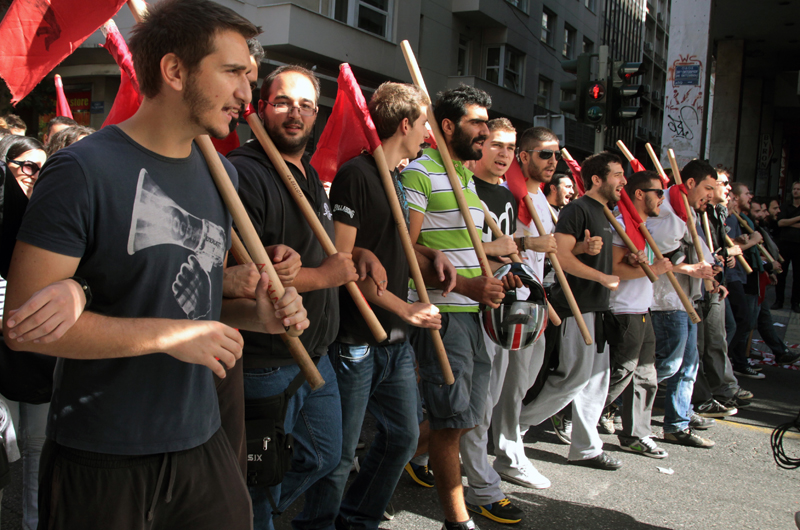
A great deal of pressure has also been brought to bear on independent, non-corporate media collectives or individuals who offer grassroots coverage. On 20 December 2012 and on 9 January 2013, police operations were carried out at the Villa Amalias squat in Athens, which has been an important meeting place for alternative political movements for the last 23 years, and at the Radiozones of Subversive Expression, an Athens-based radio station at the University of Economics and Business (ASOEE). Anarchists, leftists and political dissidents used both sites to organise labour, anti-fascist and antiracist rallies. As part of the operations connected with the ASOEE raid, in late December, anti-riot squads and police targeted immigrant street vendors originally from Nigeria, Morocco and Bangladesh who were selling pirated CDs and wooden animal figurines, as well as those who were regarded as supposedly condemning Greece to an economic decline, as the Radiozones website put it. The government, as well as Golden Dawn, tends to regard the economic activities of immigrants as detrimental to the national economy and as a threat to local workers.
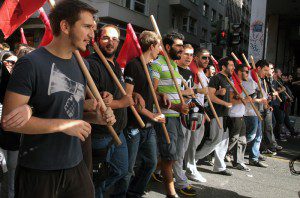
Last October, during German Chancellor Angela Merkel’s visit to Greece, nearly 100 arrests took place, as Avgi newspaper reported. During the 6-7 November general strike, a group of parliamentarians from SYRIZA denounced the massive presence of undercover police on the streets of Athens. According to the coalition, they were both acting as provocateurs among peaceful protesters and arresting people who simply looked “suspicious”. The policy of pre-emptive arrests has been repeatedly called unconstitutional by human rights organisations, including the Hellenic League for Human Rights.
Tomasz Grzyb/Demotix
During the annual Athens’ Polytechnic School rally on 17 November, dozens of pre-emptive arrests were reported on the website of the weekly political newspaper Kontra and activist websites documented many individual complaints. Indymedia Athens, the local collective of the international grassroots and activists network, published two complaints from citizens arrested on the day of the rally. In both cases, individuals were detained before the demonstration and were kept in custody for five hours without being allowed to contact a lawyer.
Mainstream media failed to report the events, while the government officially ignored complaints. Most news on the events came from blogs and free expression activists.
Online censorship
This systematic abuse is also taking place in the online environment. After posting a Facebook page that ridiculed a well-known Greek Orthodox monk, in late September 2012, a 27-year-old man was arrested on charges of‘”malicious blasphemy and religious insult”. Many online activists and commentators reflected that the page, called Elder Pastitsios the Pastafarian (which intentionally combines the name of the monk with a popular Greek food), angered members of Golden Dawn, who called for the man’s arrest under Greece’s anti-blasphemy laws. Free expression advocates responded, with the hashtag #FreeGeronPastitios trending on Twitter, and a petition addressed to parliament calling for the immediate release of the Facebook user was circulated online Vassilis Sotiropoulos, a lawyer and blogger specialising in internet legislation, writes:
“The legislature refuses to address the issue of internet censorship, thereby allowing law enforcers (prosecutors, police officers, judges and lawyers) to freely interpret and utilise the existing legal tools. This phenomenon has sometimes led to misunderstandings, which restrict individual rights of freedom of expression and privacy. Sotiropoulos added that the case of Elder Pastitsios provided perhaps the first example in Greece of an internet company disclosing information to the government in order to identify an individual accused of ‘alleged offences relating to religious satire’.
When considering freedom of speech as a universal human right, it is important to comprehend the social and economic context of our times. Currently, the political and economic elites, in Greece but elsewhere in Europe as well, are repositioning themselves within a capitalist system that is undergoing a continuous transformation.
Speaking to Al Jazeera, William I Robinson, Professor of Sociology and Global Studies at the University of California, Santa Barbara, argued that we are currently living through a phase of capitalism where “nation-state constraints” no longer apply. He stated that the “the strength of popular and working class movements around the world, in the wake of the global rebellions of the 1960s and the 1970s”, are now being effectively and successfully undermined.
Historically, during periods when there have been attempts to devalue the working class, there have also been challenges to the fundamental right to voice dissent, which has had a direct impact on efforts to improve living conditions. The current economic crisis, then, fits this model; it can also be used as an effective tool for the far right and those using fascist rhetoric to attack immigrants and workers.
Freedom of speech and protest in Greece must, then, be seen in very specific terms. The right to free expression is being systematically and effectively challenged by formidable political and economic agendas. It is crucial that activists, journalists and those being censored and abused continue to make their voices heard.
Christos Syllas is a freelance journalist in Athens. He tweets from @csyllas