30 Nov 2020 | News
“The invasion of privacy is the reverse side of censorship. If you don’t feel that your privacy is immune, you’re not going to speak out, you’re going to hold your tongue. Or not talk about certain things. So it has this strange underbelly of censorship,” said Judith Vidal-Hall, former editor of Index on Censorship from 1993 to 2007. I meet Vidal-Hall on a sunny afternoon at a river-side cafe in West London to discuss her experiences of editing the magazine. We’re chatting about the internet and the privacy concerns that come with it, a concern that went from almost non-existent to ubiquitous during her time as editor.
“One of the greatest threats to free expression at the moment is privacy,” she added.
Vidal-Hall worked at Index at one of the most pivotal eras in recent world history. In 1993 the Twin Towers still stood, the world wide web was in its infancy and South African apartheid continued to be enforced. By 2007 the political and social landscape had become almost unrecognisable.
Under Vidal-Hall’s stewardship, Index navigated this global metamorphosis, identifying those in power who obscured the truth, those who were being shut out of the narrative, and gave the “voiceless a voice”.
How did Vidal-Hall find herself editing the magazine in 1993?
“It’s quite a long story, it’s a bit of a saga,” she told me over sausage rolls and tea. And a bit of a saga it really is. Returning to the UK in 1976 after a couple years of travelling, Vidal-Hall approached the Guardian, on behalf of a Bangladeshi friend, to start the Guardian Third World Review. It was, she said, “an absolutely pioneering supplement where third world people told their own stories”.
She remembers a Guardian journalist at the time asking her: “Don’t you think we treat the third world fairly?”. “That’s not the point.” she had replied. “You’re keeping their voices out…I didn’t use the word at the time I don’t think, but they’re censored. You keep them out.
Without skipping a beat, she added: “We then started a magazine called South.” South: The Voice of the Third World, was a monthly magazine which was about including other voices. South closed its doors in 1989 and, Vidal-Hall chuckled, “my husband buggered off at the same time so I was left with no husband, no income”.
Shortly after, she received a call from Philip Spender, who was running Index, asking for a reference for Andrew Graham-Yooll, who had been an editor at South. Graham-Yooll became the editor of Index, and it was he who brought Vidal-Hall into the fold.
It was not the best time for Index. Many of Index’s funders had seen it as “a Cold War weapon” and, believing communism to be over with the fall of the Berlin Wall in 1989, they had withdrawn their funding. By the early 1990s Index was “basically bankrupt”.
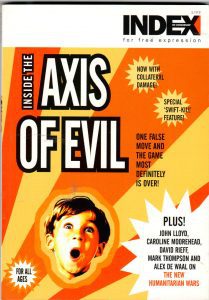
Inside the axis of evil, the spring 2003 issue of Index on Censorship magazine
Enter the Fritt Ord Foundation, a group of Norwegian newspaper owners “ashamed of the takeover of their media by the Nazis in the [19]40s, and they had made a resolution, never again to work for anyone but themselves and to support independent media.”
And so in 1993, supported by funds from the Fritt Ord Foundation, Index was relaunched with Vidal-Hall as the editor, who had some big plans.
“One was to make it an attractive, readable magazine.”
Next: “I wanted it to be much more diverse…it did have a sort of Cold War focus and I wanted to bring in a much more global focus.”
“The third thing I wanted was to get rid of the idea that censorship was what they did out there, not what we did. They censor, we don’t. So I wanted to make it universal, the concept of censorship.”
I discuss with Vidall-Hall an Index article from 2002 by Noam Chomsky, Confronting the Monster. In this article Chomsky, writing in the wake of 9/11, examines how the West considers only actions taken by the enemy to be war crimes, while believing their own actions are always justified.
“He was so much my hero,” Vidal-Hall said on hearing Chomsky’s name.
“The them and us, it’s a good way to put it [referencing Chomsky’s article]. They do it, we don’t. And I wanted to break that, so that was my main [aim], to make Index inclusive not only of all genders, colours etc and creeds, don’t forget creeds, but also to make it inclusive of us, as guilty as them in a different way.”

Underexposed, the November 1999 edition of Index on Censorship magazine, which was Vidal-Hall’s favourite to work on
As we discuss Chomksy’s article, I ask what was the most important global event that happened while Vidal-Hall was at Index.
She says gathering around the television in the office to watch events on 9/11 unfolding live: “And that in some ways was the beginning of what I would call a series of events. It changed the balance, the perspective, relationships and priorities in the world. So, off the cuff, I would say that the sequence of events between 9/11 and the invasion of Iraq…that was the changing moment.”
The conversation turns to media coverage of that time. How were the narratives controlled by the states in question? What did it mean for freedom of expression?
“[In 2001-2003] people thought they had freedom of expression but they didn’t know the facts. And why didn’t we know the facts? We were lied to, there were no weapons of mass destruction.”
She added: “For me, and it’s very personal, what that invasion did was destroy a level of what seemed like stability in international relations. And I think the revelations of the inquiry into the lies that have been told was quite shocking… Are governments transparent? No! When they need to lie they will lie if it defends them.”
While the events of 2001 to 2003 were the most important during Vidal-Hall’s time as editor, her favourite issue predates them. It is a 1999 issue called Underexposed, which explored the censorship of photographs.
“It was fascinating. I didn’t go to the office for days. I spent weeks searching [for images]…some of the ones I remember most clearly, visually, are the ones from the early 30s when Hitler was coming to power. The photos that were never published. I’ll give you one example. Never published in Germany! Photos of him. There’s this one photo where he’s being coached in sort of rhetoric and he didn’t want people to know that he was being coached.”
Vidal-Hall also reflects on interviews she conducted in the early 1990s, one with a key player in modern European far-right politics.
“When the [Berlin] Wall came down I went out to Hungary and various other places…I did some rather interesting interviews…One of them was with a man you might have heard of, Viktor Orban. I interviewed him back when the Wall had come down, communism had fallen and him and another young man whom I’m still in touch with, Peter Molnar, I interviewed them together. They were the founder of Fidesz, the party that has now gone extreme right. And Orban seems to have undergone a personality change.”
Meditating on far right politics in Europe today, Vidal-Hall said: “How much of it is our mistake in thinking that democracy can just be delivered to the door by Amazon in a parcel with a smile?”
This gloomy take is offset by Vidal-Hall’s praise for Index: “As a publication you are unique, there is nobody else who is doing what index is doing. And that is extraordinary, to remain so. I feel strongly about that.”
The interview wraps up and I leave, my mind awash with the battles Index has won alongside all of those that we are still fighting today.
2 Sep 2020 | News
[vc_row][vc_column][vc_single_image image=”114690″ img_size=”full” add_caption=”yes”][/vc_column][/vc_row][vc_row][vc_column][vc_column_text]“The Hungarian public’s access to sources of balanced news and information is in greater danger than ever before.” This was the stark warning that Index on Censorship, alongside 15 other organisations, delivered to Executive Vice-President of the European Commission Margrethe Vestager today.
After a decade of Prime Minister Viktor Orban’s rule, Hungary’s media landscape is in turmoil. Last month, 70 of the approximately 90 journalists working at Index.hu – which had been considered one of the last major independent news outlets in Hungary – resigned after the editor-in-chief was fired by the company’s CEO.
“For years, we’ve been saying that there are two conditions for the independent operation of Index: that there be no external influence on the content we publish or the structure and composition of our staff. Firing Szabolcs Dull has violated our second condition. His dismissal is a clear interference in the composition of our staff, and we cannot regard it any other way but as an overt attempt to apply pressure on Index.hu,” the departing journalists wrote in an open letter.
“Index was the most widely read news website in Hungary,” explained András Pethő in an interview with Index on Censorship. Pethő is co-founder and senior editor at Direkt36, a small investigative journalism outlet that focuses on reporting abuses of power. “It was one of the few remaining independent news websites in Hungary. It was a kind of hub on the Hungarian internet: a lot of people started their day by checking Index.”
“The organisation, the outlet itself is still here. The whole staff resigned but they hired new people. There’s a new leadership and we’ll see what that looks like, how they will cover news, and how independent they will be,” said Pethő. “What happened is bad for basically everyone who is interested in independent journalism in Hungary.”
Before founding Direkt36, Pethő had been a reporter and editor at Origo.hu, one of the largest online news outlets alongside Index. But in 2014, Origo.hu’s editor-in-chief was abruptly replaced after an investigation was published about lavish expenses claimed by Orban’s chief of staff. “Basically we went through a pretty similar story [to Index],” said Pethő. “The whole project – Direckt36 – was born as a response to the negative environment.”
What happened at Index and Origo are just two examples of the Hungarian government’s efforts to undermine independent media in the country. Index on Censorship has reported regularly on Orban’s attacks on the media and has been particularly concerned by events of the last six months fearing that the Covid-19 crisis is being used as a distraction to further curtail media freedom. In this period, we have received reports of journalists being barred from press conferences, alongside other attacks that we have documented on our map.
But despite the government’s ongoing and strategic efforts to punish critical media and reward government mouthpieces, the EU has yet to meaningfully intervene. As highlighted by the signatories of today’s letter to Vestager, such efforts have included the misuse of state aid, which has resulted in two complaints being logged with the European Commission in 2016 and 2018 respectively. The first complaint relates to Hungary’s public service broadcaster which, despite having long ceased to meet international standards due to its clear pro-government bias, continues to receive state funding. The second relates to the distribution of state advertising to media outlets in Hungary.
Although it was a market leader, Index.hu had received virtually no state advertising in the years prior to the mass resignations. At the same time, its main competitor – the now pro-government Origo.hu, benefitted heavily. As stated in today’s letter, “the goal of these efforts is clear: to financially weaken independent media and hamper the production and dissemination of critical news.”
Pethő says that Direkt36 are among the organisations feeling the squeeze. “When we launched it in 2015 and when we had a bigger story, those stories were often picked up by several online news outlets, a couple of TV channels, radio stations… so it could travel quite widely in the Hungarian media,” he said.
“That space has been shrinking gradually more and more and now when we publish a bigger piece maybe it’s picked up by a couple of news websites, maybe there is a radio interview, maybe one TV channel. But it’s much less than what we had three, four or five years ago.”[/vc_column_text][/vc_column][/vc_row]
8 Apr 2020 | Hungary, News
[vc_row][vc_column][vc_column_text]
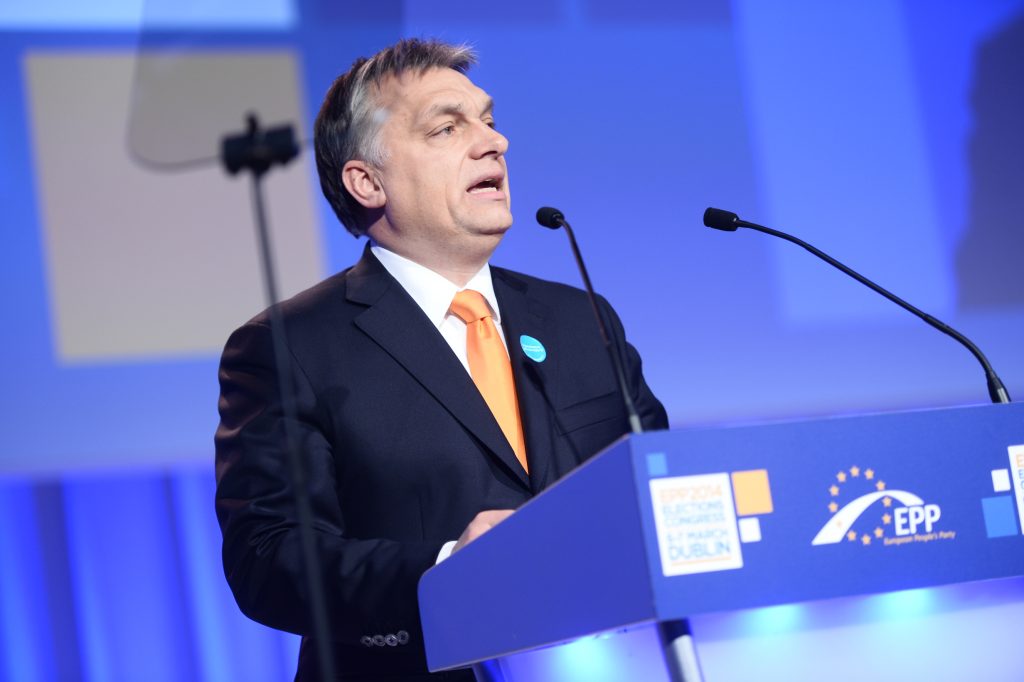
Viktor Orbán Credit: European People’s Party/Flickr
[/vc_column_text][vc_column_text]Hungary’s prime minister Viktor Orbán, leader of right-wing nationalist party Fidesz, has responded to the coronavirus crisis by pushing through sweeping emergency laws that have no time limit and have enormous potential to limit media freedom.
These laws essentially allow Orbán to rule by decree, which presents a huge threat to democracy and freedom of expression. While Index acknowledges that extraordinary measures need to be taken to protect lives, the passing of emergency laws of this nature for an indefinite time period was described in an Index statement as “an abuse of power”.
Under the emergency laws, journalists can be imprisoned for up to five years for publishing what the authorities consider to be falsehoods about the outbreak or measures taken to control it. But what exactly constitutes falsehoods is open to interpretation.
As Index notes, Hungary already has “one of the worst free speech records in Europe”. This further blow to journalists’ ability to report freely and objectively on the actions taken by the government is crippling for press freedom. It follows a pattern of state authorities infringing on press freedom under the guise of quashing “fake news” that Index has recorded happening globally in the wake of the crisis.
Transparency about the official numbers of those infected and those who have died from Covid-19 is critical for public safety. The scale of the outbreak will inform public behaviour and support for health services. Authoritarian regimes around the world such as North Korea and Turkmenistan have reported zero cases, the implausibility of which suggests censorship of the real figures by these countries’ despotic leaders.
Orbán is on the road to joining these leaders as, under the emergency laws, journalists are unable to hold the government to account over the accuracy of the data. Orbán has singular control of the public knowledge of the number of confirmed coronavirus cases, which, according to a government website, is 817 to date. See more here about this on the Index map tracking attacks on media freedom in Hungary.
Hungary’s neighbour Austria, which has a smaller population and recorded its first cases just 8 days before Hungary, has to date recorded 12,206 cases.[/vc_column_text][/vc_column][/vc_row][vc_row][vc_column][vc_basic_grid post_type=”post” max_items=”3″ grid_id=”vc_gid:1586344862424-03642fb1-d46b-2″ taxonomies=”4157″][/vc_column][/vc_row]
16 Jan 2020 | News
[vc_row][vc_column][vc_single_image image=”111830″ img_size=”full” add_caption=”yes”][vc_column_text]“When I talk about what’s happening in Saudi Arabia, I liken it to a really abusive relationship. First they [the state] gaslight you, they try to convince you that you’re not being abused, that this actually is for your own protection, for your best interests. Then when that doesn’t work out, then they beat you up and… when you escape from them they hunt you down and kill you,” said Safa Al Ahmad, award-winning Saudi Arabian journalist, at the launch of the winter 2019 issue of Index on Censorship magazine.
The issue is on the techniques that macho leaders around the world are using to stifle dissent, democracy and discussion, and how people are fighting back. From Brazilian President Jair Bolsonaro ranting against and disparaging media to Hungary’s Prime Minister Viktor Orbán using a rhetoric of family values to deny the LGBT community and others the same rights as “traditional” nuclear families, the magazine takes a global view.
Al Ahmad was joined for a panel discussion, held at Google HQ in London, with bestselling Chinese novelist Xiaolu Guo, Hungarian activist Dóra Papp and satirist and author Rob Sears. The panel was chaired by Rachael Jolley, editor-in-chief of Index on Censorship magazine.
Each panellist was invited to discuss a world leader. Al Ahmad opened with her striking analogy of abusive relationships to discuss Crown Prince of Saudi Arabia Mohammed bin Salman. She highlighted that her analogy was not an exaggeration, citing women’s rights campaigners who have ended up dead or in prison. “I think the feminist movement in Saudi must have been the most frightening for the state,” she said, explaining the lengths the state has gone to in order to silence women.
Al Ahmad also remarked on the absolutist relationship the Saudi state has with the media: “We [Saudi Arabia] have inventing the rulebook on shutting down dissent of any sort, so the state owns all the media. There is no independent media whatsoever to shut buyout – they already own it.”
Papp observed that Orbán has not locked up or killed dissenters “yet”, but that he is at the stage of attempting to create a sense of discord amongst Hungarians, thereby preventing unified protest. She said: “What this kind of leadership from Orbán is really pro in is… making the nation believe that they have to stay divided in order to protect their own identities and their own values.”
Family values is part of the rhetoric of Orbán’s government, which “concludes in a list of disadvantages for LGBT groups, for single mothers, for anyone who is thinking outside the box”. Papp, a successful campaigner, said that we need to be really cautious and not let this narrative divide people.
Guo, discussing China’s president Xi Jinping, spoke about the importance of a dominating personality in a “strongman” leader in order to control the narrative of a country. She said of Xi: “He has an extremely tough way of dealing with internal turmoil but also a very interesting and mysterious way of dealing with international conflict.” She also commented that tension between Xi and US President Donald Trump seems to be bringing about a cold war that “we thought had disappeared 20 years ago”.
A discussion about macho men would not be complete without a dissection of the presidency of Trump, which Sears did by observing how Trump stifles free expression, not by killing journalists, but by setting the media agenda. Sears highlighted two of Trump’s oratory traits: “One is that he is basically impossible to ignore and the other is that he is basically impossible to engage with.”
He explains that Trump’s repeated use of outrageous, implausible (think “build the wall” and “lock her up”) but clear images forces the media to report on them. He said: “You [journalists] can’t help but respond to them and make them the focus of attention, meaning that it’s tricky for other topics to make it into the highest levels of conversation.”
“I’m sure every politician finds the right language for that purpose. UK Prime Minister Boris Johnson cleary does and some of the other leaders we’ve talked about do as well… I don’t know if they are deliberate methods… but I do think that it’s been extremely effective against a decent, fruitful public debate in the states and worldwide.”
Click here to read more about the current magazine
Listen to Rachael Jolley and deputy editor of the magazine, Jemimah Steinfeld, discuss the current issue on Resonance radio here [/vc_column_text][/vc_column][/vc_row][vc_row][vc_column][/vc_column][/vc_row]
