20 Mar 2014 | Awards, Egypt, News
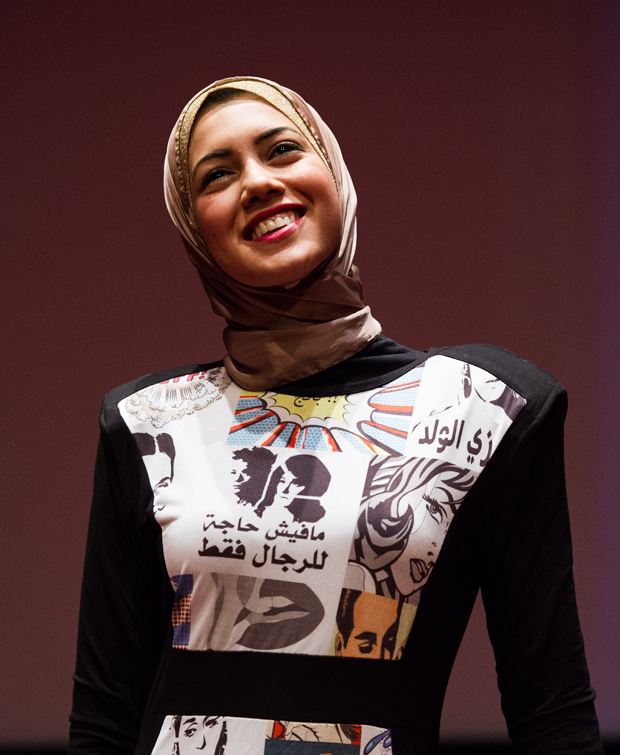
Mayam Mahmoud, award winning Egyptian Hip-hop Artist (Photo: Alex Brenner for Index on Censorship)
Rapper Mayam Mahmoud uses hip-hop to address issues such as sexual harassment and to stand up for women’s rights in Egypt. The 18-year-old rose to prominence through her appearances on the popular TV show Arabs Got Talent. Aged 12, she was introduced to poetry by her mother. She began writing her own work, which soon turned into rap — still a male dominated music genre across the world.
From her song:
Girls in our society are divided
Into those who wear the niqab, those who wear the veil
And those who are in between
There are a lot of cases that depend on the girl
How she dresses
And how she looks
But this is not the rule
How can you judge me
By my hair or by my veil?
If one day you look at me
I am not going to be the one
Hiding her/my embarrassment
You cat call and you harass
Thinking this is right not wrong
Even if these are words
This is not the kind of treatment
These are stones
It is not her clothing that is inappropriate or wrong
It’s this way of thinking which is
Sometimes the clothing is too much
But you are the one to blame
One look can be could hurt
And it is not right of you to be staring
You deserve to be slapped twice on the face
Femininity in Egypt is divided into two parts
There is a difference between what men and women consider
And both are wrong
Who said that femininity is about dresses
Femininity is about intelligence and intellect
It is also about the way she was raised
And her religiosity
Girls have lost confidence in themselves
Now she puts in makeup
And dresses in different colours on top of each other
The problem is not with the girl
The problem is with the society that influences the girl every second
If you ask girls if they have good taste in dressing
They will say yes we have
But our lives can not be described
Our lives have become very materialistic
And everyone wants something that would endure
You get what you pay for
The expensive things are better than the cheap.
— Mayam Mahmoud
Read more about Mayam Mahmoud
This article was originally posted on 20 March 2014 at indexoncensorship.org
20 Mar 2014 | Awards, News
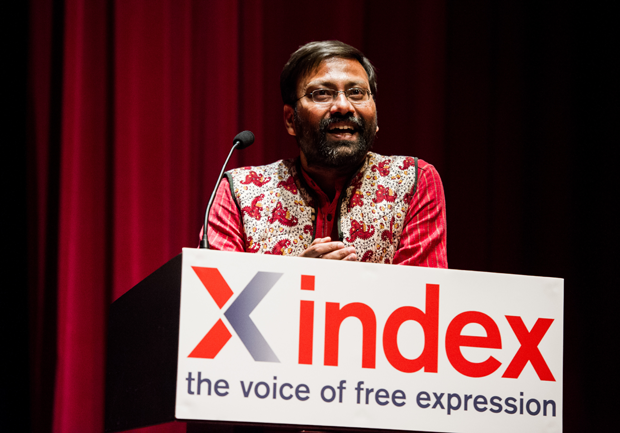
Shubhranshu Choudhary accepting his award (Photo: Alex Brenner for Index on Censorship)
Journalist Shubhranshu Choudhary is the brain behind CGNet Swara (Voice of Chhattisgarh) a mobile-phone (no smartphone required) service that allows citizens to upload and listen to local reports in their local language.
Shubhranshu Choudhary acceptance remarks:
Over the last few centuries our politics, world over has got democratized, more or less.
But if you look at mass communication, media or Journalism it still remains aristocratic, top down and more power in the hands of few.
We understand that our political democracy can not mature, function well unless we have a democratic, equitable communication.
But is that possible?
That is the experiment we are trying to do in India.
I grew up in Central India amidst hills and forest with Indigeneous people, whom we also call Adivasis, the tribals.
Central India is in the middle of a bloody war between Maoist guerrillas and Indian security forces. Tribals are led by the Maoists.
My tribal classmates once told me “our smaller problems can be solved if we have a democratic communication platform where each has equal right to speak and being heard.
To create a democratic, more equitable media we are using mobile phone in this experiment. Mobile phones have reached deep interiors even in countries like India.
Everyone has a voice and can speak in their own mother tongue.They feel more comfortable speaking rather then writing as many do not know how to read and write. And even if they know they feel more comfortable as they are an oral community.
Though mobile is owned by many but it is a personal communication tool. We use internet to convert mobile phone into a mass communication tool.
Today the same people who had no voice before are picking up their mobile and are telling their stories in their own languages. The messages, songs get recorded in our computer using an Interactive Voice recorder system and people can hear the same messages on their mobiles once they are cross-checked moderarted by some volunteers.
The same messages are also available online for Urban activists to follow with officials if they are about any problem. We are seeing many problems getting solved by making this simple connectivity.
An accumulation of these unsolved simple problems create bigger problems like the one we are facing in Central India today, which our Prime Minister once called India’s biggest internal security threat.
If problems are not being heard, not being solved, they create the “future terrorists”
But to complete this experiment we need your help.
We need help to connect this experiment to Short wave radio to create a duplicatable and sustainable independent communication model which people can own.
India, though, is world’s biggest democracy, we do not allow Radio. We will need help from outside like yours who can give us space in Radio transmitters.
But it will be a different type of radio, new radio. In this democratic radio programs will not be created in studios or newsrooms but they will be created in far off forests and villages where people through their mobile phone will report. Some of us in the middle on computer/internet will work on improving/editing them.
We Journalists will also be elected by the community and not selected by the powerful few.
This way we will create news which is by the people, of the people and for the people.
If we want a better democracy, a peaceful tomorrow we can not leave Journalism in the hands of few any more. Time has come like politics, Journalism also needs to become everybody’s business.
And it is possible.
— Shubhranshu Choudhary, CGNet Swara
More about Shubhranshu Choudhary
This article was originally posted on 20 March 2014 at indexoncensorship.org
20 Mar 2014 | Awards, Azerbaijan News, News
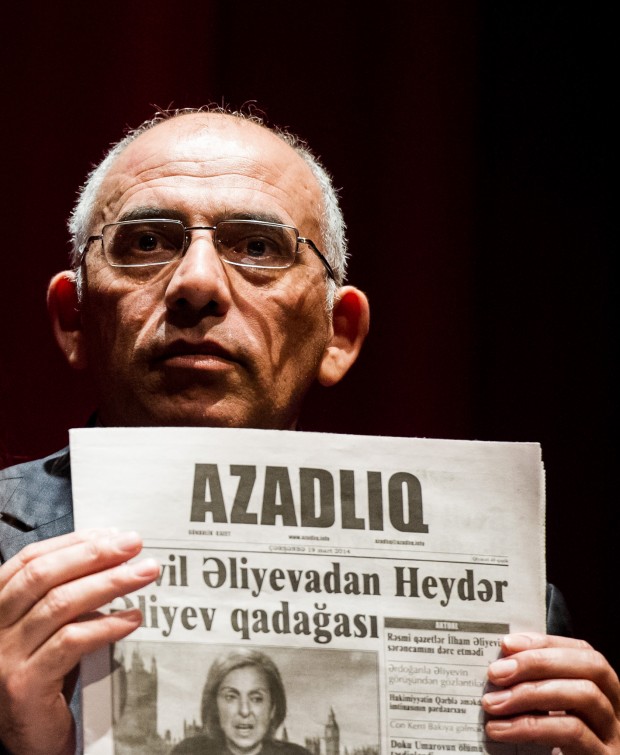
Rahim Haciyev, deputy editor-in-chief of Azerbaijani newspaper Azadliq (Photo: Alex Brenner for Index on Censorship)
One of the few remaining independent media outlets in Azerbaijan, the newspaper Azadliq has continued to report on government corruption and cronyism in spite of an increasing financial squeeze enforced by the authorities.
Accepting the award on behalf of Azadliq is the paper’s Editor-in-Chief Rahim Haciyev.
Azadliq newspaper was set up in 1989 by Azerbaijan Popular Front Party, the main opposition organization (in the mid of 90s APFP stopped funding Azadliq and it became an independent newspaper). The first editor-in-chief of the newspaper was a famous journalist Najaf Najafov. Azadliq newspaper has always been a paper admired by free and freedom-loving people. A key motto of the paper was ‘serving the truth’. This was a main reason of constant pressure and attacks on the newspaper. In 2006, the newspaper was evicted from the office located in the city centre. It had been relocated into three small rooms at “so-called” state-financed publishing house.
Harsh repressions have been started against the newspaper staff. Later on, a chief editor and the staff member of the newspaper, poet-satirist were imprisoned with fabricated charges after court decision. The kidnapping and beating of a newspaper staff followed by similar incident when an Azadliq journalist was returning back from fulfilling his job duties and was beaten in the evening. Two journalists were stabbed for their critical articles. Last year, a court had fined the newspaper 65,000 euros. The newspaper website which had 9 million visitor IPs in 2013, was a target to severe attacks. Circulation of the newspaper is only 8000 copies.
Nevertheless, our newspaper has an enormous impact on public opinion. Even by your (Western) standards, this small circulation makes the government dis-comfortable who is doing everything to shut down the paper. It reminds us a quote from Shakespeare’s Hamlet: “To be or not to be?” With this dilemma the newspapers is moving towards its 25th jubilee. Despite all the repressions, unbelievable difficulties and problems, the newspaper team is determined to continue this sacred job – serving the truth. Because this is meaning of what we do and the meaning of our lives!
Thank you for your attention and support. In addition, I would like to thank the international democratic community and the democratic community of our country who support the newspaper and let me express our special thanks to our loyal readers.
— Rahim Haciyev, Editor-in-Chief, Azadliq
This article was originally posted on 20 March 2014 at indexoncensorship.org
20 Mar 2014 | Awards, News
#IndexAwards2014: The Doughty Street Advocacy Award winner Shahzad Ahmad from Index on Censorship on Vimeo.
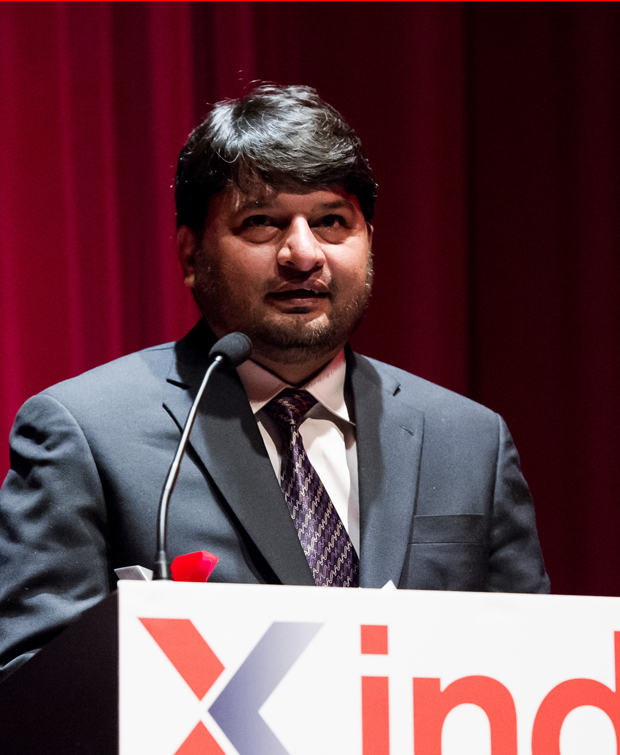
Shahzad Ahmad accepting his award (Photo: Alex Brenner for Index on Censorship)
Shahzad Ahmad is one of the leading voices in the fight against online censorship in Pakistan. The country faces a deteriorating state of cyber freedom, as the government uses draconian censorship laws and increasing surveillance to police the internet.
Ahmad’s acceptance speech:
Thank you. I feel deeply honoured to be here today among the torchbearers of the freedom fighters. And I am truly humbled by this award. For there are so many who have struggled for our freedoms, for my freedom, crossing frontiers that I yet dream to cross.…they set the stage and I feel tiny next to their gigantic stature, their brave struggles and their monumental achievements. I stand here today, and speak as I speak, because of them.
And then there are all those who, like me, continue to struggle today. These are the unsung heroes of the human rights movement. And I would like to accept this honour, this award, on behalf of them, on behalf of each and every human rights defender who is putting his or her life and liberty at stake in trying to obtain the human rights we should all enjoy in this world.
We’re here today to celebrate our common struggle for the freedom of expression. Let me say, that to me this is the ultimate freedom: to me it means the freedom to live, to think, to love, to be loved, to be secure, to be happy. To be able to think as I do, and to be able to express what I think is inextricably linked with all my other freedoms. Hence my firm belief that Freedom of Expression forms the fountainhead from which flow all other freedoms. It is indeed the First Among Equals.
My personal struggle in Pakistan has been to bring this movement to the digital spaces – to contextualize our local predicament in light of the NSA and GCHQ revelations, for example. Censorship, surveillance, curbs on expression, and invasions of privacy in the digital spaces is rampant in my country now. The onslaught is led by government – but unfortunately extreme right leaning, and powerful lobbies are the other force that we have to contend with. These groups are violent, lawless, and often resort to vigilante action to try and silence us – while the states looks on. Either too fearful to intervene, or silently complicit.
Hence our struggle remains one both layered and complicated: on the one hand we resist the government’s infringements, and, ironically, on the other, we depend on the same government to protect our rights to life, liberty, security and freedom of expression against the very same vigilante action that continues unchecked throughout the country… We see it as our role to educate, and raise people’s awareness of their digital rights. We have to continue to provide the knowledge and language that can empower everyone to participate in this dialogue, in our country and globally, as technology evolves.
I want to thank many partners and networks who have helped and supported Bytes for All in carrying the torch in a such a hard and complex country. In particular, I would like to thank the Association for Progressive Communications (APC), Privacy International, Citizen Lab, Sigrid Rausing Trust, Forum-Asia, IDRC, Media Legal Defence Initiative, Global Partners-Digital, Frontline Defenders and Tactical Tech. Without you, we would not be where we are today.
Roosevelt said, “The only sure bulwark of continuing liberty is a government strong enough to protect the interests of the people, and a people strong enough and well enough informed to maintain its sovereign control over the government.” My inspiration and my goal remain embodied in these words.
Awards, like those presented by Index tonight, often say as much about the organisation who gives them as those who receive them. Index on Censorship plays a very important role in the UK in promoting and defending freedom of expression and as a result they are respected, considered a force to be reckoned with and serve as an example for many around the world. Giving the award to me tonight for our work in digital freedom says the same things about our work. It will inspire confidence in us to continue on this important path and illustrate to our government and fellow citizens that the future is here and that the world is watching. It also acknowledges the expertise, insight, commitment and capacity of those in Pakistan who will stand for nothing less than freedom and knowing this empowers us on the way forward.
Thank you for this important acknowledgement of our good work…it will serve as a great motivation and a sign of support for us all.
— Shahzad Ahmad, Bytes for All
This article was originally posted on 20 March 2014 at indexoncensorship.org
