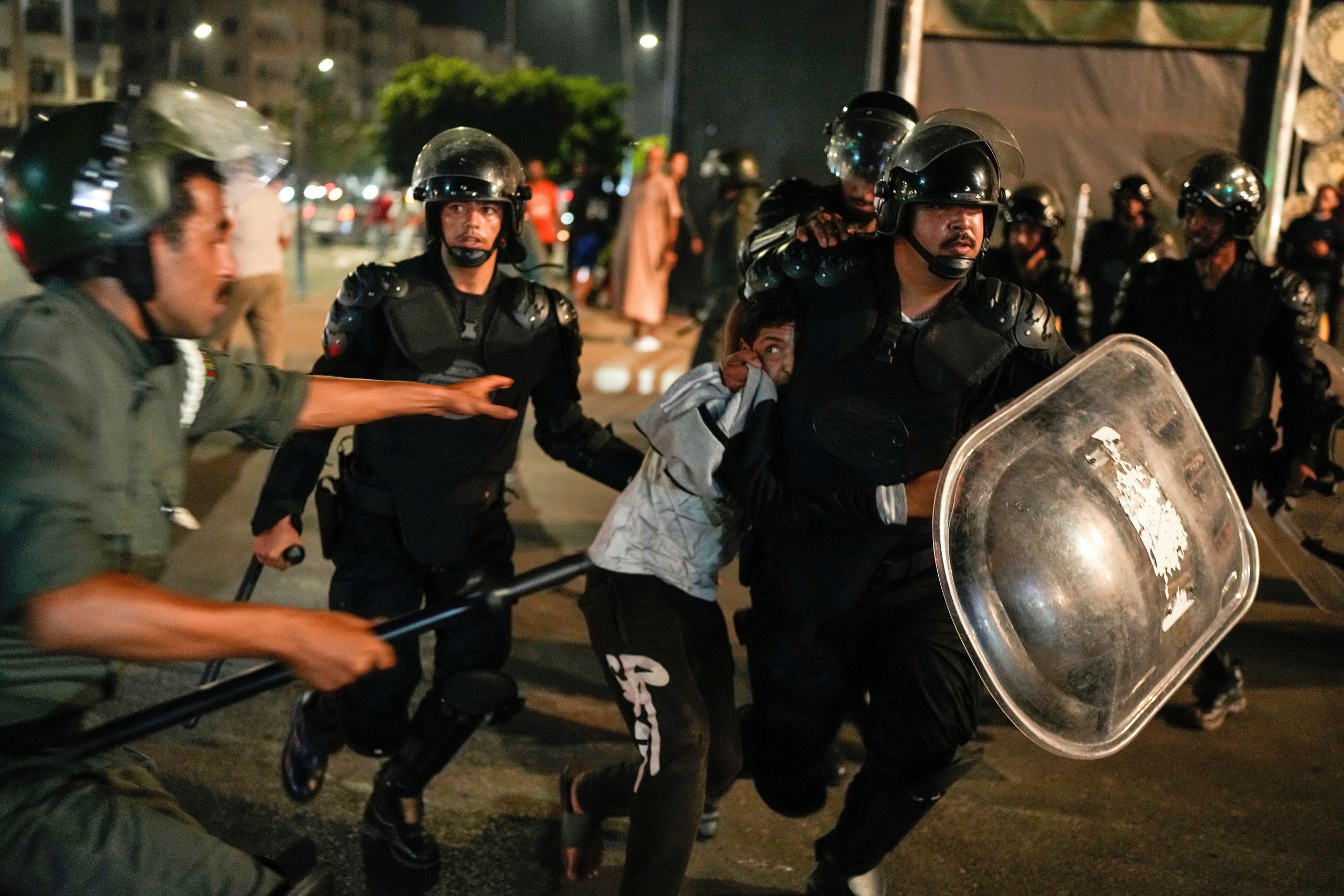
As the Africa Cup of Nations kicks off on Sunday and tens of thousands of football fans descend on Morocco, we should remember the thousands of Gen Z protesters who were arrested and beaten when they took to the streets following the death of eight women in a maternity hospital in Agadir. They are now being prosecuted and some – including minors under 12 – have already been sentenced to hundreds of years in prison. It was partly football that sparked the anger. Young people saw beautiful stadiums being built, but hospitals so crumbling they couldn’t even keep mothers safe. Read the full story by Omar Radi, whose piece appears in the Winter 2025 issue of Index on Censorship, Gen Z is revolting: Why the world’s youth will not be silenced, published on 18 December 2025.
Saturday, 27 September. At Casablanca’s Arab League Park, riot police and plainclothes agents gather in uneasy groups. Their presence is heavy and full of expectation, a show of state power preparing for a confrontation it doesn’t fully understand. By late afternoon the reason for the confusion is clear. For the first time, the authorities are facing a youth protest movement without leaders, without clear origins, formed not in political party offices or student unions, but on Discord – a platform that feels almost like science fiction to old-style security forces. The youth are anonymous, impossible to track, and everywhere.
At first, they were gamers and football supporters – voices echoing through Discord chat rooms, more familiar with memes than with political public life. Politics had been something happening elsewhere. But then there was a shift. The country’s quiet crisis found its way into their feeds. The trigger? Eight women admitted into a maternity ward at a public hospital in Agadir, in southern Morocco. None came out alive – a shortage of staff, a lack of resources, and a system too broken to respond until it was too late.
Football’s soft power
Following Morocco’s unexpected fourth-place finish at the 2022 FIFA World Cup in Qatar, football has become the cornerstone of the country’s soft power strategy. The momentum carried into 2023, when Morocco was awarded co-hosting rights for the 2030 World Cup alongside Spain and Portugal – a diplomatic victory dressed in sport. Since then, public policy has tilted toward a single, obsessive goal: turning parts of the country’s major cities into acceptable playgrounds for the global guests who will descend upon Morocco for one month in 2030. Billions of dollars are being poured into infrastructure, stadiums and urban makeovers.
The contradiction, however, is hard to ignore. In a country where hospitals resemble warzones and schools are crumbling, the dazzling promise of football has become, for many, a bitter spectacle. Morocco is a nation in love with the game – few would deny that. But among its citizens, the joy of hosting the World Cup is tinged with disillusion. The tragic deaths of eight women during childbirth was a tipping point. For the country’s youth, the women’s fate was no longer just about bad governance. It was personal.
“We don’t want to do politics,” one young activist who uses Discord, told Index. “We’re not asking for a new constitution or a regime change. We just want our hospitals to be as good as our football stadiums.”
At 6.00pm, as the protest was set to begin, the government issued a blanket ban on all public gatherings across Morocco. In Casablanca, police blocked access to public squares, surrounded potential meeting points, and deployed familiar intimidation tactics – threats, beatings, arrests. Undeterred, young protesters splintered into smaller groups, reappearing in alleyways and side streets, improvising a kind of urban guerrilla choreography. The same scene played out across the country: cat-and-mouse chases, baton charges, and standoffs stretching late into the night.
One thing became immediately clear to Morocco’s notoriously powerful political police. This was a new kind of activism – more agile, more defiant, and far more determined than anything they had seen before.
Minors charged over protests
Figures released on 29 October by Morocco’s judicial authorities surpassed even the bleakest estimates shared by rights groups such as the Moroccan Association for Human Rights (AMDH). Of the 2,480 people swept up during the protests, 1,473 were still behind bars awaiting trial. The others, while free, have been ordered to appear before judges in due course.
The charges are familiar, hallmarks of the state’s playbook against public dissent: armed rebellion, incitement to commit felonies, participation in armed gatherings.
Hundreds of detainees are being pushed into the criminal justice system by way of more severe accusations: violent assembly, insulting law-enforcement officers, possession of offensive weapons.
The first rounds of sentencing, swift and unyielding, have already handed down hundreds of years of prison time to several dozen people, including a significant number of minors under the age of 12, with sentences ranging from 5 to 15 years.
In Lqliâa, a town on the outskirts of Agadir in Morocco’s south, security forces killed three protesters with live ammunition before moving in to arrest others. The authorities insist that the shootings were acts of self-defence. Yet no independent inquiry has been launched, and public opinion remains divided after videos contradicting the official narrative began to circulate on Discord.
What the state is offering
When King Mohammed VI finally addressed the nation on 10 October in a speech read to members of Morocco’s parliament, the country braced itself for some acknowledgment of the turmoil that had shaken Morocco in the preceding weeks. But the King made no mention of the unrest and did not offer even an oblique response to the demands surging through the streets.
The disappointment was palpable. Yet, the movement itself did not harden its stance. Its demands remain well short of any direct criticism of the monarchy. Still, the speech was widely felt as a deliberate slight – an act of indifference toward a generation that has insisted, from the outset, on peaceful protest and loyalty to the Crown.
“The King ghosted us. I feel humiliated,” said an organiser of the GenZ212 Discord server, which has played a key role in the demonstrations and now boasts 200,000 members.
Two weeks later, the King presided over a cabinet meeting that approved increased budgets for healthcare and education, as well as a new fund to support young candidates in upcoming elections.
There was money being offered by one hand, in the other an invitation into institutional politics. But for many, the gesture was not received as good news.
“It’s hard to believe these promises,” a young protester declared during a public meeting in Rabat. “There are no details, no assurances that any of this will be implemented effectively.”
His scepticism, he added, is only strengthened by the way the police and courts have treated protesters.
“Shouldn’t they start by releasing all the detainees?” he asked.
Gen Z: a new source of protest
The demonstrations continue. Persistent, if modest in scale, they rarely attract more than a few dozen people per city. To the movement’s initial demands for better healthcare and education, new calls have been added within GenZ212’s discourse: the release of detainees, the dismissal of all charges, and the end of the hogra – a Moroccan term for the violence and arrogance wielded by authority against the powerless.
For observers, journalists and scholars alike, a paradox sits at the centre of any analysis of this movement. On one hand, it is the smallest in numbers and the most restrained in its demands when compared with earlier, more overtly political movements, like the 20 February 2011 protests of the Arab Spring. On the other hand, the repression has been astonishingly severe – disproportionate both in terms of the movement’s size and its relatively “diplomatic” aspirations.
There is also the question of the mark the GenZ212 will leave behind. For the first time, a protest movement in Morocco did not emerge from the political left, political Islam, or labour unions. Instead, it was born out of activity on online chat groups – out of a kind of virtual street. It was immediately echoed, even if only verbally, by social categories traditionally aligned with the regime: artists, influencers, sports champions.
Raid, a Casablanca-based rapper, became an early casualty of this shift. Arrested, released, then rearrested and placed in police custody before being charged with inciting illegal demonstrations, he has become one of the most emblematic figures of the movement, alongside others who lent their voices to the cause. Songs, art performances, widely followed podcasts: all rallied behind the movement, at least in its early days.
Here is a generation that declared itself apolitical from the outset – yet through just a few missteps by those in power was pushed headlong into politics. A generation now shouting to the world: “No, there is no freedom in Morocco – and we are the proof”.
On the streets, the popular dialect, laced with profanity, usually banished from state media, schools and family spaces, has forced its way into political life. As one protester yelled: “Free freedom, you sons of bitches!”