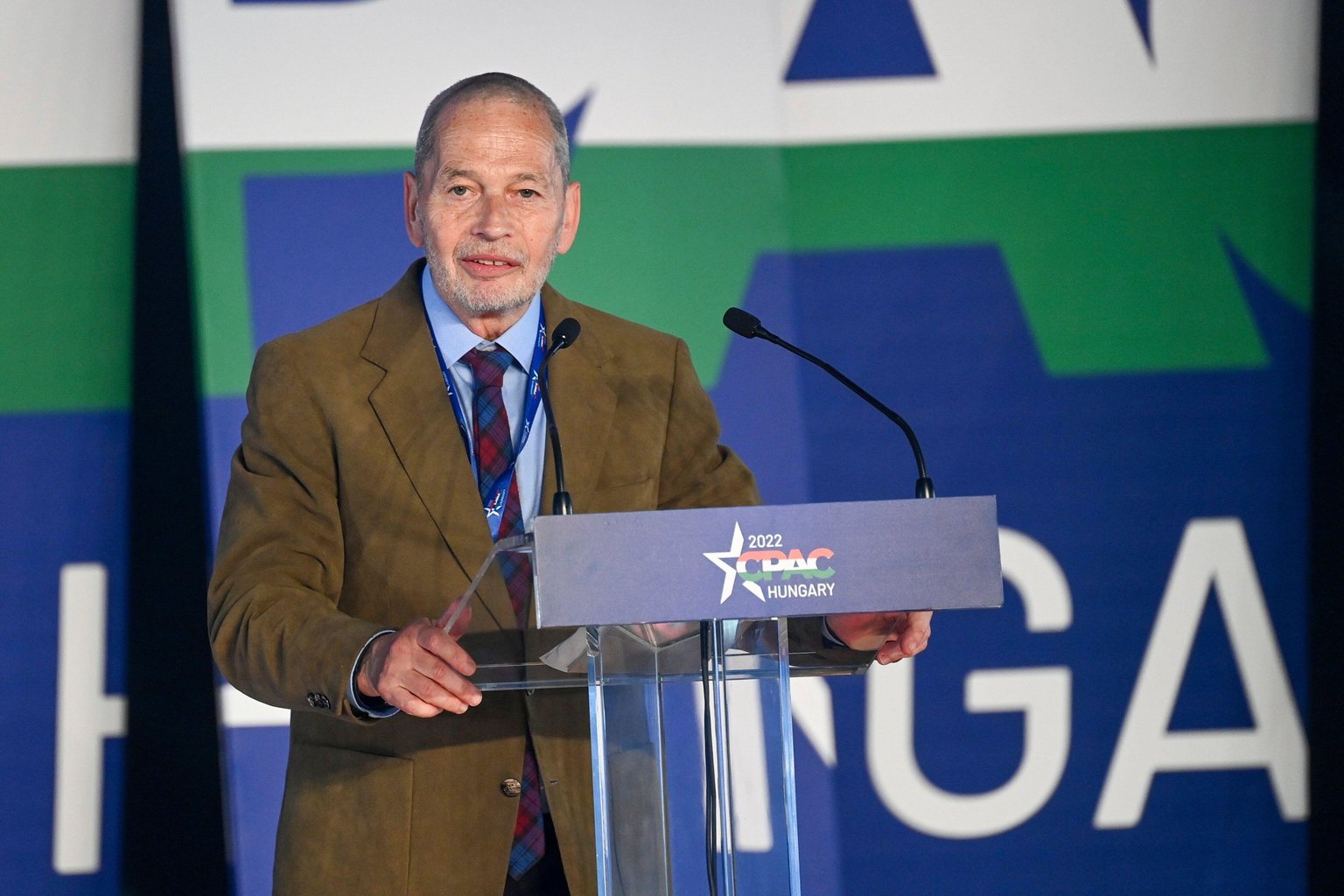
The conference, the Battle for the Soul of Europe, opens in the Belgian capital on Wednesday (3 December). Below is an interview with Frank Furedi, director of the Mathias Corvinus Collegium (MCC) in Brussels, which has organised the event.
Furedi, one time professor of sociology at the University of Kent (and still an emeritus professor), has lined up a list of mostly conservative and right-wing figures to speak. A central theme of the conference is free speech, including one panel entitled Against the language police: Why we must reclaim speech.
Speakers include British journalist Melanie Phillips and political scientist Matt Goodwin; US author Patrick Deneen and right-wing figures in Europe including Giorgia Meloni ally, Francesco Giubilei, and the French right-wing feminist Alice Cordier.
The MCC is a Hungarian think-tank and educational institute based in Budapest (with a Brussels outpost run by Furedi). Its board chairman is Balázs Orbán, who is also the political director for Hungary’s Prime Minister, Viktor Orbán (no relative).
We talked to Furedi about free speech, his relationship with the leader of Europe’s biggest “illiberal democracy”, Viktor Orbán, and being funded by MOL, Hungary’s largest oil company through which Hungary imports its oil from Russia with an EU exemption.
Index: How would you define your politics?
Furedi: I cannot put a clear label on it. I think in many ways, political labels at the moment are fairly confusing, given the shift that has occurred. I would say that when it comes to certain issues to do with history, tradition, families, I would call myself fairly on the conservative side. When it comes to individual matters to do with free speech, tolerance, autonomy, I would see myself as fairly liberal, classical liberal. But when it comes to issues to do with economics welfare, I would say that I’m fairly sympathetic to redistributionist approaches, or what I would call classical left-wing approaches in terms of provision of health and education.
So it’s three, where it’s kind of mixed together. And, yes, that’s how I would describe myself. But if anybody asked me, you know, where are you? I would never use a label just because it wouldn’t capture it. The sort of labels that comes closest to us is what they used to call, in the old days, democratic republicans, sort of republican, not in the party-political sense, but republican in the way that it was classically understood. We’re basically seen … and are probably, on the right spectrum. I suppose the main reason why I came here, I set the whole thing up, was to act as a counterpoint to the dominant political culture. We see ourselves as being like Gramsci in reverse, where we’re challenging the cultural norms that are promoted by the European Commission, and that are fairly hegemonic in most of Western Europe.
Index: I think that’s quite intriguing, because in a sense, you’re using the language of the kind of classical left-wing tradition against the European liberal tradition. Would that be a fair?
Furedi: Yes, which is why I’m very sympathetic. We have some people that work with us that I would call old-school left, as opposed to identity-politics left, who I’m fairly sympathetic to, in terms of my own origins and my own instincts. So, yes, that’s the way I would say it.
Index: You have this quite dramatic-sounding conference… looking at some of the invitees, you might describe them as pretty classically right-wing. The term that is sometimes used is National Conservative (NatCon). What do you feel about that term?
Furedi: Yes, I can see why people would characterise some of the speakers as NatCon… I cannot really help that… We had a meeting the other week… and we had a person like that, and then we had a left-wing speaker from Germany, so I do try to mix it all up. At the moment, it’s quite difficult to get people from different traditions who are roughly interested in the kind of themes that I want to pursue. So that’s why you get the balance that you do. And so, yes, I think I would say that probably the majority of the people there, not all of them, would be conservative… They are, amongst themselves, fairly heterogeneous.
Index: Where do your loyalties lie? Are they to Hungary? Are they to the opposition to the Brussels elite? Are you hostile to Britain? Where do you put yourselves? It’s quite hard to work out.
Furedi: Yes. it is hard to work out, but that’s because you’re lucky, because you grew up in a place where you were born. You probably see yourself as having a very clear identity rooted in a particular cultural milieu. I was born in Hungary, I grew up in North America, I lived almost all my adult life in Britain, and now I’m here involved in creating a kind of a cultural political opposition to the [European] Commission. My loyalty is… I don’t know. I mean, I love Britain… All my close friends and my family are, I suppose, English or they live in Britain. I’ve got a very strong kind of affection, even though I don’t feel British, I don’t feel English. So, the way that I explain, if England is playing Hungary in a football match, I would probably support Hungary because of the underdog status. If England plays against any other team in the world, I would support England in a football match,
Index: A sort of football version of the cricket test.
Furedi: Exactly. And that’s not because I’m disloyal or whatever. It’s just, I always think of English as being my intellectual language and Hungarian, my emotional language. I don’t know if that makes any sense. When I get angry, I swear in Hungarian when I think it’s in English. I don’t feel any affinity to what’s happening here in Brussels, or I have no commitment to any abstract Europeanism, except for the fact that I would like to see a stronger, more cohesive, all-European intellectual alternative to the dominant paradigm.
Index: Clearly there are concerns about Viktor Orbán and Orbán’s government. You have been a vocal champion of free speech and free expression. This would seem somewhat contradictory to some of the things that Orbán’s been doing in terms of attacks on free media.
Furedi: I don’t have a selective approach towards free speech, that it’s good in some places, not good in others. I do think the attacks on Orbán’s government and Hungary over the free media are misconceived… You have a situation where there are TV channels in Hungary that are anti-government and have a very large viewership [Editor’s note: the RSF describes Viktor Orbán as a predator of press freedom with 80% of the media controlled through Orbán’s Fidesz party and their supporters]. You have a situation where the opposition has got a far greater presence on the social media, in social media platforms, than the government has. You go to Budapest, and you go to newspaper shops, you’ll find that there are plenty of newspapers, not one, two or three, but a lot of newspapers hostile and critical to government, so I don’t see it the way it’s represented. I don’t think is unusual… You look at Germany and the way that free speech is being encroached upon fairly systematically, the kind of laws that they have there. You look at France, you look at even Britain, just the way in which people get done for their social media posts. So unfortunately, I don’t think there’s any government, there’s any European country that I can think of that comes out as white knights in relation to the whole area of free speech. I don’t think Hungary is any worse than many of the other countries, but it gets criticised as unique in that respect, a kind of a double standard, which I think misses the point about what’s going on there.
Index: I don’t speak Hungarian. But you know, in the reports that I read Orbán himself does describe himself in semi-authoritarian terms.
Furedi: Illiberal democracy.
Index: Now, obviously part of that is teasing liberals, right? But again, please help me understand what you understand by that, because it sounds quite sinister to me.
Furedi: Well, if you actually look at the speech where he used the term “illiberal democracy”, what he is really saying is that he, he sees democracy as being logically prior to liberalism. As you know, there’s always a big debate between freedom and democracy in all kinds of different environments… He basically argues that his illiberal thing is part of his critique of what he sees liberalism as being. But he doesn’t mean that that freedoms are taken away, or freedoms are encroached in a way that you might imagine. It’s his attempt to be provocative, very successfully, as it happens, in relation to the kind of prevailing consensus. Hungary, and Orbán, is invariably accused of democratic backsliding time and again – I just don’t see that. If there was democratic backsliding, then the opposition wouldn’t win the election in Budapest last time we had local elections…
Index: You are largely funded by the Hungarian government?
Furedi: We are funded by two companies, the oil company, MOL, and Gedeon Richter, the pharmaceutical company. Now you could argue that MCC Hungary has got a close association with the government and it empathises with the government’s politics. Our particular organisation is entirely autonomous. That was the condition on which I took the job or set it up… We decide what issues are important and what issues are not important… Obviously, on many issues, we are very sympathetic to what they’re doing. But we don’t just simply, like in the Soviet Union or in any kind of dictatorial system, tick the boxes. We’re not asked to tick the boxes, but even if we were, [we] wouldn’t tick the boxes unless we agree with it.
Index: So why is it in the interest of the oil company and the pharmaceutical company to back you?
Furedi: Well, that’s an interesting question. I think that these companies, like anywhere else, when you have funders, either for philanthropic or for political reasons, do it for our idea. I think it’s their way of demonstrating their social connection or responsibility. I’ve never met anybody from either one of these two companies, so I don’t really know. But I would imagine it’s because they think that what MCC is doing is really important, because we do a lot of educational work. Part of our job is to, is to raise the intellectual game that Hungary plays. And I think that what we also do through hopefully the interesting and inspirational work that we do, we give Hungary a good name, even though we’re not a Hungarian thinktank. Because most people that work for MCC Brussels are not Hungarian. They come from Europe. But that’s probably the reason why. But you’d have to ask them. I’ve never actually met any of them.
Index: That would seem strange to me, but that’s, I don’t know whether you made a conscious decision not to meet them. But if I were in your position, I would want to meet them and find out what their motivations were.
Furedi: Why? The point is that you’re assuming that he who pays the piper… that we’re somehow kind of internally corrupt, and if somebody sort of gives us money, then we just simply sing from their song sheet. But that’s never happened. If it did, I think not only me, but almost all the key people here would leave, because the whole buzz about doing what we’re doing is we got this real capacity to be independent, and we’re not accountable. We don’t have to play somebody else’s game.
Index: There have been suggestions of a Russian connection. What do you say to the allegations that you are Russian funded?
Furedi: It’s not true. But also, if anybody cared to read a book I wrote a few years ago on the Ukraine War, which has been published by a legitimate Western publisher, I’m totally critical of Russia, and I support Ukraine’s struggle for national independence 120 percent. I stood up at the time against pro-Russian speakers, and I debated them. So I think it’s a weird fantasy to suggest that there is anything to do with a Russian connection. Plus, given my family’s background in ‘56, we are not exactly going to the defense of Russia, given our historical connections.
The interview was conducted by our editor at large Martin Bright
Battle for the Soul of Europe is taking place on 3 and 4 December. Click here for more information