The final month of 2025 brought many Belarusians a rare feeling of joy and hope when 123 Belarusian political prisoners were released from jail under the terms of agreements reached between the USA and the president, Alyaksandr Lukashenka. The USA’s special envoy for Belarus, John Cole, also announced that further releases could be expected in the future. It is impossible to overstate the significance of this event for those who were allowed to go free and for their families. No one who has seen a political prison from the inside or even at close quarters could ever take a casual attitude to such news.
But the inherent logic of releases like this merits a separate discussion. The releases do not take place as a result of judicial review or acknowledgement of the injustice of prisoners’ sentences, and they do not represent the beginning of systemic change. For Lukashenka, the freedom of his country’s finest people – journalists, activists and human rights advocates – is a bargaining chip for getting sanctions against Belarusian companies lifted.
This is a long-established mechanism, involving dozens of consultants, employees of the administration and members of the security services. There are behind-the-scenes agreements and constant work on lists, in which some people’s names are crossed out and others rise higher in the queue to freedom.
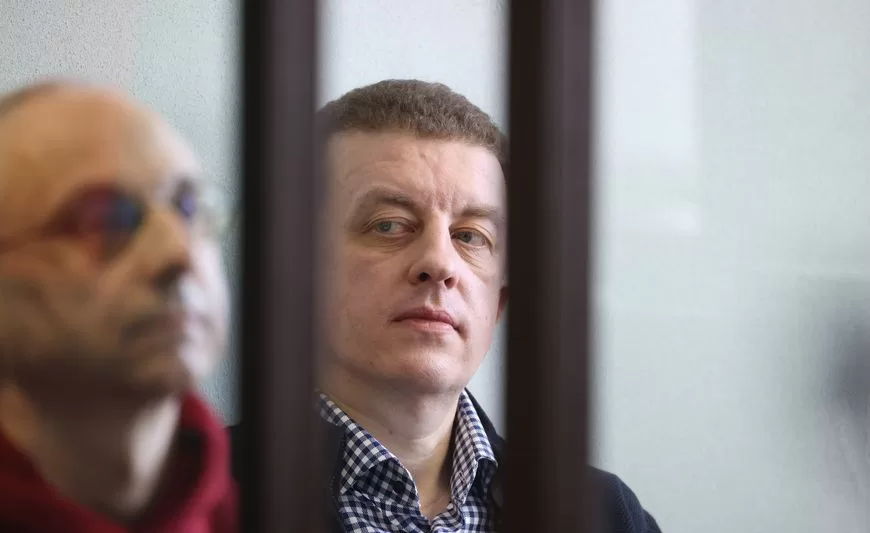
Today is the birthday of Belarusian journalist Andrei Aliaksandraŭ. This is the fifth year he has celebrated his birthday in prison. Today he turns 48.
In 2020, following yet another falsified presidential election, hundreds of thousands of people throughout Belarus came out into the streets to peacefully demand honest elections. Lukashenka ordered the protest to be crushed. As the whole world watched, the attempted revolution ended with people being arrested en masse, savagely beaten, tortured and even killed.
Belarus is one of the top five countries with the greatest number of arrested journalists, ahead of Russia. Andrei was one of those who ensured the protesters were heard, helped arrested people access legal assistance, find lawyers, pay their fines and legal costs. Three years ago, he was sentenced to 14 years in prison on a charge of high treason.
Andrei is remembered in the UK. Not long before his arrest he was awarded a prestigious international grant and spent a year in London, working with organisations active in the areas of human rights and freedom of speech, including Index on Censorship and Article 19. He shared his experience of what pressure on the media looks like from the inside and its consequences for society.
His former colleagues have fond memories of him. “Keen to learn and receptive”, “a huge Liverpool fan”, “he really loved Belarus”, “great fun!” The news of his arrest came as a terrible shock to them, since Belarus, the country where he was arrested, is the last one in Europe that still applies the death penalty. Including for high treason.
Charging journalists under the criminal code’s article on high treason ceased to be an exception long ago. It has become one instrument among others which is used regularly to apply pressure on media workers. The article defines the grounds for charges hazily, allowing the authorities wide scope for interpretation, it allows trials to be held behind closed doors and cruel punishments to be applied, up to and including life imprisonment. And it simultaneously serves a stigmatising function by depriving an individual of moral legitimacy in the eyes of one sector of society. In this way, the accused or convicted individual is categorised as a “traitor” or a “spy”. An old, familiar, Soviet move.
For me this story also has a personal dimension. In my childhood I spent every summer at my grandmother’s apartment in the small, provincial Belarusian town of Novopolotsk, in the Vitebsk region. In that place, I was a very happy child. I remember the squeaking swings in the yard, grazed knees, ice cream, my friends, my bicycle, taking the asters which grew in the garden back to town from our dacha. For me, that place became a synonym for carefree happiness.
Many years later, I would receive my own political sentence in Russia. Eight years, for a song against the war in Ukraine. In that same year, I would hear Andrei’s story. And learn that he was serving his sentence in Novopolotsk. I would read that human rights advocates referred to his correctional colony as a concentration camp surrounded by oil processing plants. That, in addition to performing slave labour, the political prisoners are constantly confined in punitive isolation cells, that the inmates of this colony are beaten and tortured. That they are forbidden to wear glasses or use a walking-stick, that if an inmate suffers a broken bone or other serious injury, even as a result of torture, the chances of medical assistance are minimal. The wound is bandaged up and the inmate is sent back to the barracks, or an isolation cell, so that no one can see his condition. That men there commit suicide and die from neglected illnesses.
Andrei Aliaksandraŭ is in that colony at this very moment. I open Google Maps. From my grandmother’s old apartment to Correctional Colony No. 1 it is 13 minutes by car.
In that place Andrei wrote this poem, which his colleagues at Index helped to translate from Belarusian to English
When you look out through the bars at the sky,
It’s not bars you see but the sky overhead.
Yesterday’s bread smells of mould and loss,
but tomorrow’s smells like genuine bread.
You say: the sky is a trick of the light.
But the bars are the trick of the light, I say!
Because bars are a hashtag, just a habit, right?
And this is the hashtag trending today.
Yet the sky cares nothing for hashtags at all,
the sky has no thought for trends up ahead,
it does not feel the ground where our feet fall,
nor count the centuries and slices of bread.
The sky just draws clouds of cotton wool
over time – this is all that goes on really.
And the sky does not see any bars at all
when it peers deep into the sky in me.
The question that inevitably arises against the backdrop of the recent releases is: Why is Andrei Aliaksandraŭ still in jail?
Generally speaking, in such cases the answer does not lie in the details of specific negotiations, but in the logic of the authoritarian system. People who create broad connections, help others and strengthen independent professional communities, constitute a long-term threat to the regime. Their release does not yield any immediate political advantage and does not weaken the actual infrastructure of resistance. In this sense, the selective releases are not a step towards freedom, but a means of maintaining control by demonstrating a managed “humane” approach. However, as a humanist, I always greet news of the release of hostages with joy.
Having spoken with people who worked with him for a while in Britain, as I examine his photographs, I see before me a cheerful romantic, an individual who, in a situation of danger to himself, was not afraid to do the right thing, an individual who has paid for this choice with his own freedom and his own health. I am filled with admiration for him and want to do everything I possibly can to hasten his release.
Andrei’s story is only one out of thousands, but it clearly demonstrates that in today’s Belarus, people are not punished for their crimes, but for their profession and their solidarity. By definition, a journalist cannot be a “traitor”.
I believe that Andrei must spend his next birthday at liberty, continuing to pursue his profession, for a journalist’s work consists in shining light into those places where it is easy for evil to hide without it.
Translation by Andrew Bromfield