This piece first appeared in the Winter 2025 issue of Index on Censorship, Gen Z is revolting: Why the world’s youth will not be silenced, published on 18 December 2025.
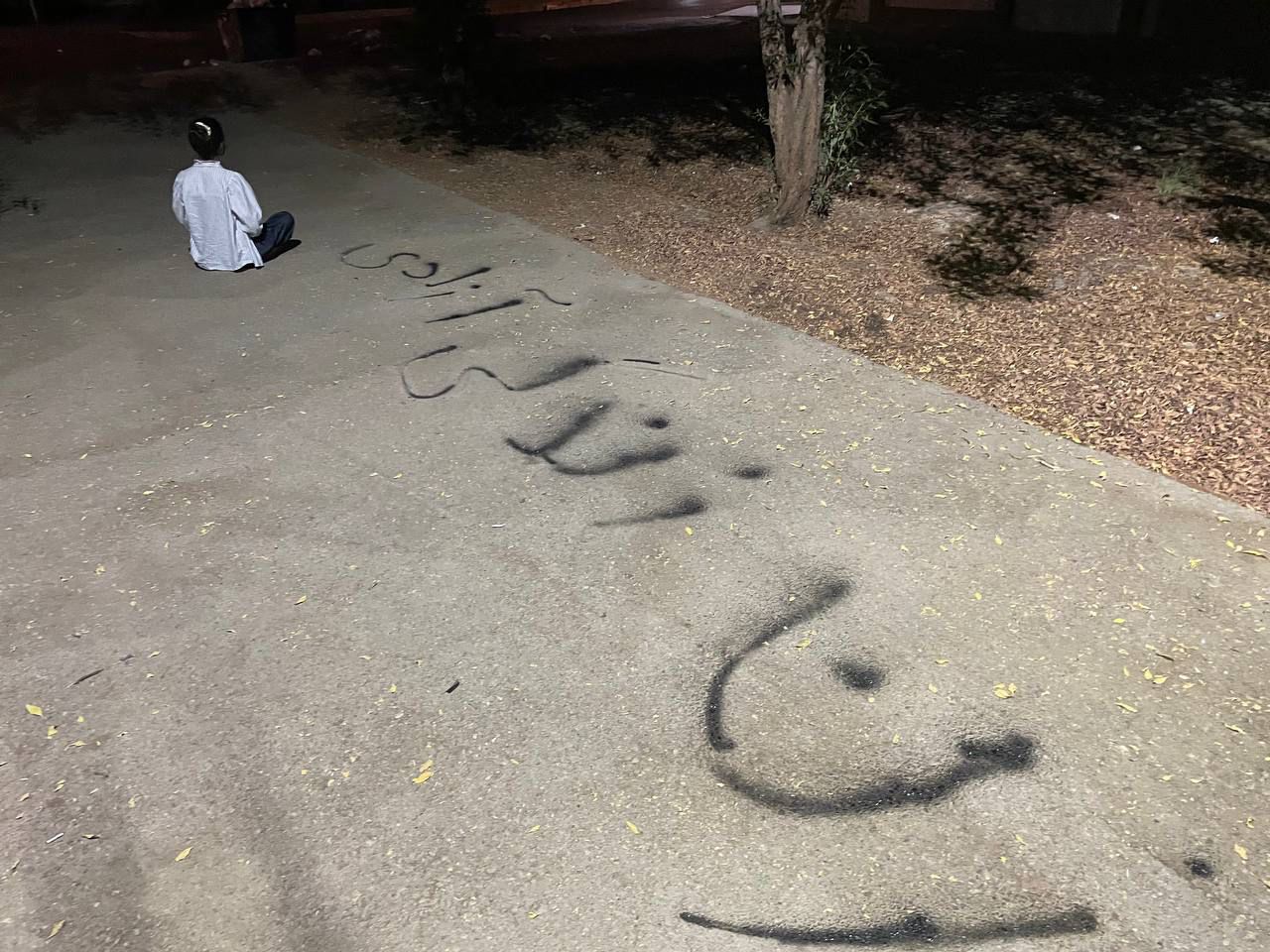
She leaves before dawn, when Tehran is at its quietest. Sara, mother of three and grandmother of two, fingers the metal nozzles in her tote bag to keep the spray cans from rattling. She maps the alleyways in her head, the blind corners and burned-out bulbs, the CCTV arcs and the places where a single shouted word can turn a street into an alarm. Hair uncovered since 2022, she moves quickly toward a wall that has already forgotten yesterday’s words.
“Writing on walls is the only thing in my power,” she told me. Sara is not her real name – it would be impossible for her to safely reveal her identity.
Each night she searches for a patch that isn’t in view of a camera and hasn’t been freshly scrubbed clean. She bends close and writes the phrases she has come to know by muscle memory: “Death to Khamenei. Death to the dictator. Woman, Life, Freedom.” By sunrise, municipal crews will pass with rollers and solvent to strip away the words. By night, she will return.
The Shi’a faith dictates that Ali Khamenei, the Supreme Leader, enacts God’s will on Earth. This mix of religious zeal and power makes Khamenei one of the most brutal modern dictators, and today, protesters in Iran often chant the phrase: “Death to Khamenei” at risk of imprisonment, or worse.
Nazi Abad, in south Tehran, was one of the 2022 uprising’s epicentres: narrow streets, modest courtyards and the then regular scene of teenagers in sneakers facing men in body armour. At some point between a funeral and a scuffle, Sara met a mother whose 16-year-old son, Siavash, had been shot during a protest.
“I am a mother,” Sara said, remembering the scene. “I put myself in her place. My heart burned. How could I stay silent while mothers buried their children?” She bought markers and paint that afternoon.
She feared arrest, but knew this was nothing compared to what happened to some of the young people who took part in anti-establishment protests that started in September 2022. Many people like Sara now sneak out to graffiti across the city.
“I think of Nika, Sarina, Siavash, Abolfazl – children who died at sixteen. At worst, I will go to prison. They gave their lives.”
Sara’s life had been drawn inside firm lines: illiterate parents who raised her to piety; marriage at sixteen; decades caring for a man shaped by trauma; three children, two of them daughters who now have daughters of their own. For years, she enforced those same lines on her family. Then the years turned, the city shifted, a young Kurdish woman named Mahsa (Jina) Amini died in the custody of the morality police in September 2022 following her arrest for not complying with strict hijab rules. It wasn’t long before the words “Woman, Life, Freedom” found their way from banners onto people’s lips.
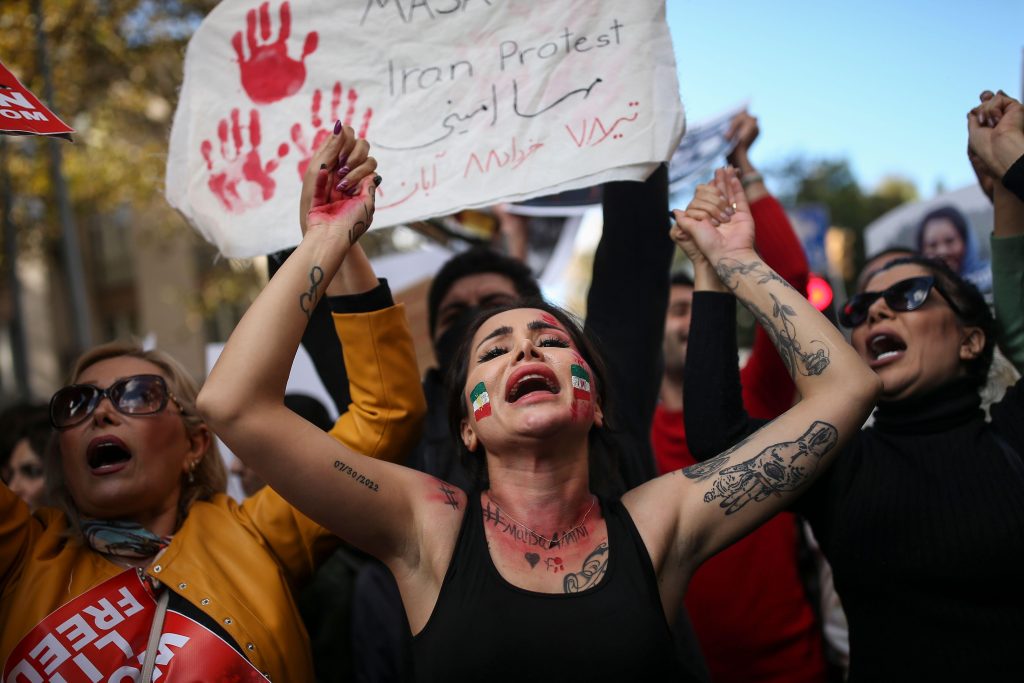
Iranian women protest the death in custody of Mahsa (Jina) Amini outside the Iranian consulate in Istanbul. Photo: AP Photo/Emrah Gurel/Alamy
Sara kept her secret night-life from almost everyone. But Sepideh (not her real name), her eldest daughter, found Sara’s sprays. It was October 2022, and Sepideh was on a visit to see her parents. She wore a denim skirt and white blouse, her wavy, black hair falling to her shoulders, with no hijab. She was in her late thirties and travelled on the metro without a headscarf. Dozens of women were doing the same. When she arrived, her religious mother smiled. Her father said nothing.
In the parking area in her parents’ apartment block, Sepideh noticed spray cans lined up like tools on a workbench. She turned to her teenage cousin: “Mohammad, be careful when you go to write slogans.”
He shook his head. “They’re your mother’s.”
Sepideh quizzed Sara about the accusation.
“It’s none of your business,” Sara said. And then, after a beat, admitted: “Yes. Every night, our neighbour and I write. Whatever they erase in the morning, we rewrite. With thick markers – on buses, on the metro, everywhere. With spray cans – on the walls. I even wrote on the door of the IRGC [Islamic Revolutionary Guard Corps] man on our street.”
“What do you write?” Sepideh asked.
“Whatever you post on your Instagram Stories,” Sara said. “I copy them onto paper, then onto the walls and anywhere I can. Mostly: ‘Death to Khamenei. Death to the dictator. Woman, Life, Freedom.’”
Sara told her daughter that she wanted to make up for the past. “Back then I was afraid. Now I cannot be.”
Days later, Sara visited her daughter in central Tehran. Sepideh told her she had been at the protests, and described how a riot officer had called her a prostitute on Keshavarz Boulevard.
She stopped and told him: “My uncle was martyred in the war, my father wounded, so their daughter could be safe without being insulted.”
The officer stepped forward with a thin apology.
“Don’t apologise,” she said flatly. “You are ordered to verbally and sexually harass us.”
Another day, near Valiasr Square, tear gas burned through the crowd. Sepideh told a solider that he must be able to feel it too. When he denied that they had launched the gas, Sepideh pointed out that the soldiers were armed with batons, shields and guns, and were there to beat the protesters. He moved toward her, and she backed up to the lip of the metro stairs. She stood eye to eye with him. Strangers around her applauded, and swept her to safety via a motorbike.
There were even darker moments, too. A security agent grabbed Sepideh’s hair to drag her into a van.
“When I felt the cold of his hand, I thought it was over,” she told me.
Instead, a pack of young men burst from an alley, ripped his hand away, and whisked her away down the block on another motorbike.
“This wouldn’t have happened before. Men would have stayed silent. Now they understand their freedom is tied to ours,” she said.
Even during the day, Sara looks at the city as a potential canvas, ready for defiant slogans to be painted across surfaces. As the mother and daughter stepped out of a stairwell onto Villa Street together, an area in the heart of Tehran and packed with CCTV cameras, Sara gestured with her chin at a row of freshly whitewashed walls.
“What are you doing?” she asked her daughter, half-teasing. “Why didn’t you write on these? Why are these walls all white?”
Three years after protests erupted in Iran, Sara has not stopped playing her part in this quietly relentless revolution. Inspired by the young, this grandmother is still going out at night with her tote bag of spray cans, consistently continuing to daub the words of the Woman, Life, Freedom protests across Tehran. While the words may be gone by morning, their meaning endures, and women like Sara and Sepideh will not be silenced.
This piece is published in collaboration with Egab, an organisation working with journalists across the Middle East and Africa.