When I met Can Dündar in London, he was in a jovial mood. His book, I met my killer (Ich traf meinen Mörder) had been published in Germany to much acclaim.
When we met, Dündar had just flown in from Berlin to London to present the Index Arts Award to Mohamed Tadjadit, a slam poet imprisoned in Algeria for reciting his poets during the Hirak protests. Dündar is a friend of Index on Censorship and was one of the judges for the 2025 Freedom of Expression Awards.
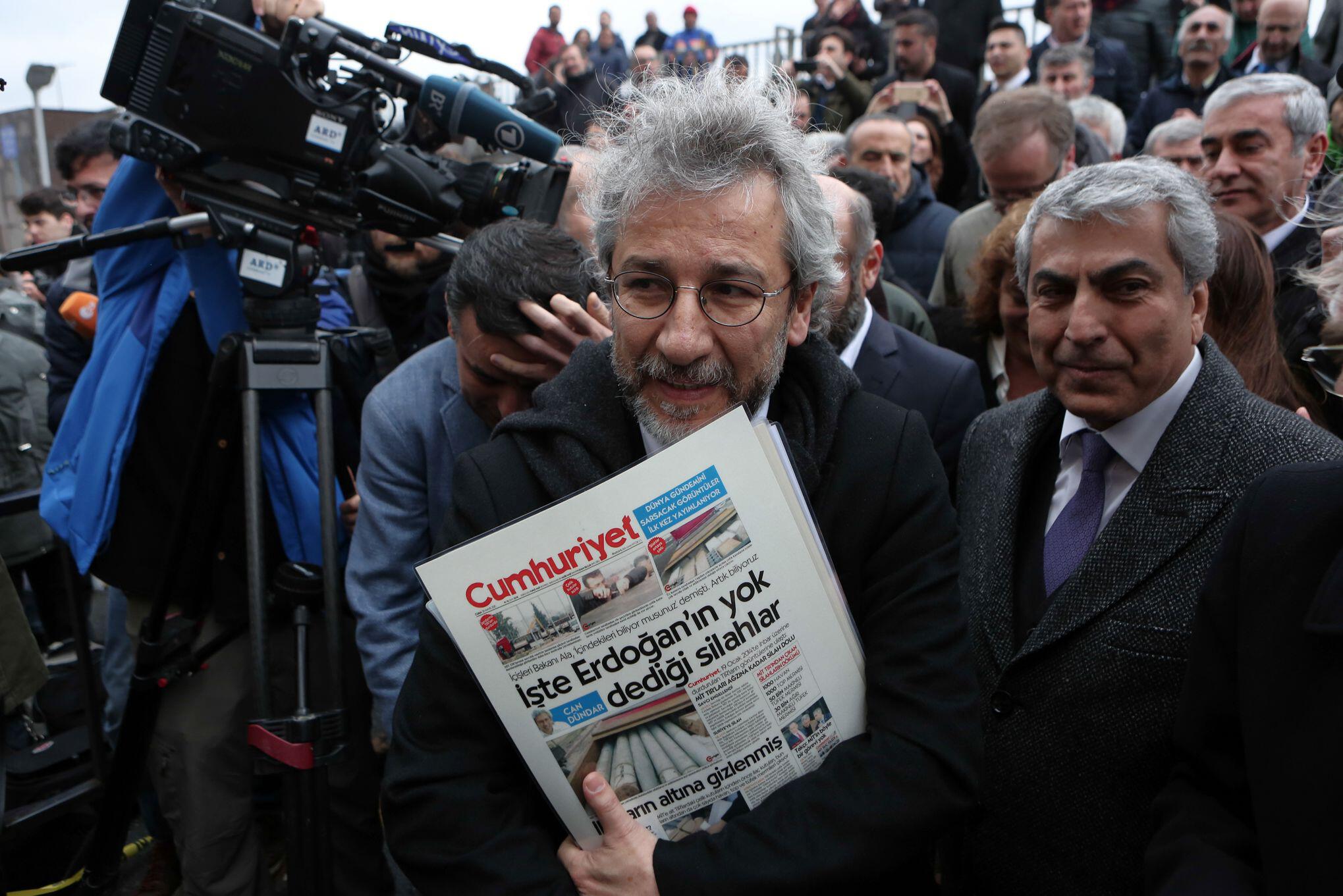
Dündar, a dapper man in his early 60s, is a fearless journalist, once the editor of Turkey’s largest newspaper Cumhuriyet. But he’s now in exile. He was enjoying the anonymity of London when I saw him. Dündar has lived in Berlin since 2016, and he is sometimes attacked in the capital’s street verbally by Turks who want to prove their loyalty to the regime. They film themselves while doing it, so that they can post videos on social media. But as Dündar explains, he would rather be in Germany because he also enjoys huge support and it’s a place he’s given a serious hearing.
People in Germany care about Turkey precisely because of the large Turkish diaspora (the biggest in the world) who first came over in the 1950s as Gastarbeiter. Increasingly Turkish-Germans are in positions of influence in politics, business and the arts.
Dündar’s new book describes in vivid detail the kind of mafia state Turkey has become – it’s more Godfather than Le Carré. In it, Dündar tells the story of how he uncovered the full extent of Erdoğan’s ties with organised crime.
Dündar had to leave Turkey for good after being jailed for his journalism and then attacked in a botched assassination attempt on a square outside the Istanbul Palace of Justice while his case was being heard. He was only saved because of the quick-thinking of his wife Dilek who took hold of the collar of the killer’s shirt when she saw him point a gun at close range towards her husband.
He landed in trouble with Recep Tayyip Erdoğan’s government because he published a story the Turkish authorities would far rather had never come to light – that the Turkish secret services were smuggling arms and rocket launchers, under the guise of humanitarian aid across the border to IS and other extremist groups in Syria during the war there in 2015.
It all began when lorries carrying arms were stopped by local police and prosecutors near the Syrian border. Excited that they had uncovered an illegal gun-running operation, they filmed the search and the arms they found (thousands of mortars and tens of thousands of machine gun rounds). An accompanying secret service man was hauled out of the lorry and handcuffed on the ground. There then ensued a huge battle between Turkey’s various police and secret services forces – and an intervention by the government’s justice minister who knew about the illegal arms delivery and ordered it to continue. The saga is all described in gripping detail in the book.
Dündar’s newspaper was passed the video footage and he ran the story despite knowing he would be prosecuted. Dündar spent three months in jail and later a court sentenced him to 27 years in absentia. But the government decided that a jail term was not enough. They needed to silence him forever and officials asked their links in the underworld to murder him.
It was at the end of 2020 after four and a half years in Germany when Dündar received a letter from a man in jail in Buenos Aires, Argentina. The man wrote: “I was given the contract to kill you. Now I’m prepared to tell you everything I know.” The man’s name was Serkan Kurtulus.
In the end Kurtulus had refused to carry out the hit and it was another man who did it. But Kurtulus was able to tell him who had ordered the job, and the deep connections between the government and Turkish organised crime. Kurtulus had also been on the gun-running trips to Syria. He told Dündar he didn’t want to be deported back to Istanbul and thought that getting his story out would give him some sort of protection. As Dündar writes he was put in the uncomfortable position of being able to potentially save his would-be killer’s life.
I Met My Killer also includes three other interviews Dündar carried out with repentant whistleblowers. One man who ran a gun-running business described how, in the two and a half years up to August 2015 enough weapons were sent over the border to Syria by the Turkish government to arm 100,000 men. His business bought them in Serbia, Croatia and Bulgaria and transported them to IS and others with the support of government officials and the Turkish secret service.
I talk to Dündar later over email when I’ve read the book in German and ask what the reaction in Turkey has been to the revelations about the links between the government and organised crime and just the sheer numbers of weapons that went to jihadists in Syria.
“The aspect of the matter is even more frightening that the scandal itself: there is complete silence. It is as if these things never happened, even discussed. It is impossible for my book to be published in Turkey. Those who write about the subject are punished. Fear grows like a veil over the truth,” Dündar told me.
And in Europe and the EU?
“Nothing so far…. Apart from the astonished looks of readers in the German cities I visited for the readings. I have not seen any reactions yet.”
Dündar is convinced the Americans and Europeans knew what was happening and didn’t do anything about it, either because it wasn’t in their interests or they were powerless to do so.
We talk about journalism. There are far fewer journalists in jail now than there used to be, Dündar says, because the independent press has gone out of business. People like him are in exile and others have simply chosen different jobs. Those that remain are afraid. A colleague lives with a little bag packed by the door, awaiting the day that he will be picked up by the police. I say it reminds me of Julian Barnes novel The Noise of Time about Shostakovich waiting to be arrested by Stalin’s secret agents.
One imprisoned journalist who has fascinated Dündar is Fatih Altaylı. He is no friend though, because Altaylı was once a loyal supporter of the Erdoğan regime, even prepared to change polling number for Erdoğan when he was prime minister to make him look more popular. But Altaylı became disillusioned and compared Erdoğan and his cronies to Ottoman Sultans, reminding them of the fate of Sultans (murdered and plotted against). The regime was not impressed.
“It’s symbolic that someone, even someone who supported Erdoğan once upon a time, could be a target,” Dündar told Index
The police arrested Altaylı, but he continued to report from Istanbul’s Marmara prison where he was being held, because he had access to prominent people who were in the cells with him: judges, lawyers, opposition politicians. His colleagues broadcast his YouTube channel but with an empty chair, where he used to sit, and a narrator reading out his investigations. Unfortunately, now the authorities have silenced him completely and his reports from prison are no longer broadcast.
Dündar is currently working on another documentary with Germany’s international news service Deutsche Welle, about the academic and judicial system in the USA and why it has suddenly been put at risk.
“It’s like the re-release of a film we saw 20 years ago in Turkey… It sounds strange, but I am as a Turkish exile meeting with ‘American exiles’. The country which was a [safe] harbour for exiles until now has suddenly started sending its own exiles. The political epidemic is spreading round he world”.
Finally we talk more about the situation in Turkey itself: the opposition mayor of Istanbul who has been locked up since March and has now been sentenced to more than 2,000 years in prison. Dündar laughs at how ridiculous this. The mayor is in prison because he would be the likely successful challenger to Erdoğan in upcoming presidential elections.
And as for Turkey, has he learnt more about his home country after writing his book? “I knew about the intelligence services collaboration with the mafia, but I saw more clearly that the government had transformed power into a mafia state.”
Dündar is looking for an English publisher of Ich traf meinen Mörder. I hope he finds one. The story is a shocking one, and the English-speaking world should take note.