24 Jun 2014 | News, Politics and Society
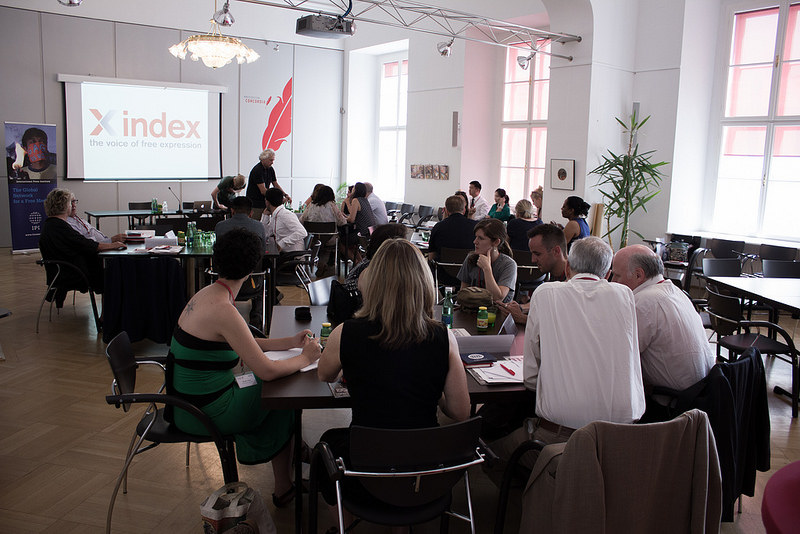
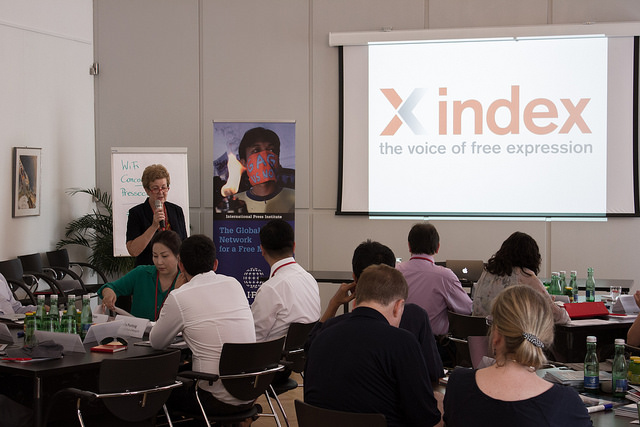
Index speaks at the IAPC meet 2014, Vienna
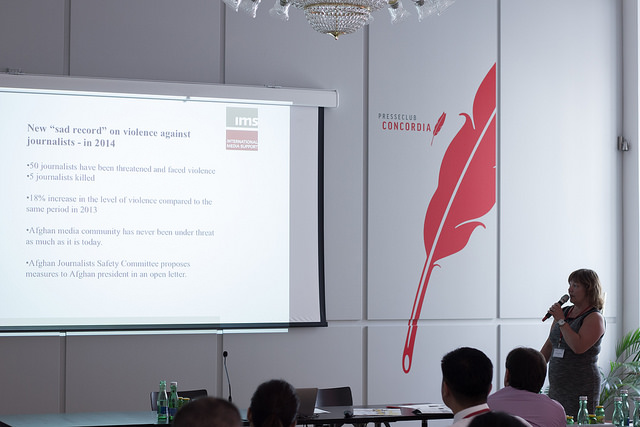
There has been an 18% rise in violence towards journalists compared to the same period last year, International Media Support, an organisation that works in many of the world’s biggest danger zones, told an international journalism conference.
News from Egypt – as three journalists from Al-Jazeera are sentenced to seven years in prison – demonstrates the huge threats that journalists can face. The subject was covered in detail at this year’s International Association of Press Clubs annual conference in Vienna, which Index on Censorship attended this month.
“Some countries we just can’t work in,” said John Barker from Media Legal Defence Initiative, who help represent journalists facing legal charges for reporting and presented on their work. “Every time we work in Vietnam, for example, the lawyers are arrested. In many places, we can’t transfer money to them.” Nonetheless, they are currently working on 102 cases in 39 countries.
Other topics for discussion included:
- The increasing number of freelancers working in danger zones – and with little training
- How to protect fixers, translators and local journalists
- Possible methods for funding legal representation (Crowdfunding worked as a recent experiment in Ethiopia, said MLDI)
The event was hosted by Austria’s PresseClub Concordia – said to be the oldest press club in the world (founded in 1859 – reformed in 1946, after having its assets seized by Nazis). It was attended by press clubs from around the world, including Poland, Belarus, Syria, the Czech Republic, the US, India, Ukraine, Mongolia, Germany, and Switzerland. Other NGOs – alongside Index, International Media Support and Media Legal Defence Initiative – included the International Press Institute and RISC (Reporters Instructed in Saving Colleagues).
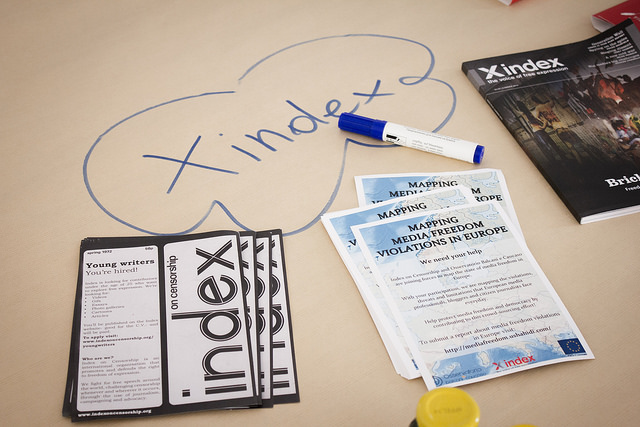
Index was invited to present on the work the organisation is doing around the world, which included sharing the stories of our Freedom of Expression Awards winners and nominees, and news of our current work, including a crowdsourcing project to map media freedom violations across the EU. Plus we also shared stories from our quarterly magazine – including a report on violent threats to journalists in Tanzania and how news stories are getting out of Syria via citizen reports.
Index also hosted round-table discussion on censorship, which provoked an impassioned debate. One of the most interesting topics covered was on contracts that some journalists are being made to sign on what they can and can’t write. We heard of cases in Mongolia and Germany. We also discussed self-censorship and censorship by complying to advertisers’ will. One attendee from the Berlin Press Club said: “There is no censorship in Germany, but journalists feel like they have scissors in their heads. You have to self-censor before you write.” This is an area that we are researching, so please get in touch if you have experiences and examples.
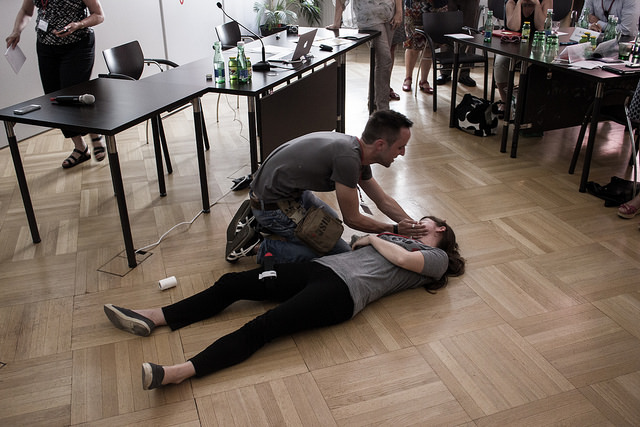
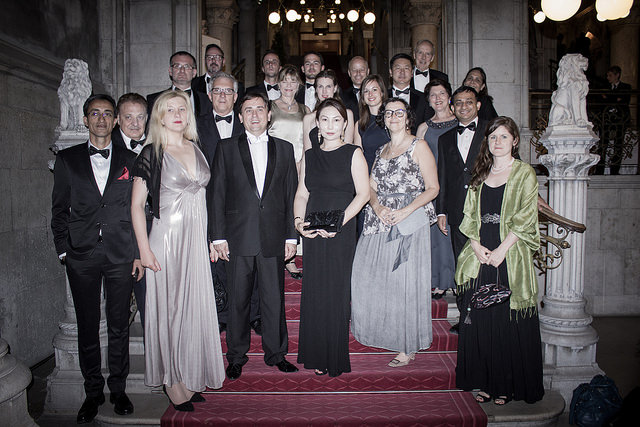
The meeting also visited a new exhibition on censorship during WW1 and ended with the Concordia Press Club’s annual ball, which is a key fundraiser for the club and attended by over 2,000 guests. See photos from the event below.

This article was posted on June 24, 2014 at indexoncensorship.org
3 Jun 2014 | Campaigns, Politics and Society
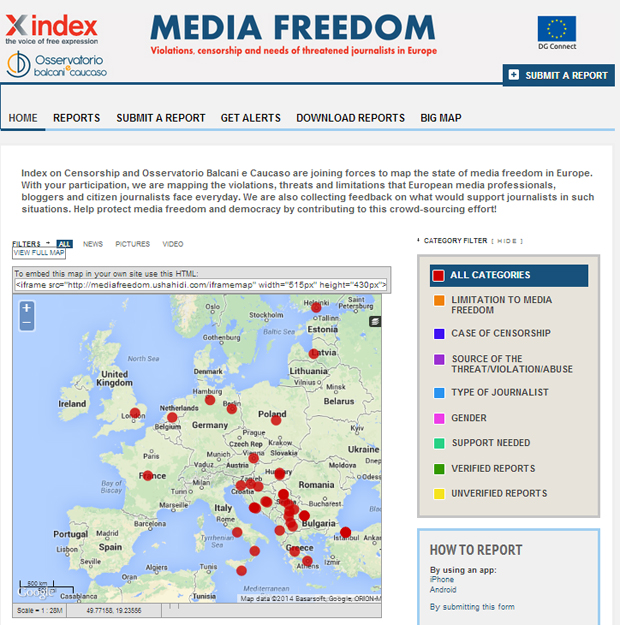
As part of its effort to map media freedom in Europe, Index on Censorship’s regional correspondents are monitoring media across the continent. Here are incidents that they have been following.
AUSTRIA
Police block journalists’ access to protest
Police denied journalists access to the site where members of the right-wing group “Die Identitären” were demonstrating on May 17. News website reports and a video from Vice News show police using excessive force against demonstrators. The Austrian Journalists’ Club described the police’s treatment of journalists as one of the recent “massive assaults of the Austrian security forces on journalists” and called for journalists to report breeches in press freedom to the club. (Austrian Journalists’ Club) (Twitter)
CROATIA
Croatian law threatens journalists
Croatia’s new Criminal Code establishes the offence of “humiliation”, a barrier to freedom of expression that has already claimed its first victim among journalists – Slavica Lukić, of newspaper Jutarnji list. A Croatian journalist is likely to end up in court and be sentenced for “humiliation” for writing that the Dean of the Faculty of Law in Osijek, Croatia’s fourth largest city, is accused by the judiciary of having received a bribe of 2,000 Euros to pass some students during an examination. For the court, it is of little importance that the information is correct – it is enough for the principal to state that he felt humbled by the publication of the news. According to Article 148 of the Criminal Code, introduced early last year, the court may sentence a journalist (or any other person that causes humiliation to others) if the information published is not considered as of public interest.
CYPRUS
Cyprus’ Health ministry Director General accused of 30million scandal whitewash
9.5.2014: The former Director General of the Ministry of Health, Christodoulos Kaisis, is alleged to have censored the responses of two ministerial departments during an audit regarding a 30 million scandal of mispricing of drugs. He did not send the requested information to the Audit Committee of the Parliament. (Politis)
DENMARK
Journalists convicted for violating law protecting personal information
On May 22 2014 two Danish journalists got convicted for violated Danish law protecting personal information because they named twelve pig farms in Denmark as sources of the spread of MRSA, a strain of drug-resistant bacteria. They argue they had been trying to investigate the spread of MRSA, but the government had wanted to keep that information secret. Their defense attorney claims revealing the names was appropriate because ‘there is public interest in openness about a growing health hazard’. The penalty was up to six months imprisonment, but the judge ruled they have to pay 5 day-fines of 500 krone (68 euro). The verdict is a ‘big step back for the freedom of press’ in Denmark, one of the journalists, Nils Mulvad said after the trial.
FINLAND
ECHR rejects journalist’s free speech claim
On April 29 2014, the European Court of Human Rights rejected a free speech claim over a defamation conviction by a Finnish journalist. In August 2006 journalist Tiina Johanna Salumaki and her editor in chief were convicted of defaming a businessman. The newspaper published a front page story, asking whether the victim of a homicide had connections with this businessman, K. U. The court ruled that Salumaki and the newspaper had to pay damages and costs to K. U. According to Salumaki her right to free expression was breached.
GERMANY
Journalist’s phone tapped by state police
A journalist’s telephone conversation with a source was tapped by state criminal police. The journalist, Marie Delhaes, spoke about the police’s subsequent contact with her on the media show ZAPP on German public television. Police asked her to testify as a witness in a criminal case against the source she communicated with, an Islamist accused of inciting others to fight with rebels in Syria. Delhaes was threatened with a fine of 1000 Euros if she were to refuse to testify. She has since claimed reporter’s privilege, protecting her from being forced to testify in a case she worked on as a journalist. (NDR: ZAPP)
Local court rules police confiscation of podcasters’ recording equipment and laptops was illegal
A court ruled on May 22 that police officers’ 2011 confiscation of recording equipment and laptops in a van used by the podcasters Metronaut and Radio Freies Wendland was illegal. The podcasters were covering the transport of atomic waste through Germany and were interviewing anti-atomic energy activists. When the equipment was confiscated, police officers also asked the podcasters to show official press passes, which they did not have. The court ruled that police failed to determine the present danger of the equipment in the van before confiscating it for three days. Metronaut later sued the police. (Metronaut) (Netzpolitik.org)
GREECE
Lost in translation
The Greek newswire service ANA-MPA is accused by its own Berlin correspondent of engaging in pro government propaganda after a translation of the official announcement by the German Chancellor regarding Angela Merkel’s Athens visit is ‘revised’, eliminating all mentions of ‘austerity,’ replacing the word with ‘consolidation’. (The Press Project)
Radio advert from pharmacists banned
A union representing pharmacists in Attica has accused the government of censorship, after it was told it may not broadcast adverts deemed by the authorities to be a political nature in the run up to elections later this month. (Eleftherotypia, English Edition)
ITALY
The regional Italian newspaper “L’ora della Calabria” is shut down due to political pressure
After the complaint, in February, against the pressures to not refer in an article to the son of senator Antonio Gentile, and to the block of the printing presses on the same day (an episode that is under investigation by the judiciary), now the newspaper L’Ora della Calabria is closing. The publications have been halted, even that of the website. This was decided by the liquidator of the news outlet, who had for a long time been in financial difficulties.
Reporter sued for criticizing the commissioner
Marilena Natale criticized a legal consultancy that cost €60’000 in the town whose City Council has dissolved for mafia, and which suffers from thirst due to the closure of the artesian wells. Ms Marilena Natale, reporter for the Gazzetta di Caserta and +N, a local all-news television channel, was sued. She had in the past already been the victim of other complaints and assaults. To denounce the journalist was Ms Silvana Riccio, the Prefectural Commissioner who administers the City of Casal di Principe, fired due to Camorra infiltrations. The Commissioner Riccio feels defamed by a series of articles written by the reporter in which the decision to spend €60’000 for legal advice is criticized, while the citizens suffer thirst due to the closure of numerous wells due to groundwater pollution.
MACEDONIA
A band to defend press freedom
24.4.2014: A music band called “The Reporters” was created recently by famous Macedonian journalists. The project aims to defend press freedom in Macedonia and support their colleagues who are facing censorship and other limitations. (Focus)
Macedonian government member encourages censorship in the press
14.5.2014: The Macedonian government quietly encourages censorship in the press, buys the silence of the media through government advertising and at the same time gives carte blanche to use hate speech, said Ricardo Gutierrez, Secretary General of the European Federation of Journalists during a conference of the Council of Europe in Istanbul on the 14th of May. (Focus)
Macedonian Journalists ‘Working Under Heavy Pressure’
24.3.2014: Sixty-five per cent of Macedonian journalists who responded to a survey publish last March, have experienced censorship and 53 per cent are practicing self-censorship, says the report, entitled the ‘White Book of Professional and Labour Rights of Journalists’. (Balkan Insight)
MALTA
The Nationalist Party complains of censorship by the public broadcaster PBS
The Nationalist Party (PN) has accused PBS of censoring it in its coverage of the European parlament elections campaign. The party noted that PBS did not send a journalist to report on Simon Busuttil’s visit to Attard and Co on Tuesday and it had also failed to sent a reporter to cover a press conference addressed by PN Secretary General Chris Said in Gozo this morning. “This is nothing but censorship during an electoral campaign,” the PN said. The PN has also complained with the national TV station on its choice of captions for news items carried in the bulletin.
NETHERLANDS
Press photographers’ equipment seized
During a raid on a trailer park in Zaltbommel on may 27 2014, the cameras of two press photographers were seized by the police. According to the spokesman of the court of Den Bosch the police took the cameras after several warnings. The photographers were on the public road. After a few days the two photographers got their cameras back, but their memory cards with the photo’s are still not returned. The NVJ, de Dutch journalist Union, has pledged to stand with one of the journalists in his claim to get his photo’s back.
SERBIA
Serbia Floods Interrupt Free Flow of News
Websites criticising the government’s handling of the flood disaster in Serbia have come under attack from hackers in what some call a covert act of censorship. Creators of the Serbian blog Druga Strana, which published critical posts on the Serbian state’s handling of the flooding, were forced to shut it down on Tuesday after repeat attacks on the site. “The site has been under heavy attack so we decided to shut it down in order not to compromise other sites on the server,” Nenad Milosavljevic said.
Serbian Newspaper Editor Fired After Criticising Govt
The sacking of Srdjan Skoro, editor of state-owned newspaper Vecernje Novosti, who publicly criticized Serbia’s new ministers, has been described as an attack on independent media. Skoro said that he was told that he was no longer the editor of the Serbian tabloid Vecernje Novosti on Friday morning, but was given no explanation for his sacking. “I have been told to find another job and that I would perhaps do better there,” Skoro said. He said that although no one has said it directly, the reason for his dismissal was his recent appearance on public service broadcaster RTS’s morning TV show, in which he openly criticised some candidates for posts in the new Serbian cabinet.
SERBIA
Media in Serbia: the government’s double standard
Aleksandar Vučić’s government seems to be adopting a double standard when it comes to media: one for the EU, one for Serbia, with tight control over newspapers and television stations. I do not believe in chance, and I know “where all this is coming from and who is behind it”. Thus Aleksandar Vučić, Prime Minister of Serbia, commented the statement by Michael Davenport, head of the EU Delegation, about “unpleasant and unacceptable” issues in Serbian media. Davenport said that elements of investigations conducted by the judiciary are leaked to the public through some media, and that the “cases” of parallels being made between representatives of civil society and crime are “a clear violation of the ethical standards of the media”.
SLOVENIA
If you can’t stand the heat, don’t turn up the oven: Strasbourg Court expands tolerance for criticism of xenophobia to criticism of homophobia
On the 17th of April 2014, the European Court of Human Rights issued a judgement in the case of Mladina v. Slovenia. In this case, the Court further develops its standing case law on “public statements susceptible to criticism”. When assessing defamation cases, the Court has in the past found that authors of such statements should show greater resilience when offensive statements are in turn addressed to them.
SPAIN
The government threats to censor social media
“We have to combat cybercrime and promote cybersecurity, and to clean up undesirable social media.” These were the words of the Spanish Minister of Interior, Jorge Fenández Díaz, after the wave of comments published on social media about the assassination of Isabel Carrasco, president of the Province of León and member of the government party (Pp). Although the majority expressed their condolences to the family of the victim, there were some that took advantage of the moment to openly criticize the politician, including mocking her assassination. These tweets generated a strong reaction of rejection in certain circles. For their part, Tweeters have reacted by creating two hashtags, #TuiteaParaEvitarElTalego (Tweet to stay out of Jail) y #LaCárcelDeTwitter [Twitter Prison], through which many Internet-users vent their frustration against politicians who want to silence them. On the other hand the Federal Union of Police has published a note that proposes a change in legislation with the alleged intent of protecting minors, relatives of victims, and users in general.
Extremadura public television don’t broadcast the motion of censure on the regional president Monago
Extremadura public television did not broadcast the debate and subsequent vote of no confidence on the regional president and member of the government party Antonio Monago on May 14th, despite the political relevance of the issue (the debate was broadcasted only trough the TV’s website). The workers called a protest to consider a motion of censure “is a matter of highest public interest and should be covered by public broadcast media in all its channels”, as expressed by the council in a statement.
TURKEY
Founder of satirical website sentenced for discussion thread considered insulting to Islam
The founder of the satirical online forum Ekşi Sözlük was given a suspended sentence of ten months in prison. Forty authors for the user-generated website were detained in connection to a complaint that a thread in an Ekşi Sözlük forum was insulting to Islam. Founder Sedat Kapanoğlu and another defendant received suspended prison sentences for insulting religious values. (Hürriyet Daily News)
Journalists recently released from prison speak out against government using release for political capital
Journalists who had been imprisoned for two years in connection to the KCK case were released this month. Several of the released journalists gave a press conference on May 13 condemning the government’s manipulation of the case to improve its own human rights and press freedom standing internationally. Yüksek Genç, a journalist who spoke at the press conference, said that the amount of journalists in prison can not be the only measure of Turkey’s press freedom, since the government has other ways of meddling in media and putting economic pressure on news organisations. A number of journalists have been released from prison this year after a court regulation was changed, enforcing a shorter maximum detention time for prisoners awaiting trial on terrorism charges. (Bianet)
Police detain and injure journalists at May 1 protests
During May Day protests in Istanbul, police blocked journalists’ access to demonstrating crowds and demanded they show official press passes to enter the area around Taksim Square. At least 12 journalists were injured by police officers using rubber bullets, teargas and bodily force. Deniz Zerin, an editor of the news website t24, was detained trying to enter his office and held for three days. (Bianet)
Prominent journalist sentenced to ten months in prison for tweet insulting Prime Minister Erdoğan
On April 28, the journalist Önder Aytaç was sentenced to ten months in prison for a 2012 tweet that the court ruled to be insulting to Turkish Prime Minister Erdoğan under blasphemy laws. The tweet included a word that translates to “my chief” or “my master” (relating to Erdoğan), but included an additional letter at the end that made the word vulgar. Erdoğan sued Aytaç, who maintained that the extra letter in his tweet was a typo. (Medium)
For more reports or to make your own, please visit mediafreedom.ushahidi.com.
With contributions from Index on Censorship regional correspondents Giuseppe Grosso, Catherine Stupp, Ilcho Cvetanoski, Christina Vasilaki, Mitra Nazar
This article was posted on June 3, 2014 at indexoncensorship.org
22 May 2014 | Czech Republic
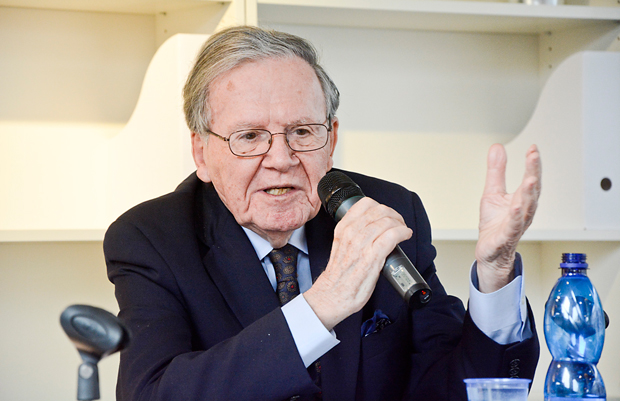
Peter Demetz (Photo: Prague Book Fair)
Emeritus Yale University professor and author Peter Demetz was awarded the Jiri (George) Theiner prize at the Prague Literary Festival this year.
George’s son Pavel, the prize organiser, said Demetz received the award because “all his life he has remained intellectually honest in his demystification of views which sometimes became popular such as the notion of magical Prague, rather stressing the reality of Czech history, as well as his life-long commitment to Czech literature in American and German environments and as translator of Frantisek Halas´ and Jiri Orten´s poetry”.
Theiner set up the prize in memory of his father’s work, as a former editor of Index on Censorship magazine he brought attention to Czech writing and writers during the communist era. He said: “Almost five years ago I discussed with the director of World of Books (Prague Book Fair), Dana Kalinova, the possibility of making this prize an important permanent fixture at the annual book fair. Looking back I realised that George Theiner´s reputation here was as solid as it was in other countries, despite the fact that he left in 1968.
The jury this year was chaired by Lenka Jungmannova (professor at the Institute of Czech Literature, Academy of Sciences), Martin Putna (literary historian, professor at Prague´s Charles University and critic), Jiri Gruntorad (guardian of the largest samizdat collection in central and eastern Europe, dissident persecuted in the 1970´s and 1980´s) and Ivan Biel (documentary film-maker and lecturer in Film Studies). Next year’s jury was also announced and will include Karel Schwarzenberg (a former Czech foreign minister, one of Havel´s closest aides and supporter of dissidents before 1989 whilst living in Austria), Michal Priban (academic at the Institute of Czech Literature, Academy of Sciences), Vladimír Pistorius (samizdat publisher who successfully made the transition into becoming a ´straight´ book publisher) and Jan Bednar (radio journalist and commentator, signatory of Charter 77, between 1985 and 1992 and who worked for the BBC in London).
Theiner said that they received between 35 and 60 nominations each year from all over the world. The criteria stated that the recipient (or organisation) had made a major long-term contribution to the promotion of Czech literature overseas, with an expectation that they have also made a contribution to freedom of speech and human rights in general. Other prize winners include Andrzej Jagodzinski, translator of Havel, Hrabal, Kundera, journalist as well as a leading member of the democratic opposition on Poland); Ruth Bondy (an Israeli of Czech origin, survivor of Auschwitz and Bergen-Belsen who worked as a journalist on the Hebrew daily Davar; and Paul Wilson (a Canadian who lived in Czechoslovakia as a young man before being thrown out in 1977 for collaborating with dissidents and, above all, the band Plastic Pepople of the Universe, translator of Skvorecky, Klima, Havel, Hrabal, radio producer, editor and writer).
Theiner said: “One of the most positive aspects that has come out of the activity surrounding the prize has been the link made between old and new Index on Censorship. It was a real joy to welcome to Prague at the first prize-giving the founding editor Michael Scammell along with some of his old colleagues such as Philip Spender, Haifaa Khalafallah and others. Four years later the present editor Rachael Jolley joined us and moderated a discussion following the award-giving ceremony on freedom after the fall of the Berlin Wall, a reflection on the democratisation of society and freedom of expression in literature and journalism. It´s great to see that the bridge-building that George Theiner was so adept at is still going strong.”
This article was published on May 22, 2014 at indexoncensorship.org
9 Apr 2014 | Digital Freedom, European Union, News

(Photo illustration: Shutterstock)
Retaining data is the reflex of a functioning bureaucracy. What is stored, how it is stored, and when it is disseminated, poses the great trinity of management. These principles lurk, ostensibly at least, under an umbrella of privacy. The European Union puts much stake in Article 8 of the European Convention on Human Rights, stressing the values of privacy that covers home, family and correspondence. But there are also wide qualifications – interferences are warranted in the interest of national security and public safety, allowing Member States, and the EU, a degree of room to gnaw away at privacy rights.
That entitlement to privacy has gradually diminished in favour of the “security” limb of Article 8. The surveillance narrative is shaping privacy as a necessarily circumscribed right. The realm of monitoring and surveillance is being extended. Technologies have proliferated; laws have remained, if not stagnant, then ineffective.
Unfortunately for those occasionally oblivious drafters of rules in Brussels, the judges of the Court of Justice of the EU did not take kindly to the Data Retention Directive, which requires telecommunications and internet providers to retain traffic and location data. That is not all – the directive itself also retains data identifying the user or subscriber, a true stab against privacy proponents keen on principles of anonymising users.
The objective of the DRD, like so many matters concerned with bureaucratic ordering, is procedural: to harmonise regimes of data retention across various member states. More specifically, Directive 2006/24/EC of the European Parliament and of the Council of March 15 2006 deals with “retention of data generated or processed in connection with the provision of publicly available electronic communications services or of public communications networks”.
Other courts have expressed concern with the directive, which propelled the hearings to the ECJ. These arose from separate complaints in Ireland and Austria over measures taken by citizens and parties against the authorities. The Irish case began with a challenge by Digital Rights Ireland in 2006. The Austrian legal challenge was pushed by the Kärntner Landesregierung (Government of the Province of Carinthia) and numerous other concerned parties to annul the local legislation incorporating the directive into Austrian law.
The Constitutional Court of Austria and the High Court of Ireland shook their judicial fingers with rigour against it – the judges were not pleased. The disquiet continued to their brethren on the ECJ, which proceeded to make its stance on the scope of the retention law clear by declaring it invalid. EU officials should have seen it coming – in December last year, the Advocate General of the ECJ was already of the opinion that the DRD constituted “a serious interference with the privacy of those individuals” and a “permanent threat throughout the data retention period to the right of citizens of the Union to confidentiality in their private lives.”
The defensive stance taken by the authorities is so old it is gathering dust. Technology changes, but government rationales never do. Invariably, it is two pronged. The ever pressing concerns of security forms the first. The second: that such behaviour does not violate privacy – at least disproportionately. You will find these principles operating in tandem in each defence on the part of authorities keen to justify extensive data retention. Such intrusive measures have as their object the gathering of information, rather than the gathering of useful data. The usefulness is almost never evaluated as a criterion of extending the law. Instinct, not evidence, is what counts.
The rationale of the first premise is simple enough: information, or data, is needed to fight the shady forces of crime and terrorism. Better data retention practices equates to more solid defence against threats to public security. The ECJ acknowledged the reason as cogent enough – that data retention “genuinely satisfies an objective of general interest, namely, the fight against serious crime and, ultimately, serious security.” The authorities were also keen to emphasise that such a regime of retention was not “such as to adversely affect the essence of the fundamental rights to respect for private life and to the protection of private data.”
In dismissing the main arguments of the authorities, the points of the court are clear. In retaining the data, it is possible to “know the identity of the person with whom a subscriber or registered user has communicated and by what means”. Identification of the time of the communication and place form which that communication took place is also possible. Finally, the “frequency of the communications of the subscriber or registered user with certain persons during a given period” is also disclosed. Taken as a whole set, these composites provide “very precise information on the private lives of the persons whose data are retained, such as the habits of everyday life, permanent or temporary places of residence, daily or other movements, activities carried out, social relationships and the social environments frequented.” Former Stasi employees would be swooning.
The judgment provides a relentless battering of a directive that should never left the drafter’s desk. “The Court takes the view that, by requiring retention of those data and by allowing competent national authorities to access those data, the directive interfered in a particularly serious manner with the fundamental rights to respect for private life and to the protection of personal data.”
The laws of privacy tend to focus on specificity and limits. If there is to be interference, it should be proportionate. The directive had failed at the most vital hurdle – if privacy is to be interfered with, do so in even measure with minimal interference. The DRD had, in effect “exceeded the limits imposed by compliance with the principle of proportionality.” The decision is unlikely to kill off regimes of massive data retention – it will simply have to make those favouring surveillance over privacy more cunning.
This article was posted on April 9, 2014 at indexoncensorship.org
