The week in free expression: 2 – 8 August 2025

Bombarded with news from all angles every day,  important stories can easily pass us by. To help you cut through the noise, every Friday Index publishes a weekly news roundup of some of the key stories covering censorship and free expression. This week, we look at the imprisonment of a prominent Georgian journalist, and a blow to democracy in El Salvador.

A slap in the face: Georgian journalist is the country’s “first female prisoner of conscience”

Following a detention that lasted over 200 days, prominent Georgian journalist Mzia Amaglobeli has been sentenced to two years in prison in a case described by human rights groups as “disproportionate and politicised”.

Amaglobeli, founder of independent news websites Batumelebi and Netgazeti, was taking part in national protests against the disputed national election that took place in October 2024 when she was twice arrested by Georgian police – first for placing a sticker on a building, and then for allegedly assaulting a police officer. A recording of the altercation showed that Amaglobeli lightly slapped the officer before being forcefully arrested, and her lawyers have stated that she was verbally abused and denied access to water following her arrest.

She has been recognised as the first female prisoner of conscience in a country where democracy and free speech have rapidly crumbled. While her initial charge of assault was downgraded to “resisting or using violence against a law enforcement officer”, her two-year sentence has been condemned by the EU, with a spokesperson denouncing the “instrumentalisation of the justice system as a tool of repression against independent voices”. Numerous rights groups have called for her release, with the Committee to Protect Journalists describing the sentence as “outrageous” and “emblematic of Georgia’s increasing use of authoritarian tactics” against independent media in the country.

President Nayib Bukele here to stay: El Salvador abolishes presidential term limits

On Friday 1 August, El Salvadoran Congress voted 57-3 to abolish presidential term limits, allowing President Nayib Bukele to potentially serve for life. Following the announcement, opposition congresswoman Marcela Villatoro announced that “democracy in El Salvador has died”.

Bukele, who has described himself as the “world’s coolest dictator”, has garnered significant popular support since coming to power in 2019, with an approval rating of over 80%. This is largely due to his intense crackdown on the gang violence that has plagued the Central American nation. In 2022 he announced a “state of exception” allowing the government to arrest tens of thousands without due process. This practice has led to close to 2% of the nation’s population being incarcerated.

There may, however, be another side to the crackdown. In May, Independent Salvadoran news site El Faro released an interview with a gang leader who reportedly struck deals with Bukele to help the 44-year-old rise to power. Shortly after, numerous journalists at El Faro were forced to flee the country under threat of arrest. They are far from the only targets of Bukele’s administration; at least 40 journalists have been forced to flee El Salvador since May because of threats from the government.  The country’s leading human rights group Cristosal decided in July to completely relocate following the arrest of Ruth López, Cristosal’s chief legal anti-corruption officer.

Human rights groups are alarmed about the swift deterioration of press freedom in El Salvador  – but with Bukele’s popularity still sky-high and his party controlling 90% of seats in congress, he appears unassailable. 

The crime of speaking up: Turkish youth activist detained over Council of Europe speech

On 5 August, Turkish youth and LGBTQ+ activist Enes Hocaoğulları was detained upon arrival at Ankara’s Esenboğa Airport over a speech he gave at a Council of Europe (COE) meeting in Strasbourg.

Hocaoğulları, who is Turkey’s youth delegate to the COE’s Congress of Local and Regional Authorities, gave a speech in March titled “Young people in Turkey say ‘Enough’” in which he railed against police brutality, crackdowns on dissent, and the imprisonment of opposition politicians such as Istanbul’s mayor Ekrem İmamoğlu, who was arrested earlier that month. Following his address, Hocaoğulları was subject to a targeted smear campaign branding him as a “traitor” who seeks to “spread LGBTI+ ideology”. 

Hocaoğulları faces charges of “publicly disseminating misleading information” and “inciting hatred and enmity”, charges that “flout the fundamental right to free expression”, according to COE’s congress president Marc Cools. The COE previously expressed concern over the Turkish Government’s attacks on democracy after the arrest of İmamoğlu, who intends to challenge Turkish President Recep Tayyip Erdoğan in the 2028 elections. The COE have called for Hocaoğulları’s immediate release, describing his arrest as “scandalous and unacceptable”.

A step in the right direction: St Lucia strikes down colonial-era anti-LGBTQ+ law

In a landmark judgement, the Eastern Caribbean Supreme Court has ruled that St. Lucia’s colonial-era “buggery”and “gross indecency” laws outlawing consensual same-sex relations are unconstitutional.

Previously, engaging in intercourse with a member of the same sex was punishable by up to 10 years in prison. Although the law was rarely enforced, Human Rights Watch have detailed how such laws imposed under British colonial rule allow for discrimination in employment and healthcare, creating a “climate of fear” for LGBTQ+ communities who felt they could not report homophobic abuse to the authorities. The court held that criminalisation of homosexual conduct results in “public humiliation, vilification and even physical attacks” on LGBTQ+ individuals.

St. Lucia is the latest Caribbean nation to repeal colonial-era anti-LGBTQ+ legislation, following in the footsteps of Dominica, St Kitts and Nevis, and Barbados, among others. However, many of its neighbours still hold on to these laws, with Trinidad and Tobago & St. Vincent and the Grenadines recently voting to uphold repressive legislation targeting LGBTQ+ people.

Jailed for a TikTok: Ugandan university student imprisoned for posting TikTok critical of the president

Ugandan university student Elson Tumwine, who went missing for over a month after posting a TikTok criticising Ugandan President Yowerei Museveni, has been sentenced to two months imprisonment.

Tumwine, a third-year student at Makerere University in Uganda’s capital Kampala, posted a video accusing Museveni of being responsible for the 1989 Mukura massacre, allegedly doctoring a clip of parliamentary speaker Anita Among to make these claims. He was working as an agricultural intern in Hoima, western Uganda, when he disappeared, causing Makerere University to issue an urgent appeal for his whereabouts. Secretary-general of opposition NUP party David Lewis Rubongoya claimed to have information that Tumwine was dumped at a police station on 13 July after being subjected to “incredible torture” by military intelligence units.

The prosecution stated that the TikTok was intended “to ridicule, demean and incite hostility” against Museveni and Among, and charged Tumwine with offensive communication and computer misuse. In court he swiftly pled guilty, resulting in a more lenient sentence than expected. although local reports allege that he may have done so under pressure from security operatives.

Tumwine is the latest Ugandan to face charges over videos critical of the government on social media, with the Ugandan e-paper Monitor stating he is the sixth TikToker to be imprisoned in the country for “offensive communication”. Emmanuel Nabugodi, was jailed for 32 months in November 2024 for “insulting” Museveni in a TikTok, while Edward Awebwa faced 24 months on similar charges in July 2024.

Index Index

What is the Index Index? The Index Index is a pilot project that uses innovative machine learning techniques to map the free expression landscape across the globe to gain a clearer country-by-country view of the state of free expression across academic, digital and...

Padraig Reidy: In defence of Mario Balotelli
I feel sorry for Mario Balotelli. I’m sure he’ll take that as a comfort; knowing he’s not the only one asking “why always Mario?” That is not to say I think he’s drifted through life blameless and immaculate: not at all. I’ve only seen him in the flesh once, when Manchester City played Arsenal. He had a terrible game and got sent off for what even I, sitting in row Z at the other end of the ground, could see was a stupid and dangerous tackle.

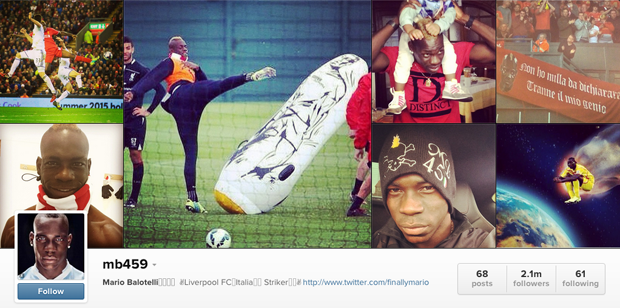
But I’ve had a soft spot for Balotelli ever since someone pointed out he looks like a baby dinosaur. Without wishing to infantilise him, he’s like the boy in school who can’t help getting in trouble even when he’s trying to be good. Ballotelli’s current situation is the perfect example. Last week, the player posted an image on Instagram, showing Nintendo character Super Mario (from whom the footballer takes his nickname, or at least would like to).

“Don’t be racist!”, it read (Yay!)

“Be like Mario” (LOL!)

“He’s an Italian plumber” (indeed he is)

“created by Japanese people” (correct)

“who speaks English” (sort of)

“and looks like a Mexican” (I suppose he does. A bit.)

“…jumps like a black man” (hmmm)

“and grabs coins like a Jew” (oh)

Long story short: people suggested that this might be a bit racist towards black and Jewish people, Balotelli responded that his mum is Jewish. Eventually, he took the post down and apologised. But by then it was too late. The Football Association announced over the weekend that the striker would face an investigation for using insulting and improper language with “reference to ethnic origin and/or colour and/or race and/or nationality and/or religion or belief”.

For what it’s worth, I don’t believe for a moment that Balotelli meant to insult anyone with his Instagram post. I think he entirely sincerely posted the meme seeing it as an anti-racist message. The problem for poor Mario was that his ill-judged but innocent Instagram came while the football world was actually paying attention to anti-semitism, as Wigan chairman Dave Whelan spouted a series of inappropriate race-related comments (Jews, money, you know, that stuff) after hiring former Cardiff manager Malky Mackay, who himself had run into controversy over dubious texts (Jews, money, on and on it goes).

Whelan stylishly compounded the issue with a “clarifying” interview in the Jewish Telegraph, where he spun the ”some of my best friends are…” line, saying there must be “a dozen” Jews with apartments near his residence in Majorca, and “so many Jewish people go to Barbados at Christmas. That’s when I go. I see a lot of them in the Lone Star, in restaurants. I play golf with a few of them.”

In the same interview, Whelan told how when he was younger, people called the only Chinese restaurant in Wigan “the Chingalings”, and absolutely nobody had minded (though one doubts anyone asked the Chinese people of Wigan).

Whelan now also faces charges of misconduct from the FA. I’m not about to suggest that the FA has no right to investigate Whelan, or anyone involved in professional football in England. Associations can have their own rules and standards. But it would be sad if, in football’s newfound determination to deal with discrimination, innocents such as Balotelli got caught in the dragnet.

The interesting question is whether, in combating racism, one confronts the words used, the stereotypes invoked, the intent behind them, or all three at once. Is it possible to disentangle the three?

Nowhere is this more clearly illustrated than the debate about whether Tottenham Hotspur fans should be able to chant “yids” or not. Short explanation: some Spurs fans are Jewish, many identify as the “yid army”. Some people — mostly not Spurs fans — feel that Spurs fans chanting “yids” legitimises anti-semitic chanting by fans of other teams. Spurs fans say it’s their chant and their word and they are using it positively. Unpick that one, sports fans.

Words in and of themselves are neutral entities. Does saying the word “yid” — in and of itself — make me more or less anti-semitic? No. But the creation of a taboo can elevate a word, bringing a certain thrill to its use. In a society where, more or less, we have decided bigotry is a bad thing (which is not to suggest a society where bigotry is no longer a problem), the use of words and phrases associated with bigotry can take on a thrill of its own, as much for the well intentioned as for the malevolent. The bad taste joke, the inappropriate interjection, the drunken football chant using the words you might not be supposed to use, are the shared cigarette behind the school bike shed; the shared, line-crossing moments that so often bond people.

The joy for most Unilad Bantalopes lies in that shared bond. For the person who created the meme which ill-feted Mario Balotelli shared (very much from the Bantasauraus school), one could simultaneously attempt to be anti-racist and use racial stereotypes. Human beings are complicated like that. And that’s why a zero-tolerance approach to words and meanings is unlikely to work on us.

This article was posted on 11 December 2014 at indexoncensorship

SUPPORT INDEX'S WORK