8 Apr 2009 | Uncategorized
Dyab Abou Jahjah is the Lebanese-born founder of the Arab European League, an Antwerp-based organisation which claims to speak for Europe’s Muslims. The Arab European League gained a certain notoriety when it weighed into the Motoons debate by publishing a series of anti-Semitic cartoons, ‘testing the limits’ of free expression in Europe.
Abou Jahjah is also, according to this New York Times profile, a former teenage member of Hezbollah, and still apparently a supporter of that organisation, having gone so far as to say he would return to Lebanon to fight with them against Israel in 2006.
Abou Jahjah was in London on Monday 30 March to address a Stop the War Coalition meeting, alongside Hezbollah MP Hussein El-Hajj Hassan, among others. He returned to Belgium after the meeting, with the intention of coming back to London for more meetings on the Friday of that week.
However, when he attempted to enter Britain again, he was prevented from doing so by customs officials, and sent back to Belgium after being detained for six hours.
Naturally, he is not happy about this, and believes the reason he has been barred is a campaign by ‘Zionists’.
In a statement, the Home Office told Index on Censorship:
‘This individual has been barred from entering the UK as we believe he is not conducive to the public good — he has made statements that incite religious hatred and place community harmony at risk.
‘The government supports freedom of expression, but believes it needs to be exercised responsibly. We will continue to oppose extremism in all its forms.
‘That is why we are determined to stop those who try to spread hatred and violent messages in our communities from coming to our country and that was the driving force behind tighter rules on exclusions for unacceptable behaviour that the Home Secretary announced in October last year.
‘EEA nationals can be refused admission to the UK on grounds of public security.’
Which is consistent with the previous reasons for banning Geert Wilders, Fred Phelps, and others. But it is curious that Dyab Abou Jahjah, who has been on the political radar for several years now, seemingly only came to the attention of the Home Office last week.
17 Oct 2008 | News, United Kingdom
 The European Arrest Warrant is a valuable tool, writes Chris Huhne, but it should not be used to restrict freedom of expression
(more…)
21 Feb 2008 | Comment, Middle East and North Africa
 A Tunisian comic may have paid a high price for making fun of the country’s leader, writes Rohan Jayasekera
Index on Censorship is calling for the release of Tunisian comedian Hédi Ouled Baballah, who has been jailed on the basis of suspect evidence, apparently in punishment for mimicking the country’s president.
The trigger seems to have been a private recording (available here) of comedian Hédi Ouled Baballah’s satirical imitation of Tunisian president Zine el-Abidine Ben Ali that has spread across the country by mobile phone.
Index on Censorship, together with fellow members of the Tunisian Monitoring Group (TMG) of international free speech groups, believes that Ouled Baballah was targeted by police and framed for drugs and currency charges as punishment for the popular satire.
(more…)
16 Jan 2008 | Comment
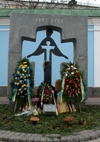 The battle over the legacy of the Ukranian famine threatens to divide the country, writes Michael Foley
So often that which politicians hope will unite their countries does exactly the opposite. The legacy of the famines which devasted Ukraine in the 1930s might do just that. Ukraine’s President Viktor Yushchenko is to campaign internationally for the famine, or the Holodomor, as it is called in Ukrainian, that killed possibly as many as 10 million people in 1932-3 to be recognised by the United Nations as genocide. Mr Yushkenko is hoping to complete his task by November, 2008, to mark 75th anniversary of the Holodomor.
In November last year a law was tabled in the Ukrainian parliament in November making it illegal to deny the Holodomor.
The famine of 1932 and 1933 was a man-made one. Unlike, for instance, the Irish Famine of the 1840s, no crops failed. The Holodomor was the result of Stalin’s farm collectivisation programme. When in 1932 the grain harvest did not meet imposed targets, Communist party activists travelled to Ukraine’s villages and confiscated all the grain and bread, and all other foodstuffs, ensuring starvation. Watchtowers were erected in order to make sure no peasants tried to take a few ears of corn.
The confiscations continued into 1933, with devastating results. It is uncertain how many died, and most Ukrainians knew little of the famine due to the extreme secrecy of the Soviet period, but with records now open and historical investigations taking place, it is believed as many as 10 million people may have perished.
(more…)
