14 Mar 2017 | Digital Freedom, Mapping Media Freedom, News
[vc_row][vc_column][vc_column_text]
Each week, Index on Censorship’s Mapping Media Freedom project verifies threats, violations and limitations faced by the media throughout the European Union and neighbouring countries. Here are recent reports that give us cause for concern.
The Madrid Journalists Association (APM) received a petition from a group of journalists they had experienced a “systemised campaign of personal and network harassment” from the left-wing Podemos party.
According to a press release from APM, the reporters said they had been harassed and pressured by the Podemos, led by Pablo Iglesias, for over a year. The press release also said that the harassment came in the form of threatening phone calls, emails, and messages or comments on social media such as Twitter. APM believes that the harassment is an attempt by Podemos officials to improve their reputation and image by eliminating any media criticism of the party.
Elvi Fundo, the news editor for the online publication Citynews.al and Radio Best, was attacked in Tirana on the morning of 8 March. The reporter was on his way to his office in the city when he was violently assaulted by two unknown assailants and suffered from injuries which landed him in the hospital.
Fundo, who is known for publishing investigations into corruption and conflict of interests, told the Balkan Insight that he does not believe the attacks had political connotations. Instead, Fundo said, he believes the attack was “the work of criminals financed by corrupt media clans tied to drug-trafficking.” Both journalists and politicians, including the Albanian Union of Journalists and Prime Minister Edi Rama, have condemned the attack as a threat to media and press freedom.
Journalists and politicians, including the Albanian Union of Journalists and Prime Minister Edi Rama, have condemned the attack as a threat to media and press freedom. Although the police have launched an investigation into the assault, the identity and motive of the assailants are still unknown.
Reporter Igor Zalyubovin and photographer Vladimir Yarotsky were arrested and detained by officers of the Russian Security Service (FSB) in Svetogorsk on 7 March. The journalists, who work for Snob, a Moscow-based independent news magazine, were taken to a detention centre and charged with crossing into a border zone without permission.
Zalyubovin and Yarotsky had rented an apartment in Svetogorsk, a town of about 15,000 outside the border of Finald, to use while reporting on Mayor Sergey Davydov’s claim that it is a “city without sin” because there are no homosexual residents. A 2014 law requires journalists to have specific permission from the FSB to work in the border zone, however, according to Snob’s editor-in-chief, they did not apply for a permit due to time constraints.
The Committee to Protect Journalists denounced the incident and said that this is the second time that journalists were detained and forced to leave Svetogorsk for border zone violations while doing follow-up reporting on the Mayor’s comments. [/vc_column_text][/vc_column][/vc_row][vc_row equal_height=”yes” content_placement=”middle” css=”.vc_custom_1489421829923{background-color: #d5473c !important;background-position: center !important;background-repeat: no-repeat !important;background-size: cover !important;}” el_class=”text_white”][vc_column width=”1/2″][vc_column_text]
[/vc_column_text][/vc_column][vc_column width=”1/2″ css=”.vc_custom_1489422066539{background-image: url(https://www.indexoncensorship.org/wp-content/uploads/2017/01/MMF_report_2016_WEB-1-1A.jpg?id=85872) !important;background-position: center !important;background-repeat: no-repeat !important;background-size: cover !important;}”][/vc_column][/vc_row][vc_row][vc_column][vc_column_text]
Nu Ener, a news editor for the Yeni Asya daily, said was arrested by police on charges of association and membership to the FETO/PDY terrorist organisation.
According to a report published in Yeni Asya, Ener was originally detained following a police raid on her home on 3 March. Three days later, the 4th Criminal Judicature of Peace found that she was guilty of membership to the terrorist organisation which has ties to Fethullah Gulen, the Muslim preacher whom the Turkish government blames for the failed coup this past July. Ener was specifically accused of using Bylock, a mobile communications application, to help organise the coup attempt.
Ener, who remains incarcerated in the Bakirkoy Prison for women, is one out of 155 journalists currently imprisoned in Turkey.
The circulation of Pras Press, a new satirical newspaper by Bulgaria’s “Society of Rude Cartoonists,” was blocked by the State Distribution Company on 5 March. The newspaper, which is known as the Bulgarian version of ‘Charlie Hebdo,’ first went on sale on 1 March, but since distribution ceased, only one tenth of the printed copies has been sold.
Journalist Ivan Bakalov said that he believes MP Delyan Peevski is behind the incident although he is not one of the listed owners of the State Distribution Company. Bakalov and his colleagues believe that the mocking of political elites in Pras Press likely contributed to the circulation block.
Despite Bulgaria’s low ranking of 113 in the 2016 Press Freedom Ranking of Reporters without Borders, the journalists of Pras Press have pledged to bring their case to the Commission for Protection of Competition, the state prosecution, caretaker government, and President Rumen Radev in hopes to resume circulation.[/vc_column_text][/vc_column][/vc_row][vc_row][vc_column][vc_column_text]
Click on the bubbles to view reports or double-click to zoom in on specific regions. The full site can be accessed at https://mappingmediafreedom.org/
[/vc_column_text][/vc_column][/vc_row][vc_row][vc_column][vc_basic_grid post_type=”post” max_items=”4″ element_width=”6″ grid_id=”vc_gid:1489422274293-9bbe61ad-21b3-2″ taxonomies=”6564″][/vc_column][/vc_row]
9 Feb 2017 | Mapping Media Freedom, News, Youth Board
[vc_row][vc_column][vc_column_text]
To highlight the most pressing concerns for press freedom in Europe in 2017, members Index’s outgoing youth board review the year gone by with some of our Mapping Media Freedom correspondents.
Youth board member Sophia Smith Galer, from the UK, spoke to Ilcho Cvetanoski, Mapping Media Freedom correspondent for Croatia, Montenegro, Bosnia and Macedonia.
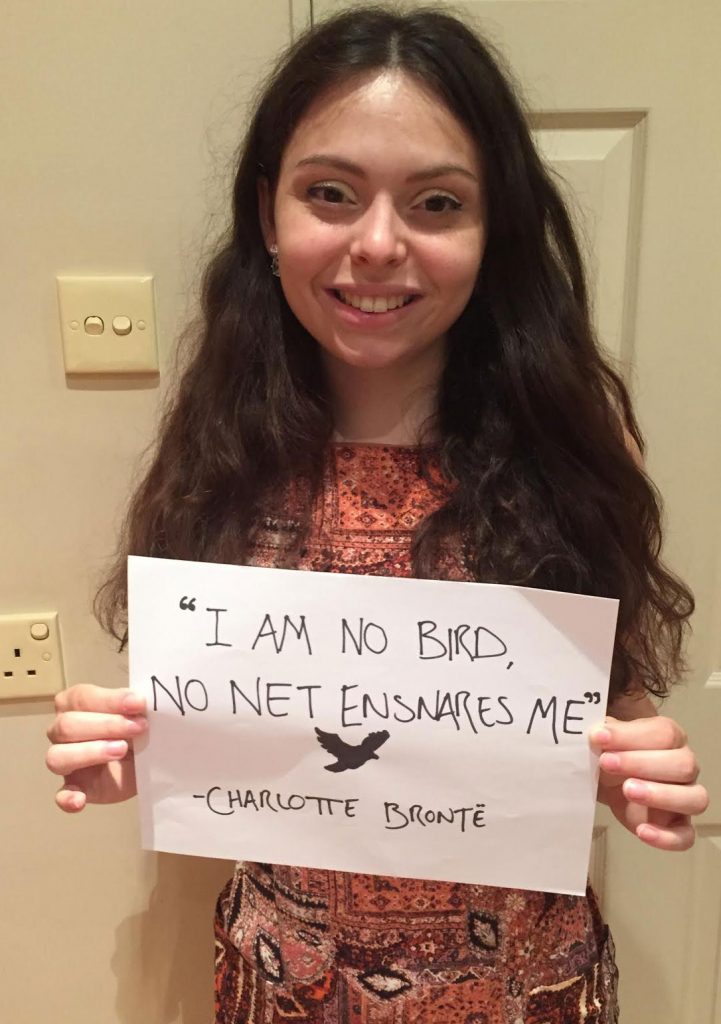 According to Cvetanoski, a lot has improved in the region over the last 15 years. The era during which journalists were targeted and killed is long passed, but the media is still dogged by censorship and political divides. In fact, journalists are regularly threatened and vilified by political elites, often denounced as foreign mercenaries, spies and traitors. Cvetanoski reports that this has led to “physical threats, the atmosphere of impunity, media ownership and also verbal attacks amongst the journalists themselves”. He notes that techniques pressuring journalists have changed from “blatant physical assaults to more subtle ones”.
The breaking up of the former Yugoslavia has undoubtedly been a historical burden on Bosnia and Herzegovina and Croatia. Cvetanoski describes this legacy as having left “deep scars in every aspect of the people’s lives, including the lives and the work of journalists”. Media workers are still remembered as having once been tools of the state. Nowadays, the opposite is happening; they’re being criticised by political elites as enemies of the state simply for scrutinising politicians’ behaviour.
It’s unsurprising that this has left many journalists in the region politicised, undermining professionalism and trust in the media. Conservative politicians court sympathisers in the media so that they can manipulate the angle and content of stories that are run. The fact that journalist salaries are low and that the economic situation is poor overall further imperils journalistic integrity in the face of bribes.
If the situation remains as it is – with limited and highly controlled sources for financing the media, a poor political culture and low media literacy among citizens – then Cvetanoski holds little hope for the future of press freedom in the region. News consumers aren’t equipped with the literacy levels to distinguish between professional versus sensational journalism, nor are the sources of media funding transparent or appropriate. “In this deadlock democracy, the first victims are the citizens who lack quality information to make decisions.”
Mapping Media Freedom is helping to change this. Making journalists feel less alone and offering a space for them to report threats to press freedom ensures that the hope for a free press throughout Europe is kept alive.
The youth board’s Constantin Eckner, from Germany, spoke with Zoltán Sipos, the MMF correspondent for Hungary, Romania and Bulgaria.
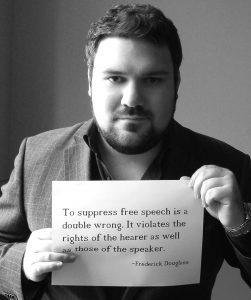 As MMF illustrates, journalists in all three countries have to deal with constant pressure from authorities and various degrees of censorship. In 2016, 42 incidents were reported in Hungary, 21 in Romania and 7 in Bulgaria.
Index on Censorship’s regional correspondent Zoltán Sipos, who is also the founder and editor of Romania’s investigative outlet Átlátszó Erdély, points out that the Hungarian government and its allies within the country follow a sophisticated plan to neutralise critical media outlets. Several newspapers that struggled financially have been purchased by rich business people or media moguls in recent history. “Just like in regards to any other part of society, prime minister Viktor Orbán seeks for a centralisation of the media industry,” Sipos says.
Yet, instead of simply controlling the media, Orbán and the reigning party Fidesz intend to use established outlets and broadcasters to construct narratives in favour of their agendas. Only a handful of independent outlets remain in Hungary.
In November 2016, Class FM, Hungary’s most popular commercial radio channel, was taken off the air. The Media Council of Hungaryʼs National Media refused to renew its licence as Class FM was owned by Hungarian oligarch Lajos Simicska, whose outlets became very critical towards the government after a quarrel between him and Orbán.
The authorities in Romania and Bulgaria might not follow a well-wrought plan, but the situation for critical journalists is as severe. “The main problem is that most outlets can’t generate enough revenue from the market,” Sipos explains. “These outlets found themselves under constant pressure, as powerful business people are willing to purchase them and use them to promote their own political agendas.” Ultimately, this issue leads to the demise of independent reporting and weakens voices critical of the ruling parties and influential political players.
Sipos concludes that “these three countries have little to no tradition of independent journalism.” Although death threats towards, or even violence against journalists do not exist, the working conditions for critical reporters are difficult.
He recommends the investigative outlets Bivol.bg from Bulgaria, atlatszo.hu and Direkt36.hu from Hungary as well as RISE Project and Casa Jurnalistului from Romania as bastions of independent journalism. A few mainstream outlets that conduct critical reporting are 444.hu, index.hu, HotNews.ro and Digi24.
Layli Foroudi, a youth board member from the UK, interviewed Mitra Nazar, MMF correspondent for Serbia, Kosovo, Slovenia and the Netherlands.
 A Dutch national based in Belgrade, Serbia and the Netherlands are Nazar’s natural beats, and she also monitors media freedom in the nearby Balkan states of Slovenia and Kosovo.
This year, Serbia has been the most intense of the four countries to cover. Serbian journalists have been subject to physical attacks and the government has maintained a smear campaign against independent media outlets in the country.
“This is a very organised campaign,” explains Nazar, “they’re being called foreign spies and foreign mercenaries.”
The “foreign spy” accusation has a real effect on the personal safety of journalists, whose pictures are often published alongside such accusations in the pro-government media. Nazar, who wrote a feature on the subject, says that this can cause such journalists to be branded as unpatriotic and anti-Serbian: “When the government accuses journalists of being “foreign spies”, it gives the impression that these independent journalists are against Serbia as a country.”
The ruling party of Serbia even went so far as to organise a touring exhibition called Uncensored Lies, where the work of independent media was parodied in an attempt to prove that the government does not censor, however, the exhibition also served to discredit these publications by calling the content “lies”.
“Can you imagine the ruling party organises an exhibition discrediting independent media,” says Nazar, shocked, “this is not indirect censorship, it is directly from the government.”
The media landscape in the Netherlands does not experience direct state-sponsored censorship, but there are other challenges. The Netherlands ranks 2nd in the 2016 RSF World Press Freedom Index, but Nazar has still reported a total of 49 incidents since the Mapping Media Freedom project started, from police aggression against journalists, to assaults on reporters during demonstrations, to broadcasters being denied access to public meetings.
For 2017, she is interested in looking into how the Dutch media deals with the rise of the far right and a growing anti-immigrant sentiment, especially in the upcoming elections which will see controversial far-right candidate Geert Wilders stand for office.
Last year, a Dutch tabloid De Telegraaf published an article about the arrival of refugees to the Netherlands with a sensational headline that generated a lot of debate in the Dutch media, which Nazar says is becoming increasingly politicised and polarised.
For Nazar, there is a line to be drawn with what legacy media outlets should and should not publish. “That line is representing and following the facts,” she says, “if you publish a headline that says there is a “migrant plague”, that is beyond facts – it is a political agenda.”
The youth board’s Ian Morse, from the USA, interviewed Vitalii Atanasov, the MMF correspondent for Ukraine.
In just the past two months in Ukraine, journalists have been assaulted, TV stations have been banned and governments on both sides of the country’s conflict with Russia have sought to limit public information and attack those who publicise.
Vitalii Atanasov is the correspondent who reported these incidents to the Mapping Media Freedom project. Drawing on sources from individual journalists to large NGOs, Atanasov monitors violations of media plurality and freedom in Ukraine for the project. To verify a story, he sometimes contacts media professionals directly, or crowdsources through social media, as he finds that all journalists publicise cases of violation of their rights, attacks, and incidents of violence.
“Some cases are complicated, and the information about them is very contradictory,” Atanasov tells Index. “So I’m trying to trace the background of the conflict that led to the violation of freedom of expression and media.”
Many of the violations that occur in Ukraine are either individual attacks on media workers by separatists in the east or Ukrainian officials attempting to control the media through regulation and licensing.
Of about a dozen and a half reports since he began working with MMF, Atanasov says many reports stick out, such as the “blatant” attempts of authorities to influence the work of major TV channels such as Inter and 1+1 channels. Most recently, Ukraine banned the independent Russian station Dozhd from broadcasting in Ukraine. While TV has recently been the target, problems with media freedom have come from almost everywhere.
“The sources of these threats can be very different,” Atanasov says, “for example, representatives of the authorities, the police, intelligence agencies, politicians, private businesses, third parties, criminals, and even ordinary citizens.”
Atanasov and MMF build off the work of other groups working in Ukraine, such as the Institute of Mass information, Human Rights Information Center, Detector Media, and Telekritika.ua.
Click on the bubbles to view reports or double-click to zoom in on specific regions. The full site can be accessed at https://mappingmediafreedom.org/
[/vc_column_text][/vc_column][/vc_row][vc_row][vc_column][vc_basic_grid post_type=”post” max_items=”4″ element_width=”6″ grid_id=”vc_gid:1486659943480-96bea7cd-9879-6″ taxonomies=”6514, 6564″][/vc_column][/vc_row]
7 Apr 2016 | Mapping Media Freedom, mobile, News, Serbia
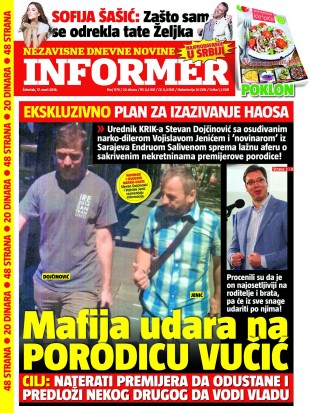
The 17 March 2016 cover of Informer featured a photograph of Stevan Dojcinovic, editor-in-chief of the Crime and Corruption Reporting Network (KRIK), with accusations that he was part of a “mafia” trying to bring down the Serbian government.
The front page of Serbian tabloid Informer stands out from the other newspapers displayed at Belgrade’s countless cigarette kiosks. Its red and yellow coloured headlines scream in block capitals at everyone who passes by.
It is the word “Mafija” that attracts most attention on the morning of 17 March 2016. It’s printed on the front page, as is a blurry photo of a journalist. The journalist, Stevan Dojcinovic, is editor-in-chief at Crime and Corruption Reporting Network (KRIK). The headline translates: “Mafia is planning attack on family Vucic.” According to Informer, Dojcinovic and his colleagues at KRIK are the mafia and want to bring down the government of Serbian Prime Minister Aleksandar Vucic.
Psychological attacks on KRIK by the tabloid have happened so often that this was hardly surprising. KRIK has become well known throughout Serbia, not because of its investigative reporting, but because of the attention from Informer.
Informer was founded in 2012 and its editorial coverage has been called “pro-regime oriented” by Konrad-Adenauer-Stiftung, a German political foundation. The paper’s editor-in-chief, Dragan Vucicevic, is said to be a close friend of the prime minister’s.
Since its launch in July 2015, KRIK has published a series of revealing stories about corruption and misuse of office by several high-profile government officials. And ever since, KRIK has been targeted by Informer: KRIK journalists have been called foreign spies trying to bring down the government; they have been accused of spreading lies; they have been personally discredited on Informer’s front pages.
It began on 7 September 2015. KRIK published leaked footage showing one of the biggest drug lords of the Balkans meeting with Ministry of Police officials, including Ivica Dacic, a former prime minister. The video was posted on the KRIK website and caused immediate controversy. A day after the revelation, Informer published an article stating that KRIK was involved with opposition parties and that Dojcinovic is a “Western spy” backed by US embassy staff.
On 19 October KRIK published a thorough investigation into Belgrade’s mayor Sinisa Mali, who allegedly owns offshore companies dealing with selling apartments at the Bulgarian coast.
Exposing Mali, who is a political ally of Vucic’s, soon sparked a new round of allegations by Informer.
Early November 2015 Informer claimed that KRIK, as well as two other independent media organisations BIRN and CINS, were given foreign grants for publications of “false affairs against people close to the government”. Informer’s Vucicevic said on national broadcaster TV Pink, in a special 4-hour-long programme called “Bringing down Vucic”, that the media organisations were planning a step-by-step plot to bring down the government.
Serbia’s journalist unions condemned what they called a smear or lynch campaign. The chairman of the Independent Journalists Association of Serbia (NUNS), Vukasin Obradovic, said that Informer created “an atmosphere of fear and lynching in the society, which may have serious consequences for the personal safety of the journalists involved”.
But the investigative journalists from KRIK were not scared off. They were, in fact, working on their next investigation into another government official: the minister of health, Zdravko Loncar.
KRIK found out that Loncar had been involved with Serbia’s most notorious criminal gang known as the “Zemun clan” when he was still an unknown doctor working at an emergency ward back in 2002. He allegedly had received a free apartment as a reward for “finishing off” a severely wounded gang member by “injecting him with a fatal cocktail”.
KRIK published the full story on February 22. A day later Dojcinovic’s photo was featured on the Informer’s front page again. The article stated that KRIK’s editor-in-chief was “launching false scandals” and was “intentionally creating chaos in the country”. Health minister Loncar was invited to talk on TV Pink, where he did not respond to the allegations but instead accused KRIK of not paying taxes.
Up to that point KRIK had investigated cases of corruption involving high-profile state officials in Vucic’s inner circle. But what everybody was waiting for was an investigation into Vucic himself.
Then came March 18 2016. Informer once again published a photo of KRIK’s Dojcinovic on its front page. But this time it was different.
The tabloid revealed a story KRIK had not yet published about Vucic’s large real estate assets in Belgrade, which he is supposedly hiding under the names of family members.
Informer exposed details of an investigation by KRIK that they could not have obtained in an ordinary manner. According to KRIK, the Informer appears to have relied on information that could only have been gathered through secret service surveillance techniques including physically following journalists and phone tapping.
“For about a year Informer has been attacking us regularly,” Dojcinovic told Index on Censorship. “This is the first time we are being attacked before we even publish the story. Now they are using information from state intelligence agency to discredit us. I don’t care about a smear campaign, they can’t destroy my credibility with a smear campaign. But now the state is after us.”
Currently KRIK is still working on finishing their newest investigation, which is indeed about Vucic’s real estate assets. But meanwhile Dojcinovic fears for the fate of his sources.
“We’ve now seen that they know exactly who we are meeting with. There is pressure on our sources, most of them work in state institutions. Some have already been fired,” Dojcinovic said.
This article was originally posted at indexoncensorship.org
21 Jan 2016 | Europe and Central Asia, Hungary, Mapping Media Freedom, mobile, News
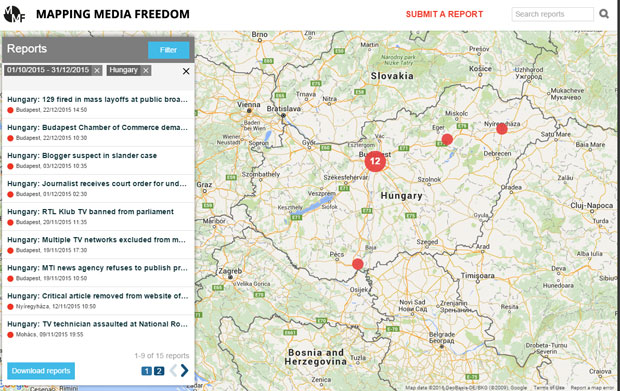
Hungary’s media outlets are coming under increasing pressure from lawsuits, restrictions on what they can publish and high fees for freedom of information requests, according to a survey of the 15 verified reports to Index on Censorship’s media monitoring project during the fourth quarter of 2015.
The Mapping Media Freedom project, which identifies threats, violations and limitations faced by members of the press throughout the European Union, candidate states and neighbouring countries, has recorded 129 verified incidents in Hungary since May 2014. In the fourth quarter of 2015 the country had the second-highest total of verified reports among EU member states and the sixth highest total among the 38 countries monitored by Mapping Media Freedom.
In 2015, Hungary was ranked #65 (partially free) on the World Press Freedom Index compiled by Reporters Without Borders. Only two EU member states, Greece and Bulgaria received a worse score.
In autumn 2015, the law governing freedom of information (FOI) was amended after a series of investigative reports uncovered wasteful government spending through FOI requests. Under the changes, the Hungarian government was granted sweeping new powers to withhold information and allowed the government and other public authorities to charge a fee for the “labour costs” associated with FOI queries. Critics warned that fees would prevent public interest journalism, and, in at least one case, it appears they were right.
In other cases, journalists have been sued for slander and issued court orders for undercover reporting on the refugee crisis.
Here are the 15 reports with links to more information.
- 22 December 2015: Budapest Chamber of Commerce demands high price to answer FOI request
The Budapest Chamber of Commerce (BCCI) asked for 3-5 million HUF ($10,356-16,352) to answer a freedom of information (FOI) request submitted by channel RTL Klub. The Budapest Chamber of Commerce and Industry said that the price will cover the salaries of 2-3 employees who would be given the task to respond to the FOI regarding BCCI’s spending and finances.
- 22 December 2015: 129 fired in mass layoffs at public broadcaster
Even the jobs of those who work for the government-friendly state broadcaster are far from being secure. On 22 December 2015, 129 employees were laid off by the umbrella company for public service broadcasters (MTVA) in pursuit of “operational rationalisation”.
Those fired included journalists, editors and foreign correspondents. According to the MTVA, the reason for the dismissal was the “better exploitation of synergies”, “increase of efficiency” and “cost reduction”.
- 3 December 2015: Blogger suspect in slander case
András Jámbor, a blogger is suspect in a slander case because he refuted the claims of Máté Kocsis, the mayor of Józsefváros (8th district of Budapest). In August 2015, Mayor Kocsis published a Facebook post alleging that the refugees have been making fires, littering, going on rampage, stealing and stabbing people in parks.
In response, Jámbor wrote a post for Kettős Mérce blog, disproving the mayor’s claims. He added that “Máté Kocsis is guilty of instigation and scare-mongering”. The mayor denounced him for slander.
On 3 December 2015, Jámbor confirmed to police that he is the author of the blog post and sustains the affirmations he made. The police took fingerprints and mugshots of the journalist.
- 1 December 2015: Journalist receives court order for undercover report on refugee camps
Gergely Nyilas, a journalist working for Hungarian online daily Index.hu, was summoned to court for his undercover report on refugee camp conditions published in August 2015.
The journalist reentered Hungary’s borders with a group of asylum seekers and, upon being detained, told the border guards that he was from Kyrgyzstan. Dressed in disguise, Nyilas reported on his treatment by border guards, the conditions at the Röszke camp, a bus ride and his experience at the police station in Győr. He eventually admitted he was Hungarian, at which point the police let him go, the Budapest Beacon reported.
Based on a police investigation, prosecutors first charged Nyilas with lying to law enforcement officials and forging official documents. The charges were then dropped but prosecutors still issued a legal reprimand against the journalist.
- 20 November 2015: Parliament speaker bans RTL Klub TV
On 20 November 2015, László Kövér, the speaker of the parliament has banned RTL Klub television from entering the parliament building, saying that the crew broke parliament rules on press coverage. According to Kövér, the journalists were filming in a corridor, where filming was forbidden, and then refused to leave the premises after they were repeatedly asked to.
The day before, on 19 November, RTL Klub was not allowed to participate at a press conference held by Hungarian prime minister Viktor Orbán and NATO secretary general Jens Soltenberg in parliament.
RTL Klub, along with other Hungarian media outlets such as 444.hu or hvg.hu, were not invited to the press conference, but RTL Klub journalists still showed up. They attempted to enter the room with the camera rolling but were denied access. This incident reportedly led to the ban on their access.
- 19 November 2015: Multiple TV networks excluded from major press conference
RTL Klub TV, 444.hu and hvg.hu journalists were not invited to a joint press conference held in parliament by Hungarian prime minister Viktor Orbán and NATO secretary general Jens Soltenberg.
RTL Klub journalists still attempted to attend by entering the room with a camera already rolling but were still barred from entering.
They were told that the meeting was “private”, and journalists were not allowed to ask questions. Bertalan Havasi, the press secretary for the Hungarian prime minister, told them that their pass was only for the plenary session and that they must leave. However, state media outlets like M1 were allowed live transmission of the press conference, and MTI, the Hungarian wire service also published a piece about the meeting.
- 19 November 2015: MTI news agency refuses to publish press release
Publicly funded news agency MTI refused to publish a press release by Hungarian Socialist Party vice president Zoltán Lukács, where he asked for a wealth gain investigation into István Tiborcz, the son-in-law of the Hungarian prime minister. MTI refused to publish the press release, claiming that István Tiborcz is not a public figure.
The business interests of the son-in-law of Prime Minister Victor Orbán are widely discussed in the Hungarian media, especially because companies connected to Tiborcz are frequently winning public procurement tenders.
- 12 November 2015: Critical article removed from website of local newspaper
An article about a photo manipulation of Hungarian prime minister, Viktor Orbán was removed from the website of Szabolcs Online.
The article titled, A Mass of People Saluted Viktor Orbán at Nyíregyháza – Or Not?, had a photo showing that only two dozen people gathered around the Hungarian prime minister visiting the city of Nyíregyháza. Soon after the piece was published, it was removed from the szon.hu website. However, it was reportedly still available temporarily in Google cache.
The article was a reaction to a photo published by the state news agency, MTI, that was shot in such a way that it leaves the impression that there was a big crowd around the prime minister.
- 9 November 2015: TV technician assaulted at National Roma Council meeting
A technician working for Hír TV news television was assaulted at a meeting of the National Roma Council held in the city of Mohács. The technician was standing near a door, when the daughter of a member of the National Roma Council, hit him in the stomach, as she was leaving the room.
The mother of the aggressor, Jánosné Kis denied any wrongdoing, although her daughter actions were captured on film.
- 4 November 2015: Government could force media to employ secret service agents
Hungarian media is demanding that the government repeal a plan that could force newspapers, television and radio stations as well as online publications to add agents from the constitution protection office (national intelligence and counterintelligence) to their staff, the Associated Press reported.
The Hungarian publishers’ association claimed that if the draft proposal by the interior ministry is passed by parliament, it could “harshly interfere with and damage” media freedom, and would facilitate censorship. The association represents over 40 of Hungary’s largest media companies.
- 4 November 2015: Government official asks to criminalise defamation in media law
Geza Szocs, the cultural commissioner in the Hungarian Prime Ministry, has asked for a modification of Hungary’s media law that would criminalise defamation, in an article for mandiner.hu. Szocs has also asked for a stricter regulation of damages caused by defamatory articles.
The commissioner wrote the piece in response to a series of articles published by index.hu, which criticised the Hungary’s presence at the 2015 Milan World Fair, a project that Szocs was managing.
- 26 October 2015: Journalist told to delete photographs of government official
A journalist working on a profile of András Tállai, Hungarian secretary of state for municipalities, was asked to delete pictures he had taken of the politician eating scones.
“Don’t take pictures of the state secretary while he is eating,” a staff member told the journalist, who works for vs.hu.
The journalist briefly interviewed Tállai, who is also head of the Hungarian Tax Authority, in the township of Mezőkövesd, where the politician started the conversation by asking, “Why do you want to write a negative article about me?”. Tállai then smiled and asked the journalist, “You are registered at the Tax Authority, right?”
- 22 October 2015: Public radio censors interview with prominent historian
Editors at MR I Kossuth Rádió, part of Hungarian public radio, did not broadcast an interview with János M. Rainer, one of the most acclaimed historians on the 1956 Hungarian revolution.
“We don’t need a Nagy Imre-Rainer narrative!” was the justification given by one of the editors to censor the content, the reporter who interviewed Rainer claimed.
- 17 October 2015: State press agency refuses to publish opposition party press release
Hungarian state news agency MTI refused to publish a press release issued by Lehet Más a Politika (LMP), an opposition parliamentary party.
In the press release, LMP criticised MTI by stating the Hungarian government is spending more money every year on the news agency, yet MTI fails to meet the standards of impartiality and is being transformed into a government propaganda machine.
- 7 October 2015: National press barred from asking questions at conference
Hungarian journalists were not allowed to ask questions at a press conference held after a meeting between the Hungarian president János Áder and the PM of Croatia, Kolinda Grabar-Kitarovic.
Only international journalists from Reuters and the Croatian state television were allowed to ask the politicians questions.
