7 Nov 2018 | Burma, Campaigns -- Featured, Statements
At the recent World Economic Conference in Hanoi, Viet Nam, Aung San Suu Kyi defended the 3 September conviction and sentencing of Reuters reporters Wa Lone and Kyaw Soe Oo and invited anyone who believes in the rule of law to point out why the judgment was problematic. 52 IFEX members and other groups have taken her up on this invitation.
Aung San Suu Kyi
State Counselor
Naypyidaw
Myanmar
Your Excellency,
Recently, at the World Economic Conference in Hanoi, Viet Nam, you defended the September 3 conviction and sentencing of Reuters reporters Wa Lone and Kyaw Soe Oo for violating the Official Secrets Act, and invited anyone who believes in the rule of law to point out why the judgment was problematic. As a concerned group of more than 50 human rights and free expression organizations from around the world, we would like to take this opportunity to respond to your invitation and to call for Wa Lone and Kyaw Soe Oo’s immediate and unconditional release.
First and foremost, contrary to your comments, the case is a clear attempt to restrict freedom of expression and independent journalism in Myanmar. Wa Lone and Kyaw Soe Oo were arrested on December 12, 2017, in the course of doing their job as professional journalists: investigating military operations in northern Rakhine State. Specifically, the two men were investigating a massacre that took place in the village of Inn Din, during which 10 Rohingya men and boys were summarily executed by the security forces—a crime which the military later admitted to. This investigation—which came at a time when the Myanmar military and the civilian-led government rejected mounting reports of human rights violations in northern Rakhine State—was clearly in the public interest, and still is.
The law that was then used to prosecute them—the colonial-era Official Secrets Act—is one of a number of repressive laws that have been used to prosecute journalists and stymie media freedom. The Act is broadly worded, and grants wide powers to the government to determine what classifies as a “secret”—indeed, the entire Act goes well beyond the restrictions on the right to freedom of expression which are permitted under international human rights law on the grounds of national security.
Even within the terms of the Act itself, for a conviction under Section 3.1 (c), evidence should demonstrate that the accused had in their possession secret documents that “might be or is intended to be, directly or indirectly, useful to an enemy.” However, evidence and testimony presented during the pre-trial and trial hearings failed to demonstrate this was the case and instead established the following facts:
• The documents Wa Lone and Kyaw Soe Oo are accused of possessing are not secret, but contain information already in the public domain;
• There is no evidence of intent to turn documents over to an enemy or to harm the country;
• Police testimony regarding the circumstances of their arrest was contradictory;
• Moreover, a police whistleblower credibly testified that the two journalists had been framed: namely, that police were ordered by their superiors to invite Wa Lone to a meeting so he could be handed documents and then immediately arrested;
• Wa Lone and Kyaw Soe Oo were subject to ill-treatment after their initial arrest, including incommunicado detention for two weeks, hooding, and sleep deprivation.
In summary, we believe that that Wa Lone and Kyaw Soe Oo should never have been arrested in the first place, let alone prosecuted, convicted and imprisoned. Their trial, which was already manifestly unfair, was made more so by the repeated failure to uphold key tenets of the rule of law and to build a convincing evidence-based case against these journalists.
We therefore call on the Myanmar authorities to immediately and unconditionally release these two men, and reject the convictions against them. We further urge your government to work towards the swift review and amendment of all laws that can be used to unlawfully restrict the right to freedom of expression, so as to bring them into line with international human rights law and standards.
Yours respectfully,
PEN America
Adil Soz – International Foundation for Protection of Freedom of Speech
Afghanistan Journalists Center (AFJC)
Africa Freedom of Information Centre (AFIC)
Albanian Media Institute
Americans for Democracy & Human Rights in Bahrain (ADHRB)
ARTICLE 19
Association for Freedom of Thought and Expression (AFTE)
Bytes for All (B4A)
Cambodian Center for Human Rights (CCHR)
Cartoonists Rights Network International (CRNI)
Center for Media Freedom and Responsibility (CMFR)
Centre for Independent Journalism (CIJ)
Committee to Protect Journalists (CPJ)
Freedom Forum
Fundamedios – Andean Foundation for Media Observation and Study
Globe International Center
Human Rights Watch (HRW)
Independent Journalism Center (IJC)
Index on Censorship
Initiative for Freedom of Expression – Turkey
International Federation of Journalists (IFJ)
International Press Institute (IPI)
Mediacentar Sarajevo
Media, Entertainment and Arts Alliance
Media Foundation for West Africa (MFWA)
Media Institute of Southern Africa (MISA)
Media Rights Agenda (MRA)
Mizzima News
Norwegian PEN
OpenMedia
Pakistan Press Foundation
PEN Canada
Reporters Without Borders (RSF)
Southeast Asian Press Alliance (SEAPA)
South East Europe Media Organisation
Vigilance for Democracy and the Civic State
World Association of Newspapers and News Publishers
Amnesty International
Athan – Freedom of Expression Activist Organization
Burma Campaign UK
Civil Rights Defenders
CSW
English PEN
Equality Myanmar
Free Expression Myanmar
Myanmar Media Lawyers’ Network
Norwegian Myanmar Committee
PEN Myanmar
Society for Threatened Peoples – Germany
South East Asian Journalist Unions (SEAJU)
The Swedish Burma Committee
26 Oct 2018 | Campaigns -- Featured, Saudi Arabia, Statements
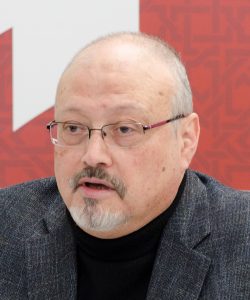
Saudi journalist, Global Opinions columnist for the Washington Post, and former editor-in-chief of Al-Arab News Channel Jamal Khashoggi offers remarks during POMED’s “Mohammed bin Salman’s Saudi Arabia: A Deeper Look”. March 21, 2018, Project on Middle East Democracy (POMED), Washington, DC.
Recognising the fundamental right to express our views, free from repression, we the undersigned civil society organisations call on the international community, including the United Nations, multilateral and regional institutions as well as democratic governments committed to the freedom of expression, to take immediate steps to hold Saudi Arabia accountable for grave human rights violations. The murder of Saudi journalist Jamal Ahmad Khashoggi in the Saudi Consulate in Istanbul on 2 October is only one of many gross and systematic violations committed by the Saudi authorities inside and outside the country. As the International Day to End Impunity for Crimes against Journalists approaches on 2 November, we strongly echo calls for an independent investigation into Khashoggi’s murder, in order to hold those responsible to account.
This case, coupled with the rampant arrests of human rights defenders, including journalists, scholars and women’s rights activists; internal repression; the potential imposition of the death penalty on demonstrators; and the findings of the UN Group of Eminent Experts report which concluded that the Coalition, led by Saudi Arabia, have committed acts that may amount to international crimes in Yemen, all demonstrate Saudi Arabia’s record of gross and systematic human rights violations. Therefore, our organisations further urge the UN General Assembly to suspend Saudi Arabia from the UN Human Rights Council (HRC), in accordance with operative paragraph 8 of the General Assembly resolution 60/251.
Saudi Arabia has never had a reputation for tolerance and respect for human rights, but there were hopes that as Crown Prince Mohammed Bin Salman rolled out his economic plan (Vision 2030), and finally allowed women to drive, there would be a loosening of restrictions on women’s rights, and freedom of expression and assembly. However, prior to the driving ban being lifted in June, women human rights defenders received phone calls warning them to remain silent. The Saudi authorities then arrested dozens of women’s rights defenders (both female and male) who had been campaigning against the driving ban. The Saudi authorities’ crackdown against all forms of dissent has continued to this day.
Khashoggi criticised the arrests of human rights defenders and the reform plans of the Crown Prince, and was living in self-imposed exile in the US. On 2 October 2018, Khashoggi went to the Consulate in Istanbul with his fiancée to complete some paperwork, but never came out. Turkish officials soon claimed there was evidence that he was murdered in the Consulate, but Saudi officials did not admit he had been murdered until more than two weeks later.
It was not until two days later, on 20 October, that the Saudi public prosecution’s investigation released findings confirming that Khashoggi was deceased. Their reports suggested that he died after a “fist fight” in the Consulate, and that 18 Saudi nationals have been detained. King Salman also issued royal decrees terminating the jobs of high-level officials, including Saud Al-Qahtani, an advisor to the royal court, and Ahmed Assiri, deputy head of the General Intelligence Presidency. The public prosecution continues its investigation, but the body has not been found.
Given the contradictory reports from Saudi authorities, it is essential that an independent international investigation is undertaken.
On 18 October, the Committee to Protect Journalists (CPJ), Human Rights Watch, Amnesty International, and Reporters Without Borders (RSF) called on Turkey to request that UN Secretary-General Antonio Guterres establish a UN investigation into the extrajudicial execution of Khashoggi.
On 15 October 2018, David Kaye, the UN Special Rapporteur on freedom of expression, and Dr. Agnès Callamard, the UN Special Rapporteur on summary executions, called for “an independent investigation that could produce credible findings and provide the basis for clear punitive actions, including the possible expulsion of diplomatic personnel, removal from UN bodies (such as the Human Rights Council), travel bans, economic consequences, reparations and the possibility of trials in third states.”
We note that on 27 September, Saudi Arabia joined consensus at the UN HRC as it adopted a new resolution on the safety of journalists (A/HRC/Res/39/6). We note the calls in this resolution for “impartial, thorough, independent and effective investigations into all alleged violence, threats and attacks against journalists and media workers falling within their jurisdiction, to bring perpetrators, including those who command, conspire to commit, aid and abet or cover up such crimes to justice.” It also “[u]rges the immediate and unconditional release of journalists and media workers who have been arbitrarily arrested or arbitrarily detained.”
Khashoggi had contributed to the Washington Post and Al-Watan newspaper, and was editor-in-chief of the short-lived Al-Arab News Channel in 2015. He left Saudi Arabia in 2017 as arrests of journalists, writers, human rights defenders and activists began to escalate. In his last column published in the Washington Post, he criticised the sentencing of journalist Saleh Al-Shehi to five years in prison in February 2018. Al-Shehi is one of more than 15 journalists and bloggers who have been arrested in Saudi Arabia since September 2017, bringing the total of those in prison to 29, according to RSF, while up to 100 human rights defenders and possibly thousands of activists are also in detention according to the Gulf Centre for Human Rights (GCHR) and Saudi partners including ALQST. Many of those detained in the past year had publicly criticised reform plans related to Vision 2030, noting that women would not achieve economic equality merely by driving.
Another recent target of the crackdown on dissent is prominent economist Essam Al-Zamel, an entrepreneur known for his writing about the need for economic reform. On 1 October 2018, the Specialised Criminal Court (SCC) held a secret session during which the Public Prosecution charged Al-Zamel with violating the Anti Cyber Crime Law by “mobilising his followers on social media.” Al-Zamel criticised Vision 2030 on social media, where he had one million followers. Al-Zamel was arrested on 12 September 2017 at the same time as many other rights defenders and reformists.
The current unprecedented targeting of women human rights defenders started in January 2018 with the arrest of Noha Al-Balawi due to her online activism in support of social media campaigns for women’s rights such as (#Right2Drive) or against the male guardianship system (#IAmMyOwnGuardian). Even before that, on 10 November 2017, the SCC in Riyadh sentenced Naimah Al-Matrod to six years in jail for her online activism.
The wave of arrests continued after the March session of the HRC and the UN Committee on the Elimination of Discrimination against Women (CEDAW) published its recommendations on Saudi Arabia. Loujain Al-Hathloul, was abducted in the Emirates and brought to Saudi Arabia against her will on 15 May 2018; followed by the arrest of Dr. Eman Al-Nafjan, founder and author of the Saudiwoman’s Weblog, who had previously protested the driving ban; and Aziza Al-Yousef, a prominent campaigner for women’s rights.
Four other women’s human rights defenders who were arrested in May 2018 include Dr. Aisha Al-Manae, Dr. Hessa Al-Sheikh and Dr. Madeha Al-Ajroush, who took part in the first women’s protest movement demanding the right to drive in 1990; and Walaa Al-Shubbar, a young activist well-known for her campaigning against the male guardianship system. They are all academics and professionals who supported women’s rights and provided assistance to survivors of gender-based violence. While they have since been released, all four women are believed to be still facing charges.
On 6 June 2018, journalist, editor, TV producer and woman human rights defender Nouf Abdulaziz was arrested after a raid on her home. Following her arrest, Mayya Al-Zahrani published a letter from Abdulaziz, and was then arrested herself on 9 June 2018, for publishing the letter.
On 27 June 2018, Hatoon Al-Fassi, a renowned scholar, and associate professor of women’s history at King Saud University, was arrested. She has long been advocating for the right of women to participate in municipal elections and to drive, and was one of the first women to drive the day the ban was lifted on 24 June 2018.
Twice in June, UN special procedures called for the release of women’s rights defenders. On 27 June 2018, nine independent UN experts stated, “In stark contrast with this celebrated moment of liberation for Saudi women, women’s human rights defenders have been arrested and detained on a wide scale across the country, which is truly worrying and perhaps a better indication of the Government’s approach to women’s human rights.” They emphasised that women human rights defenders “face compounded stigma, not only because of their work as human rights defenders, but also because of discrimination on gender grounds.”
Nevertheless, the arrests of women human rights defenders continued with Samar Badawi and Nassima Al-Sadah on 30 July 2018. They are being held in solitary confinement in a prison that is controlled by the Presidency of State Security, an apparatus established by order of King Salman on 20 July 2017. Badawi’s brother Raif Badawi is currently serving a 10-year prison sentence for his online advocacy, and her former husband Waleed Abu Al-Khair, is serving a 15-year sentence. Abu Al-Khair, Abdullah Al-Hamid, and Mohammad Fahad Al-Qahtani (the latter two are founding members of the Saudi Civil and Political Rights Association – ACPRA) were jointly awarded the Right Livelihood Award in September 2018. Yet all of them remain behind bars.
Relatives of other human rights defenders have also been arrested. Amal Al-Harbi, the wife of prominent activist Fowzan Al-Harbi, was arrested by State Security on 30 July 2018 while on the seaside with her children in Jeddah. Her husband is another jailed member of ACPRA. Alarmingly, in October 2018, travel bans were imposed against the families of several women’s rights defenders, such as Aziza Al-Yousef, Loujain Al-Hathloul and Eman Al-Nafjan.
In another alarming development, at a trial before the SCC on 6 August 2018, the Public Prosecutor called for the death penalty for Israa Al-Ghomgam who was arrested with her husband Mousa Al-Hashim on 6 December 2015 after they participated in peaceful protests in Al-Qatif. Al-Ghomgam was charged under Article 6 of the Cybercrime Act of 2007 in connection with social media activity, as well as other charges related to the protests. If sentenced to death, she would be the first woman facing the death penalty on charges related to her activism. The next hearing is scheduled for 28 October 2018.
The SCC, which was set up to try terrorism cases in 2008, has mostly been used to prosecute human rights defenders and critics of the government in order to keep a tight rein on civil society.
On 12 October 2018, UN experts again called for the release of all detained women human rights defenders in Saudi Arabia. They expressed particular concern about Al-Ghomgam’s trial before the SCC, saying, “Measures aimed at countering terrorism should never be used to suppress or curtail human rights work.” It is clear that the Saudi authorities have not acted on the concerns raised by the special procedures – this non-cooperation further brings their membership on the HRC into disrepute.
Many of the human rights defenders arrested this year have been held in incommunicado detention with no access to families or lawyers. Some of them have been labelled traitors and subjected to smear campaigns in the state media, escalating the possibility they will be sentenced to lengthy prison terms. Rather than guaranteeing a safe and enabling environment for human rights defenders at a time of planned economic reform, the Saudi authorities have chosen to escalate their repression against any dissenting voices.
Our organisations reiterate our calls to the international community to hold Saudi Arabia accountable and not allow impunity for human rights violations to prevail.
We call on the international community, and in particular the UN, to:
- Take action to ensure there is an international, impartial, prompt, thorough, independent and effective investigation into the murder of journalist Jamal Ahmad Khashoggi;
- Ensure Saudi Arabia be held accountable for the murder of Khashoggi and for its systematic violations of human rights;
- Call a Special Session of the Human Rights Council on the recent wave of arrests and attacks against journalists, human rights defenders and other dissenting voices in Saudi Arabia;
- Take action at the UN General Assembly to suspend Saudi Arabia’s membership of the Human Rights Council; and
- Urge the government of Saudi Arabia to implement the below recommendations.
We call on the authorities in Saudi Arabia to:
- Produce the body of Jamal Ahmad Khashoggi and invite independent international experts to oversee investigations into his murder; cooperate with all UN mechanisms; and ensure that those responsible for his death, including those who hold command responsibility, are brought to justice;
- Immediately quash the convictions of all human rights defenders, including women and men advocating for gender equality, and drop all charges against them;
- Immediately and unconditionally release all human rights defenders, writers, journalists and prisoners of conscience in Saudi Arabia whose detention is a result of their peaceful and legitimate work in the promotion and protection of human rights including women’s rights;
- Institute a moratorium on the death penalty; including as punishment for crimes related to the exercise of rights to freedom of opinion and expression, and peaceful assembly;
- Guarantee in all circumstances that all human rights defenders and journalists in Saudi Arabia are able to carry out their legitimate human rights activities and public interest reporting without fear of reprisal;
- Immediately implement the recommendations made by the UN Group of Eminent Experts on Yemen; and
- Ratify the International Covenant on Civil and Political Rights, and bring all national laws limiting the rights to freedom of expression, peaceful assembly and association into compliance with international human rights standards.
Signed,
Access Now
Action by Christians for the Abolition of Torture (ACAT) – France
Action by Christians for the Abolition of Torture (ACAT) – Germany
Al-Marsad – Syria
ALQST for Human Rights
ALTSEAN-Burma
Americans for Democracy & Human Rights in Bahrain (ADHRB)
Amman Center for Human Rights Studies (ACHRS) – Jordan
Amman Forum for Human Rights
Arabic Network for Human Rights Information (ANHRI)
Armanshahr/OPEN ASIA
ARTICLE 19
Asian Forum for Human Rights and Development (FORUM-ASIA)
Asian Human Rights Commission (AHRC)
Asociación Libre de Abogadas y Abogados (ALA)
Association for Freedom of Thought and Expression (AFTE)
Association for Human Rights in Ethiopia (AHRE)
Association malienne des droits de l’Homme (AMDH)
Association mauritanienne des droits de l’Homme (AMDH)
Association nigérienne pour la défense des droits de l’Homme (ANDDH)
Association of Tunisian Women for Research on Development
Association for Women’s Rights in Development (AWID)
Awan Awareness and Capacity Development Organization
Bahrain Institute for Rights and Democracy (BIRD)
Bureau for Human Rights and the Rule of Law – Tajikistan
Cairo Institute for Human Rights Studies (CIHRS)
Cambodian League for the Promotion and Defense of Human Rights (LICADHO)
Canadian Center for International Justice
Caucasus Civil Initiatives Center (CCIC)
Center for Civil Liberties – Ukraine
Center for Prisoners’ Rights
Center for the Protection of Human Rights “Kylym Shamy” – Kazakhstan
Centre oecuménique des droits de l’Homme (CEDH) – Haïti
Centro de Políticas Públicas y Derechos Humanos (EQUIDAD) – Perú
Centro para la Acción Legal en Derechos Humanos (CALDH) – Guatemala
Citizen Center for Press Freedom
Citizens’ Watch – Russia
CIVICUS
Civil Society Institute (CSI) – Armenia
Code Pink
Columbia Law School Human Rights Clinic
Comité de acción jurídica (CAJ) – Argentina
Comisión Ecuménica de Derechos Humanos (CEDHU) – Ecuador
Comisión Nacional de los Derechos Humanos – Dominican Republic
Committee on the Administration of Justice (CAJ) -Northern Ireland
Committee to Protect Journalists
Committee for Respect of Liberties and Human Rights in Tunisia
Damascus Center for Human Rights in Syria
Danish PEN
DITSHWANELO – The Botswana Center for Human Rights
Dutch League for Human Rights (LvRM)
Election Monitoring and Democracy Studies Center – Azerbaijan
English PEN
European Centre for Democracy and Human Rights (ECDHR)
European Saudi Organisation for Human Rights (ESOHR)
FIDH within the framework of the Observatory for the protection of human rights defenders
Finnish League for Human Rights
Freedom Now
Front Line Defenders
Fundación regional de asesoría en derechos humanos (INREDH) – Ecuador
Foundation for Human Rights Initiative (FHRI) – Uganda
Global Voices Advox
Groupe LOTUS (RDC)
Gulf Centre for Human Rights (GCHR)
Hellenic League for Human Rights (HLHR)
Human Rights Association (IHD) – Turkey
Human Rights Center (HRCIDC) – Georgia
Human Rights Center “Viasna” – Belarus
Human Rights Commission of Pakistan
Human Rights Concern (HRCE) – Eritrea
Human Rights in China
Human Rights Center Memorial
Human Rights Movement “Bir Duino Kyrgyzstan”
Human Rights Sentinel
IFEX
Index on Censorship
Initiative for Freedom of Expression (IFoX) – Turkey
Institut Alternatives et Initiatives citoyennes pour la Gouvernance démocratique (I-AICGD) – DR Congo
International Center for Supporting Rights and Freedoms (ICSRF) – Switzerland
Internationale Liga für Menscherechte
International Human Rights Organisation “Fiery Hearts Club” – Uzbekistan
International Legal Initiative (ILI) – Kazakhstan
International Media Support (IMS)
International Partnership for Human Rights (IPHR)
International Press Institute
International Service for Human Rights (ISHR)
Internet Law Reform and Dialogue (iLaw)
Iraqi Association for the Defense of Journalists’ Rights
Iraqi Hope Association
Italian Federation for Human Rights (FIDH)
Justice for Iran
Karapatan – Philippines
Kazakhstan International Bureau for Human Rights and the Rule of Law
Khiam Rehabilitation Center for Victims of Torture
KontraS
Latvian Human Rights Committee
Lao Movement for Human Rights
Lawyers’ Rights Watch Canada
League for the Defense of Human Rights in Iran (LDDHI)
Legal Clinic “Adilet” – Kyrgyzstan
Ligue algérienne de défense des droits de l’Homme (LADDH)
Ligue centrafricaine des droits de l’Homme
Ligue des droits de l’Homme (LDH) Belgium
Ligue des Electeurs (LE) – DRC
Ligue ivoirienne des droits de l’Homme (LIDHO)
Ligue sénégalaise des droits humains (LSDH)
Ligue tchadienne des droits de l’Homme (LTDH)
Maison des droits de l’Homme (MDHC) – Cameroon
Maharat Foundation
MARUAH – Singapore
Middle East and North Africa Media Monitoring Observatory
Monitoring Committee on Attacks on Lawyers, International Association of People’s Lawyers (IAPL)
Movimento Nacional de Direitos Humanos (MNDH) – Brasil
Muslims for Progressive Values
Mwatana Organization for Human Rights
National Syndicate of Tunisian Journalists
No Peace Without Justice
Norwegian PEN
Odhikar
Open Azerbaijan Initiative
Organisation marocaine des droits humains (OMDH)
People’s Solidarity for Participatory Democracy (PSPD)
People’s Watch
PEN America
PEN Canada
PEN International
PEN Lebanon
PEN Québec
Promo-LEX – Moldova
Public Foundation – Human Rights Center “Kylym Shamy” – Kyrgyzstan
Rafto Foundation for Human Rights
RAW in WAR (Reach All Women in War)
Reporters Without Borders (RSF)
Right Livelihood Award Foundation
Robert F. Kennedy Human Rights
Sahrawi Media Observatory to document human rights violations
SALAM for Democracy and Human Rights (SALAM DHR)
Scholars at Risk (SAR)
Sham Center for Democratic Studies and Human Rights in Syria
Sisters’ Arab Forum for Human Rights (SAF) – Yemen
Solicitors International Human Rights Group
Syrian Center for Legal Studies and Research
Syrian Center for Media and Freedom of Expression (SCM)
Tanmiea – Iraq
Tunisian Association to Defend Academic Values
Tunisian Association to Defend Individual Rights
Tunisian Association of Democratic Women
Tunis Center for Press Freedom
Tunisian Forum for Economic and Social Rights
Tunisian League to Defend Human Rights
Tunisian Organization against Torture
Urgent Action Fund for Women’s Human Rights (UAF)
Urnammu
Vietnam Committee on Human Rights
Vigdis Freedom Foundation
Vigilance for Democracy and the Civic State
Women Human Rights Defenders International Coalition
Women’s Center for Culture & Art – United Kingdom
World Association of Newspapers and News Publishers (WAN-IFRA)
World Organisation Against Torture (OMCT) within the framework of the Observatory for the protection of human rights defenders
Yemen Center for Human Rights
Zimbabwe Human Rights Association (ZimRights)
17Shubat For Human Rights
11 Oct 2018 | Artistic Freedom, News, Risks, Rights and Reputations
[vc_row][vc_column][vc_single_image image=”97076″ img_size=”full” add_caption=”yes”][vc_column_text]Agnieszka Kolek is curator and co-founder of Passion for Freedom, an annual competition exhibition of by artists facing censorship worldwide. In February 2015, Kolek survived the terrorist attack in Copenhagen, targeting the panel discussion she appeared in alongside Swedish artist Lars Vilks. Later that year in London, the Passion for Freedom 2015 exhibition at Mall Galleries, London, hit the headlines when a work Isis Threaten Sylvania by Mimsy was removed by the curators on the advice of the police. They had no choice because they couldn’t pay the £36,000 demanded by the police to guarantee security of the exhibition.
JF: How does your experience of the Danish police compare to the British police?
AK: The panel discussion — Art, Blasphemy and Freedom of Speech — was organised by the Lars Vilks Committee with the full support of the police. This was only a month after the Charlie Hebdo attack, but there was no question that the discussion should go ahead. There were two plain-clothed police officers, two uniformed police and then two special service officers responsible for Lars, who has 24-hour police protection. Police checked bags as the audience came in. When the attack happened — the Danish filmmaker Finn Nørgaard, one of the guests, was shot outside the venue and died on the pavement — the two special service officers took Lars to safety. We know that after an attack on freedom of speech the next target is Jews – it happened with Charlie Hebdo and it happened in Copenhagen when the same gunman attacked a bat mitzvah party in the evening, killing the security guard. Danes feel very bad that they didn’t anticipate this pattern and there was a lot of blaming of the police for this, but they did their best considering the circumstances. I think there has to be more legal power give to the police to extinguish the sources of the extremism, and its results. When you already have flames it is harder to put it, instead you have to prevent the fire from starting.
In London in 2015 it was very different. The police wanted to determine what artworks could go on show, and even the artistic value of exhibited works, showing an indirect form of censorship claiming it was “for your own good – security”. Police intelligence identified “serious concerns” regarding the “potentially inflammatory content” of Mimsy’s work and for this reason “advised” us to remove the work or pay protection money at £6,000 a day. We were completely shocked. Out of all the works in the exhibition, we would never have thought that they would pick this one out. We asked for more information about the “serious concerns”, especially because we wanted to know if there was a threat to Mimsy herself. They didn’t give us any more information. They wanted to place blame on the festival or its artists for causing problems, rather than protecting the space for art to show the suffering of people around the world and the lack of freedom to openly discuss it. While we tried to fundraise for our own protection, we were threatened with more works being withdrawn. Art cannot be controlled by the police – not in London, which for hundreds of years is a symbol of democracy and freedom. Not in the creative capital of Europe where artists flock from all over the world.
JF: But in Copenhagen two people lost their lives – you could have lost yours. How do you reconcile the loss of life with the pursuit of freedom?
AK: It is not easy to answer as I am not treating others’ and my own life lightly. Behind each individual there is a unique person, unique life story and to cut it short for the supposedly abstract ideal of free speech and expression might seem reckless. It is not. Again and again we learn how giving concessions to those who want to restrict freedoms of speech allows the darkness not only to enter our home but also our hearts. Not resisting it at early stages causes our societies to change beyond recognition.
I was invited to the Copenhagen event way ahead, so after the Charlie Hebdo attack, the chair got in touch with me to say she would understand in view of the heightened security risk, if I chose not to come. So I thought long and hard about it and said I will have to die someday, and I know I will look back at that this moment and I will remember the choice I made and it will be important.
Passion for Freedom is a very effective tool for assessing how much freedom there is in society. Artists cannot be easily controlled. In their inner core they are idealists. We stand with them giving them space and time to express themselves. Freedom will prevail despite political and corporate pressure to censor and restrict open debate. We are its guardians.
JF: How have the experiences of 2015 impacted on how you approach this year’s exhibition?
AK: The commitment and the conviction are still there. But we are not clear where we stand, because there is no clear definition of what is appropriate or what is inflammatory. It is a shifting ground. In the past, we created the space to fully exhibit work that had been censored elsewhere by a curator or a gallery owner. Now we are in the situation where the state, through the arm of the police, imposes this pre-emptive self-censorship on you. Since the censorship incident, we cannot guarantee artists that they will be able to exhibit/perform during a festival talking about freedom. Over the years there has been a number of artists who requested to be exhibited under pseudonyms (as often their lives are threatened in the UK or back in their home countries). Can we guarantee that the police will not arrest them? Until now, we could guarantee it to them. Since 2015 we are not sure that is the case. My approach is not to have any preconceived idea of how it will go with the police this time. We will still try to be open and have a dialogue in the belief that the police are still there to protect us and it is still a democratic country. I will be honest – we are also treating it as a kind of testing ground. Let’s see if this is still a democratic country or is it just on paper?
The artistic community in the United States and Australia is shocked by the police’s censorious attitude to arts in London. There are groups of people who decided to open Passion for Freedom branch offices in New York and Sydney to ensure that British censorship is being exposed. And in case freedom is completely extinguished in the UK they can continue the important work to give artists the platform to exhibit their works and debate important issues in our societies. And if we discover that there is even less freedom than in 2015, we are considering moving this exhibition to Poland because there is more freedom there. This is on the cards, we are already discussing it.
JF: Do you think Passion for Freedom exhibition represents a security risk?
AK: The way it is being framed in the media it looks like we are troublemakers and we are asking for it. I see it another way – we are representing the majority of society that wants to ask questions, to solve problems and to move forward together. Instead of giving in to a minority that wants to use violence and threats as a way to push forward their own agenda. I think it is in the interests of any society to make sure there is the space for difficult conversations because it moves away from creating the situation where the only way to solve problems is violence. You need to allow people to have this space and art is a wonderful tool to do that, without falling for propaganda, or just favouring one way of looking at things over another. Here you can have different voices, at different volumes, and different issues at play.
JF: The 2015 terror attack in Copenhagen targeted Swedish artist Lars Vilks and those who support him. Why do you think it is important for an artist to be free to deliberately insult and offend people’s religious beliefs?
AK: The world is a much more complex place than the newspaper headlines would like us to believe. Lars Vilks was invited to participate in an art exhibition on the theme “The Dog in Art” that was to be held in the small town of Tällerud in Värmland. Vilks submitted three pen and ink drawings on A4 paper depicting Muhammad as a roundabout dog. At this time, Vilks was already participating with drawings of Muhammad in another exhibition in Vestfossen, Norway, on the theme “Oh, My God”. Vilks has stated that his original intention with the drawings was to “examine the political correctness within the boundaries of the art community”. It is not a secret that Sweden is known for vehemently criticising the United States and Israel, whereas political Islam and its influence on non-Muslim communities are rarely questioned.
Artists practising various forms of art, whether poetry, drama, drawing or film, have been challenging those who hold power for millennia.
Few kings, warlords or dictators allowed criticism or satire of themselves. The blasphemy laws were in place not to protect God but those who claimed to be his only representatives on earth. Nowadays, the same seems to be disguised in the cloak of hurt feelings and delicate egos. Artists are idealistic visionaries. They cannot hold themselves back pretending that they are blind to what is in front of their eyes. Lack of open discussion stifles our development as societies. Fear of reprisal and death cripples the human spirit. Those who cower under the whip hoping to appease and remove the threat are actually risking the fate of a slave and subordinating to dehumanised serfdom their true nature – that of a free man.
JF: Why do you have this passion for freedom?
AK: Behind the Iron Curtain we naively believed that not only was the West this Land of Milk and Honey of material goods, we were also certain that there was freedom here, that people would value and protect it. So moving here, first you discover that everything is not so perfect materially, but then the bigger eye-opener is that there is always someone who wants to take freedom away and if you don’t stand up tall in society this threat is always present. I don’t think you can continue just exercising freedom of speech without appreciating what it has brought to us over the long years when previous generations were fighting for it, and though it is not ideal, the state we are in is much better than it used to be.[/vc_column_text][vc_row_inner][vc_column_inner width=”1/4″][vc_single_image image=”103159″ img_size=”full”][/vc_column_inner][vc_column_inner width=”3/4″][vc_column_text]
Passion for Freedom Art Festival
10th-anniversary edition, 1 – 12 October 2018, London
The Royal Opera Arcade Gallery & La Galleria Pall Mall
Royal Opera Arcade, 5b Pall Mall, London SW1Y 4UY
The 10th-anniversary edition of internationally renowned Passion for Freedom Art Festival will open in London on 1 – 12 October 2018 at its new location – the Royal Opera Arcade Gallery & La Galleria Pall Mall. The exhibition showcases uncensored art from around the world, promoting human rights, highlighting injustice and celebrating artistic freedom.
Passion for Freedom was founded in 2008 and over the past ten years grew into an international network of artists, journalists, filmmakers and activists striving to celebrate and protect freedom of expression. We have displayed more than 600 artworks from 55 countries, including China, Iran and Venezuela.
The competition attracts much worldwide attention. This year, we received more than 200 submissions out of which we will exhibit over 50 shortlisted artists. From Venezuela to Turkey to the United Kingdom, those artists ceaselessly expose the restraints on freedom of speech, expression, and information in their countries. Altogether, we will display 100 such artworks during the festival. Passion for Freedom covers painting, photography, sculpture, performance, video, as well as authors, filmmakers and journalists.
Competitors will be judged by a prestigious selection panel. Winners will be announced on the 6th of October at the Gala Award Night.
This year’s judges are:
Andrew Stahl (United Kingdom)
Francisco Laranjo (Portugal)
Gary Hill (USA)
Lee Weinberg, PhD (Israel)
Mehdi-Georges Lahlou (Belgium)
Miriam Elia (United Kingdom)
Mychael Barratt PRE (Canada/United Kingdom)
This year we are thrilled to announce a Special Theo Van Gogh Award awarded in honour of his courage and contributions to freedom of expression.
Furthermore, we have invited a select group of special guest artists to display their latest works.
Passion for Freedom 2018 Guest Artists are:
Agata Strzalka (Poland)
Andreea Medar (Romania)
Emma Elliott (United Kingdom)
Jana Zimova (Czech Republic/Germany)
Mimsy (United Kingdom)
Öncü Hrant Gültekin (Turkey/Germany)
Oscar Olivares (Venezuela)
[/vc_column_text][/vc_column_inner][/vc_row_inner][/vc_column][/vc_row][vc_row][vc_column][vc_basic_grid post_type=”post” max_items=”12″ style=”load-more” items_per_page=”4″ element_width=”6″ grid_id=”vc_gid:1539249597657-189331c4-e1af-0″ taxonomies=”15471, 8884″][/vc_column][/vc_row]
29 Aug 2018 | Bahrain, Bahrain Statements, Campaigns -- Featured, Statements
[vc_row][vc_column][vc_single_image image=”95198″ img_size=”full” add_caption=”yes”][vc_column_text]For the second time since 2013, the United Nations (UN) Working Group on Arbitrary Detention (WGAD) has issued an Opinion regarding the legality of the detention of Mr. Nabeel Rajab under international human rights law.
In its second opinion, the WGAD held that the detention was not only arbitrary but also discriminatory. The 127 signatory human rights groups welcome this landmark opinion, made public on 13 August 2018, recognising the role played by human rights defenders in society and the need to protect them. We call upon the Bahraini Government to immediately release Nabeel Rajab in accordance with this latest request.
In its Opinion (A/HRC/WGAD/2018/13), the WGAD considered that the detention of Mr. Nabeel Rajabcontravenes Articles 2, 3, 7, 9, 10, 11, 18 and 19 of the Universal Declaration on Human Rights and Articles 2, 9, 10, 14, 18, 19 and 26 of the International Covenant on Civil and Political Rights, ratified by Bahrain in 2006. The WGAD requested the Government of Bahrain to “release Mr. Rajab immediately and accord him an enforceable right to compensation and other reparations, in accordance with international law.”
This constitutes a landmark opinion as it recognises that the detention of Mr. Nabeel Rajab – President of the Bahrain Center for Human Rights (BCHR), Founding Director of the Gulf Centre for Human Rights (GCHR), Deputy Secretary General of FIDH and a member of the Human Rights Watch Middle East and North Africa Advisory Committee – is arbitrary and in violation of international law, as it results from his exercise of the right to freedom of opinion and expression as well as freedom of thought and conscience, and furthermore constitutes “discrimination based on political or other opinion, as well as on his status as a human rights defender.” Mr. Nabeel Rajab’s detention has therefore been found arbitrary under both categories II and V as defined by the WGAD.
Mr. Nabeel Rajab was arrested on 13 June 2016 and has been detained since then by the Bahraini authorities on several freedom of expression-related charges that inherently violate his basic human rights. On 15 January 2018, the Court of Cassation upheld his two-year prison sentence, convicting him of “spreading false news and rumors about the internal situation in the Kingdom, which undermines state prestige and status” – in reference to television interviews he gave in 2015 and 2016. Most recently on 5 June 2018, the Manama Appeals Court upheld his five years’ imprisonment sentence for “disseminating false rumors in time of war”; “offending a foreign country” – in this case Saudi Arabia; and for “insulting a statutory body”, in reference to comments made on Twitter in March 2015 regarding alleged torture in Jaw prison and criticising the killing of civilians in the Yemen conflict by the Saudi Arabia-led coalition. The Twitter case will next be heard by the Court of Cassation, the final opportunity for the authorities to acquit him.
The WGAD underlined that “the penalisation of a media outlet, publishers or journalists solely for being critical of the government or the political social system espoused by the government can never be considered to be a necessary restriction of freedom of expression,” and emphasised that “no such trial of Mr. Rajab should have taken place or take place in the future.” It added that the WGAD “cannot help but notice that Mr. Rajab’s political views and convictions are clearly at the centre of the present case and that the authorities have displayed an attitude towards him that can only be characterised as discriminatory.” The WGAD added that several cases concerning Bahrain had already been brought before it in the past five years, in which WGAD “has found the Government to be in violation of its human rights obligations.” WGAD added that “under certain circumstances, widespread or systematic imprisonment or other severe deprivation of liberty in violation of the rules of international law may constitute crimes against humanity.”
Indeed, the list of those detained for exercising their right to freedom of expression and opinion in Bahrain is long and includes several prominent human rights defenders, notably Mr. Abdulhadi Al-Khawaja, Dr.Abduljalil Al-Singace and Mr. Naji Fateel – whom the WGAD previously mentioned in communications to the Bahraini authorities.
Our organisations recall that this is the second time the WGAD has issued an Opinion regarding Mr. Nabeel Rajab. In its Opinion A/HRC/WGAD/2013/12adopted in December 2013, the WGAD already classified Mr. Nabeel Rajab’s detention as arbitrary as it resulted from his exercise of his universally recognised human rights and because his right to a fair trial had not been guaranteed (arbitrary detention under categories II and III as defined by the WGAD).The fact that over four years have passed since that opinion was issued, with no remedial action and while Bahrain has continued to open new prosecutions against him and others, punishing expression of critical views, demonstrates the government’s pattern of disdain for international human rights bodies.
To conclude, our organisations urge the Bahrain authorities to follow up on the WGAD’s request to conduct a country visit to Bahrain and to respect the WGAD’s opinion, by immediately and unconditionally releasing Mr. Nabeel Rajab, and dropping all charges against him. In addition, we urge the authorities to release all other human rights defenders arbitrarily detained in Bahrain and to guarantee in all circumstances their physical and psychological health.
This statement is endorsed by the following organisations:
1- ACAT Germany – Action by Christians for the Abolition of Torture
2- ACAT Luxembourg
3- Access Now
4- Acción Ecológica (Ecuador)
5- Americans for Human Rights and Democracy in Bahrain – ADHRB
6- Amman Center for Human Rights Studies – ACHRS (Jordania)
7- Amnesty International
8- Anti-Discrimination Center « Memorial » (Russia)
9- Arabic Network for Human Rights Information – ANHRI (Egypt)
10- Arab Penal Reform Organisation (Egypt)
11- Armanshahr / OPEN Asia (Afghanistan)
12- ARTICLE 19
13- Asociación Pro Derechos Humanos – APRODEH (Peru)
14- Association for Defense of Human Rights – ADHR
15- Association for Freedom of Thought and Expression – AFTE (Egypt)
16- Association marocaine des droits humains – AMDH
17- Bahrain Center for Human Rights
18- Bahrain Forum for Human Rights
19- Bahrain Institute for Rights and Democracy – BIRD
20- Bahrain Interfaith
21- Cairo Institute for Human Rights – CIHRS
22- CARAM Asia (Malaysia)
23- Center for Civil Liberties (Ukraine)
24- Center for Constitutional Rights (USA)
25- Center for Prisoners’ Rights (Japan)
26- Centre libanais pour les droits humains – CLDH
27- Centro de Capacitación Social de Panama
28- Centro de Derechos y Desarrollo – CEDAL (Peru)
29- Centro de Estudios Legales y Sociales – CELS (Argentina)
30- Centro de Políticas Públicas y Derechos Humanos – Perú EQUIDAD
31- Centro Nicaragüense de Derechos Humanos – CENIDH (Nicaragua)
32- Centro para la Acción Legal en Derechos Humanos – CALDH (Guatemala)
33- Citizen Watch (Russia)
34- CIVICUS : World Alliance for Citizen Participation
35- Civil Society Institute – CSI (Armenia)
36- Colectivo de Abogados « José Alvear Restrepo » (Colombia)
37- Collectif des familles de disparu(e)s en Algérie – CFDA
38- Comisión de Derechos Humanos de El Salvador – CDHES
39- Comisión Ecuménica de Derechos Humanos – CEDHU (Ecuador)
40- Comisión Nacional de los Derechos Humanos (Costa Rica)
41- Comité de Acción Jurídica – CAJ (Argentina)
42- Comité Permanente por la Defensa de los Derechos Humanos – CPDH (Colombia)
43- Committee for the Respect of Liberties and Human Rights in Tunisia – CRLDHT
44- Commonwealth Human Rights Initiative – CHRI (India)
45- Corporación de Defensa y Promoción de los Derechos del Pueblo – CODEPU (Chile)
46- Dutch League for Human Rights – LvRM
47- European Center for Democracy and Human Rights – ECDHR (Bahrain)
48- FEMED – Fédération euro-méditerranéenne contre les disparitions forcées
49- FIDH, in the framework of the Observatory for the Protection of Human Rights Defenders
50- Finnish League for Human Rights
51- Foundation for Human Rights Initiative – FHRI (Uganda)
52- Front Line Defenders
53- Fundación Regional de Asesoría en Derechos Humanos – INREDH (Ecuador)
54- Groupe LOTUS (DRC)
55- Gulf Center for Human Rights
56- Human Rights Association – IHD (Turkey)
57- Human Rights Association for the Assistance of Prisoners (Egypt)
58- Human Rights Center – HRIDC (Georgia)
59- Human Rights Center « Memorial » (Russia)
60- Human Rights Center « Viasna » (Belarus)
61- Human Rights Commission of Pakistan
62- Human Rights Foundation of Turkey
63- Human Rights in China
64- Human Rights Mouvement « Bir Duino Kyrgyzstan »
65- Human Rights Sentinel (Ireland)
66- Human Rights Watch
67- I’lam – Arab Center for Media Freedom, Development and Research
68- IFEX
69- IFoX Turkey – Initiative for Freedom of Expression
70- Index on Censorship
71- International Human Rights Organisation « Club des coeurs ardents » (Uzbekistan)
72- International Legal Initiative – ILI (Kazakhstan)
73- Internet Law Reform Dialogue – iLaw (Thaïland)
74- Institut Alternatives et Initiatives Citoyennes pour la Gouvernance Démocratique – I-AICGD (RDC)
75- Instituto Latinoamericano para una Sociedad y Derecho Alternativos – ILSA (Colombia)
76- Internationale Liga für Menschenrechte (Allemagne)
77- International Service for Human Rights – ISHR
78- Iraqi Al-Amal Association
79- Jousor Yemen Foundation for Development and Humanitarian Response
80- Justice for Iran
81- Justiça Global (Brasil)
82- Kazakhstan International Bureau for Human Rights and the Rule of Law
83- Latvian Human Rights Committee
84- Lawyers’ Rights Watch Canada
85- League for the Defense of Human Rights in Iran
86- League for the Defense of Human Rights – LADO Romania
87- Legal Clinic « Adilet » (Kyrgyzstan)
88- Liga lidských práv (Czech Republic)
89- Ligue burundaise des droits de l’Homme – ITEKA (Burundi)
90- Ligue des droits de l’Homme (Belgique)
91- Ligue ivoirienne des droits de l’Homme
92- Ligue sénégalaise des droits humains – LSDH
93- Ligue tchadienne des droits de l’Homme – LTDH
94- Ligue tunisienne des droits de l’Homme – LTDH
95- MADA – Palestinian Center for Development and Media Freedom
96- Maharat Foundation (Lebanon)
97- Maison des droits de l’Homme du Cameroun – MDHC
98- Maldivian Democracy Network
99- MARCH Lebanon
100- Media Association for Peace – MAP (Lebanon)
101- MENA Monitoring Group
102- Metro Center for Defending Journalists’ Rights (Iraqi Kurdistan)
103- Monitoring Committee on Attacks on Lawyers – International Association of People’s Lawyers
104- Movimento Nacional de Direitos Humanos – MNDH (Brasil)
105- Mwatana Organisation for Human Rights (Yemen)
106- Norwegian PEN
107- Odhikar (Bangladesh)
108- Pakistan Press Foundation
109- PEN America
110- PEN Canada
111- PEN International
112- Promo-LEX (Moldova)
113- Public Foundation – Human Rights Center « Kylym Shamy » (Kyrgyzstan)
114- RAFTO Foundation for Human Rights
115- Réseau Doustourna (Tunisia)
116- SALAM for Democracy and Human Rights
117- Scholars at Risk
118- Sisters’ Arab Forum for Human Rights – SAF (Yemen)
119- Suara Rakyat Malaysia – SUARAM
120- Taïwan Association for Human Rights – TAHR
121- Tunisian Forum for Economic and Social Rights – FTDES
122- Vietnam Committee for Human Rights
123- Vigilance for Democracy and the Civic State
124- World Association of Newspapers and News Publishers – WAN-IFRA
125- World Organisation Against Torture – OMCT, in the framework of the Observatory for the Protection of Human Rights Defenders
126- Yemen Organisation for Defending Rights and Democratic Freedoms
127- Zambia Council for Social Development – ZCSD[/vc_column_text][/vc_column][/vc_row][vc_row][vc_column][vc_basic_grid post_type=”post” max_items=”4″ element_width=”6″ grid_id=”vc_gid:1535551119543-359a0849-e6f7-3″ taxonomies=”716″][/vc_column][/vc_row]
