27 Apr 2017
About this report
This non-exhaustive study of threats to media freedom in the United States researched over 150 publicly reported incidents involving journalists. It uses the criteria developed for and employed by Mapping Media Freedom, Index on Censorship’s project launched in May 2014 that monitors the media landscape in 42 European and neighboring countries. This survey reviewed media freedom violations that occurred in the United States between June 30, 2016, and February 28, 2017.
Reports were submitted by a team of researchers. Each incident was then fact-checked by Index on Censorship against multiple sources.
Index on Censorship is a UK-based nonprofit that campaigns against censorship and promotes freedom of expression worldwide. Founded in 1972, Index has published some of the world’s leading writers and artists in its award-winning quarterly magazine, including Nadine Gordimer, Mario Vargas Llosa, Samuel Beckett and Kurt Vonnegut. Index promotes debate, monitors threats to free speech and supports individuals through its annual awards and fellowship program.
Acknowledgements
Author: Sally Gimson
Editor: Sean Gallagher
Research: Hannah Machlin,
Elise Thomas, Amanda James,
Laura Stevens, Alex Gibson,
Gary Dickson, Courtney Manning, Madeline Domenichella
Additional research/editing:
Ryan McChrystal, Melody Patry, Atticus O’Brien-Pappalardo,
Esther Egbeyemi, Samuele Volpe, Jemimah Steinfeld
Illustrations: Eva Bee
Design: Matthew Hasteley
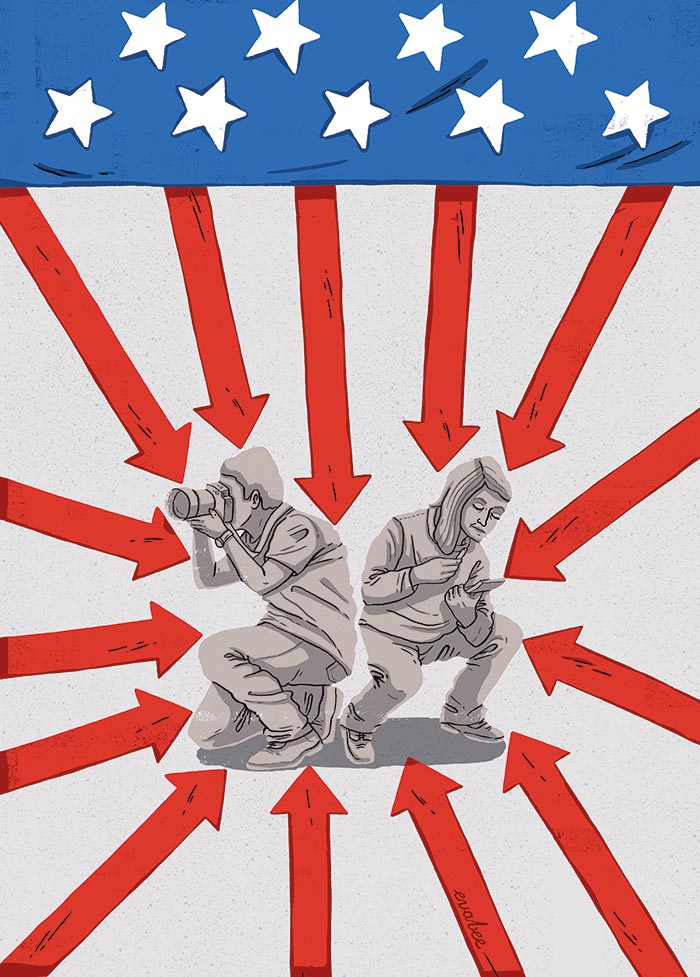
Smears about the media made by US President Donald Trump have obscured a wider problem with press freedom in the United States: namely widespread and low-level animosity that feeds into the everyday working lives of the nation’s journalists, bloggers and media professionals. This study examines documented reports from across the country in the six months leading up to the presidential inauguration and the months after. It clearly shows that threats to US press freedom go well beyond the Oval Office.
“Animosity toward the press comes in many forms. Journalists are targeted in several ways: from social media trolling to harassment by law enforcement to over-the-top public criticism by those in the highest office. The negative atmosphere for journalists is damaging for the public and their right to information,” said Jodie Ginsberg, CEO at Index on Censorship, which documented the cases using an approach undertaken by the organization to monitor press freedom in Europe over the past three years.
The US study shows journalists have been on the receiving end of online and offline harassment, as well as being arrested and charged with criminal offenses just for doing their job.
Reporters traveling into the country have also been caught up in the move to tighten border security, a trend that began during President Barack Obama’s administration but gathered pace after the Trump inauguration on January 20, 2017. Without clear guidelines, journalists have found themselves at the mercy of Customs and Border Protection agents who have seized and searched their electronic devices.
The arrests and border searches come as states are introducing new legislation or interpreting older laws in ways likely to have a detrimental effect on reporting.
For citizen reporters and freelancers, who do not have the protection of media organizations, the climate was already hostile and is now becoming more so. As the experience of Gawker has shown, even large media websites can be driven out of business if they rile the rich and powerful.
“Attention on the media has focused on the very public spat between Donald Trump and major news outlets,” Melody Patry, head of advocacy at Index on Censorship, said. “But this survey shows that threats to media freedom are far more deep-rooted and affect local journalists, bloggers and investigative reporters across the country. This is a serious cause for concern in a country that prides itself on the First Amendment principles protecting a free press.”
Arrests and detainments
The arrest of journalists covering demonstrations poses one of the largest direct threats to the freedom of reporters performing their professional duties. Not only are they physically removed from the protests but they are also being charged with serious criminal offenses. Previously journalists may have been charged with misdemeanors – the most serious of which only carries a large fine or up to a year in prison. Now they are being charged with felonies, which can carry decades in jail.
“This trend towards treating reporters at protests as active participants is alarming. Although these charges are most often dropped, the continuing arrests could cause journalists to think twice about covering a demonstration or reporting on police abuses against participants,” Hannah Machlin, project officer for Index on Censorship’s Mapping Media Freedom, said.
This pattern did not begin with the election of Trump. These decisions were also taken during the Obama administration by local law enforcement agencies and state attorneys.
Six journalists who were covering protests at Trump’s inauguration were arrested in the capital and charged with felonies, the most severe punishment under Washington DC’s law against rioting.
They included two reporters, a documentary producer, a photojournalist, a live-streamer and a freelance reporter. However, charges against four of the journalists were dropped nine days later. Charges against videographer Shay Horse were dismissed on February 21. Only freelance reporter Aaron Cantu remains charged with felony rioting.
Other examples of reporters targeted during protests include those covering the Dakota Access Pipeline and Black Lives Matter demonstrations discussed in more detail below.
More incidents suggest law enforcement officers need training and directives to respect journalists’ rights to cover events – like the case of Chris Hayes, a Fox 2 St. Louis journalist, who on June 30, 2016, was handcuffed and shackled to a bench in Kinloch, Missouri. He was detained after objecting to being barred from a public meeting on uninsured and unregistered police cars, a story that Fox 2 had originally investigated. Hayes was issued a court summons for failure to comply and disorderly conduct.
North Dakota Access Pipeline (DAPL) and associated protests
Several journalists and documentary filmmakers covering protests against the controversial oil pipeline project have been arrested and charged with felonies.
The law enforcement response to protesters and reporters has been increasingly militarized in the state according to the American Civil Liberties Union. In August 2016 the former governor of North Dakota Jack Dalrymple (R) declared a state of emergency.
Among journalists arrested and charged were Amy Goodman, host of the news program Democracy Now! She was taken into custody on September 3, 2016, after she filmed private security guards employed by Dakota Access LLC using dogs and pepper spray to disperse the protests against construction work. Her video has been viewed over 14 million times on Facebook. At first Goodman was charged with a misdemeanor offense of criminal trespass, but that was escalated by the state attorney to a rioting felony. A district judge finally dismissed the charges in October.
I don’t see why I would not be allowed to get a photo of peaceful protesters being arrested. If that is off limits, what else is?
In another pipeline protest, documentary filmmaker Deia Schlosberg was detained while filming a demonstration on October 11, 2016, where climate change activists manually closed off the TransCanada Keystone Pipeline in Walhalla, North Dakota, which brings tar sands oil across the border from Canada. It was one of five similar demonstrations that day held by climate change activists as an act of solidarity with the campaign against the DAPL. Schlosberg was charged with three offenses which could have landed her in prison for 45 years: conspiracy to theft of property, conspiracy to theft of services and conspiracy to tampering with or damaging a public service. The charges were eventually suspended and will be formally dropped, but only if she commits no further crimes for six months. Schlosberg told The Guardian that she hasn’t covered a protest since October to avoid serious consequences were she to be arrested again, demonstrating the effect that such actions can have on journalism.
On the same day, at another protest near Skagit County in Washington state, documentary producer Lindsey Grayzel and her cinematographer Carl Davis were arrested and held for 24 hours for filming activist Ken Ward manually closing off the Trans Mountain pipeline. Grayzel is in the process of making a documentary about Ward.
Though neither Grayzel nor Davis were on pipeline property, they were charged with second-degree burglary, criminal sabotage and assemblage of saboteurs, all felony cases which could lead to a 30-year prison sentence. The charges were ultimately dismissed, but Grayzel said the police still had her memory cards with footage on them, her phone and her notes.
The charges against other filmmakers, who also filmed activists on October 11, are still pending and they could still face prison sentences.
CASE STUDY: TRACIE WILLIAMS
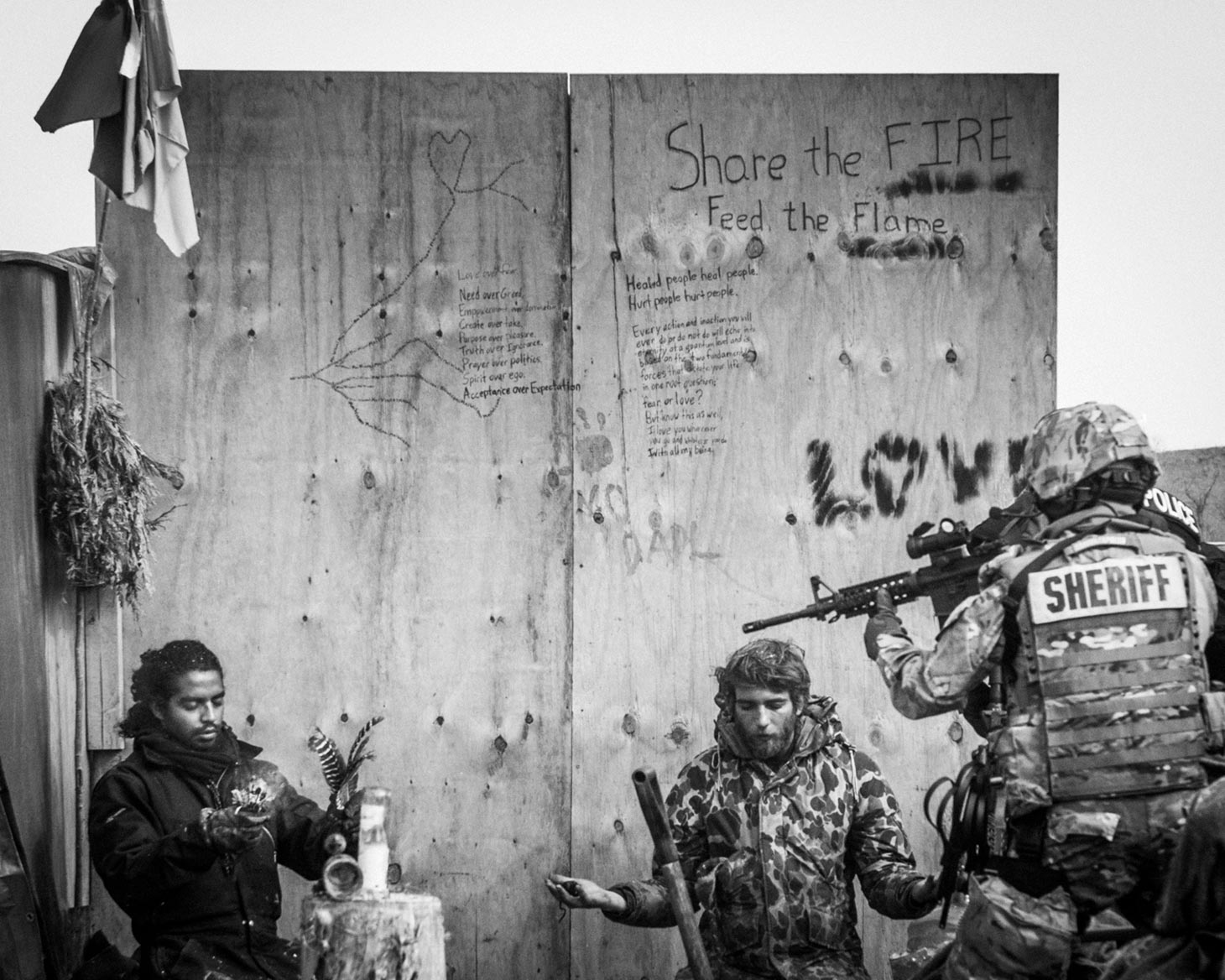
Tracie Williams is an experienced documentary photographer. She had been covering the main protest camp at Standing Rock for three weeks before she was arrested on February 23, 2017, during a police operation to evict protesters from the site. She says the police arrived at the camp with humvees, helicopters and automatic weapons. “I feared for the protesters’ safety and felt a duty to photograph their imminent arrests,” Williams said, recalling the photograph she made as members of the Morton County Sheriff’s Department advanced towards two men praying near the sacred fire with weapons aimed at them at point-blank range. Officers approached her from the side, without notice or warning, Williams said, and she was arrested while photographing the arrests. She was covering the protest for the National Press Photographers’ Association and told police she was a journalist, but they did not seem to care, she added.
Williams was handcuffed with zip ties and transported first to the Morton County Sheriff’s Department, where she, along with seven other women were held in chain-link cages in a drafty garage. They were asked to strip down to their base layers and all their belongings, including their jackets, were placed in clear plastic bags. They were then transferred to McLean County, where they were charged with “Obstruction of Gov. Function.” The plastic ties they used to handcuff her, she said, have caused her nerve damage. She now faces a class A misdemeanor charge, which carries a possible sentence of up to a year in prison and $3K in fines. All of her gear including her camera, phone, audio recorder and memory cards, were confiscated as evidence. Williams got the equipment back but not until she had harnessed help from two lawyers, several advocacy groups and a local senator. She is still facing charges in North Dakota.
Black Lives Matter protests
Journalists at Black Lives Matter and similar demonstrations have been arrested by police, even though they clearly identified themselves as members of the press.
Ryan Kailath was on an assignment for National Public Radio covering the New Black Panthers protests in Baton Rouge, Louisiana, on July 9, 2016, when he was arrested. The incident took place following the killing of Alton Sterling, a 37-year-old black man, by Baton Rouge police officers. Kailath said he was standing on a grass verge covering the protests but as things got violent he retreated into another line of police officers who arrested him. Kailath said he repeatedly identified himself as a journalist but was ignored. As he tweeted on July 11, a police officer said to him: “I’m tired of y’all saying you’re journalists.” Kailath explained that when he was arrested, the police identified him as a black man although he is an Indian-American.
Kailath said of his experience: “I was transferred between six locations, searched naked, given an orange jumpsuit and a medical and mental health screening, and finally checked in to the East Baton Rouge Parish Prison. In the morning, we were given the local paper, The Advocate. It was only when an inmate paging through it looked up at me and said: ‘Hey, you’re in here!’ that I learned I was being charged with simple obstruction of a highway.” Within the week all charges against him had been dropped.
I was transferred between six locations, searched naked, given an orange jumpsuit and a medical and mental health screening, and finally checked in to the East Baton Rouge Parish Prison
Two other journalists were also arrested at the same demonstration. WAFB (a CBS-affiliated TV station for Baton Rouge) assistant news editor Chris Slaughter, who was clearly identified by his staff shirt and media credentials, and Breitbart News reporter Lee Stranahan were charged with obstruction of a highway.
Two black reporters were briefly handcuffed by police in Rochester, New York during similar protests over the shooting of black men. Carlet Cleare and Justin Carter of WHAM-TV were detained in the early hours of July 9, 2016, for a short time before being released with a public apology from the mayor and chief of police.
On August 22, 2016, in Asheville, North Carolina, Dan Hesse, a reporter for the local paper Mountain Xpress, was arrested while covering a sit-in protest by Black Lives Matter. He was with protesters who were occupying the lobby of the police and fire department when it was cleared by police. He told officers and protesters he was a journalist. He was nevertheless arrested and charged, though charges were dropped a week later. “I don’t see why I would not be allowed to get a photo of peaceful protesters being arrested,” said Hesse. “If that is off limits, what else is?”
On November 9, 2016, two reporters, Jason Silverstein and EJ Fox, were arrested while covering protests outside Trump Tower in New York. Silverstein said in an article for the Daily News, New York that he was handcuffed with plastic ties by a police officer who accused him of blocking the sidewalk. He was charged with disorderly conduct and refusing an order to disperse. Fox said he was held from 9pm until 2am and considered himself lucky, but hoped that the behavior of the NYPD had not been affected by the Trump presidency.
US border detentions
Many journalists have found themselves detained at the US border. Over the period covered by the survey, there were several reports of journalists being stopped by US Customs and Border Protection agents, detained and asked to hand over equipment and notes. Some of these incidents occurred before Trump was elected and before he signed an executive order for a travel ban. According to NBC News, data provided by the Department of Homeland Security shows that searches of all travelers’ phones by border agents has grown fivefold in just one year, from fewer than 5,000 in 2015 to nearly 25,000 in 2016. DHS officials told the network that 2017 would be a “blockbuster” year. Some 5,000 devices were searched in February 2017 alone, as many as in all of 2015.
The most disturbing aspect of these detentions is that journalists (and indeed any US citizen) can have their phones and electronic equipment searched at the border without customs officers or Homeland Security officials having to prove any suspicion of wrongdoing. Only journalists and US citizens actually inside the country are protected by a 2014 Supreme Court ruling which says police must get warrants to search phones. Otherwise they have no protection under the Fourth Amendment at the border.
Customs and Border Protection officials should respect the right of journalists to protect confidential information, and refrain from demanding access to people’s devices and passwords
In one incident, a Wall Street Journal Middle East correspondent and US citizen, Maria Abi-Habib, was detained on July 14, 2016, by border control officers at Los Angeles International Airport and asked for access to her two phones. She recounted in a Facebook post how she managed to hold them off by threatening to call WSJ lawyers because the phones were the property of her employer. Another journalist, Kim Badawi, was held at Miami International Airport for 10 hours when he flew in from Rio for Thanksgiving. A US citizen who works for Le Monde in Rio, Badawi was questioned by Customs and Border Protection agents about his passport stamps for Middle Eastern countries, his political views and his religious affiliation. His baggage was searched and he was forced to surrender the password of his phone so agents could go through all of his contacts, photos and messages, including confidential WhatsApp messages from Syrian refugees. Badawi wrote a first-person account of his experience for the Huffington Post.
After the travel ban was imposed in January, more journalists found themselves detained. BBC journalist Ali Hamedani, a British citizen born in Iran, live tweeted his detention. He was held for two hours on January 29, 2017, and said he was subjected to “invasive checks” after he had flown into Chicago. Hamedani said he was forced to hand over his phone and its password. Sama Dizayee, a Washington-based Iraqi journalist who planned to fly to London in February 2017, told NPR she was afraid to travel because of her belief that she might not be allowed back in the country. Although she has a green card, she said, she had no certainty that her rights to live in the USA would be guaranteed if she left and tried to come back into the country. Meanwhile, senior CNN editor Mohammed Tawfeeq filed a lawsuit against the travel ban after being detained at Atlanta’s airport over the weekend of January 28 and 29, the days following Trump’s signing of the travel ban executive order. He is an Iraqi citizen with a US green card. The lawsuit argued that officials have used Trump’s executive order “to subject returning residents like Mr. Tawfeeq to inappropriate exercises of discretion with regard to their right to return to the United States, and to lengthy delays and interrogations at ports of entry”.
“Officials should respect the right of journalists to protect confidential information and refrain from demanding access to people’s devices, online accounts and passwords. Journalists must be aware of possible requests by border agents, which may compromise their security and that of their sources,” Mapping Media Freedom’s Machlin said.
CASE STUDY: ED OU
Ed Ou, an award-winning Canadian photojournalist, tried to cross the US-Canadian border to cover the Dakota Access Pipeline protests on October 1, 2016. He found himself detained for six hours, had his phone searched, his journal photocopied and was then refused entry. Border security was not interested in Ou’s concerns about protecting his sources. In a letter to Customs and Border Protection and Homeland Security, American Civil Liberties Union attorney Hugh Handeyside wrote: “[W]e believe that CBP took advantage of Mr. Ou’s application for admission to engage in an opportunistic fishing expedition for sensitive and confidential information that Mr. Ou had gathered through his newsgathering activities in Turkey, Somalia, Iraq and elsewhere.”
Most of the physical assaults against journalists across the country have been at demonstrations. For instance, on August 14, 2016, two reporters were physically attacked by about a dozen people in Milwaukee during violent demonstrations against the police shooting of Sylville Smith, a black man who was killed fleeing a traffic stop. The reporters were filming a BP gas station which had been set on fire by protesters. Their equipment, including cameras and satellite packs, was stolen and one of the journalists had to go to hospital for an evaluation. At a Black Lives Matter protest, which took place on September 21 in Charlotte, Virginia, Mary Sturgill, an anchor for the Columbia, South Carolina, station WLTX, was tackled by demonstrators and her photographer was punched.
The only solution is a greater awareness of both media organizations and police departments
On October 18, 2016, in North Dakota, activists at the Sacred Stone Camp were accused of assaulting journalist Phelim McAleer, who was making a documentary called FrackNation in favor of fracking. His microphone was taken away and he was assaulted after he asked DAPL protesters about their use of fossil fuels. When McAleer and colleagues went back to their car, a group of about 30 individuals surrounded the vehicle and the journalists were forced to call the police for help.
On November 3, 2016, during “water protector” protests over the DAPL at Standing Rock Indian Reservation, journalist and activist Erin Schrode said she was hit by a rubber bullet from “militarized police” while she was in the middle of an interview. The impact of the bullet knocked her over. She posted a video of the incident on Facebook.
Journalists were also targeted at election protests. In Portland, Oregon, a woman spat in the camera of a news crew covering demonstrations in the early hours of November 9, as the election results were being reported. The woman, who was an anti-Trump protester, yelled directly into the KOIN 6 News camera held by video journalist Karl Petersen before spitting.
During separate protests in north Baltimore on the evening of November 9, Fox45 reporter Keith Daniels and photographer Ruth Morton had to be moved to safety by police. An angry crowd had surrounded them and ordered them to leave the scene. The end of the encounter was broadcast live on Fox45. Daniels reported that this had never happened to him before. The crowd had told him they did not believe that he would put the “correct narrative” on his coverage.
The inauguration protests in Washington DC on January 20, 2017, also turned violent. Photographer Vanessa Koolhof, working for ABC affiliate news station WJLA, was knocked over and injured in the middle of a stand-off near the National Mall when a Trump supporter came into the crowd and police tried to break up scuffles. She was slightly injured before being assisted by police officers.
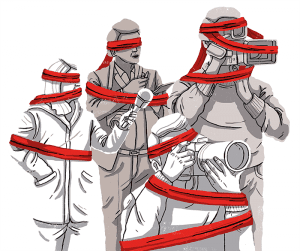
There have been other physical incidents against journalists in the period. For instance, a reporter and photographer from NBC6 were injured on November 21, 2016, when a man drove a stolen SUV into the news crew’s car in Fort Lauderdale, Florida. In December 2016, a woman accused of faking her own abduction threatened a reporter from the same TV station and shouted at a photographer. She said: “I will knock your ass out. Get that shit out of my face.” She also threw a rock at another station’s crew and was detained by police. She was released after the crews declined to press charges.
Having equipment stolen is an occupational hazard in some areas. In two incidents within a week of each other in the San Francisco East Bay area, reporters had their cameras stolen. In the first incident, on September 19, a field manager from KGO TV had his camera taken from him at gunpoint by two men in Alameda near Robert W Crown Memorial State Beach. On September 23, Raquel Maria Dillon, a multimedia journalist with NBC Bay Area, was approached by a man who pulled her camera from her hands. She had just finished covering a story and was walking back to her car when she was attacked. As a result of these and other robberies, some news organizations in the area have hired security guards to look after their journalists and crews.
In Niagara Falls on October 22, a reporter and photographer from the local Buffalo station WIVB, a CBS affiliate, were cornered in an alley by four men with a gun, who asked them for money and for the camera. The crew was out covering an art installation when they were physically attacked: the photographer had to go to the hospital and the reporter suffered minor injuries. On October 13, 2016, in Bedford County, Virginia, Tim Saunders, a reporter from local station WDBJ7, was shot at when he was in the station’s vehicle. A mentally ill 18-year-old was wandering around the streets with a rifle shooting at vehicles and knocking on doors before he was arrested. Saunders was unhurt and no one else was injured in the incident.
“Journalist safety must be taken extremely seriously by law enforcement. Whether the perpetrators of violence are police officers or private citizens, violence against journalists, cases of robbery or harassment must be investigated vigorously and charges filed promptly to ensure that a culture of impunity is unable to take root,” Mapping Media Freedom’s Machlin said.
CASE STUDY: DALTON BENNETT
Dalton Bennett, a video reporter for the Washington Post, has experience covering demonstrations all over the world, from Greece to the Arab Spring. He was filming demonstrators on inauguration day when he was pushed over and grabbed by a police officer. Most of the protesters were peaceful, he said, but a smaller group of black bloc protesters were causing trouble, which was unusual for Washington DC. At one point during the protest “all hell was breaking loose” and the police began using pepper spray and stun grenades before kettling the protesters.
“In the process of getting kettled, we’re filming it, which is what a video reporter is supposed to be doing, and a police officer felt that I was too close, and decided to get me away from the situation and so pushed me,” Bennett said. “My backpack was being grabbed and I was pushed by another guy and fell to the ground in the process. I wouldn’t say it was a concerted effort to prevent us from capturing the moment, there were a lot of journalists there. I think it was, more than anything, just a police officer, just authorities generally caught up in this ebb and flow of the demonstration. I mean I don’t think it was done out of malice, or to prevent us reporting. That being said, I don’t think it was necessary at all, it definitely wasn’t necessary, and the city itself has issued a report saying some of its tactics weren’t exactly kosher.”
Bennett doesn’t believe the right to film protests is under threat in the USA, but he said: “Inevitably as more and more protests happen across the country, this is a question which is going to continue to arise. I think the only solution is a greater awareness of both media organizations and police departments on the role that the media plays in covering these protests and better practice among media organizations, [understanding] how demonstrations work, how to keep safe covering the protest.”
Criminal charges / civil lawsuits
Since the election of Trump there has been anxiety around his claims that he would loosen US libel laws. At a rally in Fort Worth, Texas in February 2016 Trump declared: “I’m going to open up our libel laws so when they write purposely negative and horrible and false articles, we can sue them and win lots of money.”
However, current US libel laws have already led to one news organization, Gawker, closing after a lawsuit alleging the site had invaded the privacy of a celebrity.
Others, like conservative political commentator and television host Glenn Beck, have found themselves on the receiving end of defamation suits. Beck, along with other journalists, including commentators from Fox News, were sued for the comments they made about a boy who brought a clock to school in a suitcase and was arrested in September 2015 after it was mistaken for a bomb. The boy from Irving, Texas, was quickly released, but Beck suggested on a show aired by The Blaze that the clock bomb hoax story was possibly a conspiracy to “turn Texas blue [Democrat]”. The boy’s father filed a lawsuit. However, a judge ruled on January 9, 2017, that Beck’s free speech was protected under the First Amendment.
Most criminal charges against media professionals have been related to journalists caught up in protests, which we have detailed above.
However, there is another worrying case of a publisher from Blue Ridge, Georgia, and his attorney, who were arrested on June 24, 2016, for requesting public records. They were charged with three felonies – identity fraud, attempted identity fraud and making a false statement on an open records request – which carries up to 20 years in prison. Fannin Focus publisher, Mark Thomason, said he was held for two days before being granted bail, but only after a $10,000 bond had been posted. An outcry in the national press led to the charges being dismissed three weeks later. Thomason and attorney Russell Stookey were charged in part because they requested copies of checks written on the operating accounts of the judge’s office, which were “cashed illegally”. Chief Judge Brenda Weaver, who presides in the three-county Appalachian Judicial Circuit, had urged the district attorney to seek an indictment. Weaver, who was in control of one of those accounts, told The Atlanta Journal-Constitution she pushed for the case because “I don’t react well when my honesty is questioned.” She was eventually forced to resign.
“US libel law has long been a model for the rest of the world. Lowering the burden of proof or otherwise loosening restrictions on lawsuits would pose a serious threat to press freedom in the country. At the same time, the misuse of the criminal justice system to silence journalists is a common occurrence in some European countries. This is not something that journalists in the USA should be exposed to,” Index’s Patry said.
CASE STUDY: GAWKER
Gawker went bankrupt and was shut down in August 2016 after a jury in Florida awarded $140 million in damages against it for invading the privacy of Hulk Hogan by publishing a sex tape of the celebrity wrestler. The lawsuit was funded by Peter Thiel, the co-founder of PayPal. Thiel told the Wall Street Journal: “I am supporting other people who have been harmed by Gawker, which routinely relied on an expectation that their less wealthy victims would have no legal recourse even against clear violations. I do not support legal actions against any other organizations.” Gawker’s assets were sold out of bankruptcy to Univision Communications Inc, and the publishers eventually settled with Hogan and others connected with the privacy suit in November 2016.
Legal measures
What laws are passed and how the law is interpreted can have an impact on journalists’ ability to report. Even when laws are not intended to restrict access to public information, they can be used to do so.
For instance, the so-called Marsy’s Law, which protects victims’ rights, has been enacted by some states. Although not its original intention, the law is being used by police forces in Sioux Falls, South Dakota, to justify withholding all information about crime locations, car accidents and crash victims in the area from journalists, according to a report in the Argus Leader on December 4, 2016. Journalists and others argue the law states that information should only be withheld “on request of the victim” and so a blanket ban on information is not justified. Similar laws have now been passed in North Dakota and Montana.
Another law, proposed by Utah State Representative Scott Chew (R) on January 31, 2017, to ban drones near livestock – with jail time for those who do – has faced criticism. Chew argues the drones may harass farm animals.
“Even well-intentioned laws can have a deleterious effect on journalists. In the case of Utah, the proposed legislation could penalize reporters doing investigative pieces around animal welfare and food safety. Even the Humane Society of the United States has expressed reservations about the draft bill,” Index’s Patry said.
The other pattern that is emerging concerns journalists who, all over the country, are being asked to hand over unpublished documents they have used in investigations, potentially compromising key sources. State “shield” laws should give legal protections for journalists, but this principle is being increasingly challenged. In Nashville, Tennessee, television reporter Phil Williams, who reported on the district attorney Glen Funk, was told by a judge on February 2, 2017, to hand over key documents. To add further pressure Funk has filed a $200 million defamation suit against the journalist and his employer, News Channel 5. The channel has condemned the actions as “an attempt by an elected public official to silence and intimidate a journalist and news organization that has accurately reported on questionable conduct and judgment by that official”.
Meanwhile in San Bernardino, California on January 17, 2017, a judge ruled that numerous journalists will have to take the stand in a corruption case on which they had reported. Prosecutors want them to testify on 56 statements contained in stories dating back 12 years. Journalists fear taking the stand because they may be forced under oath to compromise their sources.
CASE STUDY: PUBLIC BROADCASTERS
A provision added into the National Defense Authorization Act signed into law on December 23, 2016, has abolished the bipartisan board running Voice of America, Radio Free Europe and other news outlets. The board is to be replaced with a single chief executive appointed by the US president. Supporters argue that the change will make the $800 million media operation more efficient, but critics say it will give the president the ability to jeopardize the political independence of the operation.
“Politically independent public broadcasters are a vital segment of the media landscape at a time of increased propaganda. We’ve documented a series of moves by European governments to nationalize the public media in ways that make it more likely to toe the ruling party’s line,” Index’s Ginsberg said.
Works censored or altered
There is little information about works censored during the period we examined. This may well be because journalists tend not to report these kinds of incidents out of fear of negative repercussions for their career or because the pressure is more subtle. The case study below, however, is taken from a New York Times article from February 17, 2017.
On university campuses, there were more published examples of censored works. A report entitled Threats to the Independence of Student Media, published in October 2016 by the American Association of University Professors and others, explains how “college and university officials threatened retaliation against students and [media] advisers not only for coverage critical of the administration but also for otherwise frivolous coverage that the administrators believed placed the institution in an unflattering light.” The document details particular cases, including when “California’s Southwest College mounted a campaign of intimidation and bullying of student journalists – including freezing the newspaper’s printing budget, cutting the adviser’s salary and even threatening staff members with arrest – as part of an effort to conceal high-level wrongdoing.” There are many other examples given in the report of censorship and intimidation on campus, and of media advisers who have lost their jobs or been demoted as a result of not exercising enough censorship.
CASE STUDY: RICK CASEY
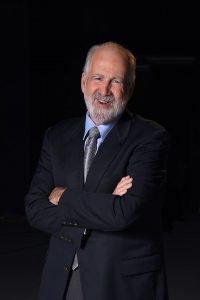 Rick Casey is the host of a show called Texas Week for San Antonio television station KLRM. At the end of every show he presents a short commentary. On this occasion, Republican representative from Texas, Lamar Smith, was on his agenda for giving a speech on January 24, 2017, about the unfair way he believed the media covered Trump. Smith suggested the only way of getting the truth was from the president himself. Casey was so outraged that he ended his commentary: “Smith’s proposal is quite innovative for America. We’ve never really tried getting all our news from our top elected official. It has been tried elsewhere, however. North Korea comes to mind.” Some 40 minutes before the show, the president of the station, Arthur Rojas Emerson, called Casey to tell him the commentary had been pulled. Emerson said he was worried that the commentary could affect the financing of the station, which is publicly funded by the Corporation for Public Broadcasting. It was also the case, as The New York Times reported, that Emerson had left journalism for several years to work in advertising and Smith had been a client. After the affair was publicized in a local newspaper column, another prominent local journalist took Casey’s censored commentary up with the PBS board and Emerson finally agreed to run the clip. He admitted to the Times it was a “mistake”, but he only had 20 minutes to make a decision. Casey is 70 years old and said that he was more ready to push back because of his age. He said he didn’t know whether he would have acted differently at 45, when it could have affected his career.
Blocked access
Blocking access to events, places and – more crucially – information is a way of government, lawmakers and others preventing journalists in the USA from covering their activities.
“Mapping Media Freedom has documented a growing list of incidents from across Europe and neighboring countries where journalists have been barred from reporting in the public interest. Though this survey looked at a small number of cases in the context of the American media market, we expect there were many more cases during the same period that were not reported by the media or located by our researchers,” Mapping Media Freedom’s Machlin said.
Reporters have recently been blocked from covering the airport protests over the travel ban in January 2017. Time journalist Charlotte Alter tweeted early on January 28, 2017, that reporters were asked to move from terminal 4 of JFK airport in New York because it was a “private space”.
Later that same day, the Council on American-Islamic relations barred a Breitbart News reporter, Neil Munro, from one of its press conferences where it criticized the travel ban.
On January 10, 2017, Texas Congressman Louie Gohmert (R) prevented a photojournalist from taking pictures of protesters during attorney general nominee Jeff Sessions’ confirmation hearings. Back in his home state of Texas in January, at about the same time, the Senate ruled to stop journalists wandering the floor and doing interviews. This was justified in the name of order and propriety but is seen by Texan reporters as a way of blocking access to local politicians.
On October 11, 2016, Baltimore Mayor Stephanie Rawlings-Blake (D) banned Kenneth Burns, a WYPR radio reporter, from her weekly press briefings based on allegations of “verbally and physically threatening behavior,” because she did not like his aggressive questioning at her small regular meetings with the press.
On January 12, 2017, The New York Times petitioned the New York State Executive Department for the right to see public records relating to a billion-dollar development scandal in Buffalo. The newspaper accused New York Governor Andrew Cuomo’s (D) office of repeatedly stonewalling attempts to see the documents relating to a lobbyist and one of his aides.
Courthouse News Service has documented the challenges they have encountered getting information from court clerks about the scheduling of civil cases, including multi-million dollar lawsuits. The news service won a First Amendment case against the clerk in Manhattan’s state court in mid-December 2016, which granted them access to newly filed civil cases.
Press organizations were banned and their accreditation canceled arbitrarily
The service also launched a First Amendment case in Santa Ana, California, on January 24, 2017, against a similar policy brought in by Orange County’s county court clerk.
“Having access to this information is important for journalists, because without knowing what cases are being scheduled, they cannot cover them. And without general access, plaintiff’s lawyers are then able to leak cases to friendly news outlets,” Machlin said.
In Wyoming, the highway patrol records office said it was charging local newspaper, the Wyoming Tribune Eagle, $1,800 to fulfill a public records request put in on October 31, 2016, concerning state troopers deployed to the Dakota Access Pipeline protests.
“Imposing expensive fees to fulfill public records requests can deter investigative journalism, especially for publications already struggling for funding in a shifting media landscape,” Machlin said.
Reporters have been prevented from accessing information held by public bodies that relate to President Trump. On January 31, 2017, Newsweek national security correspondent Jeffrey Stein filed a federal complaint because he was not allowed to see documents that detail the process by which Trump aides are vetted. Stein argued, for example, that three of Trump’s children and Rex Tillerson, the new US Secretary of State, had extensive business ties to foreign nations that normally would raise clearance alarms. Stein explained that these requests sought “all records, including emails, about any steps taken to investigate or authorise (or discussions about potentially investigating or authorising) [15 individuals] for access to classified information.”
Other journalists reported they were not allowed to examine documents that Trump piled up on a table at a widely publicized press conference on January 11. Trump said the papers detailed how he was divesting himself from his business interests.
Blocked from Trump’s campaign and White House briefings
During the presidential election campaign, numerous press organizations were banned and their accreditation cancelled arbitrarily. Targeted organizations included Politico, BuzzFeed, the Huffington Post, Univision and the Des Moines Register. In June 2016, the Washington Post had its credentials canceled. Trump accused the Post of being “dishonest” and “phony” after the newspaper published an article critical of Trump’s comments about shootings at a gay nightclub in Orlando, Florida.
Trump declared The New York Times coverage of him “very dishonest” at a campaign rally in Columbus, Ohio, on August 1, 2016 and suggested he could take away their accreditation too.
By September 7, 2016, Trump and his team changed their tactics and lifted the ban on news organizations attending his rallies. However, this meant reporters attending could be penned and harangued by the crowds.
Since Trump won the election, CNN, in particular, has been targeted by the administration and questions from the network’s reporters have been refused at press conferences. In a further escalation of these tactics, an off-camera press conference on February 24, 2017, organized by press secretary Sean Spicer, was held without outlets such as The New York Times, Politico, CNN, BuzzFeed and the BBC. This exclusion of a good proportion of the media came despite Spicer’s previous assurances to White House journalists that bans, such as those imposed during the Trump campaign, would not happen once Trump was in the White House.
“Picking media outlets friendly to the country’s government is a tactic often deployed in illiberal democracies or by political parties on the far-right, like France’s Front National or Germany’s AfD. In the context of Mapping Media Freedom, the Trump administration and staffers have repeatedly and routinely threatened press freedom before and after the election,” Machlin said.
Intimidation
Intimidation is probably the most widely reported form of violation against press and media freedom. It takes various forms of offline and online harassment, including defamation, psychological abuse and sexual harassment.
“As we have seen increasingly in Europe, groundless, derogatory and corrosive comments by a country’s leaders – specifically in Hungary, Russia and the Balkans – have a tendency to permeate into law enforcement and local administrations, and undermine trust in media coverage among the general public. In addition, the use of pro-government media outlets to target journalists further undermines press freedom in some European countries. Though it remains to be seen whether this trend will continue at an alarming rate in the United States, it is certainly something for press freedom organizations to be alert to,” Index’s Patry said.
Much of the most prominent intimidation has come from both Trump and his aides during the presidential campaign, after his election and after his inauguration. This intimidation and harassment has also been mirrored by people who appear to be his supporters.
CASE STUDY: ALTERNATIVE FACTS
The argument over the size of the crowd at Trump’s inauguration dominated the first few days of Trump’s presidency. On a visit to the CIA headquarters on his first full day in office, he called journalists “the most dishonest people on earth” for saying that he had attacked the agency during his campaign. He also derided media reports, which showed far fewer attendees at his inauguration ceremony than the 1.5 million he claimed. Sean Spicer later held his first press conference in the briefing room of the West Wing, where he said that news organizations had deliberately under-estimated the size of the crowd, which was allegedly “the largest in history”, in order to sow disarray when Trump was trying to unify the country. Spicer threatened the media by saying the new administration would “hold the press accountable”. Kellyanne Conway appeared on the media the next day to say that Sean Spicer wasn’t lying when he claimed that Trump’s inauguration drew the largest crowd in history. Rather, he was presenting “alternative facts”.
Trump and supporters before the election
During Trump’s election campaign, journalists were routinely jeered and intimidated.
His campaign rallies frequently became places where the media and journalists in general were accused of being part of a broad conspiracy against him and his supporters. During a weekend in mid-August 2016 when his poll numbers were dropping, Trump went on the offensive against media bias. On Friday August 12, at a rally in Erie, Pennsylvania, Trump called journalists the “lowest form of humanity”. At a rally the following day in Fairfield, Connecticut, he declared: “I am not running against crooked Hillary Clinton, I’m running against the crooked media.” On Sunday August 14, he issued a series of tweets including claims that the biased media was affecting his poll ratings and that The New York Times wrote fiction.
In October 2016, when reporters uncovered stories about Trump’s abusive behavior towards women, his public attacks on the “mainstream media” intensified.
At one large rally of 15,000 supporters in Cincinnati, Ohio on October 14, Trump claimed that Hillary Clinton and her campaign “control the mainstream media” and use it “quite viciously”. The New York Times described how the organizers penned in journalists behind metal barriers at the same rally and then got the crowd to boo, insult and flip middle fingers at them.
Trump’s public personal attacks on journalists were virulent during the same period. He singled out Katy Tur, a reporter for NBC, at a November 2 rally in front of a crowd of 4,000 people. He blamed her for under-reporting the size of the crowd. It was the third time he had intimidated her at one of his rallies.
CASE STUDY: BERATING THE PRESS
Even before Trump was inaugurated, his supporters berated the press. Texas Congressman Randy Weber (R) tweeted on January 12 that Jim Acosta, CNN’s White House correspondent, should be fired and prohibited from press conferences. Kellyanne Conway also said in an interview on January 29 that journalists who showed bias against Trump during the campaign should be fired.
Trump after he won the presidency
After Trump’s election, intimidation of the media changed, in part because he was making the comments personally, often through Twitter, while holding the office of president. Trump devoted a whole press conference on February 17 to berating the media as “the enemy of the people”, a phrase news organizations reported is more commonly associated with Soviet leader Joseph Stalin and other dictators throughout history. Since his election, Trump’s official spokespeople, most notably Sean Spicer and Kellyanne Conway, have been brought more prominently into the frame. Both have repeatedly attacked journalists and defended lies told by the president. Conway has gone so far as to say in an interview with Fox News on January 27, 2017, that it was “dangerous for democracy” for journalists to accuse Donald Trump of lying.
Other Trump administration staffers have also threatened journalists. In February 2017, reporter April Ryan accused Trump staffer Omarosa Manigault of physically intimidating her. Ryan, a onetime friend of Manigault’s, also said the communications official made verbal threats, including the assertion that Ryan was among several journalists on whom Trump officials had collected “dossiers of negative information”.
“Collecting ‘dossiers’ about journalists is the type of tactic practiced in countries like Azerbaijan, which routinely targets anyone trying to hold the regime to account. The US executive branch should not be seeking to emulate the behaviors of some of the world’s most authoritarian regimes,” Index on Censorship CEO Jodie Ginsberg said.
“Alternative facts”, or the more frequently used “fake news”, have been the catchphrases of the Trump administration to describe news stories they do not like, or that challenge statements they have made. Trump also uses the phrase generally to discredit news organizations and claim they never report the truth. In one instance, Trump accused CNN on Twitter of cutting off Senator Bernie Sanders (D) because he was exposing the fact they reported fake news. Sanders was in fact doing the opposite, joking about Trump’s tendency to dismiss any negative reports as “fake news”.
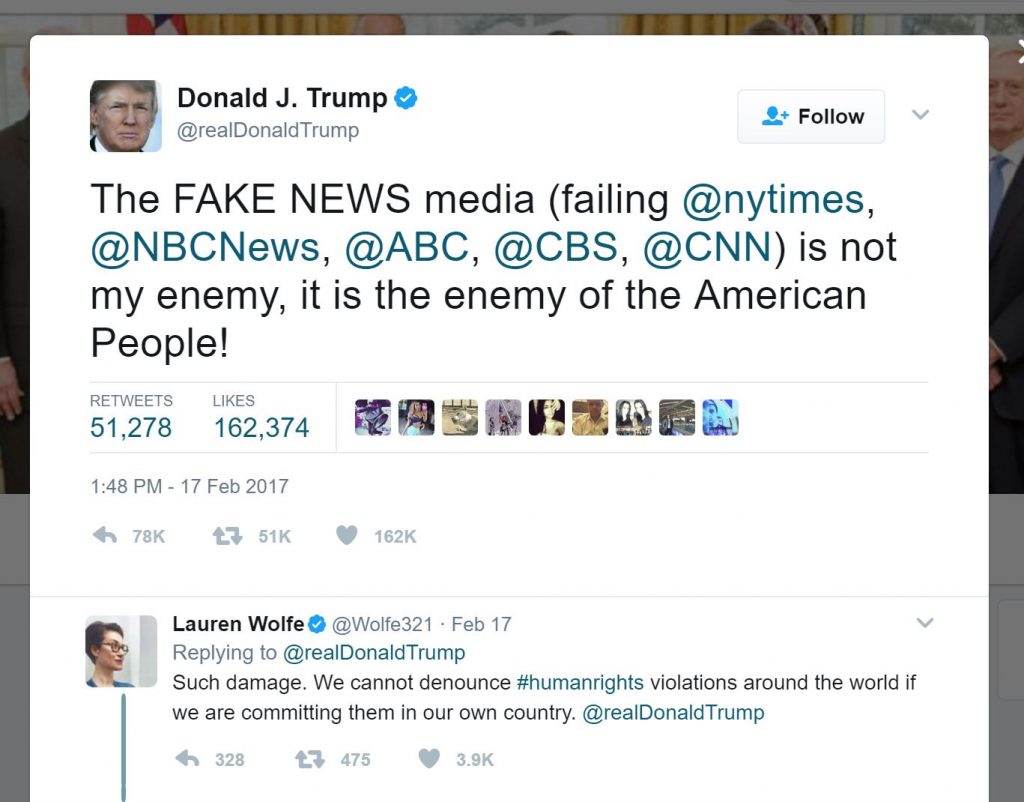
In a series of tweets from his personal account, Trump has called some of the USA’s major news organizations “failing” and purveyors of “fake news”, including the Washington Post, The New York Times, NBC news, CNN and ABC.
The other way that Trump and people speaking on his behalf have tried to intimidate the media is to call for the sacking of individual journalists. The most prominent calls have come from members of congress and Trump aides.
Online harassment
Online harassment is a growing problem for journalists. On December 5, 2016, Fox News host Megyn Kelly accused the president’s social media director Dan Scavino of being directly responsible for stirring up the nastier elements of the internet to harass and intimidate. Kelly said that she received death threats and has had to employ armed security.
On January 31, Rosa Brooks, a professor of law at Georgetown University, wrote in Foreign Policy magazine about threats Trump poses to the US Constitution, and what would happen if he arbitrarily decided to carry out some form of military action. Two days later she was accused by Trump-friendly Infowars of inciting a military coup. Although Brooks said that she had concerns about the way executive power was used under Obama, the intimidation she has received – including death threats – for suggesting the dangers under Trump, went far beyond anything that had happened before. She wrote: “Here’s the other thing that’s different now: The alt-right has long occupied the internet’s darker corners, but with the elevation of Bannon to the Trump White House and National Security Council, it’s now occupying the White House itself.”
Some of the most virulent harassment cases have been against conservatives like Kelly who did not support Trump. On October 26, 2016, David French, who writes for the conservative publication National Review, told National Public Radio program Fresh Air how he was targeted. He wrote an article about the alt-right movement being white nationalist in its tone and tenor and found himself and his wife bombarded with hateful tweets and messages, including an image of his seven-year-old child, who was adopted from Ethiopia, in a gas chamber. He said it was his linking of Trump and the alt-right that specifically led to his family being subjected to anti-Semitic, racist and pornographic abuse.
French received anti-Semitic abuse despite not being Jewish. The abuse against Jewish journalists has been more systematic.
CASE STUDY: ANTI-SEMITISM
In October 2016, the Anti-Defamation League published a report entitled The Anti-Semitic Targeting of Journalists During the 2016 Presidential Campaign. One of its key findings was that 800 journalists received anti-Semitic tweets with an estimated reach of 45 million. The top 10 most targeted journalists (all of whom were Jewish) received 83% of those anti-Semitic tweets. The report found the abuse got worse as the presidential campaign intensified in the period between January and July 2016. The words most frequently used in anti-Semitic tweets directed at journalists included “kike”, “Israel” and “Zionist”. A majority of tweets (60%) were in reply to tweets by journalists. Writer and former Breitbart reporter Ben Shapiro, who was on the receiving end of vast amounts of abuse for launching the #NeverTrump campaign, told ADL: “It’s amazing what’s been unleashed. I honestly didn’t realize they were out there. It’s every day, every single day.” Despite Shapiro’s efforts to shield his family from the abuse, his wife and child were targeted as well. “When my child was born there were lots of anti-Semitic responses talking about cockroaches.”
Though our review of incidents represents just a short period of time, it points to areas that journalists and law enforcement, as well as the country’s political establishment, need to improve
- Frontline police services – as well as journalists – should be clear on the rights of protesters and those covering demonstrations, rallies and other public events and receive regular training in this area. It is also vital that journalists are aware of these rights when covering such events.
- Police forces must adhere to Freedom of Information laws. All levels of government should work to minimize fees associated with FOI requests.
- Customs and Border Protection officials should respect the rights of journalists to protect confidential information and cease immediately the invasive examination of people’s online activity at the border.
- States need to enact strong shield laws to protect journalists from having to reveal sources. This is vital especially in cases involving whistleblowing in the public interest.
- State lawmakers need to ensure that that new or revised legislation does not encroach on the First Amendment rights of journalists. Where necessary, laws should have a public interest clause that could be used by journalists.
- Harassment and crimes against journalists that go beyond protections offered by the First Amendment – whether online or off – must be investigated and prosecuted vigorously to prevent the establishment of a culture of impunity.